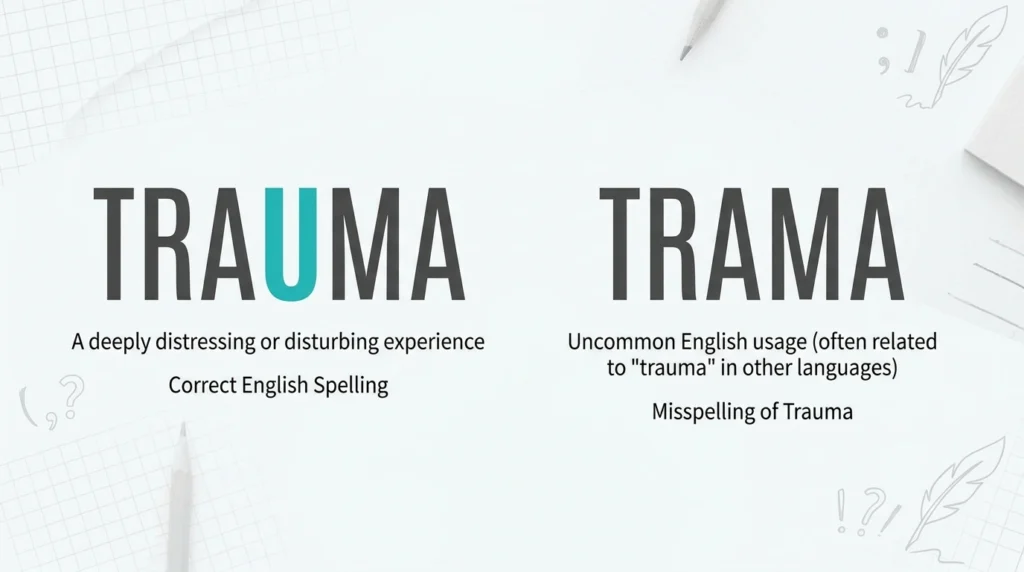

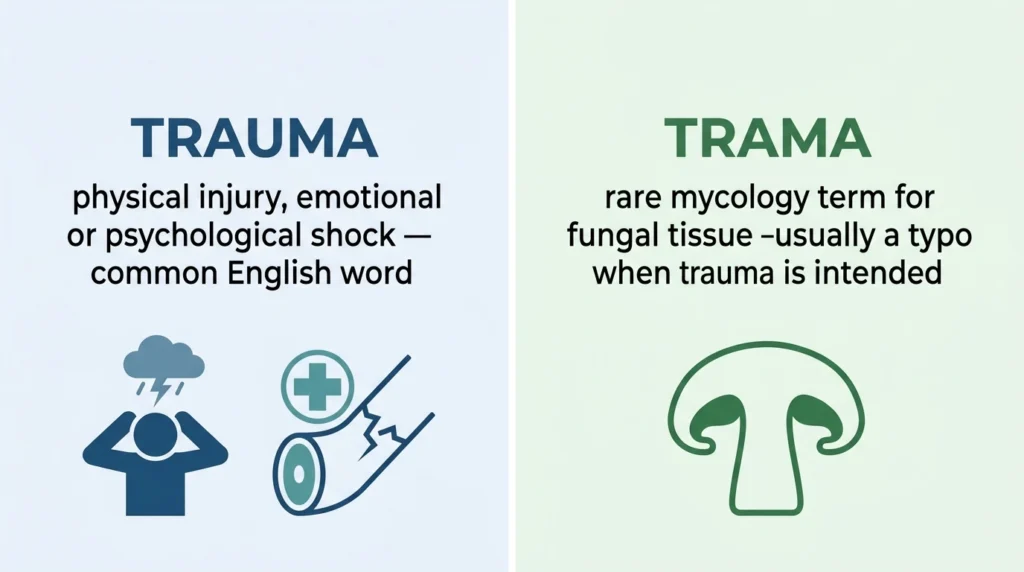
Trauma is the correct English word when you mean a serious physical injury, emotional shock, or lasting psychological distress. Trama is usually a spelling mistake in these contexts because the letter u is missing. However, trama is also a real but rare technical English word used in mycology for tissue inside certain parts of a mushroom. Therefore, the two words are not normally interchangeable.
What Is the Trauma vs Trama Difference?
The main difference between trauma and trama is meaning and usage.
Trauma is a common English noun. It can describe a physical injury caused by an accident or external force. It can also describe severe emotional or psychological distress connected with a deeply upsetting experience.
Trama, by contrast, is not an alternative spelling of trauma. When people write trama while discussing emotional pain, accidents, injuries, therapy, or medical treatment, they have normally misspelled trauma.
There is one important exception. Trama exists as a specialized term in mycology, the study of fungi. It refers to internal fungal tissue, particularly tissue associated with structures such as mushroom gills.
So the accurate distinction is:
- Trauma = physical injury or serious emotional/psychological shock.
- Trama = usually a typo for trauma in everyday English.
- Trama = a legitimate technical word in mycology.
- Trama and trauma are not interchangeable.
Why the Difference Matters
Missing one letter may look like a minor mistake, but it can change how professional and reliable your writing appears.
Imagine writing a medical report that says a patient experienced “head trama.” The reader will almost certainly understand that you mean head trauma, but the spelling mistake weakens the credibility of the document.
The same problem appears in school assignments, professional emails, health-related writing, academic papers, reports, and online articles.
There is another reason accuracy matters. Saying that trama is not a word at all is also incorrect. It is a specialized English term. Good writing requires knowing not only which spelling is normally needed but also when the less familiar word is genuinely valid.
The Core Rule
Rule: If you are talking about physical injury, emotional shock, psychological distress, or a deeply upsetting experience, write trauma, not trama.
Use trama only when you specifically mean the technical mycology term or when you are using the word from another language in the appropriate context.
Also Read: Scoup vs Scoop: Which Spelling Is Correct?
How to Use Trauma and Trama Correctly
Use “Trauma” for Physical Injury
In medical English, trauma can refer to bodily injury caused by an external force, accident, impact, or similar event.
Examples include:
- head trauma
- chest trauma
- blunt trauma
- physical trauma
- traumatic injury
- trauma patient
- trauma center
For example:
The doctors examined the patient for signs of head trauma.
Here, trauma refers to physical injury.
Read More: Seal vs Seel: Which Is Correct and What Is the Difference?
Use “Trauma” for Emotional or Psychological Distress
Trauma can also describe severe emotional or psychological effects associated with deeply distressing experiences.
For example:
The experience caused lasting emotional trauma.
Other common combinations include:
- childhood trauma
- emotional trauma
- psychological trauma
- past trauma
- traumatic experience
- trauma recovery
- trauma response
Use “Trama” Only in Its Specialized Meaning
In English-language mycology, trama has a specialized meaning connected with fungal tissue.
For example:
The researcher examined the trama of the mushroom gill under a microscope.
This sentence is correct because the topic is mushroom anatomy rather than emotional or physical injury.
Use This Three-Step Test
When deciding between trauma and trama, ask:
- Am I talking about injury, severe shock, or emotional distress? Use trauma.
- Am I discussing specialized mushroom anatomy? Trama may be correct.
- Am I writing ordinary English and simply unsure about the spelling? You almost certainly need trauma.
Correct Examples
Here are original examples showing how the words work across different situations.
- Conversation: She is still processing the trauma caused by the accident.
- Email: I appreciate your understanding while our team recovers from the trauma of the incident.
- School: The student wrote an essay about how war can create lasting psychological trauma.
- Workplace: The organization introduced additional support for employees affected by workplace trauma.
- Medical: Doctors found no evidence of serious head trauma.
- Social Media: People respond to traumatic experiences in very different ways.
- Academic Writing: The study examined the relationship between childhood trauma and later behavior.
- News Writing: Several passengers were treated for physical trauma following the collision.
- Healthcare: The hospital operates a specialized trauma center.
- Personal Writing: He described the event as one of the most traumatic experiences of his life.
- Mycology: The scientist compared the trama in several mushroom specimens.
- Biology Class: Students observed differences in the structure of the gill trama.
Also Read: Commit vs Comit: Which Spelling Is Correct?
Incorrect vs. Correct Examples
| ❌ Incorrect | ✅ Correct | Why |
|---|---|---|
| She experienced emotional trama after the accident. | She experienced emotional trauma after the accident. | Emotional or psychological injury is spelled trauma. |
| He suffered severe head trama. | He suffered severe head trauma. | Physical injury uses trauma. |
| Childhood trama can affect people differently. | Childhood trauma can affect people differently. | The intended meaning is emotional or psychological distress. |
| The patient was taken to a trama center. | The patient was taken to a trauma center. | Trauma center is the standard medical expression. |
| She talked about her past trama. | She talked about her past trauma. | Past distressing experiences are described with trauma. |
| The crash caused serious chest trama. | The crash caused serious chest trauma. | Injury to the chest requires trauma. |
| The counselor uses trama-informed practices. | The counselor uses trauma-informed practices. | The established word is trauma, so the compound begins with trauma. |
| The event was trama-tic for everyone. | The event was traumatic for everyone. | The adjective formed from trauma is traumatic. |
| Doctors treated several trama patients. | Doctors treated several trauma patients. | Medical injury contexts use trauma. |
| The mushroom’s trauma was examined under a microscope. | The mushroom’s trama was examined under a microscope. | In mycology, trama can describe specialized internal fungal tissue. |
Why People Confuse Trauma and Trama
Several factors make this spelling mistake surprisingly easy to make.
The Letter “U” Is Easy to Miss
The visual difference between the words is only one letter:
trauma
trama
When someone types quickly, the u can easily disappear.
Because trama still looks like a believable word, the mistake may not stand out immediately.
Pronunciation Does Not Clearly Reveal Every Letter
English spelling does not always match pronunciation letter by letter.
The au in trauma does not require speakers to pronounce a separate audible sound for both written vowels. Depending on accent, the first syllable can sound different from what a learner expects after seeing the spelling.
That makes spelling the word entirely from sound unreliable.
“Trama” Looks Structurally Possible in English
Words such as drama may make trama look perfectly normal to an English learner.
A person may unconsciously apply a familiar spelling pattern:
drama → trama
However, similar-looking words do not necessarily follow the same spelling pattern.
Read More: Shute vs Chute: Which Spelling Is Correct?
Translation Can Interfere
The word trama exists in languages including Spanish and Italian, where it can refer to concepts such as a story’s plot and, in certain contexts, weaving or related ideas.
A multilingual writer may therefore already recognize trama as a legitimate word.
The problem occurs when that spelling is transferred into an English sentence where trauma is intended.
Spellcheck May Not Always Save You
Spellcheckers are helpful but they do not understand every intended meaning perfectly.
Because trama can exist as a technical term, foreign-language word, proper name, or specialized vocabulary item, some systems may fail to flag it.
Grammar tools should support your judgment rather than replace it.
Autocomplete Can Reinforce the Wrong Form
Search bars, phones, keyboards, and writing applications learn from previous input.
If you have typed trama before, autocomplete may continue suggesting it. Repeated suggestions can make an incorrect spelling look familiar.
Familiarity, however, does not make it correct for the intended meaning.
Common Mistakes Checklist
Before publishing your writing, check for these common problems.
Missing the “U”
Mistake: Writing trama when you mean emotional or physical trauma.
Why it happens: Fast typing, pronunciation, or simple spelling uncertainty.
How to avoid it: Search your document for trama whenever you write about injury or emotional distress.
Assuming Trama Is Always Meaningless
Mistake: Saying “trama is not an English word.”
Why it happens: Most people encounter the word only as a misspelling of trauma.
How to avoid it: Remember that trama exists as specialized terminology in mycology.
Using Trama in Medical Writing
Mistake: Writing expressions such as head trama, physical trama, or trama center.
Why it happens: The writer remembers the sound but not the spelling.
How to avoid it: Medical injury uses trauma with au.
Misspelling Related Words
Correctly learning trauma also makes its word family easier to remember.
Write:
- trauma
- traumatic
- traumatize
- traumatized
- traumatizing
Do not invent forms such as tramic, trama-tic, or tramatized when you mean words from the trauma family.
Assuming Similar Pronunciation Means Similar Spelling
English contains many words whose spelling cannot be reconstructed perfectly from sound.
Treat trauma as a word whose spelling should be learned as a complete unit.
Trauma vs Trama in Real English
Grammatically Correct English
In normal English, sentences such as “The accident caused severe physical trauma” and “She spoke about childhood trauma” are both standard. The noun trauma can refer to physical injury or serious emotional and psychological distress depending on context. Trama is also grammatically correct when used by specialists for its mycological meaning, although most general readers will rarely encounter that use.
Grammatically Possible but Unnatural English
A sentence can be understandable without sounding like the phrasing most English speakers would normally choose. For example, “The incident gave her a trauma” may be understood, but “The incident caused trauma” or “She experienced trauma after the incident” usually sounds more natural in general English. Likewise, using the technical word trama outside fungal science can confuse readers even if some specialized interpretation is theoretically possible.
Natural, Everyday English
Everyday speakers commonly use phrases such as “childhood trauma,” “emotional trauma,” “past trauma,” “a traumatic experience,” and “recovering from trauma.” In physical-injury contexts, expressions such as “head trauma” and “severe trauma” are also natural. If someone writes trama in an everyday discussion about accidents, mental health, painful experiences, or emotional distress, readers are very likely to interpret it as a spelling mistake.
American vs. British English
There is no standard American-versus-British spelling difference here.
Both varieties use:
trauma
Neither standard variety normally replaces it with trama when discussing injury or emotional shock.
A genuine difference can appear in pronunciation. American and British speakers may pronounce the first vowel in trauma differently, and more than one accepted pronunciation exists.
The spelling, however, remains trauma.
Therefore:
| Feature | American English | British English |
| Standard spelling | trauma | trauma |
| “Trama” as alternative spelling | No | No |
| Pronunciation | Can vary | Can vary |
| Core meaning | Physical or psychological injury/shock | Physical or psychological injury/shock |
Formal vs. Informal Usage
Trauma appears naturally in both formal and informal English.
In formal medical or academic writing, it may refer precisely to physical injury, psychological trauma, traumatic exposure, or related concepts.
In ordinary conversation, people also use trauma more broadly when discussing painful experiences.
Informal speakers sometimes exaggerate and call a merely unpleasant or embarrassing experience “traumatic.” This can work as humorous hyperbole, but it should not be confused with precise clinical or medical usage.
Trama does not function as a casual alternative spelling of trauma. Its legitimate English use remains specialized.
Trauma vs Trama Comparison Table
| Feature | Trauma | Trama |
| Is it an English word? | Yes | Yes, but rare and specialized |
| Common in everyday English? | Yes | No |
| Means emotional shock/distress? | Yes | No |
| Means physical injury? | Yes | No |
| Used in medical writing? | Yes | Not for injury |
| Used in psychology-related writing? | Yes | Not as an alternative to trauma |
| Used in mycology? | Not for mushroom tissue | Yes |
| Correct in “childhood ___”? | Trauma | No |
| Correct in “head ___”? | Trauma | No |
| Correct in “mushroom gill ___”? | Usually not for the tissue term | Trama |
| Contains the letter U? | Yes | No |
| Pronounced identically? | No | No |
| Interchangeable? | No | No |
Memory Trick
Use this simple reminder:
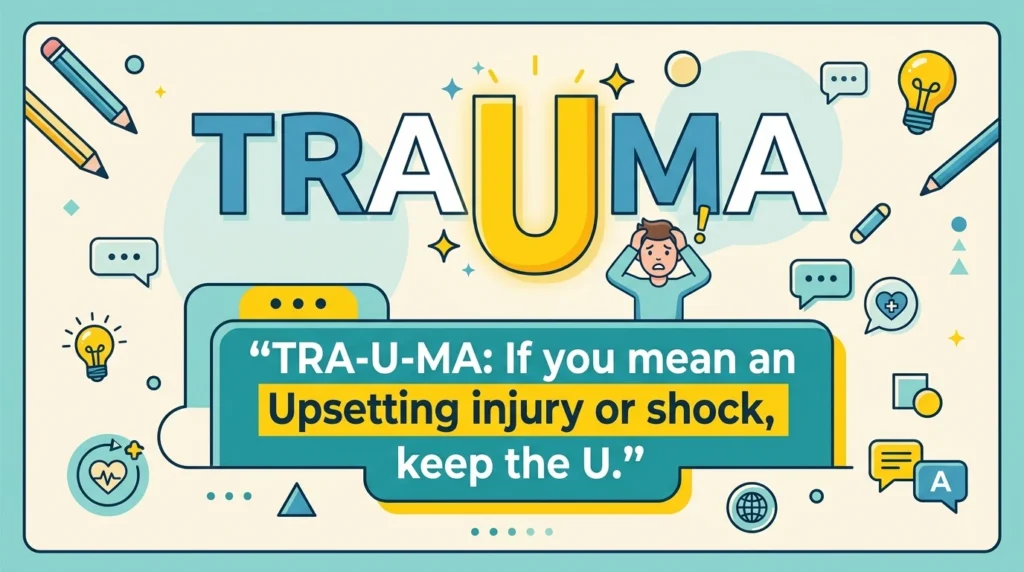
TRA-U-MA: If you mean an Upsetting injury or shock, keep the U.
The key letter is U.
If the sentence concerns emotional pain, psychological shock, or physical injury, stop before writing trama and check whether you have dropped the u from trauma.
Read More: Icycle vs Icicle Differences: Which Spelling Is Correct?
Real-Life Situations
Interview
Natural: “That experience taught me how important trauma-informed communication can be.”
Using trama-informed would simply be a spelling error.
Meeting
Natural: “We should consider how employees affected by trauma can access appropriate support.”
The context is emotional distress, so trauma is required.
Professional Email
Natural: “The report documents the physical trauma caused by the accident.”
Because the sentence refers to injury, trauma is correct.
Text Message
Natural: “That whole experience was pretty traumatic.”
The adjective is traumatic, which belongs to the same word family as trauma.
Exam
Question: “The patient showed signs of head ___ after the collision.”
Correct answer: trauma
The sentence describes physical injury.
Biology Lab
“The central tissue of the mushroom gill was identified as the trama.”
Here, the unusual spelling is intentional because the sentence uses the specialized fungal term.
Expert Tips
- Learn the whole word family. Remembering trauma, traumatic, and traumatize together makes the spelling easier to retain.
- Search before submitting. Use Find or Ctrl/Cmd + F to search for trama in documents discussing health, injury, or emotional experiences.
- Check meaning, not just spelling. A dictionary-recognized word can still be the wrong word for your sentence.
- Learn common combinations. Phrases such as head trauma, emotional trauma, and childhood trauma reinforce the correct spelling naturally.
- Do not trust autocorrect blindly. A spelling tool may recognize a specialized term without realizing that you intended another word.
- Watch the adjective. The adjective is traumatic, not tramic or tramatic.
- Consider your audience. If you genuinely need the mycology term trama in general-audience writing, briefly define it on first use.
- Use context as your final test. Injury or severe emotional shock almost always signals trauma.
Frequently Asked Questions
Is Trama a Real English Word?
Yes. Trama is a real but uncommon technical English word used in mycology. It can refer to specialized internal tissue in fungi, including tissue associated with mushroom gills.
However, if you mean physical injury or emotional distress, trama is not the correct word. You need trauma.
Is It Trauma or Trama When Talking About Emotional Pain?
Use trauma.
For example:
She is working through emotional trauma from the experience.
Writing emotional trama would be incorrect in standard English.
Is Trauma Spelled With a U?
Yes. The correct spelling is:
T-R-A-U-M-A
The u comes between a and m.
What Does Trama Mean in English?
In specialized English mycology, trama refers to internal fungal tissue.
It may also appear as a word from other languages. Its meaning in those languages should not be confused with the English word trauma.
Why Doesn’t Spellcheck Always Correct Trama?
A spellchecker may recognize trama because it can exist as specialist terminology, foreign-language vocabulary, a name, or another recognized entry.
Spellcheck therefore cannot always determine that you intended trauma.
Context remains important.
Can Trauma Refer to Both the Mind and Body?
Yes.
Physical trauma concerns bodily injury.
Psychological or emotional trauma concerns serious emotional or psychological effects associated with distressing experiences.
The surrounding sentence usually makes the intended meaning clear.
Read More: Present vs Presant Differences: Meaning, Spelling, and Correct Usage
What Is the Adjective Form of Trauma?
The adjective is traumatic.
For example:
It was a traumatic experience.
The verb is traumatize in American spelling. British English may also use traumatise.
What Is the Plural of Trauma?
Traumas is a standard plural form.
The form traumata also exists, particularly in some specialized or formal contexts, because of the word’s Greek history.
For most general writing, traumas is the more straightforward choice.
Is “Trama Center” Correct?
No, not when referring to emergency medical care.
The correct expression is:
trauma center
In British English, you may also encounter trauma centre, with the normal British spelling of centre. The word trauma itself does not change.
Can I Use Trama Instead of Trauma in Informal Writing?
No. Informality does not make trama an accepted alternative spelling of trauma.
You might encounter the misspelling in texts or social posts, but it remains a spelling mistake when injury or emotional distress is intended.
Mini Quiz
| # | Type | Question | Answer | Explanation |
| 1 | Fill in the blank | The accident caused severe head ___. | trauma | Physical injury is described with trauma. |
| 2 | Multiple choice | Which spelling is correct for emotional distress: trauma or trama? | Trauma | Emotional and psychological injury use trauma. |
| 3 | Correct the sentence | She experienced childhood trama. | She experienced childhood trauma. | The word needs the letter u. |
| 4 | Multiple choice | Can trama ever be a legitimate English word? A) Never B) Yes, in specialized mycology | B | Trama is a technical term connected with fungal tissue. |
| 5 | Fill in the blank | Doctors transferred him to the ___ center. | trauma | Trauma center is the standard medical expression. |
| 6 | Correct the sentence | The event was very tramatic. | The event was very traumatic. | The adjective derived from trauma is traumatic. |
| 7 | Multiple choice | Which is correct for mushroom anatomy in specialist mycology: trama or trauma? | Trama | The rare technical noun trama can refer to fungal tissue. |
| 8 | Fill in the blank | She described the experience as emotionally ___. | traumatic | An adjective is required, so use traumatic. |
| 9 | Correct the sentence | He received treatment for chest trama. | He received treatment for chest trauma. | Physical injury requires trauma. |
| 10 | Multiple choice | Do American and British English use different spellings of trauma? | No | Both use trauma, although pronunciation may differ. |
Quick Summary
Trauma and trama are different English words, although most searches comparing them involve a spelling mistake. Use trauma when referring to serious physical injury, emotional shock, psychological distress, or a deeply upsetting experience. Expressions such as head trauma, childhood trauma, and emotional trauma all require the u. Trama is not a standard alternative spelling of trauma, but it is a legitimate specialized term in mycology for certain internal fungal tissues. The easiest rule is simple: if your sentence concerns injury or emotional distress, choose trauma. American and British English use the same spelling, although pronunciation can vary. Always check context instead of relying only on spellcheck.