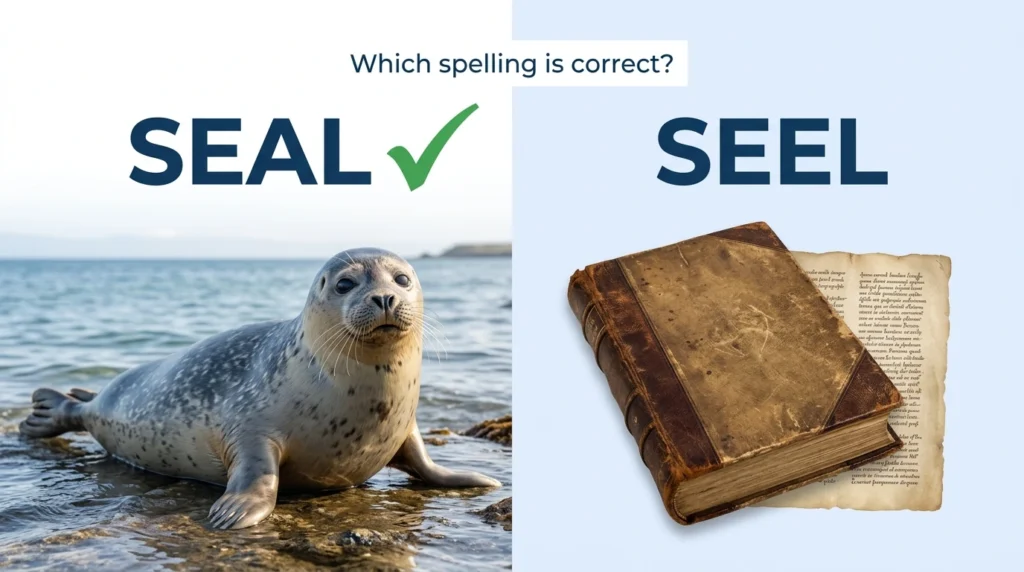

Seal is the correct word for a marine animal, a secure closure, an official mark, or the act of closing something tightly. Seel is also a real word, but it is an extremely rare historical verb connected mainly with closing or sewing shut a bird’s eyes. In normal modern English, you almost always need seal, not seel.
What Is the Difference Between Seal and Seel?
Seal and seel are pronounced alike but have completely different uses.
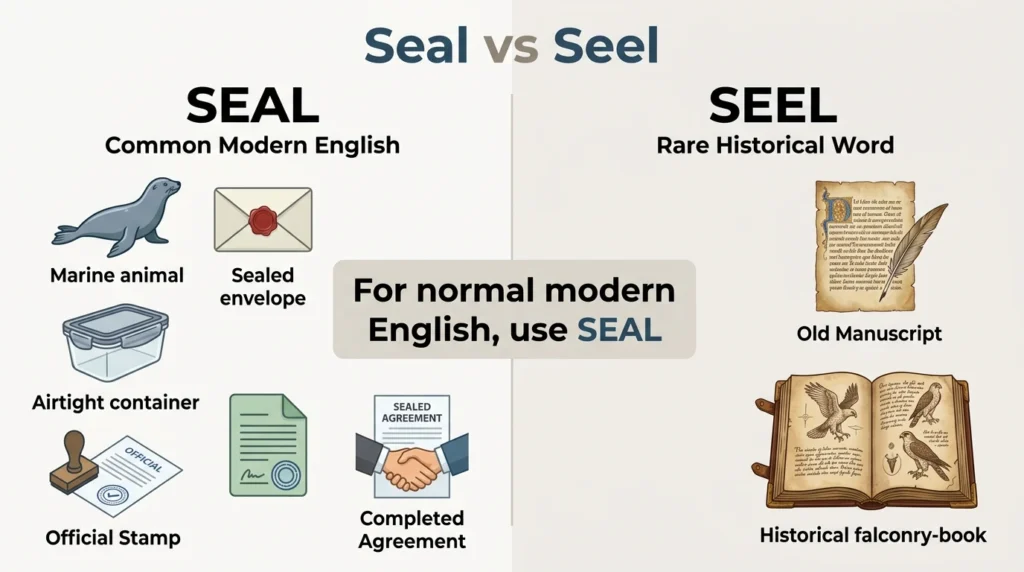
Seal is a common modern English noun and verb. As a noun, it can describe a marine mammal, an official mark, or something that prevents air, water, or another substance from passing through an opening. As a verb, it commonly means to close, secure, fasten, confirm, or prevent something from entering or escaping.
Seel is a rare transitive verb. Historically, it referred to closing a hawk’s or another bird’s eyes, traditionally by drawing threads through the eyelids. It can also appear archaically with the broader meaning of closing someone’s eyes or preventing sight. Its recorded forms include seel, seels, seeled, and seeling.
For ordinary writing, the distinction is simple:
- Use seal for animals, envelopes, packages, containers, agreements, official marks, leaks, doors, gaps, and similar modern meanings.
- Use seel only when its rare historical or literary meaning is genuinely intended.
- Do not use seel merely because seal sounds as though it should contain two e’s.
Why Seal vs Seel Matters
Confusing these words usually creates a spelling error rather than a small stylistic difference.
Writing “seel the envelope” in an email, school assignment, instruction manual, product description, or business document can make polished writing look careless. The reader will almost certainly expect seal.
The unusual complication is that a spelling checker may not always save you.
Because seel exists as a real dictionary word, some software may accept it without warning. That makes context more important than simply checking whether a word appears in a dictionary.
The Core Rule
Core Rule: Use seal in normal modern English. Use seel only when you specifically mean the rare historical verb connected with closing or blinding the eyes.
An easy decision process is:
- Ask whether you mean a marine animal, closure, mark, barrier, confirmation, or the action of closing something.
- If yes, write seal.
- Use seel only when discussing its specialized historical meaning.
How to Use Seal Correctly
Seal as a Marine Animal
Seal is a noun for a type of marine mammal.
Examples:
“The seal rested on the shore.”
“We watched several seals swimming near the rocks.”
The spelling is always seal in this meaning.
Seal Meaning a Secure Closure
A seal can be something that closes an opening or prevents air, gas, water, or another substance from passing through.
Examples:
“Check the seal around the refrigerator door.”
“The container has an airtight seal.”
This meaning appears frequently in engineering, packaging, manufacturing, construction, and everyday household language.
Seal Meaning an Official Mark
A seal can also be an official symbol, impression, stamp, or mark showing authority, approval, or authenticity.
Example:
“The certificate carried the institution’s official seal.”
This meaning is especially common in legal, administrative, academic, and government contexts.
Seal as a Verb Meaning Close Securely
As a verb, seal commonly means to close something securely so that access, leakage, or movement is prevented.
Examples:
“Seal the bag before putting it in the freezer.”
“Workers sealed the opening to prevent water from entering.”
“Please seal the envelope before mailing it.”
Seal Meaning Confirm or Finalize
Seal can also have a figurative meaning connected with making something final or certain.
For example:
“The final goal sealed their victory.”
“They sealed the agreement with a handshake.”
English also uses familiar expressions such as seal the deal and seal someone’s fate.
Read More: Shute vs Chute: Which Spelling Is Correct?
When Is Seel Actually Correct?
Seel is not simply invented spelling. It has a documented historical meaning.
Traditionally, to seel meant to close the eyes of a hawk or similar bird during older falconry practices. Dictionaries also record an archaic extension meaning to close someone’s eyes or make someone unable to see.
A sentence such as this can therefore be linguistically correct:
“The historical text describes how a falconer would seel a hawk’s eyes.”
However, that does not make sentences such as these correct:
“Seel the envelope.”
“Seel the package.”
“The seel swam through the water.”
Those sentences require seal.
Correct Examples of Seal and Seel
- Conversation: Please seal the container before you put it away.
- Email: Could you seal the signed documents in the return envelope?
- School: The student wrote a report about a harbor seal.
- Workplace: Inspect the rubber seal before starting the machine.
- Social media: We spotted a seal near the beach this morning.
- Academic writing: A damaged seal may allow moisture to enter the chamber.
- Business: The two companies hope to seal the agreement this week.
- Legal writing: The document bears the official seal of the organization.
- Home: Use the lid to create a tight seal around the container.
- Historical writing: The manuscript uses the verb seel in describing an old falconry practice.
- Travel: Several seals were resting on rocks near the coastline.
- Instructions: Seal the opening after adding the contents.
Seal vs Seel: Incorrect vs Correct Examples
| ❌ Incorrect | ✅ Correct | Why |
|---|---|---|
| Please seel the envelope. | Please seal the envelope. | Closing an envelope takes the common verb seal. |
| The seel swam beside the boat. | The seal swam beside the boat. | The marine animal is spelled seal. |
| Check the rubber seel around the door. | Check the rubber seal around the door. | A barrier that prevents leakage is a seal. |
| We need to seel the package securely. | We need to seal the package securely. | Closing or securing a package requires seal. |
| The contract carried the official seel. | The contract carried the official seal. | An official mark or stamp is a seal. |
| Their final presentation helped seel the deal. | Their final presentation helped seal the deal. | The established expression is seal the deal. |
| The damaged seel allowed water inside. | The damaged seal allowed water inside. | A protective closure or barrier is called a seal. |
| He seeled the box with strong tape. | He sealed the box with strong tape. | The past tense of modern seal is sealed. |
| The rescue team seeled the entrance. | The rescue team sealed the entrance. | Closing access to an entrance uses sealed. |
| The historical account says the trainer sealed the hawk’s eyes using the old falconry practice. | The historical account says the trainer seeled the hawk’s eyes. | Seel can be correct when its specific historical falconry meaning is intended. |
Why Do People Confuse Seal and Seel?
They Sound the Same
Both words are pronounced approximately /siːl/ in standard dictionary pronunciation. Their identical sound makes the spelling difficult to determine from speech alone.
Someone hearing “seal the box” therefore receives no pronunciation clue showing whether the spelling should contain ea or ee.
Context provides the answer.
English Has Many “ee” Spellings
Words such as feel, heel, peel, and steel contain the long “ee” sound and use ee.
A learner may reasonably assume that the same sound in seal should follow the same pattern.
English spelling does not work that consistently. The long vowel sound in seal is written ea, just as it is in words such as meal, real, and deal.
The Words Look Almost Identical
Only one letter separates seal and seel.
That tiny visual difference makes the error easy to overlook when typing quickly, particularly when the writer already knows words such as see, feel, and seem.
Spellcheck May Not Always Flag Seel
Spellcheckers are useful for detecting impossible spellings. They are less reliable when the mistaken form is also a legitimate dictionary word.
Because seel exists, software may recognize the spelling while failing to notice that it makes no sense in your sentence.
Always check meaning as well as spelling.
Translation Can Encourage Phonetic Spelling
Learners whose first language has a more predictable relationship between spelling and pronunciation may naturally try to spell English words according to sound.
Since seal sounds like “seel,” the double-e spelling can seem logical.
The safer approach is to learn seal as part of a spelling family: seal, meal, real, deal.
Common Mistakes Checklist
- Writing “seel” for the animal: Remember that the marine mammal is always a seal.
- Writing “seel the envelope”: Closing or fastening something requires the verb seal.
- Assuming seel is completely nonexistent: It is a real but highly specialized historical word.
- Using seel because spellcheck accepts it: Dictionary recognition does not guarantee correct context.
- Writing “seeled” as the past tense of seal: The normal past tense is sealed.
- Changing every historical seel to seal: In genuinely historical falconry or literary contexts, seel may be intentional.
- Overthinking pronunciation: Both words sound alike, so pronunciation alone cannot choose the spelling.
- Using seel in professional documents: Unless discussing its historical meaning, modern professional writing should use seal.
Read More: Icycle vs Icicle Differences: Which Spelling Is Correct?
Seal vs Seel in Real English
Grammatically Correct and Natural
In present-day everyday English, seal is both grammatically correct and completely natural in expressions such as seal an envelope, seal a package, airtight seal, official seal, seal the deal, and seal off an area. Readers encounter these forms without noticing anything unusual. When people search “seal vs seel,” this common word is almost always the form they actually need.
Grammatically Possible but Unnatural Today
Seel can form a grammatically valid sentence when used with its genuine historical meaning. However, it will sound highly unusual outside historical writing, literary analysis, or discussion of older falconry terminology. Using seel simply as a more phonetic spelling of seal is not an alternative style. In normal communication, it will usually be interpreted as a spelling mistake.
Natural Everyday English
A modern speaker would naturally say, “Seal the envelope,” “The lid creates a tight seal,” “We saw a seal at the beach,” or “That result sealed the victory.” You are extremely unlikely to need seel during ordinary conversation, emails, schoolwork, workplace communication, or social media. Learn seal as the everyday word and treat seel as specialist vocabulary you may occasionally encounter while reading.
Formal vs Informal Usage
Seal works comfortably in both formal and informal English.
Formal uses include:
“Apply the official seal to the certificate.”
“The chamber must remain hermetically sealed.”
“The evidence effectively sealed the outcome of the case.”
Informal or conversational uses include:
“Seal the bag before you leave.”
“That goal sealed the win.”
“Let’s seal the deal.”
Seel, by contrast, is not merely a more formal version of seal. Its rarity comes from its historical meaning rather than from a difference in politeness or formality.
Seal vs Seel Comparison Table
| Feature | Seal | Seel |
| Pronunciation | /siːl/ | /siːl/ |
| Modern frequency | Very common | Extremely rare |
| Part of speech | Noun and verb | Verb |
| Marine animal | Yes | No |
| Closing a package | Yes | No |
| Leak-proof barrier | Yes | No |
| Official mark | Yes | No |
| Finalizing something figuratively | Yes | No |
| Historical falconry meaning | No | Yes |
| Archaic meaning involving closing eyes | No | Yes |
| Normal everyday choice | Yes | Almost never |
| Past tense | sealed | seeled |
| Present participle | sealing | seeling |
Memory Trick for Seal vs Seel
Remember:
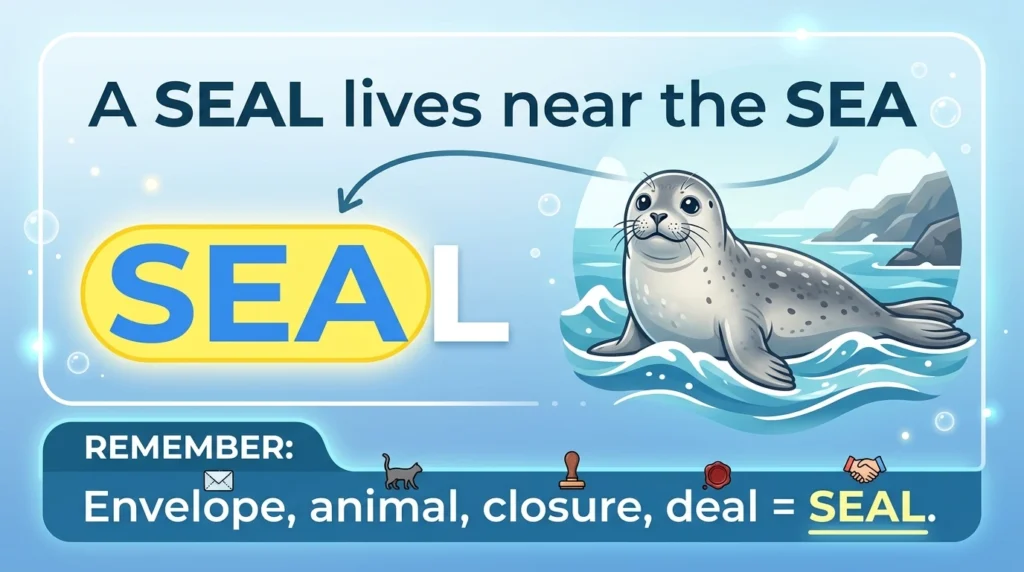
A SEAL lives near the SEA, and SEA is inside SEAL.
That immediately fixes the animal spelling.
Then extend the rule:
The same spelling—seal—is also used when you seal an envelope, create a seal around a lid, or seal a deal.
You only need seel when discussing its rare historical meaning involving eyes.
Real-Life Situations
Interview
You want to describe a successful negotiation.
Natural:
“My presentation helped seal the agreement with the client.”
Not:
“My presentation helped seel the agreement with the client.”
Meeting
A colleague discusses product packaging.
Natural:
“We need a stronger seal to prevent leakage.”
Here, seal is a noun describing the protective closure.
You are giving mailing instructions.
Natural:
“Please sign the form and seal it in the enclosed envelope.”
Using seel would look like a spelling error.
Text Message
You are describing wildlife.
Natural:
“I just saw a seal near the harbor!”
The animal is always seal.
Exam
A question asks about vocabulary in an old historical text.
If the passage uses seel to describe closing a bird’s eyes, do not automatically correct it. The spelling may represent the genuine archaic verb.
Read More: Present vs Presant Differences: Meaning, Spelling, and Correct Usage
Expert Tips for Remembering the Difference
Check the Meaning Before the Spelling
Do not ask only, “Is seel a word?”
Ask:
“What does this word mean in my sentence?”
That question solves the problem much faster.
If the sentence concerns animals, packaging, documents, barriers, leaks, closure, certainty, or finalization, you almost certainly need seal.
Learn Seal as Both a Noun and a Verb
Many learners remember only the animal.
That creates unnecessary confusion when they later encounter phrases such as:
“airtight seal”
“official seal”
“seal the package”
“seal the deal”
“seal off the area”
Learning all the major functions together makes the spelling easier to retain.
Do Not Trust Sound Alone
English contains several spelling patterns for the long “ee” sound.
Compare:
feel
piece
machine
seal
The pronunciation does not reliably tell you which letters to write.
Treat Seel as Recognition Vocabulary
Most learners do not need to actively use seel.
It is more useful as recognition vocabulary—a word you understand if you encounter it in historical, literary, or specialist material.
That saves you from memorizing an obscure word as though it were part of normal daily communication.
Watch the Past-Tense Forms
This distinction can reveal the error immediately:
seal → sealed → sealing
seel → seeled → seeling
If you mean closing a box and find yourself writing seeled, you have almost certainly chosen the wrong word.
FAQ
Is seel a real word?
Yes. Seel is a real English verb with a rare historical meaning related mainly to closing the eyes of a hawk or other bird. Dictionaries also record an archaic meaning involving closing or blinding the eyes. It is not a normal substitute for seal.
Is seel a misspelling of seal?
It can be.
If someone writes seel the package, seel the envelope, rubber seel, or a seel in the ocean, then seel is a spelling mistake and should be changed to seal.
However, seel itself exists with a separate historical meaning.
How do you spell seal when talking about the animal?
Spell it seal.
Example:
“The seal climbed onto the rock.”
Seel is not the standard spelling of the animal.
Is it seal or seel an envelope?
The correct phrase is seal an envelope.
Example:
“Please seal the envelope before sending it.”
The verb means to close or secure the envelope.
Is it seal or seel the deal?
The correct expression is seal the deal.
It means to finalize, secure, or successfully complete an agreement.
What is the past tense of seal?
The past tense and past participle of seal are both sealed.
Present: “They seal every package.”
Past: “They sealed the package yesterday.”
Past participle: “The package has been sealed.”
What is the past tense of seel?
The historical verb seel forms its past tense as seeled.
That form should not be confused with sealed, the past tense of the common modern verb seal.
Are seal and seel homophones?
Yes. They are pronounced alike in standard dictionary pronunciation while having different spellings and meanings.
That identical pronunciation is one reason writers may confuse them.
Why might spellcheck accept seel?
A spelling checker may recognize seel because it exists as a dictionary word.
Spellcheck can therefore confirm that the letters form a word without confirming that you chose the correct word for your sentence.
Does seel mean sell?
No.
Seel, seal, and sell are separate words.
Sell means to exchange something for money.
Seal commonly means to close, secure, authenticate, or refer to a marine mammal.
Seel has its rare historical meaning involving the eyes.
Is sealing spelled with one e or two?
When it comes from the common word seal, the correct form is sealing:
seal → sealing
Example:
“She is sealing the envelope.”
The rare verb seel forms seeling, but that is a different word with a different meaning.
Mini Quiz: Seal vs Seel
| # | Question | Answer | Explanation |
| 1 | Fill in the blank: Please ___ the package before shipping it. | seal | Closing a package uses the common verb seal. |
| 2 | Which is correct for the marine animal: seal or seel? | seal | The animal is spelled seal. |
| 3 | Correct the sentence: “The rubber seel is damaged.” | The rubber seal is damaged. | A barrier preventing leakage is a seal. |
| 4 | Multiple choice: Which phrase is standard? A) seel the deal B) seal the deal | B) seal the deal | The established expression uses seal. |
| 5 | Fill in the blank: The certificate displayed the official ___. | seal | An official mark is a seal. |
| 6 | Correct the sentence: “She seeled the envelope yesterday.” | She sealed the envelope yesterday. | The past tense of seal is sealed. |
| 7 | True or false: Seel is completely nonexistent in English. | False | It is a rare historical verb. |
| 8 | Multiple choice: Which could be correct in a historical falconry text? A) seel B) only seal | A) seel | Seel has a documented specialist historical meaning. |
| 9 | Fill in the blank: The final point ___ their victory. | sealed | Figuratively making an outcome certain uses sealed. |
| 10 | Correct the sentence: “We watched a seel swimming offshore.” | We watched a seal swimming offshore. | The marine mammal is always spelled seal in standard English. |
Quick Summary
Seal is the word you need in almost every modern situation. It can name a marine mammal, an official mark, a protective closure, or a barrier that prevents leakage. As a verb, seal means to close, secure, confirm, or make something final, as in seal an envelope or seal the deal. Seel is not simply a made-up spelling, however. It is a genuine but extremely rare historical verb associated mainly with closing a bird’s eyes in older falconry practices. Because seal and seel sound alike, writers sometimes confuse them. The easiest rule is simple: use seal for everyday English and reserve seel for its specific historical meaning.