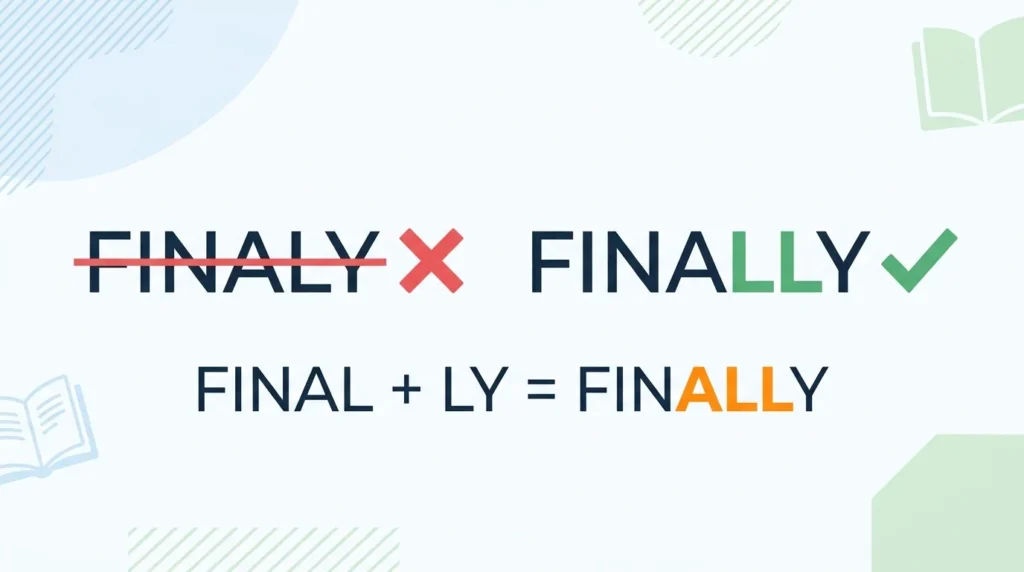

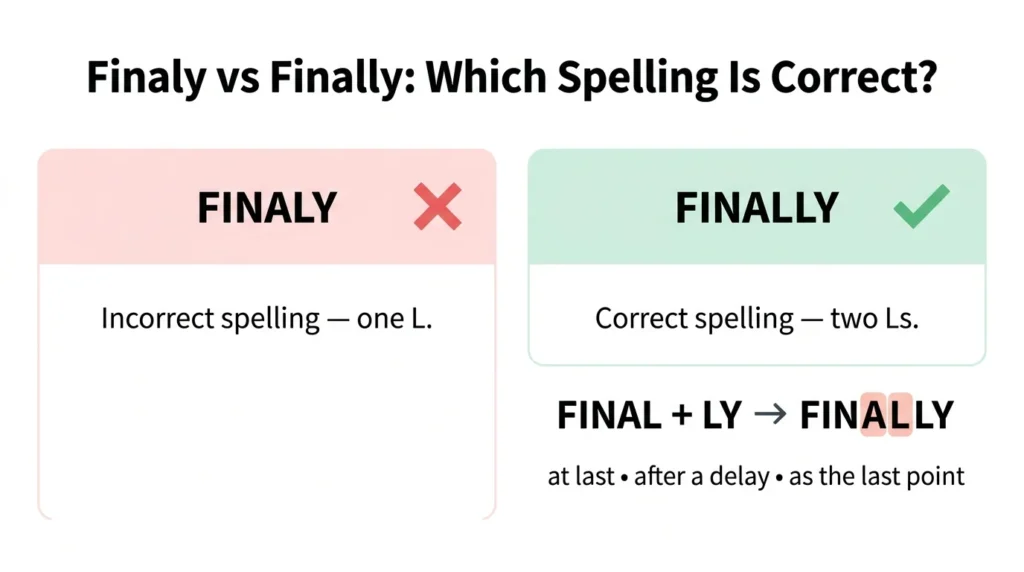
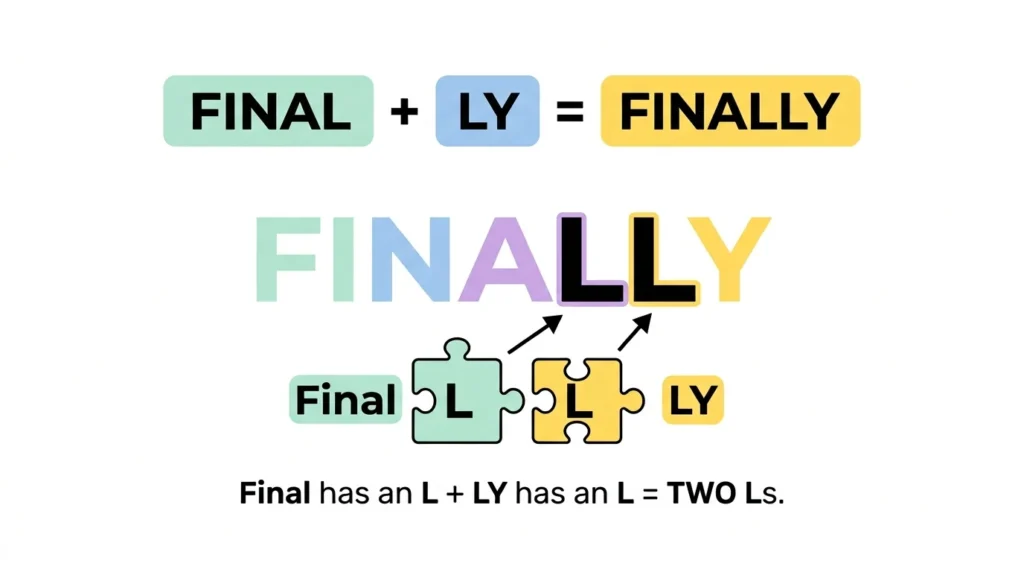
Finally is the correct spelling. Finaly is not the standard modern English spelling of this word. Finally is an adverb that can mean “after a long time,” “at last,” “in the end,” or “as the last point in a sequence.” The easiest way to remember the spelling is final + ly = finally. The base word final already ends in l, and the suffix -ly begins with l, giving you two l’s.
What Is the Difference Between Finaly and Finally?
The difference is simple: finally is the correct spelling, while finaly is a misspelling in standard modern English.
Finally is an adverb. It commonly tells us that something happened after a delay, difficulty, or long process. It can also introduce the last point in a list, discussion, speech, or set of instructions. Major dictionaries define it in these senses.
Examples:
- We finally reached the station.
- She finally understood the problem.
- Finally, let’s review the last section.
- After months of negotiations, the two companies finally reached an agreement.
Finaly, with only one l, is not the standard spelling you should use in contemporary English writing.
There is one historical nuance worth knowing: forms resembling finaly existed in Middle English and older varieties of English. Historical sources record finaly with the meaning “in the end.” That does not make it a correct spelling for present-day standard English.
For modern English, the practical rule is straightforward:
Use finally. Do not use finaly.
Why It Matters
A missing letter may seem like a tiny mistake, but spelling errors become more noticeable when they appear in places where accuracy matters.
You might type finaly in a quick text and still be understood. But the same spelling in a job application, business proposal, school assignment, academic paper, website, or professional email can make the writing look less carefully edited.
This is especially easy to miss because finaly and finally are normally pronounced the same when the writer intends the word finally. Speaking the word does not remind you that the spelling contains two l’s.
Correct spelling therefore matters most when your writing represents you.
Compare:
- “We finaly completed the project.”
- “We finally completed the project.”
The meaning is clear in both, but only the second follows standard modern English spelling.
The Core Rule
When you mean “at last,” “eventually,” “in the end,” or “as the last point,” spell the word finally with two l’s.
The spelling comes together naturally:
final + ly → finally
Do not think of the word as:
final + y → finaly ❌
The important point is that final already ends in l. When you add -ly, you keep the existing l and add the l that begins the suffix.
So:
final + ly = finally
This is also consistent with the spelling guidance for adjectives ending in l: adding -ly gives forms such as finally, totally, really, and personally.
Read More: Waring vs Wearing: Which Word Is Correct?
How to Use Finally
1. Use “finally” for something that happens after a delay
This is one of the most common uses.
The word suggests that you had to wait or that something took time.
- We finally got home after midnight.
- She finally received the letter.
- The bus finally arrived.
- I finally found my missing keys.
Cambridge describes this use as something happening after a long time or some difficulty.
2. Use “finally” for the end of a process
Finally can show that something has reached its eventual result after several stages.
- After several revisions, we finally approved the design.
- The team finally solved the technical problem.
- They discussed the options and finally chose the cheaper plan.
Here, the emphasis is on the eventual outcome rather than simply the last item in a list.
3. Use “finally” to introduce the last point
You can put finally at the beginning of a sentence when you are moving to the last point in a discussion, speech, explanation, or set of instructions.
- Finally, we need to discuss the budget.
- Finally, I’d like to thank everyone for attending.
- Finally, add the remaining ingredients.
- Finally, let’s consider what happens next.
This use is particularly common in organized writing and speech.
4. Use “finally” when expressing relief
In everyday English, finally often carries a feeling of relief, satisfaction, or impatience.
- Finally! The weekend is here.
- I finally finished the report.
- She finally called me back.
- We finally have a working solution.
The word itself does not always mean “I am relieved,” but the surrounding situation can give it that emotional meaning.
Correct Examples
Here are original examples across common writing situations.
Conversation
- “I finally found your message.”
- “We finally decided where to go for dinner.”
- “I can finally confirm that the documents are ready.”
- “Finally, please let me know if you need any further information.”
School
- “After several attempts, I finally understood the formula.”
- “Finally, the students submitted their projects.”
Workplace
- “The development team finally resolved the issue.”
- “Finally, let’s review the deadlines for each department.”
Social Media
- “Finally! A quiet evening after a very busy week.”
- “After months of practice, I finally completed my first marathon.”
Academic Writing
- “The researchers finally identified the main source of the problem.”
- “Finally, the results suggest that further research is necessary.”
Notice that finally does not have to appear at the beginning of a sentence. Its position depends on what you want it to modify and the emphasis you want to create.
Incorrect vs. Correct
| ❌ Incorrect | ✅ Correct | Why |
|---|---|---|
| I finaly finished my work. | I finally finished my work. | The standard spelling has two l’s. |
| She finaly arrived home. | She finally arrived home. | Finaly is a misspelling of finally. |
| We finaly reached an agreement. | We finally reached an agreement. | The adverb is spelled finally. |
| Finaly, we can begin. | Finally, we can begin. | The opening adverb still requires two l’s. |
| He finaly understood the lesson. | He finally understood the lesson. | The spelling does not change because the word is used after a verb. |
| I finaly found the answer. | I finally found the answer. | Finally is the correct adverbial form. |
| They finaly completed the project. | They finally completed the project. | Keep the l from final and add the l in -ly. |
| Finaly, let’s move on. | Finally, let’s move on. | Sentence position does not change the spelling. |
| The team finaly won. | The team finally won. | The word remains finally in everyday English. |
| We finaly solved the problem. | We finally solved the problem. | One l is missing in the incorrect form. |
Why People Make This Mistake
Phonetic similarity
When you hear finally, you do not see the letters. The spoken word can therefore provide little help with remembering whether there are one or two l’s in the middle.
This is a common problem with English spelling: pronunciation does not always tell you exactly how a word is written.
The spelling of “final”
The adjective final has only one l at the end:
final
That can make finaly look visually reasonable.
A writer may unconsciously think:
final + y = finaly
But the suffix is -ly, not simply -y.
So the correct formation is:
final + ly = finally
Fast typing
When people type quickly, they often leave out a letter without noticing. Familiar words are especially vulnerable because the brain can recognize the overall shape of a word without consciously checking every character.
That makes finaly an easy typo to overlook.
Autocomplete and spellcheck
Digital writing tools can reduce spelling errors, but they are not a substitute for knowing the correct form.
A spellchecker may suggest finally, automatically correct the word, or allow the mistake to remain depending on the software and context.
Do not assume that a word is correct simply because your keyboard did not flag it.
Translation interference
English learners may transfer spelling patterns from another language into English. If the learner’s first language uses a different way of forming adverbs, the English -ly pattern may take extra practice.
The safest strategy is not to guess from pronunciation. Learn the word family:
final → finally
Common Mistakes Checklist
Mistake 1: Writing “finaly”
Problem: You leave out one l.
Why it happens: The base word final has one visible l, so finaly can look logical.
How to avoid it: Remember final + ly.
Mistake 2: Thinking “finaly” is an informal spelling
It is not a standard casual alternative to finally.
You should not use one l in a text message simply because the communication is informal.
Use:
finally ✅
not:
finaly ❌
Mistake 3: Confusing “final” and “finally”
These words are related, but they have different grammatical jobs.
Final is commonly an adjective:
This is the final version.
Finally is an adverb:
We finally approved the version.
Mistake 4: Writing “finally” when you need “final”
Consider:
This is the finally report. ❌
You need the adjective:
This is the final report. ✅
The mistake here is not spelling. It is choosing the wrong word.
Mistake 5: Assuming “finally” always means “last”
Sometimes finally means “after a long delay” rather than simply “the last item.”
Compare:
She finally called me.
This normally suggests that I had been waiting for her call.
But:
Finally, we will discuss the budget.
Here, finally introduces the last point in an organized discussion.
Finally in Real English
Grammatically correct and natural
“I finally finished the report.” is both grammatically correct and natural. It tells the reader that finishing the report happened after some delay, effort, or waiting. This is one of the most ordinary uses of finally in everyday English. The word fits naturally between the subject and the main verb, although other positions are possible.
Grammatically correct but dependent on context
“Finally, we need to discuss the budget.” is grammatically correct and natural when the budget is genuinely the last point being introduced. However, repeatedly beginning every paragraph with finally can make writing feel mechanical. Use it when the sequence matters, not simply because you need another transition.
Natural everyday alternatives
In some situations, at last, eventually, or in the end may sound more appropriate depending on the intended meaning. At last often carries impatience or relief, while in the end commonly refers to a conclusion after changes or discussion. Lastly is more specifically associated with the final item in a list.
American vs. British English
There is no spelling difference between American and British English here.
Both use:
finally ✅
Neither standard variety uses:
finaly ❌
The pronunciation can vary slightly between accents, but that does not change the spelling.
| English variety | Correct spelling |
|---|---|
| American English | finally |
| British English | finally |
| International English | finally |
So you do not need to choose between finaly and finally based on your audience’s country.
Choose finally in all standard modern English contexts.
Formal vs. Informal Usage
There is no formal/informal spelling variation.
Finally works in:
- text messages
- conversations
- emails
- business writing
- school assignments
- academic writing
- reports
- presentations
- professional documents
- social media
The difference is not the spelling. It is sometimes the placement and meaning.
For example, this is perfectly natural in a casual message:
Finally! I finished it.
And this can work in formal writing:
Finally, the findings indicate that additional research is required.
Both use the same spelling.
Comparison Table
| Feature | Finaly | Finally |
|---|---|---|
| Standard modern English | ❌ No | ✅ Yes |
| Spelling | One l | Two l’s |
| Part of speech | Not a standard modern English word | Adverb |
| Meaning | — | At last; after a delay; in the end; as the last point |
| Base word | — | final |
| Formation | Incorrect | final + ly |
| American English | ❌ | ✅ |
| British English | ❌ | ✅ |
| Formal writing | ❌ | ✅ |
| Informal writing | ❌ | ✅ |
| Academic writing | ❌ | ✅ |
| Professional writing | ❌ | ✅ |
Final vs. Finally
Because final and finally belong to the same word family, learners sometimes use the wrong one.
Final
Final is generally an adjective. It describes a noun.
We submitted the final report.
This is the final decision.
The final exam is next week.
Finally
Finally is an adverb. It modifies an action, situation, or statement.
We finally submitted the report.
They finally made a decision.
I finally passed the exam.
A useful question is:
Am I describing a thing, or am I describing when/how something happened?
If you are describing a noun, final may be the word you need.
If you are showing that something happened after a delay or at the end of a sequence, finally may be the right choice.
Finally vs. Lastly vs. Eventually vs. In the End
These words overlap, but they are not identical.
| Word/Phrase | Main idea | Example |
|---|---|---|
| finally | After a delay, or as the last point | We finally reached home. |
| lastly | The last item in a list | Lastly, check the figures. |
| eventually | At some later point, often after a process | She eventually found another job. |
| in the end | The eventual conclusion or result | In the end, we chose the smaller house. |
| at last | After a long wait, often with relief | At last, the bus arrived. |
Cambridge specifically distinguishes these expressions by how they relate to time, lists, delay, and conclusions.
This distinction can make your writing more precise.
Memory Trick
Use this:
FINAL has an L. LY starts with an L. Put them together: FINALLY.
Think of the word as two pieces:
FINAL + LY
The two l’s meet:
FINA + LL + Y
So when your brain asks:
“Is it finaly or finally?”
Answer:
FINAL already has an L, and LY brings another L. → FINALLY
Real-Life Situations
Job interview
You have explained your experience and want to make your last point:
Finally, I’d like to mention the leadership project I completed last year.
Business meeting
The discussion has covered several issues:
We’ve reviewed the budget and timeline. Finally, let’s discuss staffing.
You have been waiting for confirmation:
I can finally confirm that the order has been approved.
Text message
You have completed something difficult:
Finally! I finished the presentation.
School exam
You describe the end of a process:
After several experiments, the students finally reached the expected result.
Academic writing
You introduce a concluding point:
Finally, the evidence suggests that the policy needs further review.
Expert Tips
1. Learn the word family, not just the spelling
Instead of memorizing finally as seven separate letters, connect it to:
final → finally
Word families make spelling easier to remember.
2. Do not rely on pronunciation
The missing l is difficult to detect when you say the word aloud.
When spelling matters, think visually:
FINALLY
3. Watch for the “final + y” trap
If you automatically think:
final + y
you may produce finaly.
The suffix is -ly:
final + ly
4. Do not overuse “finally” as a transition
Although finally can introduce the last point, not every conclusion needs it.
You can also use:
- In conclusion
- To conclude
- Lastly
- Overall
- In the end
Choose based on meaning rather than simply searching for a transition word.
5. Remember that “finally” can refer to time
Do not assume it always means “the last item.”
She finally answered.
This primarily suggests that the answer came after waiting or delay.
Read More: Steer vs Stear: Which Spelling Is Correct?
6. Check the word after “final”
If you mean that something is the last or definitive version, you may need final, not finally.
the final draft ✅
not:
the finally draft ❌
FAQ
Is “finaly” a correct English word?
Not in standard modern English. If you mean the common adverb meaning “at last,” “eventually,” or “in the end,” the correct spelling is finally with two l’s.
Why does “finally” have two l’s?
Because it can be understood as final + -ly. The word final already ends in l, while the suffix -ly begins with l. Keeping both gives finally. Cambridge’s spelling guidance specifically uses finally as an example of adding -ly to an adjective ending in l.
Is “finaly” just a typo?
In present-day standard English, it is normally a misspelling or typo for finally. However, historical English sources record finaly as an older form, so saying that the spelling has never existed anywhere would be inaccurate. That historical usage does not make it appropriate in modern standard English.
Is “finally” an adjective or an adverb?
Finally is an adverb. It can describe something that happens after a delay or introduce the final point in a sequence. Final is generally the adjective: the final decision.
Can I use “finally” at the beginning of a sentence?
Yes. For example:
Finally, we reached a decision.
It is especially common at the beginning when it introduces the last point or idea.
Can “finally” appear in the middle of a sentence?
Yes. This is very common:
We finally reached an agreement.
In this use, finally often occurs in the normal mid-position for adverbs.
Is “finally” the same as “lastly”?
Not always. Finally can mean that something happened after a delay, while lastly is especially useful for identifying the final item in a list. For example, We finally arrived refers to delay, while Lastly, check the signature introduces a final instruction.
Is “finally” the same as “eventually”?
They can overlap when talking about something that happens after a period of time. But eventually emphasizes a later outcome, while finally can also emphasize relief, delay, or the final point in a sequence.
Is “finaly” correct in British English?
No. Modern British English uses finally, just like American English.
Is “finaly” acceptable in texting?
If you mean the standard English adverb, use finally even in an informal text. Informal communication does not create a standard one-l spelling.
What is the easiest way to remember “finally”?
Think:
final + ly = finally
There are two l’s because one comes from final and one comes from -ly.
Mini Quiz
| # | Question | Answer | Explanation |
|---|---|---|---|
| 1 | Choose the correct spelling: finaly / finally | Finally | The standard spelling contains two l’s. |
| 2 | Fill in the blank: “We ___ reached the station.” | finally | The word means that the arrival happened after some delay or difficulty. |
| 3 | Correct the sentence: “I finaly finished my assignment.” | I finally finished my assignment. | Finaly is missing an l. |
| 4 | Which is correct? A) final version B) finally version | A) final version | Final is the adjective that describes version. |
| 5 | Fill in the blank: “___, let’s review the conclusion.” | Finally | It introduces the last point in the discussion. |
| 6 | True or false: British English spells it “finaly.” | False | British English also uses finally. |
| 7 | Correct the sentence: “She finaly called me back.” | She finally called me back. | The correct adverb is finally. |
| 8 | Which word best fits? “___, the team chose the third proposal.” | In the end | This sentence focuses on the eventual decision. Finally could also work depending on context, but in the end clearly emphasizes the conclusion. |
| 9 | Choose the correct sentence: A) “This is the finally report.” B) “This is the final report.” | B) This is the final report. | Final is the adjective needed before the noun report. |
| 10 | Complete the spelling: final + ___ = finally | ly | Adding -ly to final gives finally. |
Quick Summary
Finally is the correct modern English spelling; finaly is a misspelling when you mean the common adverb. Finally means “after a long time,” “at last,” “in the end,” or “as the last point in a sequence.” Its spelling is easy to remember as final + ly = finally. The two l’s come from the final l in final and the initial l in the suffix -ly. American and British English use the same spelling. Do not confuse finally with final: final is generally an adjective, while finally is an adverb. Although historical forms such as finaly are documented, modern standard English uses finally.