


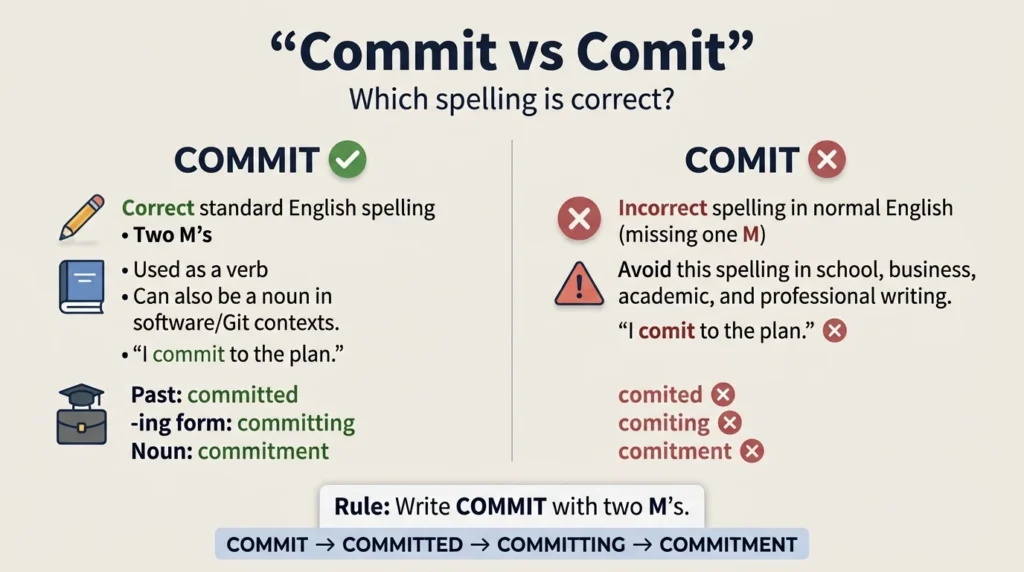
Commit is the correct spelling. Comit is a misspelling in standard English. Write commit with two m’s whether you mean to promise yourself to something, dedicate resources, carry out an act, or save changes in a software system. Its common forms include commits, committed, committing, and commitment.
Correct: commit
Incorrect in standard English: comit
Past tense: committed
-ing form: committing
Related noun: commitment
What Is Commit?
Commit is primarily a verb. In plain English, it can mean to make a firm promise, dedicate yourself or your resources to something, carry out a serious action, or place something into a particular state or use.
For example:
- You can commit to a goal.
- A company can commit money to a project.
- Someone can commit a crime.
- You can commit information to memory.
- A developer can commit changes to a software repository.
In software development, especially Git, commit can also function as a noun. A commit is a recorded point or snapshot in a project’s history.
Comit, by contrast, should not replace commit in normal English writing.
There are specialized names and acronyms written as COMIT, including the name of an early computer programming language, but these are proper or technical names rather than alternative spellings of the ordinary English verb commit.
Why Does the Correct Spelling Matter?
Writing comit instead of commit may seem like a small typo, but spelling mistakes are more noticeable in situations where readers expect careful writing.
That includes:
- job applications
- business emails
- academic papers
- client proposals
- reports
- résumés
- website content
- professional social media posts
- exams and assignments
A reader will usually understand what comit is supposed to mean. The problem is not comprehension. The problem is that the spelling can make otherwise polished writing look less carefully checked.
The distinction becomes even more useful when you start forming words such as committed, committing, and commitment, because each has its own spelling pattern. Standard references list the verb forms as commit, committed, and committing.
The Core Rule
Rule: Always spell the ordinary English word as COMMIT, with two m’s.
Do not write comit when you mean the English verb commit.
Think of the spelling as:
co + mm + it = commit
The pronunciation does not clearly tell you that there are two m’s, so this is a spelling pattern you need to remember visually.
Read More: Pentoxide vs Pentaoxide: Which Spelling Is Correct in Chemistry?
The Main Forms of Commit
| Form | Correct Spelling | Common Wrong Spelling |
|---|---|---|
| Base verb | commit | comit |
| Third-person singular | commits | comits |
| Past tense | committed | commited |
| Past participle | committed | commited |
| -ing form | committing | commiting |
| Noun | commitment | comitment / committment |
| Adjective | committed | commited |
The past and -ing forms use a doubled t: committed and committing. Standard spelling guidance specifically identifies these as the correct forms.
The related noun is different: commitment has two m’s but only one t before -ment.
How to Use Commit Correctly
The spelling is simple once memorized, but the word has several common grammatical patterns.
1. Commit to Something
Use commit to + noun when someone makes a firm decision or promise.
Examples:
- We need to commit to the plan.
- She is ready to commit to the project.
- Can you commit to a date?
- He would not commit to a final answer.
This pattern is standard when someone promises loyalty, time, effort, or support to a person, goal, plan, or course of action.
2. Commit to Doing Something
When to is part of commit to, it can be followed by an -ing form.
Correct:
- commit to working
- commit to studying
- commit to improving
- commit to reducing costs
- commit to finishing the project
For example:
The company committed to reducing unnecessary expenses.
This works because the expression commit to commonly takes a noun or an -ing form after to.
3. Commit Yourself to Something
You can also use:
commit yourself to + noun/-ing form
Examples:
- She committed herself to the project.
- He committed himself to improving his writing.
- They committed themselves to finding a solution.
This construction is correct but can sound more deliberate or formal than the shorter everyday form commit to.
4. Commit Resources, Money, or Time
Commit can mean to allocate or promise resources for a specific purpose.
Examples:
- The company committed more money to research.
- We cannot commit additional staff to the project yet.
- She committed several hours a week to training.
This use emphasizes that the resource is being assigned rather than merely discussed.
5. Commit a Crime, Offense, or Wrongful Act
Commit is commonly used for carrying out something illegal or seriously wrong.
Examples:
- The police investigated who committed the crime.
- Anyone who commits fraud may face serious consequences.
- The report described several offenses committed during the scheme.
This is one of the established dictionary senses of commit.
6. Commit Something to Memory
Commit something to memory means to learn it thoroughly enough to remember it.
Example:
You should commit these formulas to memory before the exam.
The expression is standard English and essentially means to memorize something.
7. Commit Something to Writing or Paper
In more formal English, commit something to writing or commit something to paper means to write it down rather than leave it as a spoken idea.
Example:
Before making the proposal official, she committed her ideas to paper.
The expression commit something to paper is an established phrase.
8. Commit in Software and Git
In software development, commit has an additional technical meaning.
As a verb:
I committed the latest changes.
As a noun:
That commit fixed the login bug.
In Git terminology, a commit is a recorded point in a project’s history, while to commit means to store a new snapshot of the project’s state.
The spelling is still commit, never comit.
A Simple Three-Step Spelling Check
When you are unsure whether to write commit or comit, use this process:
- Look for the middle consonant. The standard word has mm.
- Check the form you need. Use commit, committed, committing, or commitment.
- Read the whole phrase. Make sure you are using a natural pattern such as commit to a goal, commit to improving, or commit a crime.
That quick check catches most errors involving this word.
Correct Examples of Commit
Here are original examples across different types of English.
Conversation
- I can’t commit to Saturday until I check my schedule.
- If you’re going to learn the guitar, commit to practicing regularly.
- Please confirm whether your team can commit to the proposed deadline.
- We are prepared to commit additional resources to the campaign.
School
- The student decided to commit the key dates to memory before the test.
- You need to commit to completing each stage of the assignment on time.
Workplace
- Management will not commit the full budget until the proposal is approved.
- Our department has committed to reducing response times this quarter.
Social Media
- This month, I’m committing to reading for twenty minutes every evening.
- Before you announce a challenge online, make sure you can commit to it.
Academic Writing
- The organization committed substantial resources to the long-term study.
- Researchers should avoid committing themselves to a conclusion before reviewing all the evidence.
Read More: Preform vs Perform: Difference, Meaning, and Examples
Incorrect vs. Correct Examples
| ❌ Incorrect | ✅ Correct | Why |
|---|---|---|
| I will comit to the plan. | I will commit to the plan. | The base verb contains two m’s. |
| She comited to the project yesterday. | She committed to the project yesterday. | The past tense is committed, with mm and tt. |
| He is commiting more time to study. | He is committing more time to study. | The -ing form doubles the final t: committing. |
| We need more comitment from the team. | We need more commitment from the team. | The noun keeps the double m. |
| Her committment is impressive. | Her commitment is impressive. | Commitment has only one t before -ment. |
| Can you comit to Monday? | Can you commit to Monday? | Comit is not the standard spelling of this verb. |
| They comit funds every year. | They commit funds every year. | The present-tense verb remains commit. |
| He has commited several violations. | He has committed several violations. | The past participle is committed. |
| She is comitted to improving. | She is committed to improving. | The correct adjective contains mm and tt. |
| Please comit these rules to memory. | Please commit these rules to memory. | The fixed expression uses the standard spelling commit. |
Why Do People Write Comit Instead of Commit?
The mistake is understandable because English spelling does not always match pronunciation letter for letter.
Pronunciation Does Not Reveal the Double M
Commit is pronounced with one continuous m sound. You do not clearly hear two separate m’s when someone says the word.
That makes comit look plausible to someone spelling entirely by sound.
Double Letters Are Easy to Drop
Writers frequently hesitate over doubled consonants because English contains words with many different patterns.
Compare:
- admit
- permit
- omit
- commit
The endings look similar, but the beginnings are spelled differently. Visual memory is therefore more reliable than guessing.
The Related Forms Add Another Double Letter
Even after learning commit, writers may hesitate over committed and committing.
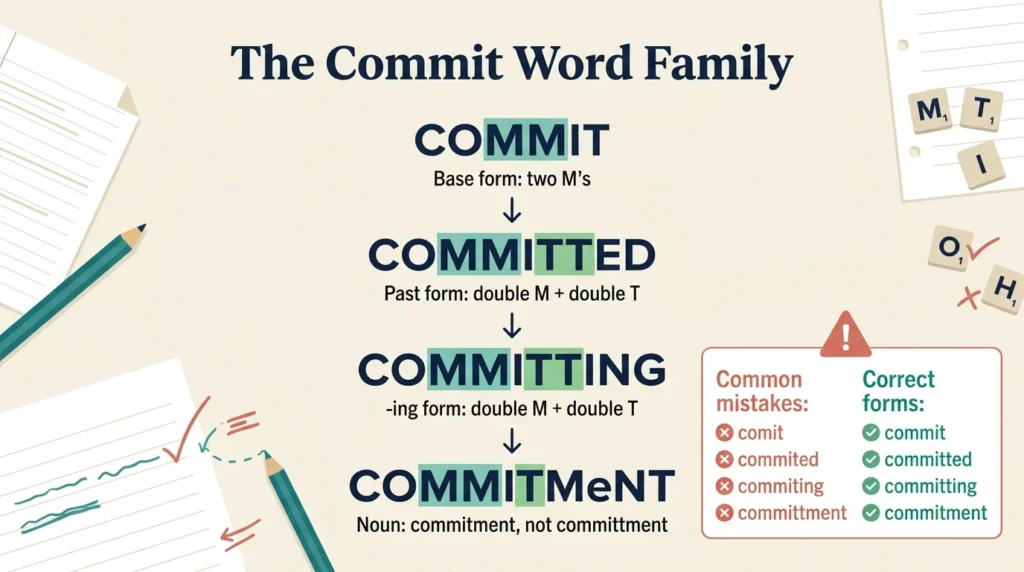
The correct sequence is:
- commit
- committed
- committing
The final t doubles before -ed and -ing in these forms.
This sometimes creates the opposite error in commitment, where writers add an unnecessary second t and write committment.
Fast Typing Can Remove One M
When typing quickly, repeated letters are easy to miss.
A writer may intend to type commit but produce:
comit
The same problem occurs with:
commited instead of committed
or:
commiting instead of committing
Spellcheck Is Helpful but Not a Substitute for Knowing the Word
Most modern spelling tools can detect obvious errors, but writers should still learn the correct form.
Names, acronyms, usernames, code, specialized terminology, and custom dictionaries may prevent a spelling checker from treating every unusual form as an error. For example, COMIT can occur as a specialized proper or technical name even though comit is wrong when you mean the everyday English verb.
Translation Can Influence Spelling
ESL learners sometimes transfer spelling patterns from another language when English has a similar-looking word.
The safest approach is not to rebuild commit from another language. Learn the English spelling as a complete visual unit:
commit
Then learn its family:
commit → committed → committing → commitment
Common Mistakes Checklist
Use this checklist when proofreading.
- Writing comit: Add the missing second m.
- Writing commited: Use committed with two t’s.
- Writing commiting: Use committing with two t’s.
- Writing committment: Remove the extra t. The noun is commitment.
- Using commit for every kind of action: The word has specific meanings. Sometimes do, make, promise, dedicate, or allocate is more natural.
- Forgetting the preposition to: When talking about dedication, the normal pattern is often commit to something.
- Forgetting the -ing form after commit to: Phrases such as commit to improving and commit to working are standard.
- Treating comit as an alternative regional spelling: It is not an American/British spelling choice. Use commit in ordinary standard English.
- Assuming every appearance of COMIT is a typo: All-capital COMIT can be a name or acronym in specialized contexts.
Commit vs Comit in Real English
Grammatically Correct English
The safest standard patterns are commit to + noun, commit to + -ing form, commit + resources + to, and commit + crime/offense. You can therefore write “commit to the plan,” “commit to improving service,” “commit funds to research,” or “commit an offense.” These patterns communicate different established meanings of the verb while keeping the spelling and sentence structure standard.
Grammatically Possible but Less Natural English
Not every sentence containing commit is equally natural. For example, commit a mistake can occur, but in ordinary everyday English, make a mistake is usually the clearer and more familiar choice. Likewise, commit oneself to improving the process is correct but more formal and deliberate than simply saying commit to improving the process. Choosing the natural collocation matters as much as spelling the word correctly.
Natural Everyday English
In conversation, workplace communication, and general writing, people commonly use phrases such as commit to a date, commit to the project, commit to doing something, fully committed, and can’t commit yet. These forms sound direct without being unusually formal. “I can’t commit yet” is especially useful when you do not want to make a definite promise before you have enough information.
Formal vs. Informal Usage
Commit itself is suitable for both formal and everyday English. What changes is the surrounding expression.
Neutral and Everyday
- I can’t commit yet.
- Can you commit to Friday?
- She committed to helping.
- We’re committed to the project.
These work naturally in conversation and professional communication.
More Formal
- The organization committed substantial resources to the initiative.
- He refused to commit himself to a specific position.
- The agreement commits the company to fulfilling its obligations.
- She committed her observations to paper.
Expressions such as commit oneself, commit resources, and commit to paper often sound more deliberate or formal than their simpler alternatives.
Read More: Really vs Realy: Which Spelling Is Correct?
Commit vs Comit Comparison Table
| Feature | Commit | Comit |
|---|---|---|
| Standard English spelling | ✅ Yes | ❌ No, when used for the ordinary English verb |
| Main part of speech | Verb | None as the standard spelling being compared |
| Meaning | Promise, dedicate, allocate, carry out, entrust, record | No alternative everyday-English meaning |
| Example | I will commit to the plan. | I will comit to the plan. ❌ |
| Past tense | committed | comited ❌ |
| -ing form | committing | comiting ❌ |
| Related noun | commitment | comitment ❌ |
| Used in professional writing | Yes | Avoid as a misspelling |
| Used in technology | Yes; can also be a noun | COMIT can occur as a specialized name |
| Easy memory point | Always remember MM | Missing one m |
Memory Trick
Use this sentence:
When you COMMIT, Make it Matter.
The words Make and Matter give you M + M.
So when you hesitate between commit and comit, remember:
Make it Matter = MM = commit
Two m’s belong in the middle.
Real-Life Situations
Interview
Interviewer: Can you commit to working two evenings a week?
Candidate: Yes, I can commit to that schedule.
Here, commit to means to make a definite promise.
Meeting
Manager: We should not commit the entire budget before the final estimate arrives.
Here, commit means to allocate or formally assign resources.
Correct: We are committed to resolving the issue before the next release.
Incorrect: We are comitted to resolving the issue.
The adjective is committed, with double m and double t.
Text Message
I’m interested, but I can’t commit until I know my schedule.
This is natural everyday English. It means the person cannot make a definite promise yet.
Exam
Question: Choose the correctly spelled sentence.
A. She comited herself to the project.
B. She committed herself to the project.
Answer: B.
Committed is the correct past form.
Expert Tips
Learn the Whole Word Family Together
Do not memorize only commit.
Memorize this sequence:
commit → commits → committed → committing → commitment
Seeing the words as a family reduces the chance of fixing one spelling problem while creating another.
Separate the M Rule From the T Rule
There are two different spelling decisions.
The m pattern:
commit = two m’s
The t pattern:
- committed = two t’s
- committing = two t’s
- commitment = one t before -ment
This distinction prevents common errors such as commited and committment.
Learn Collocations, Not Just Definitions
A collocation is a combination of words that naturally occur together.
Learn complete chunks such as:
- commit to a plan
- commit to improving
- commit resources to
- commit a crime
- commit to memory
- fully committed
You will write more naturally when you remember the phrase rather than translating one word at a time.
Prefer Make a Mistake in Everyday English
If you want to say that someone did something incorrectly by accident, make a mistake is the safest everyday expression.
Natural: I made a mistake in the calculation.
Using commit is especially natural with serious acts such as crime, fraud, offense, or violation, while ordinary errors are generally described with make.
Remember the Technical Noun
If you work with Git or read software documentation, do not be surprised by sentences such as:
The latest commit contains the fix.
Here, commit is a noun. That technical use is standard within Git terminology.
Quick Summary
Commit is the correct standard English spelling; comit is a misspelling when you mean the ordinary verb. Use commit when talking about making a firm promise, dedicating yourself to something, allocating resources, carrying out a serious act, or recording something. Common patterns include commit to a goal, commit to improving, commit funds to a project, and commit a crime. The related forms require extra attention: write committed and committing with double t, but write commitment with only one t before -ment. To remember the double m, use the phrase “Make it Matter”: MM reminds you that commit always contains two m’s.
FAQ
Is comit a real English word?
Not as an alternative spelling of the ordinary verb commit. If you mean to promise, dedicate, allocate, or carry out something, write commit. However, COMIT can appear as a specialized proper name or acronym, so context matters.
Is it commit or comit?
Use commit. It contains two m’s.
Correct: I commit to the decision.
Incorrect: I comit to the decision.
How do you spell commit correctly?
Spell it:
C-O-M-M-I-T
The key part to remember is the double m.
Is it committed or commited?
The correct form is committed.
It contains:
- two m’s
- two t’s
Standard spelling guidance gives committed as the past simple and past participle of commit.
Is it committing or commiting?
The correct spelling is committing, with double m and double t.
Is it commitment or committment?
The correct noun is commitment.
It has two m’s but only one t before -ment.
Can commit be followed by an -ing verb?
Yes. Commit to commonly takes an -ing form.
Examples:
- commit to studying
- commit to improving
- commit to reducing costs
- commit to working harder
This is a standard grammatical pattern.
Can commit be a noun?
Yes, particularly in computing and software development. In Git, a commit is a recorded point in a project’s history.
What is the noun form of commit?
The general noun is commitment, which can refer to a promise, obligation, dedication, or something pledged.
In software contexts, commit itself can also function as a noun.
Should I say commit a mistake or make a mistake?
For ordinary everyday English, make a mistake is generally the better choice.
Natural: I made a mistake in the email.
Reserve commit especially for established combinations such as commit a crime, commit fraud, or commit an offense.
What preposition normally follows commit?
When commit means to promise or dedicate, to is the most important preposition.
Examples:
commit to a plan
commit to the project
commit to improving
commit resources to research
What is the easiest way to remember commit?
Remember:
COMMIT = Make it Matter
The two words Make and Matter give you MM, reminding you that commit needs two m’s.
Mini Quiz
| # | Question | Answer | Explanation |
|---|---|---|---|
| 1 | Which is correct? A. commit B. comit | A. commit | The standard English verb contains two m’s. |
| 2 | Fill in the blank: I cannot ______ to Friday yet. | commit | The phrase commit to means to make a firm promise or decision. |
| 3 | Correct the sentence: She comited to helping us. | She committed to helping us. | The past tense is committed, with double m and double t. |
| 4 | Which is correct? A. commiting B. committing | B. committing | The -ing form doubles the final t. |
| 5 | Fill in the blank: The company has ______ additional funds to research. | committed | Committed is the past participle of commit. |
| 6 | Which noun is correct? A. commitment B. committment | A. commitment | The noun has double m but only one t before -ment. |
| 7 | Correct the sentence: We will comit more resources next month. | We will commit more resources next month. | Comit is missing the second m. |
| 8 | Which sounds more natural in everyday English? A. I made a mistake. B. I committed a mistake. | A. I made a mistake. | Make a mistake is the usual everyday collocation. |
| 9 | Complete the sentence: She committed ______ exercising three times a week. | to | The standard pattern is commit to + noun/-ing form. |
| 10 | In the sentence “The developer reviewed the latest commit,” what part of speech is commit? | Noun | In Git and software contexts, commit can name a recorded point in project history. |