
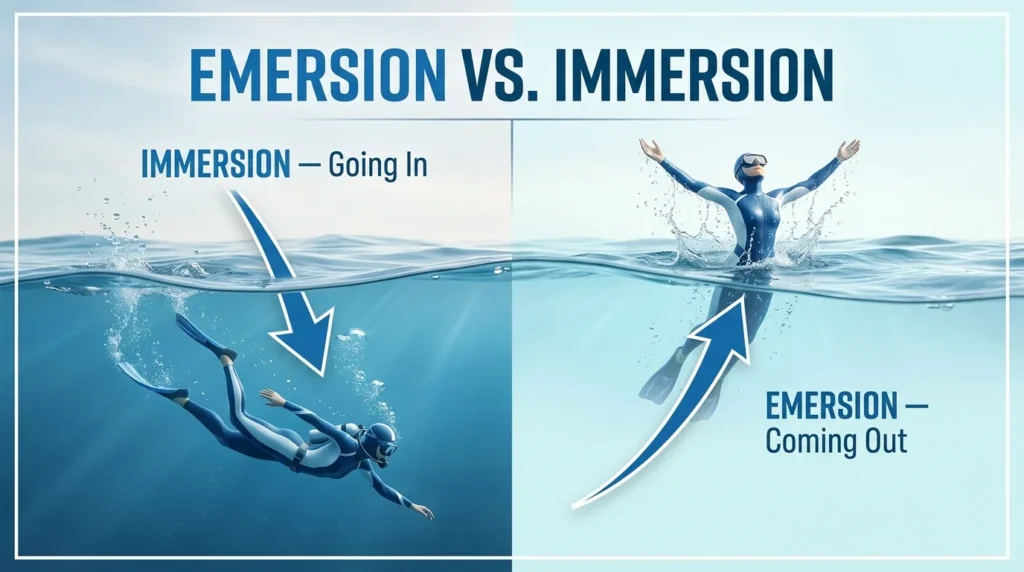

Immersion means being placed beneath a liquid, surrounded by an environment, or deeply involved in an activity. Emersion means emerging or coming out, especially after being submerged or hidden. Immersion is common in everyday, educational, and professional English. Emersion is a valid but much less common word, mainly used in scientific, marine, and astronomical contexts.
What Are Emersion and Immersion?
Emersion and immersion are nouns that look and sound similar. However, they describe different directions and should not be treated as interchangeable spellings.
What Does Immersion Mean?
Immersion is the act or state of being immersed. It can refer to something being completely covered by liquid, but it also has several common figurative meanings.
Someone can experience immersion in:
- Water
- A language
- A culture
- A subject
- A video game
- A virtual environment
- A demanding project
For example, a phone may be damaged by immersion in water. A student may learn Spanish through language immersion. A reader may experience complete immersion in a novel.
The word therefore covers both physical submersion and deep mental or practical involvement. It is also used for language instruction based on extensive exposure to the language being learned.
What Does Emersion Mean?
Emersion is the act of emerging or coming out. It is commonly contrasted with immersion when something moves from a submerged or concealed condition into an exposed or visible one.
For example, marine researchers may study an organism during periods of emersion, when low tide leaves it exposed to air. Astronomers may use emersion for the reappearance of a celestial object after an eclipse or occultation.
Although emersion is a legitimate English word, it is considerably narrower in normal modern usage than immersion. In ordinary writing, emergence, surfacing, or reappearance will often communicate the intended idea more naturally.
Why the Difference Matters
Confusing emersion and immersion can reverse the direction of your meaning.
A language school that advertises an “English emersion programme” appears to be offering a programme about coming out of something. The intended term is almost certainly English immersion programme.
The mistake can also affect professional credibility. A scientist discussing an organism’s exposure to air needs emersion, while an engineer testing a device underwater needs immersion. Choosing the wrong word may make a technically accurate report appear careless.
The distinction matters in:
- Academic papers
- School assignments
- Scientific research
- Workplace reports
- Product instructions
- Marketing copy
- Language-learning content
- Professional emails
The Core Rule
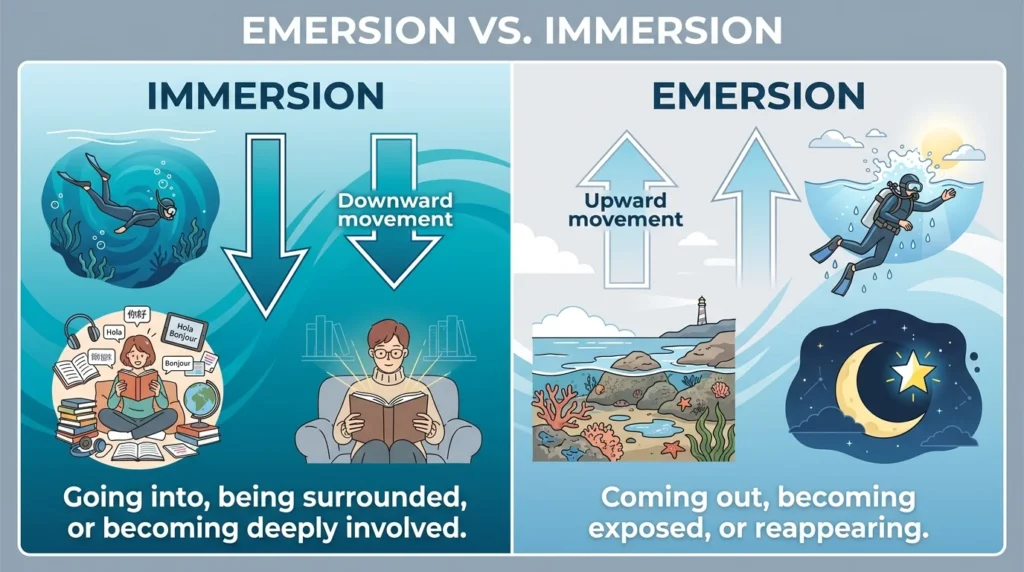
Use immersion when something goes in, stays under, becomes surrounded, or becomes deeply involved. Use emersion when something comes out, reappears, or becomes exposed after being submerged or hidden.
The rule works especially well for physical movement:
Immersion: into or under
Emersion: out of or above
However, the words are not perfect opposites in every figurative situation. Immersion has developed several everyday figurative meanings, while emersion has not developed equally common opposites for all of them.
For example:
- Immersion in a culture is natural.
- Emersion from a culture is grammatically interpretable but usually unnatural.
- Leaving a culture, returning home, or readjusting after cultural immersion would normally be clearer.
How to Use Immersion
Physical Immersion in Liquid
Use immersion when a person or object is placed partly or completely beneath a liquid.
Examples include:
- Immersion in cold water
- Full immersion of the sample
- Water-immersion testing
- Immersion of the fabric in dye
- Baptism by immersion
The word focuses on the state or process of being placed within the liquid.
Deep Involvement in an Activity
Immersion can describe complete concentration or involvement even when no liquid is present.
- Her immersion in the research lasted several months.
- The game creates a strong sense of immersion.
- His immersion in the project left little time for anything else.
In these sentences, immersion means intense mental attention or participation.
Language Immersion
A language immersion environment surrounds learners with the language they are studying. The target language may be used for lessons, activities, communication, or daily life.
Correct phrases include:
- English immersion
- French immersion school
- Language immersion programme
- Total immersion course
- Immersion-based learning
Use immersion, never emersion, for this learning method.
Cultural Immersion
Cultural immersion means participating closely in another community’s customs, routines, language, food, traditions, and everyday life.
Someone living with a host family abroad may experience cultural immersion. Someone simply reading a short article about another country probably has not.
Technology and Entertainment
Immersion is common in discussions of:
- Virtual reality
- Video games
- Films
- Interactive exhibitions
- Simulations
- Digital storytelling
In these contexts, immersion describes the feeling of being mentally present inside an experience.
Established Immersion Compounds
Several familiar compounds use immersion:
- Immersion blender
- Immersion heater
- Immersion course
- Immersion school
- Immersion programme
- Immersion circulator
- Immersion test
Replacing immersion with emersion in these terms would normally be incorrect.
How to Use Emersion
Emersion from Water
Emersion can describe the act of coming out of water or another surrounding liquid.
- The researchers recorded the animal’s emersion from the tank.
- The diver’s controlled emersion ended the experiment.
These sentences are grammatically correct, but the second may sound unnecessarily technical in an everyday conversation. Most people would simply say that the diver surfaced or came out of the water.
Emersion in Marine Biology
Emersion is useful in marine and tidal research. Intertidal organisms may remain underwater during high tide and become exposed to air during low tide.
Researchers may therefore discuss:
- Emersion periods
- Emersion stress
- Emersion tolerance
- Prolonged emersion
- Immersion and emersion cycles
Scientific studies use the term when describing how marine organisms respond to alternating periods underwater and in open air.
Emersion in Astronomy
In astronomy, emersion can mean the reappearance of a celestial object after it has been hidden during an eclipse or occultation.
In this specialised contrast:
- Immersion may describe the object’s disappearance.
- Emersion may describe its reappearance.
For example, observers may record the exact moment of a star’s emersion from behind the Moon.
Emersion as a General Word for Emergence
Because emersion can mean an act of emerging, it may occasionally appear outside science. However, emergence is normally the clearer and more familiar word for a new idea, movement, person, problem, or trend becoming visible.
Compare:
- Awkward: The emersion of a new political movement changed the debate.
- Natural: The emergence of a new political movement changed the debate.
The first sentence may be understandable, but the second is the normal choice.
A Three-Step Choice Test
- Is something going beneath a liquid or becoming surrounded? Use immersion.
- Is someone becoming deeply involved in a subject, language, culture, or experience? Use immersion.
- Is something technically emerging from water, exposure, an eclipse, or concealment? Use emersion. In ordinary conversation, consider emergence or surfacing instead.
Correct Examples of Emersion and Immersion
| Context | Correct Example | Why It Is Correct |
|---|---|---|
| Conversation | I became so immersed in the game that I forgot to check the time. | The speaker became deeply involved. |
| The training includes a week of immersion in our customer-support process. | Immersion describes intensive participation. | |
| School | Students in the French immersion class use French throughout the school day. | Language learning through exposure is immersion. |
| Workplace | Her immersion in the company’s data helped her identify the reporting problem. | She studied and engaged with the data deeply. |
| Social media | The sound design adds another level of immersion to the virtual tour. | The experience feels absorbing and realistic. |
| Academic writing | Prolonged immersion in salt water altered the material’s surface. | The material remained in liquid. |
| Product testing | The watch continued working after complete immersion in the test tank. | The watch was placed underwater. |
| Cultural context | Living with a local family gave him a valuable experience of cultural immersion. | He participated deeply in the culture. |
| Marine biology | The mussels closed their shells during emersion at low tide. | The organisms became exposed to air. |
| Astronomy | The telescope recorded the star’s emersion from behind the Moon. | The star reappeared after concealment. |
| Laboratory writing | Emersion began when the upper surface of the specimen cleared the liquid. | The specimen came out of the liquid. |
| Environmental science | The study compared the animals’ responses during immersion and emersion. | It contrasts underwater and exposed conditions. |
Incorrect vs. Correct Usage
| Incorrect | Correct | Why |
| ❌ The school offers a Spanish emersion programme. | ✅ The school offers a Spanish immersion programme. | Language learning through extensive exposure is called immersion. |
| ❌ The phone survived complete emersion in water. | ✅ The phone survived complete immersion in water. | The phone was under or surrounded by water. |
| ❌ Her emersion in the novel lasted all afternoon. | ✅ Her immersion in the novel lasted all afternoon. | Deep mental involvement is immersion. |
| ❌ We used an emersion blender to make the soup. | ✅ We used an immersion blender to make the soup. | Immersion blender is the established name of the appliance. |
| ❌ The diver’s immersion from the water was carefully timed. | ✅ The diver’s emersion from the water was carefully timed. | The diver was coming out rather than going in. In everyday English, “surfacing” would sound more natural. |
| ❌ The star’s immersion marked its return to view. | ✅ The star’s emersion marked its return to view. | In astronomical usage, emersion refers to reappearance. |
| ❌ The team needs greater emersion in customer research. | ✅ The team needs greater immersion in customer research. | The team needs deeper involvement, not emergence. |
| ❌ The rocks remained underwater throughout the emersion period. | ✅ The rocks remained underwater throughout the immersion period. | Remaining underwater describes immersion. |
| ❌ The emersion of the new trend surprised analysts. | ✅ The emergence of the new trend surprised analysts. | Emergence is the natural word for a trend becoming noticeable. |
| ❌ She immersed from the swimming pool. | ✅ She emerged from the swimming pool. | Immerse is normally transitive: something immerses a person or the person immerses themselves. To come out, use emerge. |
| ❌ The plant leaves were immersion above the water. | ✅ The plant leaves were emersed above the water. | Emersed is a technical adjective for something rising above a liquid’s surface. |
| ❌ He gained fluency through cultural emersion. | ✅ He gained fluency through cultural immersion. | Participation within a language and culture is immersion. |
Why People Confuse Emersion and Immersion
Phonetic Similarity
The two words have nearly identical stressed syllables. The main pronunciation contrast appears at the beginning:
- Emersion: roughly “ee-MUR-zhun”
- Immersion: roughly “ih-MUR-zhun”
Because the strongest stress falls later in both words, the first-vowel difference can be difficult to hear in quick speech.
Spelling Overlap
The words share most of their letters:
- emersion
- immersion
A writer who remembers the sound but not the meaning may choose the wrong initial vowel.
Overgeneralising the Opposite Relationship
Writers sometimes learn that emersion is the opposite of immersion and then apply that rule everywhere.
The relationship works well when discussing water, exposure, or astronomical concealment. It does not mean that emersion is the natural opposite of every figurative use of immersion.
For example, the opposite of immersion in a project may be:
- Disengagement
- Distraction
- Withdrawal
- Limited involvement
- Detachment
Emersion would rarely be the best choice.
Also Read: Protestors or Protesters: Which Spelling Is Correct?
Autocomplete and Spellcheck Limitations
Both emersion and immersion are correctly spelled English words. A basic spellchecker may therefore accept either one, even when the sentence requires the other.
Grammar software may notice some incorrect collocations, but no automated system understands every technical context. Writers still need to check the intended meaning.
Translation Interference
Learners may choose a word because it resembles a term in another language. They may also translate a general word for entering, emerging, exposure, or involvement without checking the normal English collocation.
The safest approach is to learn the complete phrase:
- Language immersion
- Cultural immersion
- Water immersion
- Emersion at low tide
- Astronomical emersion
Confusion with Emergence
Emersion and emergence are related in meaning, but they are not equally natural in every sentence.
Emergence is the general-purpose word. It works for ideas, trends, people, industries, problems, and objects becoming visible.
Emersion is narrower and often technical. Use it when the surrounding context makes emergence from water, concealment, or a scientific state important.
Common Mistakes Checklist
Using Emersion for Language Learning
Mistake: English emersion, French emersion, or emersion school.
Why it happens: The writer hears the word but remembers the first vowel incorrectly.
How to avoid it: Learn language immersion as one complete phrase. A student goes “into” the language environment.
Using Emersion for Deep Concentration
Mistake: His emersion in the project impressed the manager.
Why it happens: Both words appear to describe a change in mental state.
How to avoid it: Deep involvement is always immersion in normal modern English.
Using Emersion as a Stylish Replacement for Emergence
Mistake: The emersion of artificial intelligence has changed the industry.
Why it happens: Emersion sounds more unusual or sophisticated.
How to avoid it: Prefer emergence for something becoming known, important, visible, or influential.
Treating the Words as Opposites in Every Context
Mistake: Her emersion from the book happened when the phone rang.
Why it happens: The writer applies the physical in-and-out contrast to an everyday figurative situation.
How to avoid it: Say she lost concentration, stopped reading, or was pulled out of the story.
Using the Wrong Part of Speech
Mistake: The swimmer emersioned from the water.
Why it happens: The writer assumes every noun has a matching common verb.
How to avoid it: Use emerged, surfaced, or came out. Use immerse when someone or something goes in.
Forcing Emersion into Casual Conversation
Mistake: We watched his emersion from the pool.
Why it happens: The sentence is grammatically possible, so the writer assumes it must sound natural.
How to avoid it: In casual English, say he climbed out, he came up, or he surfaced.
Confusing Emersed and Immersed
Mistake: The leaves were immersed above the waterline.
Why it happens: Immersed is much more familiar than emersed.
How to avoid it: In technical botanical language, emersed means rising or standing above the water’s surface.
Also Read: Unenroll vs Disenroll: Meaning and Key Difference
Emersion vs. Immersion in Real English
Grammatically Correct English
“The diver’s emersion was recorded at 10:42” is grammatically correct because emersion is a noun and the sentence describes someone coming out of a surrounding medium. It would fit a scientific report, controlled experiment, or technical diving record. Likewise, “the organism’s emersion period lasted four hours” is accurate when researchers are discussing exposure to air after water levels fall.
Grammatically Possible but Unnatural English
“Everyone celebrated the swimmer’s emersion from the pool” is structurally correct, but it sounds unusually technical for a normal conversation. Most speakers would say that the swimmer surfaced, came up, or climbed out. “Her emersion from obscurity” is also understandable, but “her emergence from obscurity” is more idiomatic because emergence is the established general word for becoming visible or known.
Natural Everyday English
Immersion appears naturally in everyday phrases such as “immersion in a book,” “cultural immersion,” “language immersion,” and “the game’s sense of immersion.” Emersion is rarely needed in casual speech. When something comes out of water, people normally use “surface,” “come up,” “climb out,” or “emerge.” Save emersion for contexts where its technical precision adds genuine value.
Also Read: Emaculate vs Immaculate: Correct Spelling & Meaning
American vs. British English
There is no important American–British difference in the spelling or core meanings of emersion and immersion.
Pronunciation guides show a small regional difference in the final sound. British pronunciations commonly use a sound similar to the sh in ship, while American pronunciations may use the sound in vision. The more useful distinction between the two words is their opening vowel: emersion begins with an “ee” sound, while immersion begins with the shorter vowel in sit.
Formal vs. Informal Usage
Formal and Technical Usage
Emersion belongs mainly in formal or technical writing when it identifies a specific process.
Suitable contexts include:
- Marine biology
- Tidal ecology
- Environmental research
- Astronomy
- Controlled diving
- Laboratory experiments
Immersion is also common in formal writing, particularly in science, education, engineering, and psychology.
Informal Usage
Immersion works naturally in informal English:
- I was completely immersed in the film.
- The game’s immersion is incredible.
- She learned quickly through immersion.
Emersion is uncommon in informal conversation. A simpler verb will usually sound better:
- The diver surfaced.
- The swimmer came out.
- The rocks appeared as the tide fell.
- The Moon came out of the shadow.
Emersion vs. Immersion Comparison Table
| Feature | Emersion | Immersion |
| Part of speech | Noun | Noun |
| Core meaning | Emerging or coming out | Going in, being submerged, or becoming deeply involved |
| Direction | Outward or upward | Inward or downward |
| Physical use | Coming out of a liquid or exposed state | Being placed under or surrounded by liquid |
| Figurative use | Possible but uncommon | Very common |
| Everyday frequency | Uncommon | Common |
| Technical fields | Marine biology, ecology, astronomy, diving | Engineering, education, language learning, technology, psychology |
| Language learning | Incorrect in normal usage | Correct: language immersion |
| Cultural participation | Usually unnatural | Correct: cultural immersion |
| Related common verb | Emerge | Immerse |
| Related adjective | Emersed, mainly technical | Immersed or immersive |
| Natural example | The organism experienced emersion at low tide. | The student learned through language immersion. |
| Easier everyday alternative | Emergence, surfacing, reappearance | Deep involvement, absorption, submersion |
Memory Trick
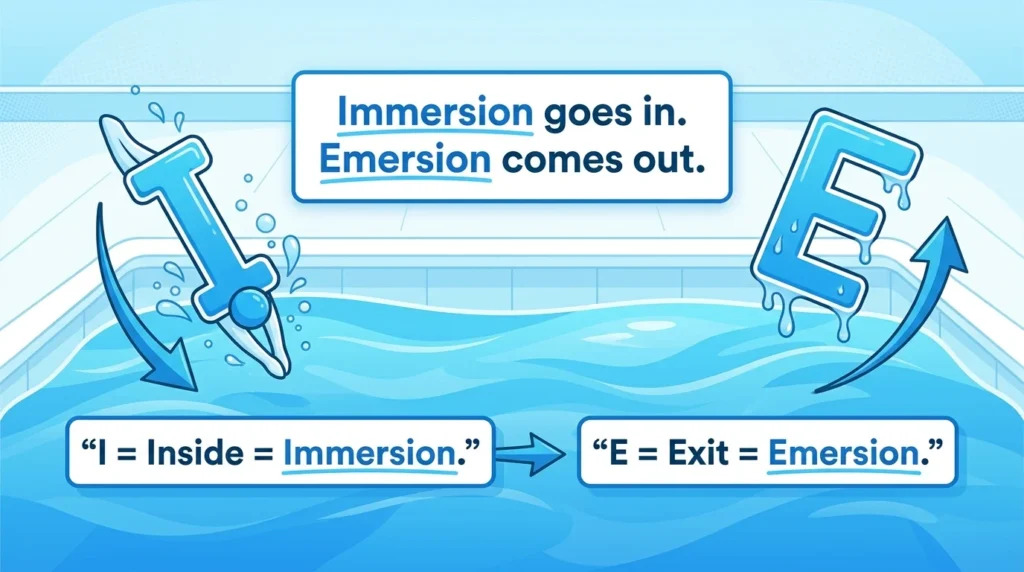
Picture the two first letters moving through water:
E rises to Exit: Emersion comes out.
I dives Inside: Immersion goes in.
You can also imagine an E lifting out of a swimming pool while an I sinks into it.
Real-Life Situations
Job Interview
Correct: “The internship gave me full immersion in the company’s research process.”
The speaker means that they participated deeply in the process.
Business Meeting
Correct: “Before changing the strategy, we need greater immersion in the customer data.”
The team needs deeper understanding and involvement.
Professional Email
Correct: “The device must continue operating after thirty minutes of complete water immersion.”
The device will be tested while underwater.
Text Message
Correct: “Sorry I missed your message. I was completely immersed in the film.”
Immersed sounds natural when someone is deeply absorbed.
Science Examination
Correct: “Emersion occurs when an organism becomes exposed after the surrounding water recedes.”
The sentence uses the technical meaning accurately.
Astronomy Lesson
Correct: “The observers timed the star’s immersion and later emersion.”
The terms describe disappearance and reappearance during an occultation.
Expert Tips
Learn Collocations, Not Isolated Words
A collocation is a group of words that commonly appear together. Learning complete phrases will prevent many errors.
Memorise:
- Total immersion
- Language immersion
- Cultural immersion
- Immersion in water
- Immersion in a subject
- Period of emersion
- Emersion at low tide
Test the Direction
Ask whether the sentence points inward or outward.
- Into, beneath, surrounded, absorbed: immersion
- Out, exposed, reappearing, surfacing: emersion
Check Whether the Context Is Technical
Before using emersion, ask whether your reader is likely to recognise the term.
In a scientific paper, emersion may be exact. In an advertisement, blog post, or conversation, emergence or surfacing may be clearer.
Do Not Replace Emergence Automatically
Emersion may share part of its meaning with emergence, but it is not a more advanced replacement.
Use emergence for:
- The emergence of a problem
- The emergence of a leader
- The emergence of a new market
- The emergence of a pattern
- The emergence of new evidence
Use the Correct Verb
The ordinary verb related to emersion is emerge.
- The diver emerged from the water.
- The Moon emerged from the shadow.
The verb related to immersion is immerse.
- Immerse the fabric in warm water.
- She immersed herself in the language.
Be Careful with Automated Corrections
Spellcheck may not flag the wrong choice because both words exist. Read the whole sentence and identify its direction and context.
Conclusion
Immersion and emersion describe different directions. Immersion means going into a liquid, being surrounded by an environment, or becoming deeply involved in an activity. It is the correct word in phrases such as language immersion, cultural immersion, water immersion, and immersion blender. Emersion means emerging or becoming exposed after being submerged or concealed.
It appears mainly in technical discussions of marine organisms, tidal conditions, diving, and astronomical events. Although emersion is a valid word, emergence or surfacing often sounds more natural in everyday English. Remember the difference through the first letters: I means inside, so immersion goes in; E means exit or emerge, so emersion comes out. You can also visit Word Differences for the more words.
Frequently Asked Questions
Is emersion a real English word?
Yes. Emersion is a recognised noun meaning an act of emerging. However, it is much less common than immersion and is most useful in specialised contexts involving water, exposure, astronomy, or scientific observation.
Is emersion the opposite of immersion?
They can be opposites in physical and technical contexts. Immersion means going beneath or into a medium, while emersion means coming out of it. They are not natural opposites in every figurative context.
Is it language emersion or language immersion?
Language immersion is correct. It describes learning a language through extensive exposure and regular use. Language emersion is usually a spelling or word-choice mistake.
Is cultural emersion correct?
Use cultural immersion when someone participates deeply in another culture. Cultural emersion might theoretically suggest coming out of a culture, but it is not a standard everyday expression for that experience.
What does emersion mean in biology?
In biological and ecological writing, emersion usually refers to an aquatic organism becoming exposed to air. This may happen when the tide falls, water drains away, or the organism leaves the water.
What does emersion mean in astronomy?
Emersion can describe the reappearance of a star, planet, moon, or other celestial object after an eclipse or occultation. It may be contrasted with immersion, which describes the object’s disappearance.
What is the difference between emersion and emergence?
Emersion is a narrower word associated with emerging from water, concealment, or a defined scientific state. Emergence is the normal general word for something becoming visible, known, important, or established.
Is it an emersion blender or an immersion blender?
The correct term is immersion blender. Its blade section is immersed directly in the food or liquid being blended.
Can emersion describe personal growth?
The sentence may be understandable, but it will often sound forced. Use emergence, development, transformation, or growth unless a specific metaphor of coming out of a surrounding state is essential.
How are emersion and immersion pronounced?
Emersion begins with an “ee” sound: roughly ee-MUR-zhun. Immersion begins with the shorter vowel heard in sit: roughly ih-MUR-zhun. The remainder of the words sounds very similar.
What is the adjective related to emersion?
Emersed is a technical adjective meaning that something stands out of or rises above a surface, especially the surface of water. Immersed means placed beneath something or deeply involved.
Should I use emersion in everyday writing?
Use it only when its exact technical meaning is useful. For general readers, words such as emergence, surfacing, reappearance, or coming out will often be clearer.
Mini Quiz
| No. | Question | Answer | Explanation |
| 1 | Fill in the blank: The school offers a French _____ programme. | immersion | Learners are surrounded by and actively use French. |
| 2 | Multiple choice: Which word describes a phone being completely covered by water? A) Emersion B) Immersion | B) Immersion | Immersion describes being placed under or surrounded by liquid. |
| 3 | Correct the sentence: “Her emersion in the research lasted six months.” | Her immersion in the research lasted six months. | Deep involvement in a subject is immersion. |
| 4 | Fill in the blank: Researchers monitored the crab during four hours of _____. | emersion | The crab is being studied while exposed outside the water. |
| 5 | Multiple choice: Which phrase is correct? A) Cultural emersion B) Cultural immersion | B) Cultural immersion | Cultural immersion means close participation in another culture. |
| 6 | Correct the sentence: “The emersion blender is stored beside the cooker.” | The immersion blender is stored beside the cooker. | Immersion blender is the established appliance name. |
| 7 | Fill in the blank: The star’s _____ from behind the Moon was visible through the telescope. | emersion | The star reappeared after being concealed. |
| 8 | Multiple choice: Which word is normally better for a new trend becoming noticeable? A) Emersion B) Emergence | B) Emergence | Emergence is the natural general-purpose word for a trend appearing. |
| 9 | Correct the sentence: “The diver immersed from the water at noon.” | The diver emerged from the water at noon. | Emerge is the verb for coming out. Immerse means putting something in. |
| 10 | Fill in the blank: The virtual-reality headset creates a strong sense of _____. | immersion | Immersion describes the feeling of being deeply present inside an experience. |