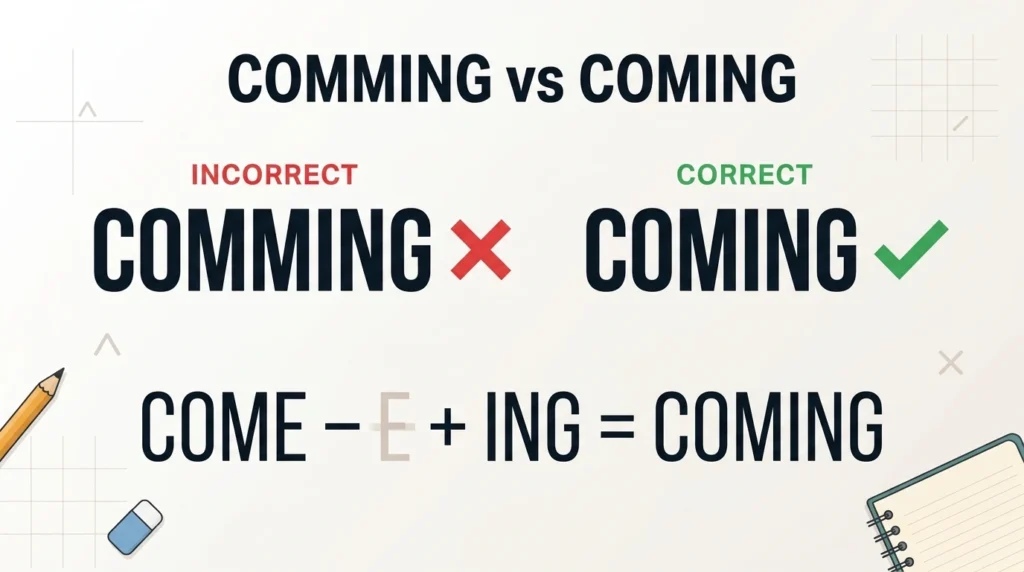

Coming is the correct spelling in modern English. Comming is a misspelling when you mean the -ing form of come. The spelling follows a simple rule: when a verb ends in a silent e, you normally remove that e before adding -ing. Therefore, come + -ing = coming, not comming.
Correct: She is coming home tonight.
Incorrect: She is comming home tonight.
What Is Coming?
Coming is formed from the verb come, which commonly means to move toward someone or something, arrive somewhere, or approach in time.
In grammar, coming often functions as the present participle of come. A present participle is the -ing form of a verb. It can help form continuous verb tenses.
For example:
The train is coming now.
Here, is coming describes an action that is happening or developing.
However, coming is not limited to continuous verb forms. It can also function as an adjective or noun depending on the sentence.
As an adjective:
We discussed our plans for the coming year.
Here, coming means approaching or about to happen.
As a noun:
The coming of spring changes the landscape.
Here, coming refers to an arrival or occurrence.
Comming, with two m’s, should not be used for any of these meanings in modern standard English.
Why Correct Spelling Matters
The difference between comming vs coming is only one letter, but that extra letter can affect how readers judge your writing.
A misspelling may be harmless in a hurried private text. However, it becomes more noticeable in situations where accuracy matters.
You should pay particular attention to the spelling in:
- Job applications and cover letters
- Professional emails
- School assignments and examinations
- Business websites and landing pages
- Advertisements and promotional graphics
- Social media posts published by a brand
- Reports, proposals, and presentations
Consider a business banner that says:
New collection comming soon.
Readers will probably understand the message. However, the spelling mistake can make a professionally designed advertisement appear poorly proofread.
The correct version is:
New collection coming soon.
Correct spelling supports clarity, credibility, and polished communication.
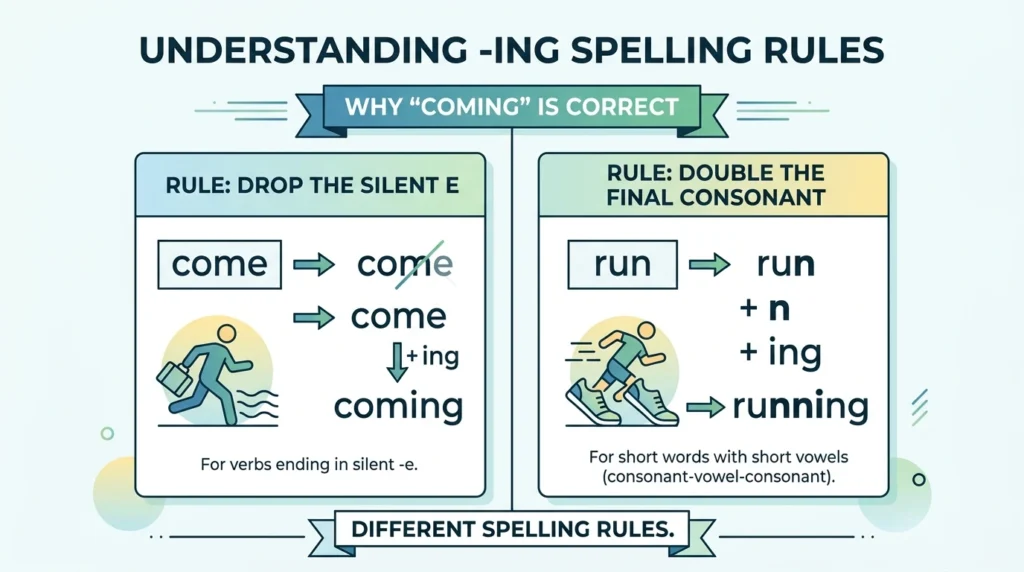
The Core Rule: Why Coming Has One M
The simplest rule is:
RULE BOX: When come takes the suffix -ing, drop the final silent e and add -ing:
come → coming
The important point is that you do not double the m.
This becomes clearer when you compare come with other verbs ending in silent e:
| Base Verb | Step | Correct -ing Form |
|---|---|---|
| come | remove e + ing | coming |
| make | remove e + ing | making |
| take | remove e + ing | taking |
| write | remove e + ing | writing |
| hope | remove e + ing | hoping |
| move | remove e + ing | moving |
A common source of confusion is the consonant-doubling rule used in words such as run → running and sit → sitting.
The crucial difference is that come does not end in m in its base spelling. It ends in silent e.
You should therefore apply the rule to the actual base word come, not remove the e and then incorrectly treat com as a new base word.
Compare:
run → running
The base word run ends in a single consonant after a single vowel.
come → coming
The base word come ends in silent e, so the normal operation is to remove that e before adding -ing.
That distinction explains why running needs two n’s while coming keeps only one m.
Read More: Trauma vs Trama Difference: Which Spelling Is Correct?
How to Use Coming Correctly
The word coming has several useful grammatical roles. Learning these roles prevents you from thinking of it only as part of phrases such as coming soon.
Coming in Continuous Verb Forms
Use coming with forms of be when describing movement, arrival, development, or an arranged future event.
Examples:
I am coming home now.
She is coming to the conference tomorrow.
The storm was coming closer.
More customers are coming through the website.
The pattern is:
am/is/are/was/were + coming
Coming as an Adjective
Coming can describe a noun when something is approaching or expected in the near future.
Examples:
We expect stronger sales in the coming months.
Students will receive the schedule for the coming semester.
The coming election will attract considerable attention.
In these examples, coming has a meaning similar to approaching or next.
Coming as a Noun
Coming can also name an arrival, appearance, or occurrence.
Examples include:
The coming of winter changed their plans.
They prepared for the coming of the guests.
This construction is grammatically correct, although it can sound more formal or literary than everyday alternatives.
Coming in Common Expressions
You will also see coming in established phrases such as:
- coming soon
- coming home
- coming back
- coming up
- coming along
- coming together
- coming to an end
- coming to terms with
- coming of age
- comings and goings
The spelling remains coming in each case.
Correct Examples of Coming
The following examples show how coming works across everyday, academic, professional, and digital communication.
- Conversation: Are you coming with us after dinner?
- Text message: I’m coming now, so I’ll be there in about ten minutes.
- Email: Thank you for coming to yesterday’s project meeting.
- Workplace: Our regional manager is coming to the office on Thursday.
- School: The teacher said the science test is coming up next week.
- Academic writing: The coming decade may produce significant changes in renewable-energy technology.
- Social media: Something exciting is coming soon.
- Customer service: Your replacement order should be coming through our delivery network shortly.
- Planning: We need to prepare the budget for the coming financial year.
- Travel: The next bus is coming around the corner.
- Business: Several new opportunities are coming from international clients.
- Personal conversation: Thanks for coming over to help me yesterday.
Every example uses coming with one m.
Comming vs Coming: Incorrect vs Correct Examples
| ❌ Incorrect | ✅ Correct | Why |
|---|---|---|
| I am comming home now. | I am coming home now. | Come drops its silent e before -ing. The m is not doubled. |
| Are you comming tonight? | Are you coming tonight? | The present participle of come is coming. |
| The train is comming. | The train is coming. | Adding another m creates a modern spelling error. |
| New products are comming soon. | New products are coming soon. | The standard phrase is coming soon. |
| She is comming to work tomorrow. | She is coming to work tomorrow. | The base verb is come, so the correct form is coming. |
| Winter is comming early this year. | Winter is coming early this year. | Coming can describe something approaching in time. |
| Thanks for comming to the meeting. | Thanks for coming to the meeting. | After a preposition such as for, coming can function as an -ing verb form. |
| The deadline is comming up quickly. | The deadline is coming up quickly. | The phrasal expression is coming up. |
| More changes are comming. | More changes are coming. | The spelling does not change according to the subject. |
| I knew this was comming. | I knew this was coming. | Was coming uses the past continuous construction. |
| The comming year will be challenging. | The coming year will be challenging. | As an adjective meaning approaching, the correct spelling remains coming. |
| We celebrated the comming of spring. | We celebrated the coming of spring. | As a noun referring to an arrival, it is still spelled coming. |
Why People Write Comming Instead of Coming
Several patterns can lead writers to type comming even when they know the verb come.
Confusion With Consonant Doubling
English does sometimes double a final consonant before -ing.
For example:
run → running
sit → sitting
stop → stopping
swim → swimming
A learner may notice this pattern and assume:
come → comming
However, the comparison does not work because the base word come ends in silent e.
Read More: Seal vs Seel: Which Is Correct and What Is the Difference?
Overgeneralizing a Familiar Rule
Once learners discover rules such as run → running, they sometimes apply them too widely.
English spelling uses several different patterns for adding -ing. A rule that works for one group of verbs does not automatically work for another.
The Spoken Word Does Not Reveal the Difference
Coming and the misspelling comming would normally be pronounced the same way. You cannot reliably hear whether a writer used one m or two.
That makes this a spelling problem rather than a pronunciation distinction.
Visual Similarity to Words With Double Consonants
Common forms such as running, swimming, beginning, and stopping make doubled consonants look familiar before -ing.
That visual pattern can influence spelling even when it does not apply to come.
Fast Typing
A repeated keyboard press can create comming accidentally. Because the intended word remains easy to recognize, the writer may read past the error during proofreading.
Autocorrect and Spellcheck Are Not Perfect
A good spellchecker will normally recognize comming as suspicious. However, writers should not depend entirely on automated correction.
Custom dictionaries, unusual formatting, search boxes, graphic-design software, filenames, and some publishing tools may not provide the same level of spelling assistance.
Translation Interference
English learners sometimes transfer spelling expectations from another language or try to build the word mainly from its pronunciation.
The safer method is to remember the written base form:
come → coming
Common Mistakes Checklist
Before publishing your writing, check for these problems:
- Writing “comming soon.” Use coming soon in announcements, signs, advertisements, videos, and launch pages.
- Treating come like run. Run ends in a consonant. Come ends in silent e, so the spelling process is different.
- Writing “comeing.” You normally remove the silent e before adding -ing, giving coming.
- Using two m’s because the vowel sounds short. Do not rebuild the spelling from pronunciation. Start with the written base word come.
- Assuming informal writing allows “comming.” Casual style can change vocabulary and punctuation, but it does not make the modern misspelling standard.
- Trusting spellcheck without proofreading. Always inspect headings, banners, buttons, captions, and graphics manually.
- Changing the spelling when coming acts as an adjective. It is still coming in phrases such as the coming year.
- Changing the spelling when coming acts as a noun. Write the coming of winter, not the comming of winter.
Comming vs Coming in Real English
Correct spelling is only part of good English. A sentence can contain coming correctly yet still sound unusually stiff for the situation.
Grammatically Correct English
Coming works naturally as a verb form, adjective, or noun. Sentences such as “She is coming tomorrow,” “the coming months,” and “the coming of winter” are grammatically correct. The surrounding sentence determines its function. The spelling itself does not change. In modern standard writing, use coming with one m whenever you need the relevant form of come.
Grammatically Possible but Unnatural English
Some constructions are grammatical but unnecessarily formal in everyday conversation. “My coming to your house will occur at seven” can be understood and its use of coming is correct, but most speakers would not normally phrase a casual plan that way. “I’m coming to your house at seven” or “I’ll come over at seven” sounds simpler and more natural in ordinary conversation.
Natural Everyday English
In daily speech and informal messages, coming often appears in short, direct expressions: “I’m coming,” “Are you coming?”, “She’s coming over,” “It’s coming soon,” or “What’s coming next?” These forms sound natural because they match common conversational patterns. You do not need a more complicated construction simply to sound fluent. Correct everyday English is often straightforward and economical.
Read More: Shute vs Chute: Which Spelling Is Correct?
Comming vs Coming Comparison Table
| Feature | Coming | Comming |
|---|---|---|
| Correct in modern standard English? | Yes | No |
| Number of m’s | One | Two |
| Base verb | come | — |
| Formation | come − e + ing | Incorrect modern formation |
| Can function as a verb form? | Yes | No |
| Can function as an adjective? | Yes | No |
| Can function as a noun? | Yes | No in modern standard usage |
| Correct in “___ soon” | coming soon | comming soon ❌ |
| Correct in professional writing | Yes | No |
| Correct in casual messages | Yes | Not as standard spelling |
| Used in American English | Yes | Not as the standard form |
| Used in British English | Yes | Not as the standard form |
The fastest answer to comming vs coming is therefore simple: choose coming every time in modern standard English.
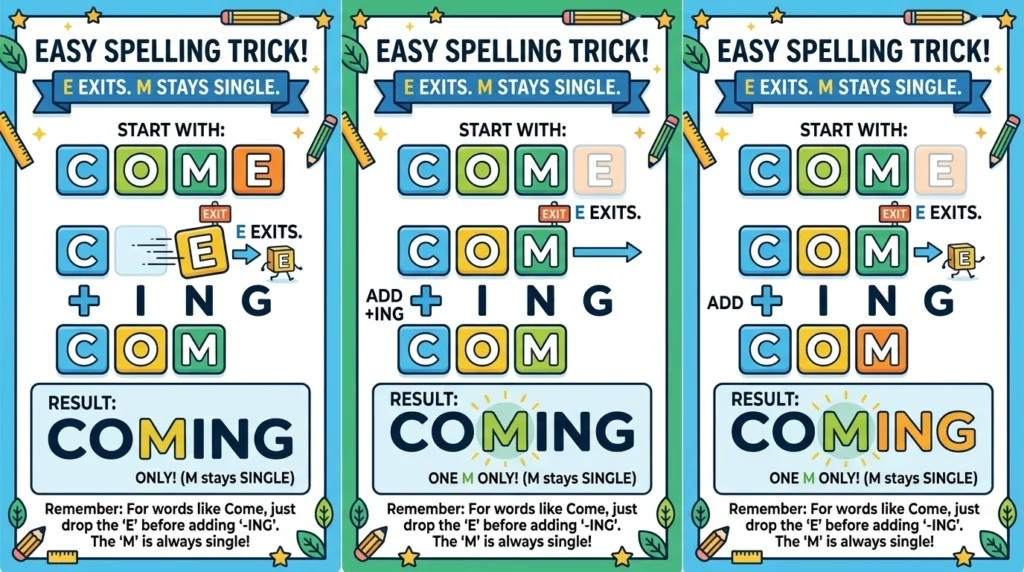
Memory Trick
Use this mnemonic:
“E exits. M stays single.”
Start with:
COME
When -ing arrives, the silent E exits:
COM + ING
Then join the parts:
COMING
The M stays single.
So remember:
E exits, M stays: COME → COMING.
This trick is safer than trying to decide the spelling only from pronunciation.
Real-Life Situations
1. Job Interview
You want to confirm attendance.
Correct:
Thank you for the invitation. I will be coming to the interview on Monday.
A simpler version is often even more natural:
Thank you for the invitation. I will attend the interview on Monday.
Never write comming in professional correspondence.
2. Team Meeting
Your manager asks whether a colleague will attend.
Yes, Daniel is coming to the meeting at 2 p.m.
Here, is coming describes an arranged future event.
3. Professional Email
You want to discuss an approaching deadline.
With the deadline coming up next Friday, please send your final revisions by Wednesday.
Coming up naturally means approaching.
4. Text Message
A friend asks where you are.
I’m coming now. See you in ten minutes.
This is natural conversational English.
5. Exam
The question says:
Complete the sentence: “The bus is ___ around the corner.”
The correct answer is coming.
Writing comming would normally count as a spelling error even though the intended meaning is obvious.
Expert Tips for Remembering Coming
Learn the Base Word Before the Suffix
Do not begin with what the word sounds like.
Begin with:
come
Then ask what happens when -ing is added.
Because the word ends in silent e, remove that e:
come → coming
Compare Similar Silent-E Verbs
Study related patterns together:
| Base | -ing Form |
|---|---|
| make | making |
| take | taking |
| write | writing |
| hope | hoping |
| move | moving |
| come | coming |
Learning a pattern is more useful than memorizing one isolated word.
Contrast It With True Doubling Examples
Now compare:
| Base | -ing Form |
|---|---|
| run | running |
| sit | sitting |
| stop | stopping |
| swim | swimming |
This contrast teaches an important lesson: not every verb adds -ing in the same way.
Proofread Large Display Text Separately
Spelling mistakes are especially embarrassing in:
COMING SOON
banners, thumbnails, advertisements, posters, product launches, headings, and video titles.
Large text may contain fewer words, but each mistake becomes more visible.
Search for the Wrong Version During Editing
If you regularly make this error, use your editor’s Find function and search for:
comming
This can catch accidental double-m spellings throughout a long document.
Frequently Asked Questions About Comming vs Coming
Is “comming soon” correct?
No. The correct phrase is coming soon.
For example:
Our new website is coming soon.
The extra m in comming soon is a spelling error in modern standard English.
Read More: Icycle vs Icicle Differences: Which Spelling Is Correct?
Why is it coming instead of comming if we write running?
The base words follow different spelling patterns.
Run already ends in a single consonant after a vowel, so its final consonant doubles:
run → running
Come ends in silent e, so the normal process is:
come → coming
Do not remove the e first and then treat com as though it were the original base word.
Is comming a real word?
For modern standard English, treat comming as incorrect when you mean coming.
You may occasionally encounter comming in historical texts because older English spelling was less standardized and obsolete spellings existed. That historical fact does not make comming acceptable in ordinary modern writing.
How do you spell coming?
Spell it:
C-O-M-I-N-G
There is one m, followed by ing.
What does coming mean?
Its meaning depends on context. It can describe movement toward someone or somewhere, an approaching event, or an arrival.
Examples:
She is coming home.
The coming months will be busy.
They celebrated the coming of spring.
Is coming always a verb?
No. Coming can serve several grammatical functions.
It can appear as a verb form:
He is coming.
It can behave as an adjective:
the coming year
It can also function as a noun:
the coming of winter
Is “I am coming” grammatically correct?
Yes.
I am coming uses the present continuous construction am + coming.
Depending on the context, it can describe movement happening now or a future arrangement.
I’m coming downstairs now.
I’m coming to the conference tomorrow.
Can coming refer to the future?
Yes.
English frequently uses coming for something approaching in time.
Examples include:
the coming week
the coming months
changes coming next year
It also appears in future arrangements such as:
She’s coming on Friday.
Is the spelling different in American and British English?
No. Standard American and British English both use coming.
There is no regional reason to write comming in ordinary modern English.
Which is better: coming or upcoming?
Both can be correct, but they do not fit every sentence in exactly the same way.
You can say:
the coming conference
or:
the upcoming conference
However:
I’m coming to the conference.
You cannot replace coming with upcoming there because coming is part of the verb phrase.
Why might spellcheck fail to fix comming?
Spellchecking behavior varies between programs and settings. Some applications have limited dictionaries while others may ignore words inside graphics, filenames, code, usernames, or customized dictionaries.
Spellcheck is useful, but proofreading remains important.
Mini Quiz: Comming or Coming?
| # | Question | Answer | Explanation |
|---|---|---|---|
| 1 | Choose the correct spelling: comming / coming | coming | Come drops its final silent e before -ing. |
| 2 | Fill in the blank: “Are you ___ to dinner?” | coming | The present participle of come is coming. |
| 3 | Correct the sentence: “The new store is comming soon.” | The new store is coming soon. | Comming contains an unnecessary second m. |
| 4 | Which is correct? A) comeing B) coming C) comming | B) coming | Drop the silent e, then add -ing. |
| 5 | Fill in the blank: “Winter is ___ earlier than expected.” | coming | The sentence describes something approaching. |
| 6 | Correct the sentence: “Thanks for comming yesterday.” | Thanks for coming yesterday. | The correct -ing form is coming. |
| 7 | True or false: Run → running means come → comming. | False | Run and come follow different spelling patterns. |
| 8 | Which sentence is correct? A) She’s comming home. B) She’s coming home. | B | Standard modern English uses coming with one m. |
| 9 | Fill in the blank: “We are planning for the ___ year.” | coming | Here, coming works as an adjective meaning approaching. |
| 10 | Correct the spelling: “The comming of spring brought warmer weather.” | The coming of spring brought warmer weather. | Here, coming functions as a noun, but its spelling remains unchanged. |
Quick Summary
Coming is the correct modern spelling while comming is a misspelling when you mean the -ing form of come. The base verb come ends in silent e, so that e is normally removed before -ing is added: come → coming. Do not apply the consonant-doubling pattern from words such as run → running because come belongs to a different spelling pattern. Coming can function in continuous verb forms, as an adjective in phrases such as the coming year, and as a noun in expressions such as the coming of spring. For an easy memory trick, remember: “E exits, M stays single.” Always proofread coming soon signs, emails, assignments, advertisements, and professional content carefully.