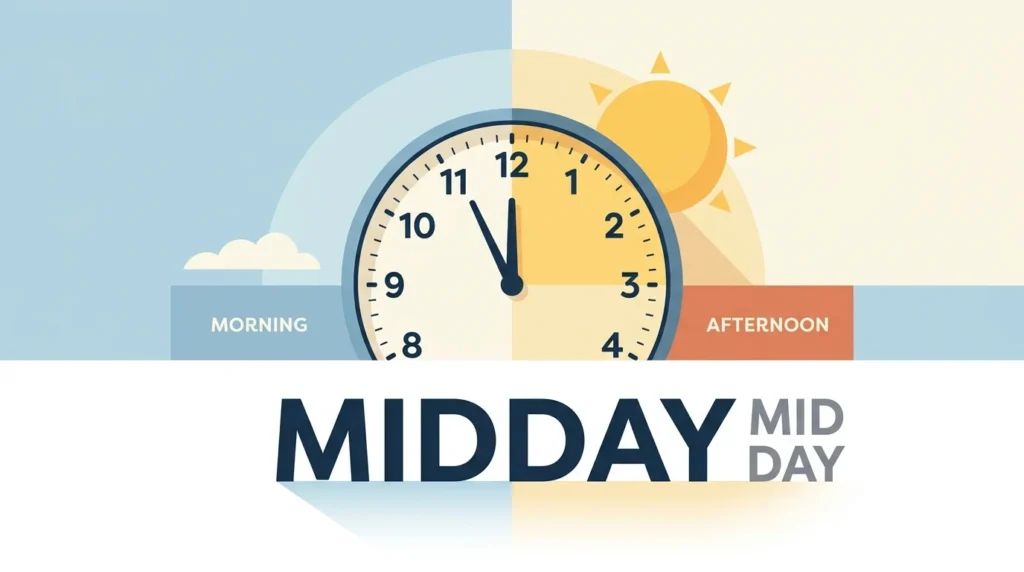

Midday is the standard modern spelling when you mean the middle of the day or around 12 o’clock. Write it as one word: midday. The form mid day is not the standard spelling for this meaning. You may also encounter mid-day in older or stylistic writing, but midday is the safest choice for modern English.
What Is Midday?
Midday is a noun meaning the middle of the day, especially around 12 o’clock. It can refer specifically to noon or, depending on context, the broader period around noon.
For example:
- The train arrives at midday.
- The temperature is highest around midday.
- We scheduled the meeting for midday.
Dictionaries also recognize midday as a modifier before another noun:
- midday heat
- midday sun
- midday meal
- midday prayer
- midday meeting
The important point is that midday is normally written as one word. Major modern dictionaries list it as a single word and define it as the middle of the day or noon.
Why It Matters
Spelling midday correctly may seem like a tiny detail, but small compound-word mistakes can make otherwise polished writing look careless.
The difference matters particularly when you are writing:
- School or university assignments
- Business emails
- Reports and proposals
- Website content
- Professional correspondence
- News or informational articles
- Social media posts
- Exams
- Formal documents
Compare these:
The interview will begin at midday.
The interview will begin at mid day.
The first sentence uses the standard modern spelling. The second may be understood, but mid day is not the normal spelling when you mean noon or the middle of the day.
The Core Rule
Use midday as one word when you mean the middle of the day or the time around noon.
The simplest rule is:
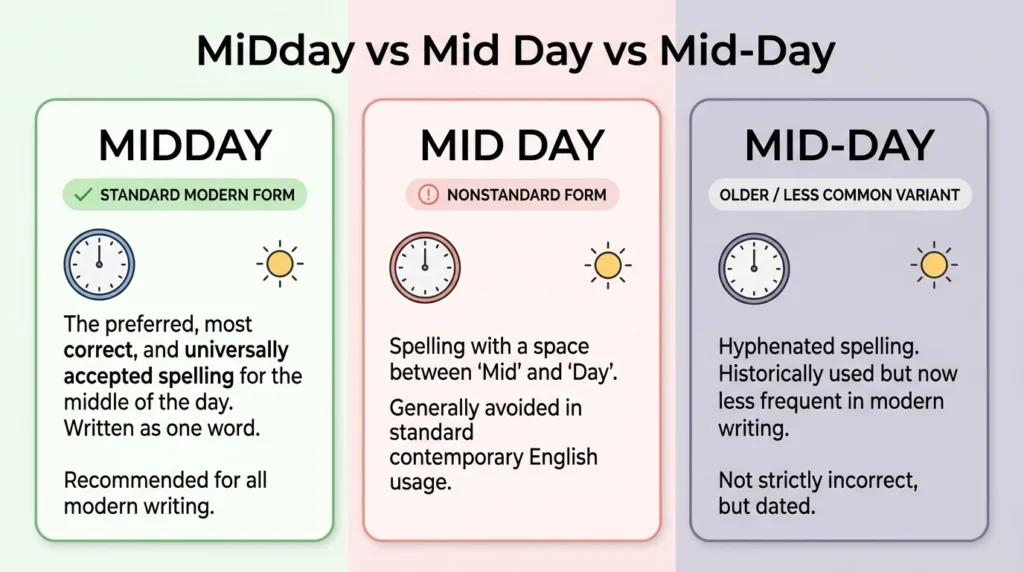
- midday = standard modern form
- mid day = not the standard form for this meaning
- mid-day = an older or less common variant that may still appear in some contexts
Modern dictionaries consistently list midday as the headword.
Why Is It One Word?
Midday is a closed compound word.
A compound word is formed when two words or word elements combine to create a single lexical unit. English contains many compounds that have developed into one-word forms.
Examples include:
- midnight
- midday
- afternoon
- weekend
- sunlight
- classroom
In midday, mid- contributes the idea of being in the middle, while day identifies the period involved.
The result is not normally treated as two independent words. It is the established noun midday.
How to Use Midday
Use “midday” as a noun
When midday names the time or period itself, use it as a noun.
Examples:
- We arrived at midday.
- The store closes at midday.
- She usually takes her break around midday.
- The storm reached the city before midday.
Common patterns include:
- at midday
- around midday
- by midday
- before midday
- after midday
- until midday
- from midday
Use “midday” before another noun
Midday can also describe something associated with the middle of the day.
Examples:
- the midday sun
- a midday meal
- a midday break
- midday traffic
- midday temperatures
- a midday meeting
In these examples, midday works as a modifier.
“At midday” is correct
One of the most common questions is whether at midday is grammatically correct.
Yes.
The meeting begins at midday.
The buses become less frequent at midday.
The preposition at is appropriate when referring to a particular point in time. Similar expressions include:
- at noon
- at midnight
- at dawn
- at sunset
“Around midday” is also correct
Around midday is useful when you do not mean exactly 12:00.
We should arrive around midday.
This could mean approximately noon rather than precisely 12:00.
That distinction matters because midday can refer not only to the exact point of noon but also to the period around the middle of the day. Dictionary definitions explicitly recognize both uses.
Correct Examples
Here are examples from different types of real-world writing.
Conversation
- Are you free around midday?
- I’ll probably finish work by midday.
- Could you send me the revised document before midday?
- Our team will meet at midday to discuss the proposal.
School
- The students returned to class after their midday break.
- The temperature was recorded at midday.
Workplace
- Please submit your expense report by midday Friday.
- The manager scheduled a midday briefing for the sales team.
Social Media
- The park looks completely different in the midday sun.
- We’re leaving around midday and heading toward the coast.
Academic Writing
- Measurements were collected at midday on each observation day.
- The researchers recorded atmospheric conditions around midday.
Everyday English
- I usually eat lunch at midday.
- By midday, the streets were already crowded.
News and Information
- The storm is expected to weaken by midday.
- Temperatures could reach their highest levels around midday.
Read More: Steer vs Stear: Which Spelling Is Correct?
Incorrect vs. Correct
| ❌ Incorrect or nonstandard | ✅ Correct | Why |
|---|---|---|
| We will meet at mid day. | We will meet at midday. | Midday is the standard closed compound. |
| The package should arrive by mid day. | The package should arrive by midday. | The time expression is normally written as one word. |
| The mid day sun was intense. | The midday sun was intense. | Midday functions as a modifier before sun. |
| Call me around mid day. | Call me around midday. | The standard noun is midday. |
| The meeting starts at mid-day. | The meeting starts at midday. | The closed form is preferred in modern general writing. |
| We finished the work before mid day. | We finished the work before midday. | Midday is an established single word. |
| Temperatures rise by mid day. | Temperatures rise by midday. | Use the established compound form. |
| I will arrive at mid day tomorrow. | I will arrive at midday tomorrow. | The two-word spelling is not the normal form. |
| The mid day report was delayed. | The midday report was delayed. | Midday can modify another noun. |
| We left shortly after mid day. | We left shortly after midday. | The time expression is written as one word. |
One important qualification
It is too simplistic to claim that mid-day can never occur.
Historical and modern sources do contain the hyphenated form mid-day, and it can appear in older writing or particular stylistic contexts. It is also possible to encounter hyphenated forms in names or titles.
The practical rule for ordinary modern English is much simpler:
If you are writing your own sentence and mean “the middle of the day,” choose midday.
That gives you the clearest and safest modern form.
Why People Make This Mistake
1. The two parts look independent
Writers naturally see:
mid + day
and assume the phrase should be:
mid day
That reasoning makes sense at first glance. English contains many expressions where two words remain separate.
But spelling is not determined simply by looking at the parts of a word. Established compounds often develop their own conventional spelling.
2. English has three compound patterns
English compounds can appear in different forms:
- closed: midday
- hyphenated: well-known
- open: high school
The difficult part is that there is no universal rule saying every compound must eventually become one word.
You have to learn the conventional spelling of established compounds.
3. Older writing can cause confusion
Readers may encounter mid-day in older books, historical documents, or particular publications.
Seeing the hyphen can make the writer wonder whether both forms are equally preferred today.
They are not equally useful for a modern writer.
Midday is the standard dictionary form and the safest general choice.
4. Spellcheck does not teach the whole rule
Spellcheckers are useful, but they are not grammar teachers.
A writing system may recognize several variants because they occur in published material. That does not necessarily mean all variants are equally appropriate for your audience or purpose.
5. Translation can interfere
English learners may mentally translate an expression meaning “middle of the day” from another language and reproduce it as separate words.
This is called language transfer: a pattern from one language influences how someone produces another language.
The solution is to learn midday as a complete English vocabulary item rather than trying to construct it every time.
Common Mistakes Checklist
Mistake 1: Writing “mid day”
Problem: Treating mid and day as two independent words.
Why it happens: The meaning appears to be simply “mid + day.”
Fix: Memorize the standard form:
midday
Mistake 2: Assuming the hyphen is required
Problem: Writing mid-day because mid- looks like a prefix.
Why it happens: English uses hyphens in many compound expressions.
Fix: Do not automatically hyphenate compounds beginning with mid-. Check the established spelling of the specific word.
Mistake 3: Thinking “midday” means exactly 12:00 in every sentence
Problem: Assuming midday always refers to one exact minute.
Why it happens: Dictionaries often connect midday with noon.
Fix: Consider the context. Midday can mean noon or the broader period around the middle of the day.
Mistake 4: Confusing midday with midnight
Problem: Mixing up day and night.
Fix:
- midday → middle of the day
- midnight → middle of the night
Mistake 5: Writing “Good midday”
Problem: Treating midday like a greeting.
Why it happens: Learners sometimes transfer greeting patterns from other languages.
Natural English: Usually say:
- Good morning.
- Good afternoon.
You can talk about midday, but Good midday is not a normal everyday English greeting.
Read More: Symptomatology vs Symptomology: Which Word Is Correct?
Midday in Real English
Grammatically correct and natural
“We will meet at midday.”
This is completely grammatical and natural. Midday works as a noun referring to the middle of the day, and at identifies the time of the meeting. It is especially useful when the writer wants a general time reference without specifying an exact clock time. The same pattern works naturally with before midday, after midday, and around midday.
Grammatically possible but more context-dependent
“The midday period was unusually hot.”
This sentence is grammatically understandable, but in ordinary English a speaker or writer may choose a more direct expression such as the middle of the day, around midday, or simply midday. The word already contains the idea of a time period, so adding period can sometimes feel unnecessarily explicit. The sentence is possible, but context determines whether it is the best stylistic choice.
Natural everyday English
“Let’s meet around midday.”
This sounds natural when arranging plans. It is flexible because around signals that the speaker does not necessarily mean exactly 12:00. In casual conversation, noon may also be very common, particularly in American English. In more general writing, midday is a clear and established choice. Both midday and noon are standard words for this part of the day.
Natural before a noun
“The midday sun was intense.”
This is a natural modifier pattern. Here, midday tells us what kind of sun is being discussed: the sun during the middle part of the day. Similar combinations include midday heat, midday meal, and midday break. Dictionary examples and collocations show that this attributive use is well established.
Natural in professional writing
“Please submit the report by midday.”
This is concise and professional. It avoids unnecessary wording such as by 12 o’clock in the middle of the day. When a deadline is approximately or conventionally understood as noon, by midday is efficient and clear. If the exact deadline matters, however, a clock time such as 12:00 p.m. may be better.
American vs. British English
There is no meaningful spelling difference here between American and British English for ordinary modern use.
Both use:
midday
The pronunciation can differ slightly between varieties of English, and noon is especially common in American English as a synonym, but the spelling midday itself is standard in both varieties. Major dictionaries provide American and British information for the same single-word form.
So you do not need separate spellings such as:
- American: midday
- British: mid-day
That would be misleading.
For normal writing, simply use:
midday
Formal vs. Informal Usage
Midday works in both formal and informal English.
Formal
The application must be submitted by midday on Friday.
Measurements were recorded at midday.
Neutral
I’ll call you around midday.
Informal alternatives
In casual conversation, speakers may choose:
- noon
- around twelve
- around lunchtime
- around twelve o’clock
The choice depends on the situation.
Midday itself is not overly formal. It is a normal English word that works comfortably in professional, academic, informational, and everyday contexts.
Comparison Table
| Feature | midday | mid day | mid-day |
|---|---|---|---|
| Spelling | One word | Two words | Hyphenated |
| Standard modern form | ✅ Yes | ❌ No for the normal time meaning | ⚠️ Less common/older variant |
| Meaning | Middle of the day; noon or around noon | Not the standard compound | Same basic meaning in variant usage |
| Use in formal writing | ✅ Recommended | ❌ Avoid | Usually avoid unless required by a specific style/context |
| Use before a noun | ✅ midday sun | ❌ mid day sun | ⚠️ Possible in older/style-specific writing |
| Best choice for learners | ✅ Yes | ❌ No | Usually no |
| Common phrase | at midday | at mid day | at mid-day |
Midday vs. Noon
These words are closely related, but they are not always interchangeable in every stylistic context.
Noon usually points directly to 12 o’clock.
Midday can mean noon but can also refer to the middle portion of the day around that time.
Compare:
The meeting starts at noon.
This strongly identifies 12:00.
The meeting starts around midday.
This can mean approximately the middle of the day.
Both are useful. The context determines which is more precise.
Read More: Distress vs Duress: Meaning, Differences, and Correct Usage
Midday vs. Midnight
These two words are easy to remember because they form a natural pair.
| Word | Meaning | Example |
|---|---|---|
| midday | Middle of the day | We arrived at midday. |
| midnight | Middle of the night | The train leaves at midnight. |
A useful memory association is:
day → midday
night → midnight
Is 12:00 AM Midday?
No.
In the conventional 12-hour clock system:
- 12:00 a.m. = midnight
- 12:00 p.m. = noon or midday
So:
12:00 a.m. → midnight
12:00 p.m. → noon / midday
However, 12-hour clock notation can cause confusion because the labels a.m. and p.m. switch at midnight and noon. When precision matters, especially in schedules, it can be clearer to write 12 noon or 12 midnight, or use a 24-hour time such as 12:00 and 00:00 where appropriate.
Can Midday Mean More Than Exactly 12:00?
Yes.
This is an important distinction.
Dictionaries define midday both as noon and as the middle part of the day around noon.
For example:
The temperature was unusually high at midday.
This does not necessarily mean the temperature was measured at exactly 12:00:00.
Similarly:
Traffic is heavy around midday.
The word around makes the approximate meaning especially clear.
So do not treat midday as a stopwatch reading. It is a time expression whose exact scope depends on context.
Real-Life Situations
1. Job Interview
The recruiter says:
Your interview is scheduled for midday.
You could understand this as approximately noon.
A professional reply could be:
Thank you. I’ll be available at midday.
2. Business Meeting
A manager writes:
Let’s meet at midday to review the sales figures.
Here, midday is a clear, concise time reference.
3. Email Deadline
Please send the final version by midday.
The writer means the document should arrive no later than around noon.
4. Text Message
I’ll be there around midday.
This is natural and conversational.
5. Academic Writing
The observations were recorded at midday and again in the evening.
The word fits naturally into formal research writing.
6. School Assignment
The temperature was highest around midday.
This is grammatically correct and clear.
7. Social Media
The midday sun was brutal today.
Here, midday modifies sun.
8. Travel Planning
We should reach the hotel by midday.
This gives a useful approximate deadline without requiring an exact time.
Expert Tips
Tip 1: Learn the whole word
Do not memorize mid + day as two separate pieces every time you write it.
Memorize:
midday
This reduces hesitation.
Tip 2: Remember the pair
Think:
midday ↔ midnight
Both are established closed compounds.
Tip 3: Use “noon” when exactness is important
If you specifically mean 12:00, noon can be very direct.
The meeting starts at noon.
If you mean a broader period:
The meeting is scheduled around midday.
Tip 4: Do not automatically hyphenate “mid-”
The prefix-like form mid- appears in many compounds, but spelling conventions differ from word to word.
For example:
- midday
- midnight
- midweek
- midair
- midterm
The safest approach is to learn established compounds individually rather than applying a blanket hyphen rule.
Tip 5: Do not confuse spelling with pronunciation
Whether you pronounce the word as one smooth unit does not by itself determine its spelling.
English spelling is conventional. A word can contain recognizable historical parts while functioning as one modern lexical item.
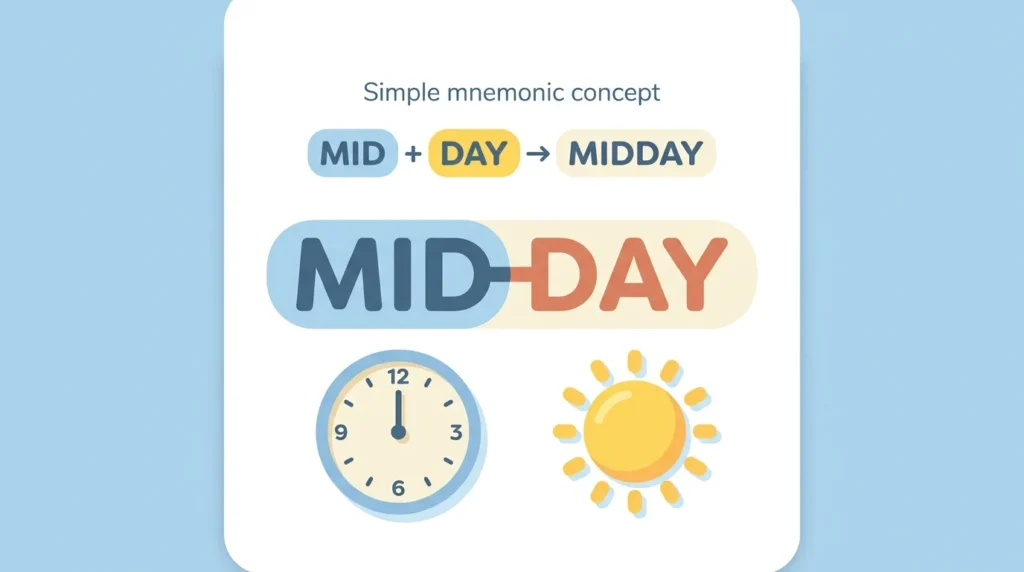
Memory Trick
MID + DAY = MIDDAY
When mid and day combine to name one time of day, close the door between them:
mid + day → midday
And remember its opposite:
midday → day
midnight → night
If you mean the middle of the day, think:
DAY stays with MID.
Quick Summary
Midday is the standard modern spelling when you mean the middle of the day, noon, or the period around noon. Write it as one word, not mid day. You may encounter mid-day in older or style-specific writing, but it is not the safest general choice for modern English. Midday can function as a noun (We arrived at midday) or as a modifier (the midday sun). It works in American and British English and in both formal and informal contexts. Midday does not always mean exactly 12:00; depending on context, it can describe the broader period around noon. If you mean precisely 12:00, noon may be clearer.
Frequently Asked Questions
Is “midday” one word or two?
Midday is one word. It is the standard modern spelling when referring to the middle of the day or noon.
Is “mid day” ever correct?
Not when you are using it as the normal word meaning “the middle of the day.” In ordinary modern English, use midday.
A separate two-word construction could theoretically occur if mid and day were functioning independently in an unusual literal structure, but that is not the standard time expression. For normal writing, choose midday.
Is “mid-day” wrong?
Not necessarily in every historical or stylistic context. Mid-day has been used as a hyphenated variant, particularly in older writing. However, midday is the standard modern form and the best choice for general contemporary writing.
Is “at midday” correct?
Yes.
We arrived at midday.
This is a standard and natural construction.
Is midday exactly 12 p.m.?
Midday can mean 12 p.m., but it can also refer to the broader period around noon. Context determines whether the word is being used precisely or approximately.
Is midday the same as noon?
They overlap in meaning. Noon specifically refers to 12 o’clock in the middle of the day, while midday can refer to noon or the broader middle part of the day.
Should I write “midday meeting” or “mid-day meeting”?
For ordinary modern writing, use:
midday meeting
The single-word form is the standard choice.
Is “midday” formal English?
Midday is neutral English. It works in formal, professional, academic, and everyday contexts.
Is “midday” American or British English?
It is used in both. There is no need to change the spelling depending on whether you are writing American or British English.
What is the opposite of midday?
The natural opposite is midnight.
- midday → middle of the day
- midnight → middle of the night
Is “good midday” a correct greeting?
It is grammatically interpretable, but it is not a natural standard English greeting. Use Good morning or Good afternoon depending on the time.
Which is better: “at midday” or “at noon”?
Both are correct.
Use at noon when you want a very direct reference to 12:00.
Use at midday when referring to the middle of the day more generally or when that wording fits your sentence better.
Mini Quiz
| # | Question | Answer | Explanation |
|---|---|---|---|
| 1 | Choose the correct spelling: “The train arrives at ___.” A) mid day B) midday C) mid-day | B) midday | Midday is the standard modern spelling. |
| 2 | Fill in the blank: “Please call me around ___.” | midday | The standard time expression is midday. |
| 3 | Correct the sentence: “We will finish before mid day.” | We will finish before midday. | Midday is normally written as one word. |
| 4 | Which means the middle of the night? A) midday B) midnight | B) midnight | Midnight refers to the middle of the night. |
| 5 | Choose the natural sentence: A) “The midday sun was intense.” B) “The mid day sun was intense.” | A | Midday can modify another noun such as sun. |
| 6 | True or false: “Midday can refer to a period around noon, not only exactly 12:00.” | True | Dictionary definitions include both noon and the middle part of the day. |
| 7 | Fill in the blank: “The report must be submitted by ___.” | midday | By midday is a standard deadline expression. |
| 8 | Correct the sentence: “The meeting begins at mid-day.” | The meeting begins at midday. | Midday is the preferred modern form. |
| 9 | Which is more precise if you specifically mean 12:00? A) noon B) daytime | A) noon | Noon directly identifies 12:00 in the middle of the day. |
| 10 | Choose the best sentence: A) “Good midday!” B) “I’ll call you around midday.” | B | Around midday is natural; Good midday is not a standard everyday greeting. |