

A nominator is the person or organization that puts someone forward for an award, position, or honor. A nominee is the person or organization being nominated. For example, if a manager nominates an employee for an award, the manager is the nominator, and the employee is the nominee. The key difference is simple: the nominator makes the nomination, while the nominee is the one being nominated. Neither role automatically means the person has won an award.
What Is the Difference Between Nominator and Nominee?
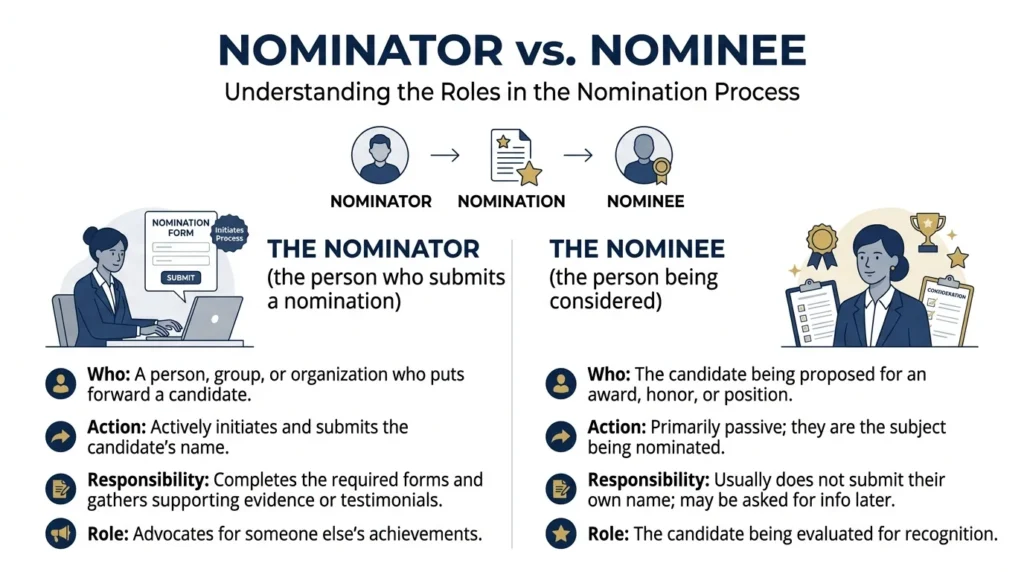
The difference between nominator vs nominee is the role each person plays in a nomination process.
A nominator puts someone forward for consideration. A nominee is the person or entity put forward.
Consider this example:
A teacher nominates a student for an academic award.
- Nominator: The teacher who submits the nomination.
- Nominee: The student being considered for the award.
- Nomination: The act or submission through which the student is put forward.
- Winner: The person eventually selected to receive the award.
The process can be remembered like this:
Nominator → Makes a nomination → Nominee → May become the winner
These terms are commonly used in award ceremonies, scholarship applications, employee recognition programs, elections, and professional appointments.
However, the exact responsibilities associated with each role depend on the rules of the organization or process.
What Is a Nominator?
A nominator is a person or organization that nominates someone or something for consideration.
The word is a noun derived from the verb nominate, which means to formally propose or put forward a person for a role, honor, award, or opportunity.
A nominator typically initiates the nomination process by submitting a name, completing a form, or providing supporting information.
Examples of a nominator
- A manager who nominates an employee for outstanding performance.
- A teacher who nominates a student for a scholarship.
- A colleague who recommends another employee for professional recognition through a formal nomination.
- A member who proposes someone for a leadership position.
- An eligible voter who nominates a candidate under an election’s rules.
Nominator in a sentence
- The nominator provided evidence of the employee’s achievements.
- Please enter the nominator’s name and contact information.
- Each nominator must explain why the candidate deserves recognition.
- The award committee contacted the nominator for additional details.
- The nominator submitted the application before the deadline.
In every example, the nominator is the person or organization making the nomination.
What Is a Nominee?
A nominee is a person or entity that has been nominated or formally put forward for consideration.
The word identifies the subject of a nomination rather than the person who makes it.
A nominee may be considered for an award, scholarship, public office, professional position, or another opportunity. Depending on the process, the nominee may need to meet eligibility requirements, provide documents, or agree to participate.
Being a nominee does not guarantee selection or success.
Examples of a nominee
- An employee nominated for a company award.
- A student nominated for a scholarship.
- A public figure nominated for an honor.
- A person formally proposed for an organizational position.
- An individual designated as a nominee under certain financial or legal arrangements.
Nominee in a sentence
- Maria became a nominee for the leadership award.
- Every nominee must meet the published eligibility requirements.
- The committee announced its nominees on Monday.
- The nominee submitted the documents requested by the organization.
- Each nominee will be evaluated according to the same criteria.
In these sentences, the nominee is the person being considered or designated through the relevant process.
An important exception: Nominee in financial and legal contexts
The word nominee has specialized meanings outside awards and competitions.
In some financial, legal, and administrative arrangements, a nominee is a person or entity designated to act, hold property, or be named in a particular capacity on behalf of another party.
The precise role depends on the applicable law, contract, and arrangement.
For example, a financial document may ask someone to designate a nominee. In that context, the nominee is not necessarily competing for an award.
Do not assume that every financial nominee has the same rights or responsibilities. The legal meaning of the designation must be understood from the relevant documents and jurisdiction.
Why the Difference Between Nominator and Nominee Matters
These words may look similar, but using the wrong one can confuse the roles of two people.
The distinction is especially important when completing official forms, writing award announcements, preparing professional documents, or communicating with an organization.
Imagine that a company asks employees to nominate colleagues for an annual excellence award.
If Ahmed nominates Sara, Ahmed is the nominator, and Sara is the nominee. Entering Ahmed’s name in the nominee field would misidentify the person being considered.
Getting the distinction right helps you:
- Complete nomination forms accurately.
- Identify the correct person in official records.
- Write clear recommendation letters and award announcements.
- Describe professional achievements honestly.
- Avoid confusing the person who makes a nomination with the person who receives it.
In formal situations, always check the field labels and instructions. A form may also request a proposer, seconder, sponsor, referee, or authorized representative. These roles may have different meanings.
The Core Rule: Nominator vs Nominee
The nominator nominates; the nominee is nominated.
Remember this simple distinction:
- Nominator: The person or organization putting someone forward.
- Nominee: The person or entity being put forward.
For example, if Fatima nominates Bilal for an employee recognition award, Fatima is the nominator and Bilal is the nominee.
The same person can occupy different roles in different situations. Someone who nominates a colleague for one award could be a nominee for another award.
In some processes, self-nomination is also allowed, so one person may occupy both roles in relation to the same nomination.
The role depends on the specific action, not the person’s identity.
How to Use Nominator and Nominee Correctly
The easiest way to choose the correct word is to identify the action in the sentence.
1. Use nominator for the person making the nomination
Use nominator when referring to the person or organization that proposes someone for consideration.
Examples:
- The nominator completed the application form.
- The organization asked each nominator to provide a supporting statement.
- We contacted the nominator to verify the information.
2. Use nominee for the person being nominated
Use nominee when referring to the person or entity that has been put forward.
Examples:
- The nominee received an email confirming the nomination.
- Each nominee will be evaluated against the same criteria.
- The nominee’s achievements were reviewed by the committee.
3. Use nomination for the action or submission
Nomination is the noun describing the act or process of nominating someone, or the submission made for that purpose.
Examples:
- Her nomination was approved for review.
- The nomination deadline is Friday.
- The committee received 120 nominations.
4. Keep nominee separate from winner
A nominee has been nominated. A winner has been selected as the successful recipient of an award or competition.
A person may be both a nominee and a winner if they are nominated and subsequently selected.
Examples:
- Correct: James was nominated for the award.
- Correct, if the result confirms it: James won the award.
These sentences describe different stages and should not be treated as interchangeable.
Read More: Reining vs Reigning: Meaning, Examples, and the Right Spelling.
Correct Examples of Nominator and Nominee
The following examples show how the terms work in conversation, education, business, and formal writing.
| Situation | Example sentence | Correct meaning |
|---|---|---|
| Conversation | “I was the nominator, and my colleague was the nominee.” | The speaker nominated the colleague. |
| “Please confirm the nominator’s contact details.” | The organization needs information about the person making the nomination. | |
| School | “The teacher nominated Aisha for the science award.” | The teacher is the nominator; Aisha is the nominee. |
| Scholarship | “Each nominee must submit the required documents.” | Each nominated student must provide the documents. |
| Workplace | “The nominator explained why the employee deserved recognition.” | The person submitting the nomination gave the explanation. |
| Social media | “Congratulations to every nominee announced today!” | The post congratulates everyone who has been nominated. |
| Academic writing | “The nomination process required a supporting statement from the nominator.” | The person making the nomination had to provide supporting information. |
| Award ceremony | “The host introduced each nominee before announcing the winner.” | The nominated people were introduced before the result. |
| Organization | “Members may nominate eligible candidates for the committee.” | Members can put eligible people forward. |
| Formal records | “The nominee’s name must match the official identification document.” | The record concerns the person being nominated. |
| Volunteer program | “The nominator described the candidate’s community service.” | The person submitting the nomination explained the candidate’s contribution. |
| Professional recognition | “The nominee was selected after the review process.” | The nominated person was selected at a later stage. |
These examples demonstrate that the two words can appear in the same situation but refer to different people.
Incorrect vs Correct Usage
The following table highlights common mistakes and explains why the corrected sentences work.
| Incorrect or misleading | Correct | Why |
|---|---|---|
| The nominee submitted the form for another employee. | The nominator submitted the form for another employee. | In this situation, the person submitting the nomination is the nominator. |
| Please enter the nominator’s name as the person being considered. | Please enter the nominee’s name as the person being considered. | The nominee is the person put forward for consideration. |
| The nominator received the award because their name was nominated. | The nominee received the award because they were nominated and later selected. | Being the nominator does not itself make someone the award recipient. |
| Every nominator will receive a certificate for being nominated. | Every nominee will receive a certificate for being nominated. | The sentence concerns people who were nominated, not those who nominated them. |
| The nominee explained why she had recommended her colleague. | The nominator explained why she had recommended her colleague. | The person making the recommendation is the nominator. |
| The award committee announced the nominators as its shortlisted candidates. | The award committee announced the nominees as its shortlisted candidates. | The people under consideration are the nominees. |
| We need the nominee’s signature from the person proposing the candidate. | We need the nominator’s signature from the person proposing the candidate. | The description identifies the person proposing the candidate. |
| The teacher was the nominee because she put forward a student. | The teacher was the nominator because she put forward a student. | The teacher performed the act of nominating. |
| The company asked each nominee to nominate a coworker. | The company asked each employee to nominate a coworker. | The revised sentence avoids assuming that nominees are the people submitting nominations. |
| The winner was called a nominee before anyone nominated them. | The person became a nominee after being nominated. | A nominee is ordinarily someone who has been nominated. |
| The nominator was considered for the award because the committee received their name. | The nominee was considered for the award because the committee received their name. | The sentence concerns the person whose name was put forward. |
| The nominee nominated herself, so she could not be the nominator. | She was both the nominator and the nominee because self-nomination was permitted. | If the rules allow self-nomination, one person can occupy both roles. |
Some sentences can be correct in special circumstances. For example, a nominee may submit a nomination if self-nomination is permitted or if they are nominating someone else. Always consider the intended meaning and the rules of the process.
Why People Confuse Nominator and Nominee
There are several reasons these words are easy to mix up.
1. They share the same root
Both words come from the verb nominate. Because they are used in the same process, readers may assume that they refer to similar roles.
Their shared origin explains the connection, but their endings help distinguish their meanings.
2. Their endings can be confusing
English often uses the ending -or for a person who performs an action and -ee for someone who receives or experiences an action.
For example:
- Operator: a person who operates something.
- Employee: a person employed by an employer.
- Interviewer: a person who conducts an interview.
- Interviewee: a person who is interviewed.
- Nominator: a person who nominates.
- Nominee: a person who is nominated.
These patterns are useful clues, not universal rules. English word formation has exceptions, and the meaning of each word still matters.

3. Both words appear on the same forms
A nomination form may ask for the nominator’s information and the nominee’s information in adjacent fields. When someone fills out the form quickly, it is easy to reverse them.
The safest approach is to identify who is submitting the nomination and who is being put forward.
4. Spellcheck cannot always detect the problem
Both nominator and nominee are correctly spelled English words. A spellchecker may accept either word even when you have used the wrong one.
The problem is not necessarily spelling. It is meaning.
5. Translation may hide the distinction
Some learners translate both words using a general term for a person who recommends or selects someone. That can obscure the difference between the person taking the action and the person receiving it.
When translating, focus on the roles in the process rather than relying only on a direct word-for-word translation.
Common Mistakes Checklist
Before publishing a document or submitting a form, check for these errors.
- Reversing the roles: Ask who actually made the nomination and who was nominated.
- Confusing nominee with winner: Confirm whether the person was merely nominated or was ultimately selected.
- Using nominee for every candidate: A candidate is someone seeking or being considered for a position or opportunity. A nominee is someone who has been nominated or formally designated under the relevant process.
- Assuming the nominator always selects the winner: A nominator puts someone forward; the final decision may belong to a committee, voters, an employer, or another authority.
- Ignoring self-nomination: Check the rules before assuming the nominator and nominee must be different people.
- Treating financial nominees like award nominees: In legal and financial contexts, the word may have a specialized meaning. Read the applicable documents carefully.
- Trusting spellcheck alone: Read the sentence for meaning, not just spelling.
A quick final check is to replace the words with simple descriptions: “the person who nominates” and “the person being nominated.” If the sentence no longer makes sense, revise it.
Nominator vs Nominee in Real English
Grammatically correct
Both nominator and nominee are standard English nouns. A sentence such as “The nominator recommended the nominee for the award” is grammatically correct and clearly identifies the two roles. Likewise, “The nominee thanked the nominator” is correct when the nominated person thanks the person who put them forward. The words are appropriate in formal documents, award announcements, workplace communication, and ordinary discussion of nomination processes.
Grammatically possible but unnatural
A sentence can be grammatically possible while sounding unnecessarily complicated. For example, “The nominator performed the act of nomination upon the nominee” is understandable, but it is awkward and overly formal. “The nominator nominated the candidate” or “The nominator put the candidate forward” communicates the same idea more naturally. In everyday writing, choose direct verbs and avoid turning a simple action into a long, abstract phrase.
Natural, everyday English
In ordinary conversation, people often use the verb nominate rather than the noun nominator. Someone might say, “I nominated Sara for the award,” rather than “I was Sara’s nominator.” Both can be correct, but the first sentence focuses on the action and is usually more direct. The noun nominee is also natural when discussing awards or official selections: “She’s one of this year’s nominees.” Choose the form that best fits the sentence.
American vs British English
There is no major American-versus-British spelling difference between nominator and nominee. Both forms are used in American and British English.
The main distinction is their meaning, not their spelling.
Some organizations may prefer different terminology in particular settings. Election rules, award procedures, and official documents can also vary between countries. These differences reflect the relevant institution or process rather than a general spelling rule.
When completing a formal document, use the terminology provided by the organization.
Formal vs Informal Usage
Both words are suitable for formal writing, but their usefulness depends on context.
Formal contexts include award nominations, scholarship applications, election documents, workplace recognition programs, professional appointments, and official records.
Example: “The nominator must provide a supporting statement explaining the nominee’s qualifications.”
Informal contexts include everyday conversations about awards, workplace recognition, and competitions.
Example: “Who nominated you? I didn’t know you were a nominee!”
In casual conversation, the person who nominated someone may sound more natural than the nominator. However, nominee is widely useful when referring to a person who has been nominated.
Nominator vs Nominee vs Candidate vs Nomination vs Winner
These related terms describe different parts of a selection process.
| Term | Meaning | Example |
|---|---|---|
| Nominator | The person or organization making the nomination | The manager nominated an employee. |
| Nominee | The person or entity being nominated | The employee became a nominee. |
| Candidate | Someone seeking or being considered for a role or opportunity | She is a candidate for the position. |
| Nomination | The act or submission of putting someone forward | The committee received the nomination. |
| Finalist | A person who reaches the final stage of a selection process, if one exists | Three nominees became finalists. |
| Winner | The person selected as the winner of a competition or award | One finalist won the award. |
| Recipient | A person or entity that receives something, such as an award or benefit | The recipient accepted the honor. |
Is a nominee the same as a candidate?
Not always.
A candidate is a broader term. It can refer to someone applying for a job, seeking political office, or being considered for an opportunity. A nominee is someone who has been nominated or formally put forward.
In some elections and appointment processes, a nominee may also be called a candidate. The precise distinction depends on the rules and terminology of the institution.
Is a nominator the same as a recommender?
Not necessarily.
A recommender expresses support for someone or something. A nominator formally puts someone forward under a nomination process.
A recommendation may be informal, while a nomination may require a specific form, deadline, or set of eligibility rules. Some processes use the terms in overlapping ways, but they should not automatically be treated as interchangeable.
Memory Trick: How to Remember Nominator vs Nominee
Use this simple mnemonic:
The nominator nominates; the nominee gets nominated.
Think of the final letters:
- Nominator — doer: The person who takes the action.
- Nominee — receiver: The person who is nominated.
Now imagine a manager putting forward an employee for a company award.
The manager is the nominator.
The employee is the nominee.
If the employee later wins, the employee is both a nominee and the winner.
You can also remember the sequence:
Nominator → Nomination → Nominee
The nominator starts the process, the nomination is the act or submission, and the nominee is the person or entity put forward.
This memory trick is especially helpful when filling out forms that ask for both names.
Nominator vs Nominee in Real-Life Situations
Situation 1: A job interview
A department manager nominates an employee for an internal leadership program.
The manager is the nominator, and the employee is the nominee. The employee may then be interviewed to determine whether they qualify for the program.
Being nominated does not guarantee acceptance.
Situation 2: A scholarship application
A professor nominates a student for a scholarship and submits a statement about the student’s academic performance.
The professor is the nominator, and the student is the nominee. The scholarship committee makes the final decision according to its eligibility criteria.
Situation 3: A workplace meeting
A team leader says, “We need to recognize someone who improved our customer service.”
Another employee nominates a colleague for the award.
The employee making the nomination is the nominator. The colleague being considered is the nominee.
Situation 4: An email
A company sends the following message:
“Dear Nominee, your name has been submitted for the annual excellence award.”
The recipient is the nominee because someone has put their name forward.
If the company asks who submitted the nomination, that person is the nominator.
Situation 5: An award ceremony
An organization announces five nominees for an award and later selects one winner.
All five people were nominees. The person selected is the winner as well as a nominee.
The people who submitted their nominations are not automatically award winners.
Situation 6: An official financial form
A form asks someone to name a nominee under a financial arrangement.
In this case, the nominee may be a designated person or entity rather than an award candidate. The exact role depends on the form, the agreement, and the applicable rules.
Do not assume that the nominee automatically owns an asset or has an unrestricted right to receive funds. Check the legal terms governing the arrangement.
Expert Tips for Using Nominator and Nominee
These practical tips help prevent mistakes that basic definitions alone may not resolve.
- Start with the verb. Ask who nominated whom. The person performing the action is the nominator; the person being nominated is the nominee.
- Check the form instructions. Some organizations distinguish nominators, proposers, seconders, sponsors, and referees. Do not assume these roles are identical.
- Separate nomination from selection. A nomination puts someone forward. The selection process determines what happens next.
- Use precise achievement language. If a person was nominated but did not win, say they were nominated. Do not describe them as the winner.
- Account for self-nomination. When the rules permit it, the same person may be both nominator and nominee.
- Pay attention to specialized contexts. In banking, law, and other formal settings, nominee may have a specific meaning that differs from its award-related use.
- Prefer direct sentences. “The manager nominated Ali” is often clearer than “Ali was the subject of a nomination made by the manager.”
- Verify the outcome before publishing. If you are writing an award announcement, confirm whether the person is a nominee, finalist, recipient, or winner.
The most important habit is to identify the person’s role before choosing the word.
Quick Summary
The difference between nominator vs nominee is straightforward: a nominator is the person or organization that puts someone forward, while a nominee is the person or entity being nominated. A nomination is the act or submission that connects these roles. A nominee may later become a finalist or winner, but being nominated does not guarantee success. Both words are standard in American and British English, and neither has a different spelling across these varieties. In formal documents, check the organization’s rules because terms such as candidate, proposer, and nominee may have specific meanings. Remember the simple rule: the nominator nominates, and the nominee gets nominated. This distinction will help you write accurately and complete nomination forms correctly.
FAQ: Nominator vs Nominee
1. Who is the nominator on an application form?
The nominator is the person who puts another person forward for consideration. This person may need to provide their name, contact details, and reasons for the nomination.
2. Who should be listed as the nominee?
The nominee is the person or entity being nominated. If you are completing a form for someone you want to recommend for an award, that person generally belongs in the nominee field.
3. Can one person be both the nominator and nominee?
Yes, if the process permits self-nomination. In that situation, the same person makes the nomination and is the person being nominated.
4. Does being nominated mean you have been selected?
No. A nomination means someone has put your name forward. Selection, appointment, or winning may occur later, depending on the rules of the process.
5. Is a nominee always a person?
No. Depending on the context, an organization, project, work of art, or another eligible entity may be nominated. The exact possibilities depend on the relevant award or selection rules.
6. What is the difference between a nominator and a proposer?
A nominator puts someone forward for consideration. A proposer also puts forward a person or motion in certain formal processes. The terms may overlap, but some organizations define them as distinct roles, so follow the applicable rules.
7. Is nominee a correct word in professional English?
Yes. Nominee is a standard English word used in professional recognition, awards, appointments, elections, and other formal processes. It can also have specialized meanings in legal and financial contexts.
8. Can a nominee nominate another person?
Yes. Being a nominee in one process does not prevent someone from nominating another person in a different process. They can also nominate someone in the same broader program if its rules permit it.
9. What is the plural of nominator and nominee?
The plural forms are nominators and nominees. For example, “The nominators submitted their forms” and “The nominees attended the ceremony.”
10. Is nominee the same as recipient?
No. A nominee is someone who has been nominated or designated in a particular process. A recipient is someone who receives something. A nominee may become an award recipient, but the terms describe different roles.
Mini Quiz: Test Your Understanding
Choose the correct answer for each question. The answers and explanations are included so readers can check their understanding.
| No. | Question | Options or task | Answer and explanation |
|---|---|---|---|
| 1 | A teacher nominates a student for an award. Who is the nominator? | A. The teacher; B. The student; C. The award committee | Answer: A. The teacher makes the nomination. |
| 2 | Complete the sentence: “The award committee announced the five ____.” | A. nominators; B. nominees; C. nominations | Answer: B. The nominees are the people put forward for consideration. |
| 3 | Correct the sentence: “Sara was the nominator because her manager put her forward for an award.” | Rewrite the sentence. | Answer: “Sara was the nominee because her manager put her forward for an award.” Explanation: Sara is being nominated, so she is the nominee. |
| 4 | What does nomination mean? | A. The person making the nomination; B. The act or submission of nominating; C. The person who wins | Answer: B. A nomination is the act or submission through which someone is put forward. |
| 5 | Complete the sentence: “The ____ explained why he believed his colleague deserved the award.” | A. nominator; B. nominee; C. winner | Answer: A. The person making the nomination provides the explanation. |
| 6 | True or false: Every nominee eventually wins the award. | True or false | Answer: False. A nomination does not guarantee that the person will be selected. |
| 7 | Complete the sentence: “The company asked each ____ to provide their contact details as the person being considered.” | A. nominator; B. nominee; C. recommender | Answer: B. The sentence refers to the person being considered. |
| 8 | Can a person be both a nominator and a nominee? | A. Never; B. Yes, if the rules permit it; C. Only in elections | Answer: B. Self-nomination may allow one person to occupy both roles. |
| 9 | Correct the sentence: “The nominee submitted the nomination for her colleague,” assuming she is the person who submitted it and is not being nominated herself. | Rewrite the sentence. | Answer: “The nominator submitted the nomination for her colleague.” Explanation: The person who submits the nomination is the nominator in this situation. |
| 10 | An organization designates a person under a financial arrangement. Must that nominee be an award candidate? | A. Yes; B. No; C. Only if they are a finalist | Answer: B. Nominee has specialized meanings in financial and legal contexts, so the person need not be an award candidate. |