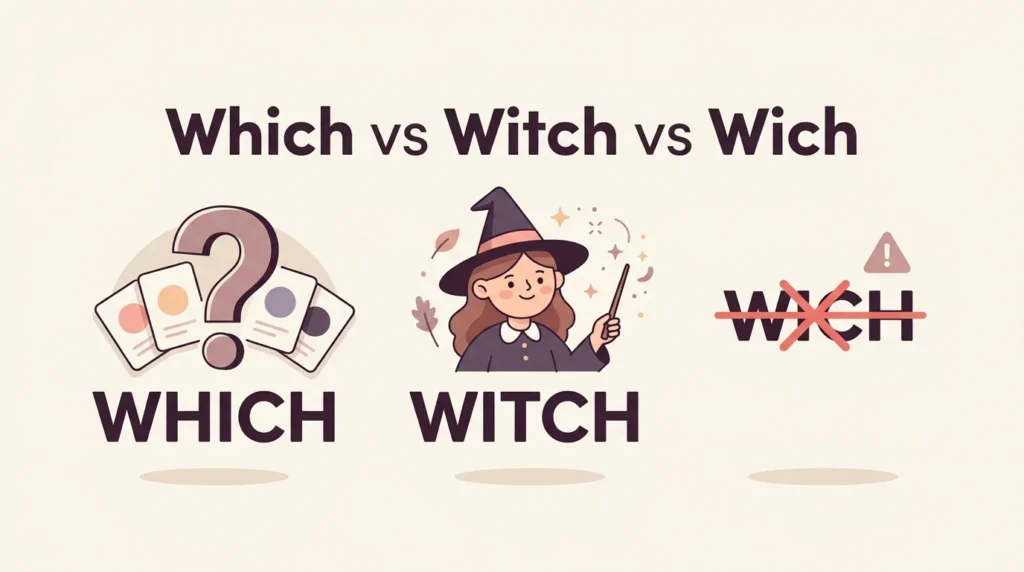

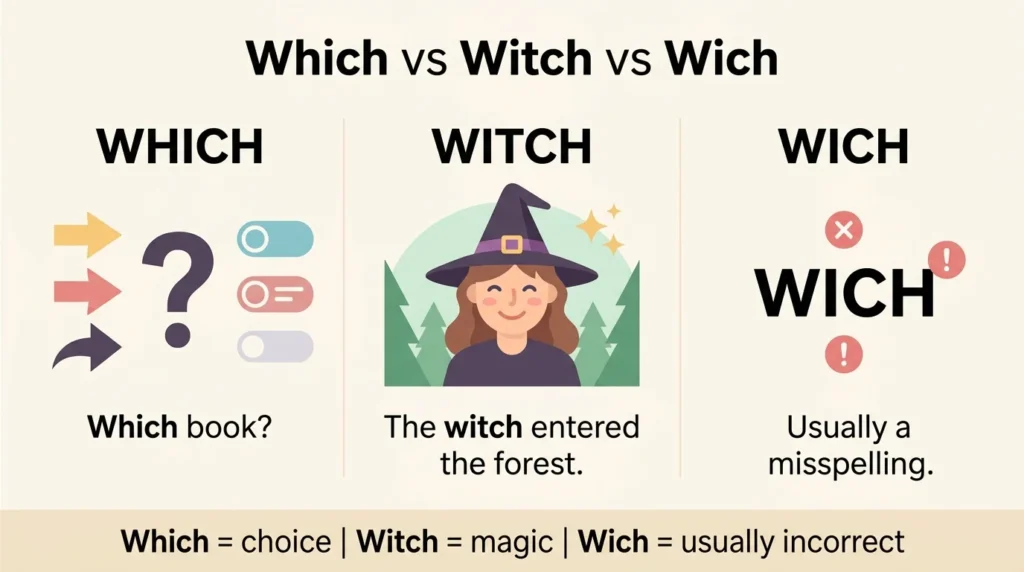
Which is the correct word when you are asking about a choice or referring back to something in a clause: “Which book do you want?” Witch is a noun for a person associated with magic or witchcraft: “The witch entered the forest.” Wich is normally a spelling mistake in standard English. The key is to focus on meaning, not pronunciation.
What Is the Difference Between Which, Witch, and Wich?
The three spellings look very similar, but they do not perform the same job.
| Word | Meaning | Part of Speech | Example |
|---|---|---|---|
| which | Used for choices, identification, or relative clauses | Determiner / pronoun | Which color do you prefer? |
| witch | A person associated with witchcraft or supernatural powers | Noun | The witch disappeared into the forest. |
| wich | Usually a misspelling of which or witch | — | ❌ Wich book did you choose? |
The most important distinction is this:
Which = choice or reference. Witch = a person associated with witchcraft. Wich = normally an incorrect spelling in standard English.
Merriam-Webster defines which as an interrogative word used to identify one or more members of a group and also as a word that introduces certain relative clauses. It defines witch as a noun associated with witchcraft, folklore, and supernatural powers.
Why Does This Difference Matter?
A one-letter spelling mistake can change the meaning of a sentence completely.
Consider:
Which book should I buy?
This asks you to make a choice.
Now compare:
The witch bought a book.
This sentence is about a person associated with witchcraft.
If you write:
Witch book should I buy?
the sentence no longer contains the normal question word which.
These mistakes matter most in situations where accuracy affects how your writing is perceived:
- School assignments
- Job applications
- Business emails
- Reports
- Blog posts
- Social media posts
- Academic writing
- Professional documents
The problem is especially easy to make when you are typing quickly because which and witch are pronounced the same in many varieties of English.
The Core Rule
Use “which” for a choice, identification, or relative clause. Use “witch” when referring to a person associated with witchcraft. Do not use “wich” as the standard spelling of either word.
A quick decision process makes the distinction easy:
- Are you asking someone to choose or identify something? → which
- Are you referring to a person associated with witchcraft? → witch
- Did you write “wich”? → Check the meaning. You probably need which or witch.
Read More: Steer vs Stear: Which Spelling Is Correct?
How to Use “Which”
Which has several grammatical functions. It is not limited to direct questions.
“Which” for Choices
Use which when asking someone to choose one or more things from a known or understood group.
Examples:
- Which shirt should I wear?
- Which laptop do you recommend?
- Which route is faster?
- Which restaurant should we try?
- Which candidate received the highest score?
The choices do not always have to be explicitly listed.
For example:
Which phone do you prefer?
The speaker assumes there are phones available to choose from.
“Which” Before a Noun
When which comes directly before a noun, it functions as a determiner.
Examples:
- Which book is yours?
- Which color do you like?
- Which employee handled the request?
- Which option should we select?
- Which university are you considering?
The basic pattern is:
which + noun
“Which” Without a Noun
Which can also stand alone as a pronoun when the noun is understood.
Examples:
- Which is yours?
- Which should I choose?
- Which do you prefer?
- I don’t know which is better.
- Tell me which you want.
In:
Which should I choose?
the word which stands for the thing or option being chosen.
“Which” in Relative Clauses
Which can also introduce a relative clause.
A relative clause is a part of a sentence that gives additional information about a noun or another part of the sentence.
For example:
My laptop, which I bought last year, is still working perfectly.
The phrase which I bought last year provides information about the laptop.
Another example:
She missed the train, which caused a delay.
Here, which refers to the situation described in the preceding clause.
This is an important use because which does not always indicate a question or choice.
How to Use “Witch”
Witch is a noun.
It traditionally refers to a person believed to have magical or supernatural powers. In fiction, folklore, history, and modern cultural contexts, the word can have different associations.
Examples:
- The witch lived in an old cottage.
- The children dressed as witches for Halloween.
- The story features a powerful witch.
- The witch cast a spell in the fantasy novel.
- The village legend was about a mysterious witch.
The plural is witches.
Examples:
- The story contains three witches.
- The witches gathered in the forest.
- Several witches appear in the novel.
Merriam-Webster also records modern uses of witch that are not limited to the stereotypical fictional image of a magical woman. The word can refer to people who identify as practitioners of witchcraft, including in modern religious or cultural contexts.
Read More: Symptomatology vs Symptomology: Which Word Is Correct?
Is “Wich” a Word?
For ordinary modern English writing, wich is generally not the word you want when you mean which or witch.
If you write:
Wich book should I buy?
the standard correction is:
Which book should I buy?
If you write:
The wich flew across the sky.
and you mean a magical person, the correction is:
The witch flew across the sky.
There is an important nuance, however: wich can appear as part of proper names and place names, such as Norwich and Greenwich. That does not make wich a standard replacement for which or witch in ordinary sentences.
So the practical writing rule is:
If you independently type wich, stop and check what you mean. In most everyday sentences, the correct spelling is either which or witch.
10 Correct Examples of Which vs Witch
| Situation | Correct Example | Why |
|---|---|---|
| Conversation | Which one do you want? | Which identifies a choice. |
| Shopping | Which shoes should I buy? | Which asks for a selection. |
| Could you tell me which file is the latest version? | Which identifies a file. | |
| Workplace | Which proposal should we discuss first? | Which asks for a choice. |
| School | Which subject do you enjoy most? | Which asks for identification. |
| Academic writing | The theory, which was published in 1998, remains influential. | Which introduces additional information. |
| Social media | Which photo should I post? | Which asks for a selection. |
| Fiction | The witch entered the castle at midnight. | Witch names a character. |
| Halloween | My daughter dressed as a witch. | Witch refers to a costume character. |
| Literature | The novel portrays the witch as a complex character. | Witch is a noun referring to the character. |
Incorrect vs Correct
| ❌ Incorrect | ✅ Correct | Why |
|---|---|---|
| Wich dress should I wear? | Which dress should I wear? | The sentence asks for a choice. |
| Wich one is yours? | Which one is yours? | Which identifies an option. |
| The which lived in the forest. | The witch lived in the forest. | The sentence refers to a magical character. |
| I don’t know wich answer is correct. | I don’t know which answer is correct. | Which introduces the choice. |
| She saw a wich in the story. | She saw a witch in the story. | The word refers to a character associated with magic. |
| Wich laptop should we buy? | Which laptop should we buy? | Which comes before the noun laptop. |
| The old which cast a spell. | The old witch cast a spell. | Witch is the noun needed here. |
| Tell me wich option you prefer. | Tell me which option you prefer. | Which identifies one option. |
| The wich flew over the village. | The witch flew over the village. | The subject is a magical character. |
| Wich movie did you watch? | Which movie did you watch? | Which is the question word. |
Notice that the error is not simply “missing a letter.” The correct spelling depends on the meaning and grammatical function of the word.
Why People Confuse Which, Witch, and Wich
They Sound the Same
In many accents, which and witch have the same pronunciation: /wɪtʃ/. Merriam-Webster gives the pronunciation of which and witch in forms that reflect this shared sound.
That means someone can hear:
“Which book?”
and:
“Witch book?”
without being able to rely on sound alone to identify the intended spelling.
English Has Many Homophones
A homophone is a word that sounds the same as another word but has a different meaning or spelling.
Examples include:
- which / witch
- right / write
- their / there
- to / too / two
- hear / here
When words sound alike, spelling has to carry the meaning.
Fast Typing
On a phone or keyboard, people often type based on sound.
That can produce:
- wich
- witch
- which
without the writer consciously checking the sentence.
Read More: Distress vs Duress: Meaning, Differences, and Correct Usage
Autocomplete and Spellcheck
Spellcheck can help, but it does not replace understanding.
A writing tool may recognize a word as correctly spelled even when it is the wrong word for the sentence.
For example:
Witch laptop should I buy?
The word witch is spelled correctly as a word. The problem is that it is the wrong word in this sentence.
That is why context-based proofreading matters.
Translation Interference
Some English learners mentally map a sound to a spelling from their first language or another language they know. When the target language contains homophones, this can make spelling errors more persistent.
The solution is not to memorize every sentence. Learn the function of the word.
Common Mistakes Checklist
Mistake 1: Writing “witch” in a question
❌ Witch phone should I buy?
✅ Which phone should I buy?
Why it happens: The two words sound alike.
How to avoid it: If the sentence asks you to select or identify something, use which.
Mistake 2: Writing “which” for a magical character
❌ The which entered the castle.
✅ The witch entered the castle.
Why it happens: Writers remember the pronunciation but not the spelling.
How to avoid it: If you can replace the word with “magical person” or “witchcraft practitioner” in context, use witch.
Mistake 3: Using “wich”
❌ Wich option is better?
✅ Which option is better?
Why it happens: The pronunciation does not clearly reveal the spelling.
How to avoid it: Remember that the standard question word contains wh + ich: which.
Mistake 4: Assuming every occurrence of “which” asks a question
Not every use of which is interrogative.
For example:
The car, which was badly damaged, was taken away.
Here, which introduces additional information. It is not asking a question.
Mistake 5: Trusting a spellchecker without checking meaning
A spellchecker may not flag witch as a spelling error because witch is a correctly spelled English word.
The problem may be word choice rather than spelling.
Which vs Witch in Real English
Which in Everyday English
Which is completely natural in everyday questions when the speaker is choosing or identifying something.
For example:
Which bus goes to the city center?
This is a normal, natural question.
Which one do you want?
is also extremely common.
The important point is that which is not restricted to formal English. It belongs to ordinary everyday conversation as well as professional and academic writing.
Witch in Everyday English
Witch is also a normal English noun, but its use depends on context.
It appears naturally when discussing:
- Fiction
- Fairy tales
- Folklore
- Halloween
- History
- Witchcraft
- Modern cultural or religious contexts
For example:
The children dressed as witches for Halloween.
sounds completely natural.
So the issue is not that witch is “informal” or “formal.” It simply has a different meaning from which.
“Wich” in Real English
In ordinary modern writing, wich is not a natural alternative to either word.
If you see:
Wich one do you want?
a reader will normally interpret it as a spelling error for which.
If you see:
The wich cast a spell.
the intended word is almost certainly witch.
This is why wich should not be treated as a casual or informal version of which. It is normally an error in these contexts.
Read More: Attornies vs Attorneys: Which Spelling Is Correct?
American vs. British English
There is no meaningful American-versus-British spelling difference between which and witch.
American and British English both use:
- which for the grammatical word
- witch for the noun
- wich as an incorrect spelling when it is intended to replace either word
The pronunciation of which can vary somewhat across accents, particularly because of historical differences involving the pronunciation of wh, but this does not create a different spelling rule.
For practical writing, use the same spellings in both American and British English.
Formal vs. Informal Usage
There is no special formal spelling of these words.
Which is appropriate in:
- Conversations
- Emails
- Reports
- Academic writing
- Business documents
- Formal correspondence
Witch is equally standard when its meaning is appropriate.
The key distinction is meaning, not register.
The main word to avoid in standard writing is wich when it is being used as a misspelling of which or witch.
Comparison Table
| Feature | Which | Witch | Wich |
|---|---|---|---|
| Standard English word | Yes | Yes | Normally no |
| Main role | Determiner / pronoun | Noun | — |
| Main meaning | Choice, identification, relative reference | Person associated with witchcraft | Usually a spelling error |
| Used in questions | Yes | No, unless witch itself is the subject/topic | No |
| Used before a noun | Yes | Sometimes, as a noun modifier in compounds | No |
| Can introduce a relative clause | Yes | No | No |
| Has a plural form | No | witches | No standard plural |
| Example | Which option is best? | The witch disappeared. | ❌ Wich option is best. |
| Memory idea | Choice | Magic | Check the spelling |
Memory Trick
Use this simple mnemonic:
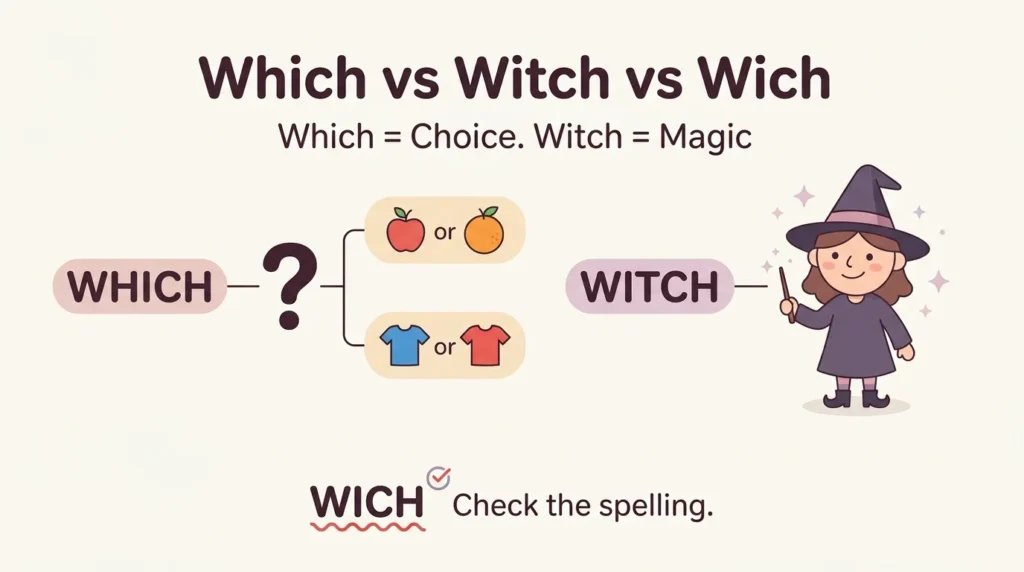
Which helps you choose. Witch has a “T” for tales of magic.
Think:
Which = choice
Witch = magic
You can also picture the difference visually:
WHICH → a question mark → ❓
WITCH → a pointy hat → 🧙
If you type WICH, stop and ask:
“Did I mean a choice or a witch?”
That one question can prevent the mistake.
Real-Life Situations
In a Job Interview
Interviewer: Which project are you most proud of?
Candidate: The website redesign.
Here, which asks the candidate to identify one project.
In a Business Meeting
Manager: Which proposal should we approve?
Employee: I recommend the second proposal.
Again, which introduces a choice.
In an Email
Could you confirm which document we should send to the client?
This is standard professional English.
In a Text Message
Which restaurant are we going to tonight?
The speaker is asking the other person to choose or identify a restaurant.
In a School Assignment
The novel, which was published in the nineteenth century, remains widely studied.
Here, which introduces additional information about the novel.
In a Story
The witch entered the village just before sunset.
Here, witch is the noun naming a character.
Expert Tips
1. Do Not Solve a Homophone Problem by Listening
When two words sound alike, pronunciation cannot reliably tell you which spelling to use.
Instead, ask what the word means and what job it performs.
2. Look at the Words Around It
If you see:
which + noun
such as:
- which book
- which car
- which answer
- which option
you almost certainly need which.
If you see:
the witch
or:
a witch
you are dealing with the noun witch.
3. Remember That “Which” Is Not Only a Question Word
This is an important point that beginners sometimes miss.
Which can introduce additional information:
My phone, which I bought last year, still works well.
So don’t use the simplistic rule “question = which” as if that were its only function.
4. Don’t Treat Spellcheck as a Grammar Expert
A correctly spelled wrong word can pass a basic spellcheck.
Compare:
Which book? ✅
Witch book? ❌
Both which and witch are correctly spelled words. Only context tells you which one belongs.
5. Proofread Homophones Separately
When editing important writing, deliberately search for commonly confused words.
For this topic, check:
- which
- witch
- wich
This is faster than rereading every sentence with equal attention.
FAQ
Is “wich” a correct English word?
Not as the standard spelling of which or witch. In ordinary English writing, wich is normally a spelling mistake. It can appear as part of proper names and place names, but that is a different matter.
Is “which” and “witch” pronounced the same?
In many accents, yes. They are commonly treated as homophones because they share the pronunciation /wɪtʃ/. Some accents may distinguish certain wh words, so pronunciation can vary regionally.
Which is correct: “which one” or “witch one”?
Which one is correct when asking someone to choose or identify something.
Example:
Which one do you prefer?
Witch one would mean something very different and is not the normal construction.
Can “witch” be used as a verb?
Yes. Witch is also recorded as a verb, although this use is much less common than the noun. Dictionary definitions include meanings connected with witchcraft, as well as some specialized or archaic uses.
Is “which” only used for two choices?
No. Which can be used when choosing or identifying one or more things from a group, and the group can contain more than two possibilities.
For example:
Which of these five designs do you prefer?
Can “which” refer to a whole sentence?
Yes. In some constructions, which can refer to an idea or situation expressed by the preceding clause.
Example:
He missed the deadline, which caused a problem for the team.
Here, which refers to the preceding situation rather than simply one noun.
Is “witch” always a woman?
Traditional definitions often describe a witch as a woman associated with magic, but modern usage is broader. The word can refer to practitioners of witchcraft without necessarily fitting the old fictional stereotype.
Why do people spell “which” as “wich”?
The most common reason is pronunciation. Since the spoken form does not clearly reveal the spelling, people may write the word based on sound. Fast typing and weak spelling memory can make the error more likely.
What is the easiest way to remember which and witch?
Remember:
Which = choice.
Witch = magic.
If you are asking someone to select something, use which. If you are talking about a person associated with witchcraft, use witch.
Is “which” formal English?
Yes. Which is standard English and works in casual conversation, professional writing, academic writing, and formal documents.
Is “witch” an informal word?
No. Witch is a standard English noun. Its appropriateness depends on what you are discussing, not on whether the writing is formal or informal.
Mini Quiz
| # | Question | Answer | Explanation |
|---|---|---|---|
| 1 | ___ color do you prefer: blue or green? | Which | The sentence asks for a choice. |
| 2 | The ___ lived in an old cottage. | witch | The sentence refers to a magical character. |
| 3 | Correct the sentence: “Wich laptop should I buy?” | Which laptop should I buy? | Which is used for selection. |
| 4 | The story featured a powerful ___. | witch | The blank needs a noun referring to a person. |
| 5 | I don’t know ___ answer is correct. | which | Which identifies one answer from a group. |
| 6 | Which sentence is correct? A) The wich cast a spell. B) The witch cast a spell. | B | Witch is the correct noun. |
| 7 | Fill in the blank: “My car, ___ I bought last year, is still reliable.” | which | Which introduces additional information. |
| 8 | Correct the sentence: “Witch option should we choose?” | Which option should we choose? | The sentence asks for a choice. |
| 9 | Fill in the blank: “The children dressed as ___ for Halloween.” | witches | Witches is the plural noun. |
| 10 | True or false: “Wich” is the normal informal spelling of “which.” | False | Wich is normally a spelling mistake, not an informal spelling. |
Quick Summary
Which, witch, and wich may sound confusing, but their uses are easy to separate once you focus on meaning. Which is used for choices, identification, and certain relative clauses: “Which book do you want?” or “The book, which I bought yesterday, is excellent.” Witch is a noun referring to a person associated with witchcraft: “The witch entered the forest.” Wich is normally an incorrect spelling when you mean either word. The easiest memory trick is which = choice and witch = magic. Because which and witch can sound identical, listening alone cannot always help. When writing, check the meaning and grammatical role before choosing the spelling.