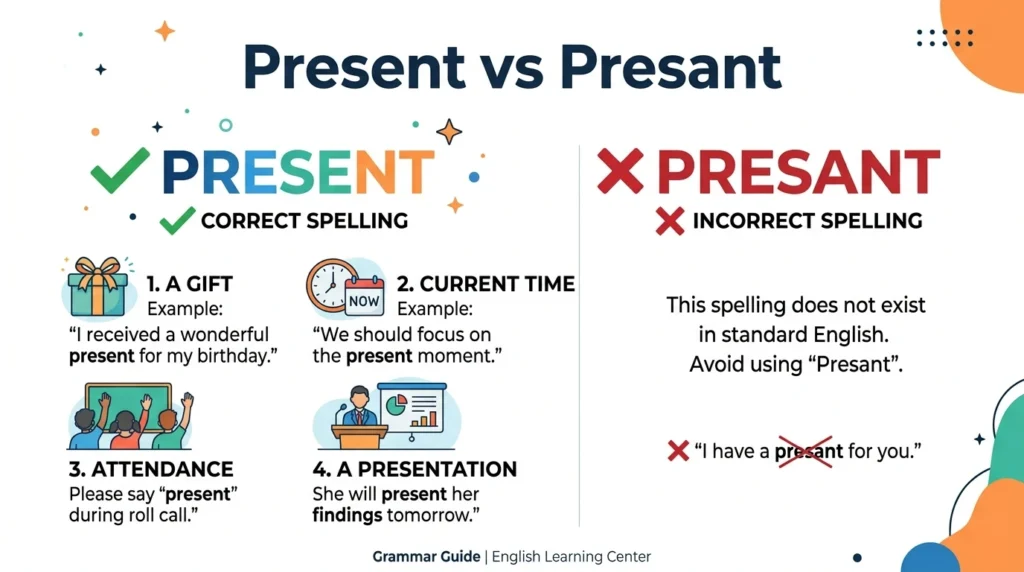

The main difference is simple: present is a standard English word, while presant is usually a misspelling of present.
Present is unusually flexible because it can function as a noun, adjective, or verb. A part of speech simply tells us the job a word performs in a sentence.
As a noun, present can mean a gift or the current period of time.
My sister gave me a birthday present.
We should concentrate on the present, not the past.
As an adjective, present can mean currently existing or physically in attendance.
Present is the correct English spelling. Presant is not a standard spelling of the common English word present. Use present when you mean a gift, the current time, someone being in a place, or the act of showing, giving, or explaining something. The spelling remains present in every one of these meanings, although its pronunciation changes when it functions as a verb.
The present situation requires careful planning.
Everyone was present at the meeting.
As a verb, present means to show, introduce, offer, submit, or formally give something.
Maya will present the results tomorrow.
These uses are recognized in standard English, and the noun, adjective, and verb forms all keep the same spelling.
Presant, by contrast, should not replace present in ordinary English writing.
Why Correctly Spelling Present Matters
Writing presant instead of present may seem like a small mistake, but spelling affects how easily readers process your message.
The error is especially noticeable in situations where careful writing is expected. These include job applications, business emails, reports, essays, presentations, academic assignments, customer messages, and professional social media posts.
Compare these sentences:
I will presant our proposal on Monday.
I will present our proposal on Monday.
Both may be understandable, but only the second uses standard English spelling.
Correct spelling also matters because present is an extremely common word. Learning it once helps you avoid the same mistake across several different meanings.
The Core Rule for Present vs Presant
RULE: Write PRESENT whenever you mean a gift, something current, someone being there, or the act of showing or giving something. Do not use PRESANT as an alternative spelling.
The meaning may change.
The pronunciation may change.
The grammatical role may change.
The spelling does not change.
How to Use Present Correctly
Present as a Noun Meaning a Gift
Use present for something given to another person, often for a birthday, holiday, celebration, or special occasion.
Leo bought his mother a present.
We opened our Christmas presents after breakfast.
The plural is simply presents.
Present as a Noun Meaning the Current Time
The present can refer to the period happening now, as opposed to the past or future.
Her research connects the past with the present.
Try to focus on the present instead of worrying about next year.
The phrase at present also means “now” or “currently,” although it can sound slightly more formal.
At present, the position is still available.
Present as an Adjective Meaning Current
Before a noun, present can describe something that exists or applies now.
The present policy will remain in effect until December.
Under the present system, applications are reviewed manually.
In these sentences, present has a meaning close to current.
Present as an Adjective Meaning Being There
Present can also describe someone who is physically at a particular place, event, or occasion.
All five managers were present.
A parent must be present during registration.
In this use, absent is a natural opposite.
Present as a Verb Meaning Show or Explain
Use the verb present when someone formally shows, communicates, or explains information.
I will present the marketing plan at noon.
The researchers presented their findings at the conference.
Present as a Verb Meaning Give or Award
Present can also mean formally giving something to someone.
The principal presented the winner with a certificate.
The award was presented to the entire team.
This construction often sounds more ceremonial or formal than simply using give.
Present as a Verb Meaning Submit or Produce
In some contexts, present means to provide something for consideration, inspection, or use.
Please present your identification at reception.
The attorney presented additional evidence.
The delay presents a serious problem for the project.
Standard references recognize these major noun, adjective, and verb uses of present.
Is There Any Exception Where Presant Is Correct?
There is no standard-English spelling rule in which presant replaces present as the common word.
However, Presant can exist as a proper name or surname. Proper names follow the spelling belonging to that particular person or family. That does not make presant an alternative spelling of the ordinary English word present.
How Do You Pronounce Present?
One feature that makes present more interesting than an ordinary spelling correction is its pronunciation.
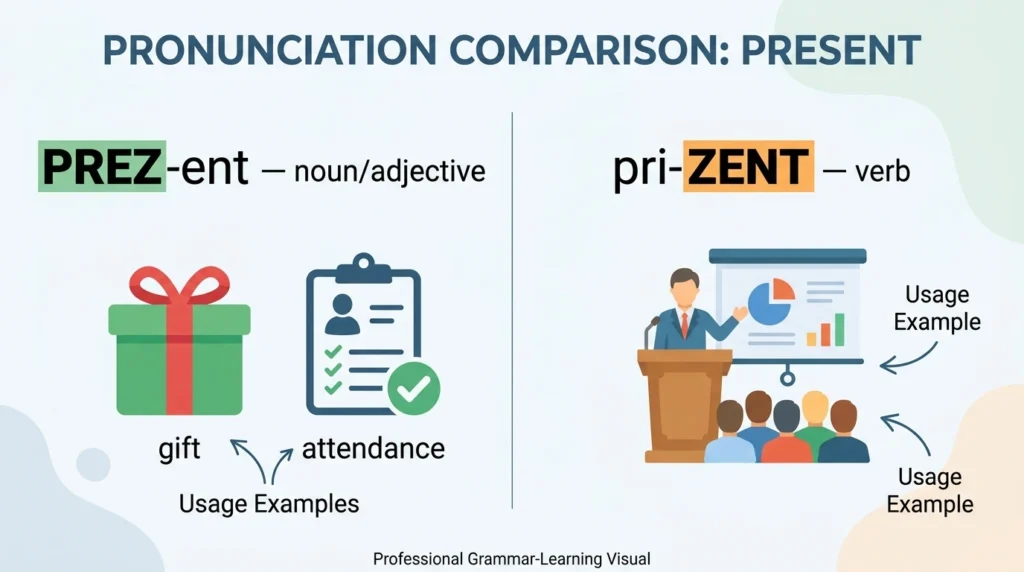
As a noun or adjective, the stress normally falls on the first syllable:
PREZ-ent
/ˈprez.ənt/
As a verb, the stress normally moves to the second syllable:
pri-ZENT
/prɪˈzent/
For example:
I received a PREZ-ent.
Everyone is PREZ-ent.
I will pri-ZENT the report.
The spelling remains identical even though the stress changes. This noun/adjective-versus-verb pronunciation distinction is recognized in both major British and American pronunciation references.
Correct Examples of Present
Here are original examples covering everyday conversation, school, work, email, social media, and academic contexts.
| Context | Correct Example | Use of Present |
|---|---|---|
| Conversation | I bought Dad a small present for his birthday. | Noun: gift |
| Conversation | I am trying to enjoy the present instead of planning everything. | Noun: current time |
| School | Every student must be present before the examination begins. | Adjective: in attendance |
| School | Sara will present her science project on Thursday. | Verb: explain/show |
| Workplace | The present system creates unnecessary delays. | Adjective: current |
| Workplace | Our director will present the quarterly results at 10 a.m. | Verb: explain |
| Please present your receipt when collecting the equipment. | Verb: provide/show | |
| At present, we cannot confirm the delivery date. | Noun in fixed phrase | |
| Social media | My favorite birthday present was a handwritten letter. | Noun: gift |
| Meeting | Everyone present agreed with the revised schedule. | Adjective: attending |
| Academic writing | The present study examines changes in consumer behavior. | Adjective: current |
| Academic writing | The authors present three possible explanations for the results. | Verb: set out/explain |
| Ceremony | The mayor presented the medal to the firefighter. | Verb: awarded |
| General writing | Rising costs present a challenge for smaller businesses. | Verb: create/pose |
Present vs Presant: Incorrect vs Correct Examples
| ❌ Incorrect | ✅ Correct | Why |
|---|---|---|
| I bought her a birthday presant. | I bought her a birthday present. | The noun meaning “gift” is spelled present. |
| Everyone was presant at the meeting. | Everyone was present at the meeting. | The adjective meaning “in attendance” is present. |
| I will presant the report tomorrow. | I will present the report tomorrow. | The verb meaning “show or explain” is present. |
| The presant situation is difficult. | The present situation is difficult. | The adjective meaning “current” uses present. |
| Please presant your ID. | Please present your ID. | The verb meaning “show or provide” is present. |
| This was the best presant I received. | This was the best present I received. | Gifts are called presents, not presants. |
| The manager presanted the figures. | The manager presented the figures. | The past tense of the verb is presented. |
| She is presanting her research. | She is presenting her research. | The -ing form is presenting. |
| Focus on the presant, not yesterday. | Focus on the present, not yesterday. | The noun for the current time is present. |
| Your presant plan needs revision. | Your present plan needs revision. | When meaning “current,” use present. |
| The award was presanted yesterday. | The award was presented yesterday. | The correct past participle is presented. |
| All members presant voted yes. | All members present voted yes. | Here present means members who were there. |
Why Do People Spell Present as Presant?
Phonetic Similarity
The biggest reason is pronunciation.
In the noun and adjective present, the second syllable contains a weak vowel sound called a schwa. A schwa is the relaxed “uh”-like sound heard in many unstressed English syllables.
Because this vowel is weak, simply listening to the word does not always tell a learner which written vowel belongs there.
That can make presant look plausible even though present is the established spelling.
Read More: Kinesthesiology vs Kinesiology: What’s the Difference?
English Does Not Always Spell Weak Vowels Predictably
English spelling does not consistently assign one written vowel to every schwa sound.
An unstressed vowel may be written with a, e, i, o, or another pattern depending on the word.
Trying to spell every unfamiliar word exactly as it sounds can therefore produce mistakes.
Confusion Between -ant and -ent Endings
English contains many words ending in both -ant and -ent.
Examples include:
-ant: important, pleasant, assistant
-ent: different, excellent, permanent
Because both endings are common, writers sometimes overgeneralize a familiar pattern and produce presant.
The safest solution is to memorize the whole word present, rather than guessing its ending.
Fast Typing
Typing quickly encourages phonetic spelling and unnoticed substitutions.
Someone who knows the correct form may still type:
presant
instead of:
present
This is a typing error rather than evidence that the two spellings are interchangeable.
Autocomplete and Spellcheck Limits
Spellcheck can catch many spelling errors, but no automated tool should replace knowing the correct form.
Names, usernames, custom dictionaries, multilingual keyboards, and previously learned typing patterns can sometimes prevent an unusual spelling from being corrected automatically.
Proofreading still matters.
Translation Interference
English learners sometimes carry spelling expectations from another language into English.
A familiar sound may normally correspond to a particular vowel in the learner’s first language. English may spell the same or a similar sound differently.
The solution is not to avoid using pronunciation. Instead, combine pronunciation with repeated exposure to the correct written form:
present, present, present
Common Mistakes Checklist
Use this checklist whenever you are unsure about presant or present:
- Writing presant for a gift: Use present — “a birthday present.”
- Writing presant for attendance: Use present — “Everyone is present.”
- Changing the spelling when it becomes a verb: Do not change it. Write present even though the pronunciation shifts to pri-ZENT.
- Writing presanted: The correct past form is presented.
- Writing presanting: The correct -ing form is presenting.
- Assuming different meanings require different spellings: Gift, current time, attendance, and the verb all use present.
- Relying only on how the unstressed vowel sounds: Weak English vowels do not always reveal their spelling.
- Confusing present with presence: Present and presence are related but grammatically different words.
Present vs Presant in Real English
Grammatically Correct English
In standard written English, present is the form to use for the ordinary word. It works naturally in sentences such as “She is present,” “I bought a present,” and “They will present the proposal.” What changes is the grammatical role and sometimes the pronunciation. The spelling remains stable. Presant should therefore be corrected when it is intended to represent this common English word.
Grammatically Possible but Unnatural Usage
Using present does not automatically make every sentence sound natural. For example, “I presented my friend a birthday gift” may be understandable, but many speakers would naturally say, “I gave my friend a birthday present.” Likewise, “I am present at home now” is grammatical in a narrow sense but unusually formal for everyday conversation. Natural wording depends on context, not spelling alone.
Natural Everyday English
In everyday speech, people commonly say birthday present, be present, or simply be here, depending on the situation. In business or school settings, present a report, present your findings, and present an idea sound completely natural. For current time, speakers often prefer right now, currently, or at the moment, while at present remains correct but can sound slightly more formal.
Read More: Encode vs Incode: Which Is Correct and When Should You Use Each?
Formal vs Informal Usage of Present
The spelling does not change between formal and informal English, but some uses of present belong more naturally to certain registers.
| Meaning | More Formal | More Conversational |
|---|---|---|
| Current situation | At present, applications are closed. | Applications are closed right now. |
| Give information | She presented the findings. | She showed us the results. |
| Give an award | They presented him with a medal. | They gave him a medal. |
| Attendance | All employees must be present. | Everyone needs to be there. |
| Gift | I bought her a present. | I got her a present. |
Present itself is not an excessively formal word. Context determines whether a simpler alternative sounds more natural.
Present vs Presant Comparison Table
| Feature | Present | Presant |
|---|---|---|
| Standard English word? | Yes | No, when intended as the common word |
| Correct spelling for a gift? | Yes | No |
| Correct spelling for current time? | Yes | No |
| Correct spelling for attendance? | Yes | No |
| Correct verb meaning show/explain? | Yes | No |
| Can function as a noun? | Yes | No standard common-word use |
| Can function as an adjective? | Yes | No standard common-word use |
| Can function as a verb? | Yes | No standard common-word use |
| Noun/adjective pronunciation | PREZ-ent | Not applicable as this word |
| Verb pronunciation | pri-ZENT | Not applicable as this word |
| Past verb form | presented | Not presanted |
| -ing form | presenting | Not presanting |
| Accepted in American English? | Yes | Not as an alternative spelling |
| Accepted in British English? | Yes | Not as an alternative spelling |
Memory Trick for Present vs Presant
Remember this sentence:
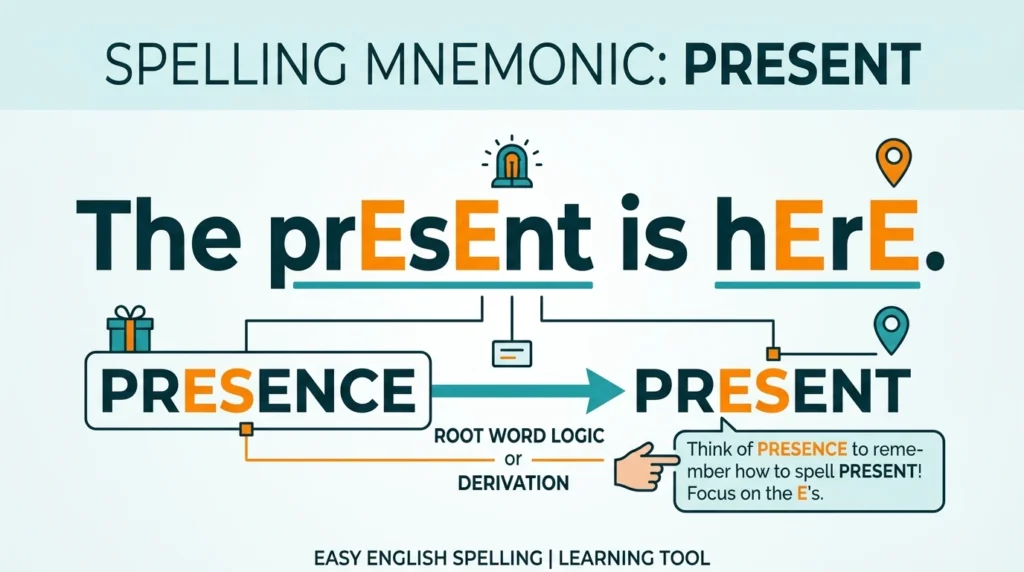
The prEsEnt is hErE.
The three capital E letters remind you that present contains e, not a.
You can also connect the related word presence:
presence → present
Both begin with presen-.
If you remember that someone who is present has a presence, the spelling becomes much easier to retain.
A Five-Step Way to Choose the Correct Spelling
- Ask whether you mean a gift, current time, attendance, or showing something.
- If you do, write present.
- Check whether the word is acting as a noun, adjective, or verb.
- Change the pronunciation when necessary, but never change the spelling to presant.
- Proofread forms such as presented, presenting, and presents before submitting important writing.
Real-Life Situations Using Present Correctly
Job Interview
An interviewer asks whether you can explain a previous project.
“Yes. I can present a short overview of the campaign and its results.”
Here, present is a verb meaning explain or show.
Business Meeting
Your manager checks attendance.
“All department heads are present, so we can begin.”
Here, present means physically attending the meeting.
Professional Email
You need to explain the company’s current position.
“At present, we are reviewing the revised contract.”
The phrase at present means currently.
Text Message
You are shopping for a friend’s birthday.
“Have you already bought Mia a present?”
Here, present is a noun meaning gift.
School Presentation
A teacher assigns speaking times.
“I have to present my history project after lunch.”
Here, the verb means formally show or explain information.
Exam
A sentence asks you to identify someone who attended an event.
“Everyone present signed the attendance sheet.”
Here, present is an adjective describing the people who were there.
Present, Presence, Presents, and Presently
Learning a few related forms prevents additional mistakes.
| Word | Meaning | Example |
|---|---|---|
| present | gift, current, attending, or show/give | She will present the award. |
| presents | plural gifts or third-person verb form | He presents the news every Friday. |
| presented | past tense/past participle | They presented the results yesterday. |
| presenting | -ing verb form | She is presenting the proposal. |
| presence | state or fact of being somewhere | His presence changed the mood. |
| presently | currently or, in some contexts, soon | She is presently unavailable. |
Be especially careful with present and presence.
✅ Your presence is required.
✅ You must be present.
The meanings are related, but the words perform different grammatical jobs.
Read More: Realist vs Realest: What Is the Difference?
Expert Tips for Remembering and Using Present
Learn the Word as a Family
Do not memorize present by itself.
Learn:
present → presents → presented → presenting → presence
Seeing the shared presen- pattern strengthens spelling memory.
Separate Spelling From Pronunciation
One of the most useful lessons from this word is that pronunciation and spelling do not always change together.
Say:
PREZ-ent — noun/adjective
pri-ZENT — verb
But write:
present
in both cases.
Use Meaning Before Grammar Labels
If grammar terminology feels difficult, begin with the meaning.
Ask:
Am I talking about a gift?
Am I talking about now?
Am I saying someone is here?
Am I talking about showing or explaining something?
If yes, present is probably the word you need.
Do Not Overcorrect
Once learners discover that presant is wrong, they sometimes become suspicious of every form containing present.
Forms such as presents, presented, and presenting are perfectly normal.
The mistake lies in replacing the e with an a, not in changing the word according to ordinary grammatical rules.
FAQ
Is Presant a Real English Word?
Presant is not the standard spelling of the common English word present. If you mean a gift, the current time, attendance, or the verb meaning to show or give something, write present.
Presant can occur as a surname or other proper name, but that is separate from the ordinary vocabulary word.
Is It Presant or Present for a Gift?
Use present.
Correct: I bought her a birthday present.
Incorrect: I bought her a birthday presant.
The plural is presents.
How Do You Spell Present When Giving a Presentation?
It is still spelled present.
I will present the proposal tomorrow.
The pronunciation changes to pri-ZENT, but no spelling change occurs.
Can Present Be Both a Noun and a Verb?
Yes. Present can be a noun, adjective, and verb.
As a noun:
This present is for you.
As a verb:
I will present the results.
As an adjective:
Everyone is present.
Why Does Present Have Two Pronunciations?
English sometimes uses stress to distinguish related grammatical forms.
The noun and adjective present generally stress the first syllable, while the verb stresses the second. The spelling remains unchanged.
What Is the Past Tense of Present?
The past tense and past participle are presented.
She presented the proposal yesterday.
Do not write presanted.
What Is the -ing Form of Present?
The correct form is presenting.
The professor is presenting new evidence.
The spelling continues to use e in the base word.
Is Present Spelled Differently in British and American English?
No standard regional spelling distinction changes present to presant. The ordinary word is spelled present in both major varieties of English.
Is Present the Same as Presence?
No.
Present can mean being somewhere:
She was present.
Presence is a noun meaning the state or fact of being there:
Her presence was appreciated.
Does Present Always Mean “Now”?
No. That is only one of its meanings.
Present may refer to current time, a gift, attendance, something currently existing, or the act of showing, giving, introducing, or explaining something.
Mini Quiz: Present vs Presant
| # | Question | Answer | Explanation |
|---|---|---|---|
| 1 | Fill in the blank: Everyone was ___ at the meeting. | present | Present means physically in attendance. |
| 2 | Choose: I bought him a present / presant. | present | A gift is spelled present. |
| 3 | Correct the sentence: “I will presant my findings tomorrow.” | I will present my findings tomorrow. | The verb meaning show or explain is present. |
| 4 | Which pronunciation is normally used for the verb: PREZ-ent or pri-ZENT? | pri-ZENT | The verb normally stresses the second syllable. |
| 5 | Fill in the blank: The ___ policy expires next month. | present | Here present means current. |
| 6 | Correct the sentence: “She presanted the award last night.” | She presented the award last night. | The correct past tense is presented. |
| 7 | Which is correct: “at present” or “at presant”? | at present | The fixed expression meaning currently uses present. |
| 8 | Fill in the blank: He is ___ the sales figures now. | presenting | The correct -ing form is presenting. |
| 9 | Which word completes the sentence: “Your ___ is required at the ceremony”—present or presence? | presence | The sentence needs a noun meaning the fact of being there. |
| 10 | True or false: Presant is an accepted alternative spelling of present in ordinary American or British English. | False | Use present for the standard English word. |
Quick Summary
Present is the correct spelling when you mean a gift, the current period, something current, a person being in attendance, or the act of showing, explaining, offering, or formally giving something. Presant is not an alternative spelling of this standard English word. Present can work as a noun, adjective, or verb, and its pronunciation changes with its grammatical role: the noun and adjective are usually pronounced PREZ-ent, while the verb is pri-ZENT. The easiest way to avoid the mistake is to remember the spelling family present, presence, presented, presenting. Whether you are writing an email, essay, report, text message, or presentation, use present, not presant.
Also Read: Nonresponsive vs Unresponsive: Both Are Correct; Context Decides