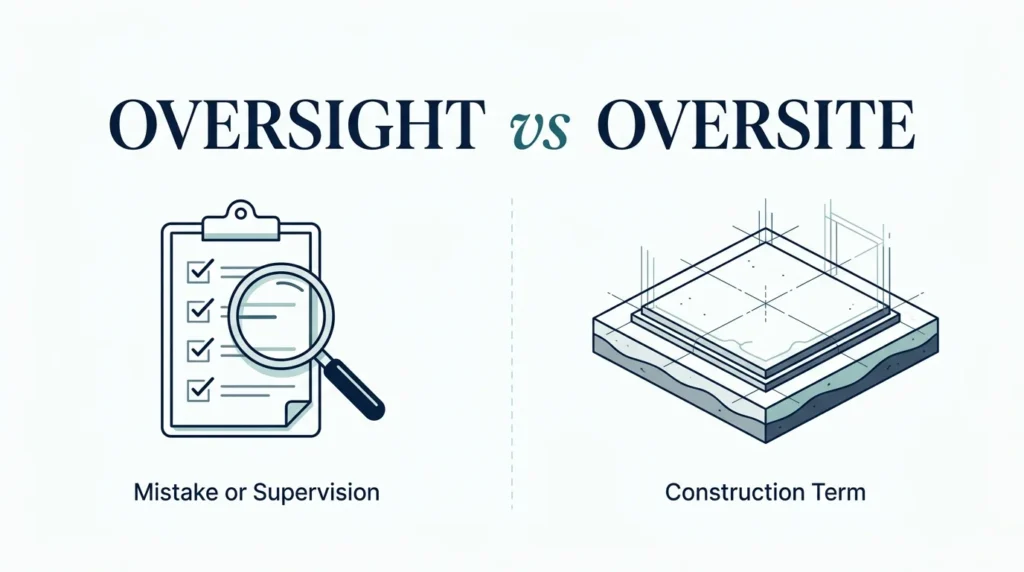

The difference between oversight and oversite depends on meaning and context. Oversight is the standard English word for supervision or an accidental mistake, such as forgetting to attach a file to an email. Oversite is a rare, specialized term used in some construction contexts for a prepared surface or layer beneath a building floor. If you are writing an everyday message, business report, essay, or academic paper, oversight is usually the word you need.
What Is Oversight vs Oversite?
Although these words look and sound similar, they are not interchangeable. One has two common meanings in everyday English, while the other has a narrow technical use.
What Does Oversight Mean?
Oversight is a noun with two established meanings:
- An accidental mistake or omission: Something you unintentionally forget, miss, or fail to notice.
- Supervision or monitoring: The process of watching over an activity, organization, person, or project to ensure it is managed properly.
Consider these examples:
- “Leaving the invoice out of the report was an oversight.” Here, oversight means an accidental omission.
- “The committee provides financial oversight.” Here, oversight means supervision and monitoring.
The surrounding sentence tells you which meaning applies.
What Does Oversite Mean?
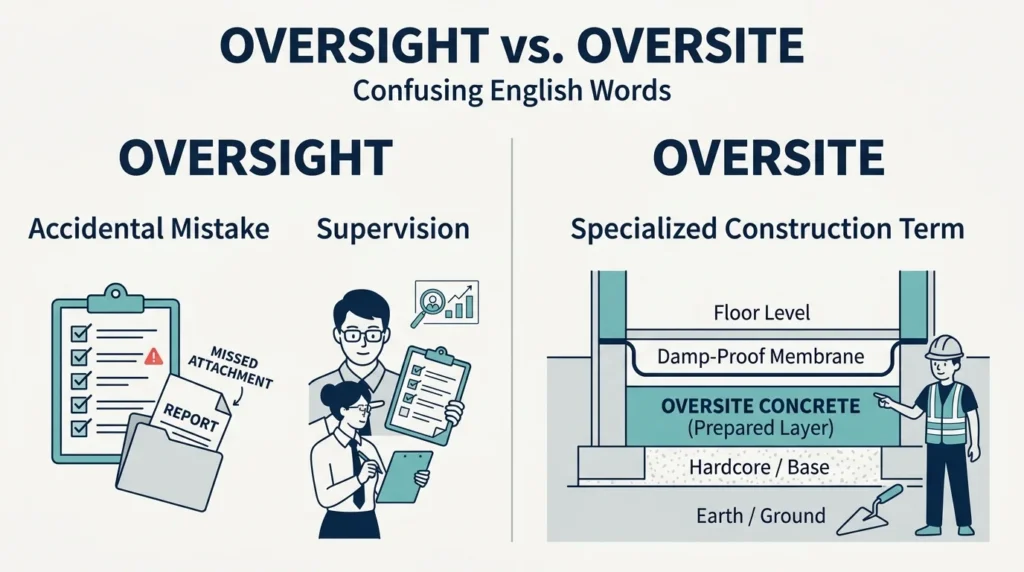
Oversite is an uncommon technical term found in some construction terminology, particularly in British building contexts. It can refer to a prepared surface or layer beneath a building floor, including a concrete layer associated with the floor’s construction.
For example:
“The contractor inspected the oversite before the next stage of floor construction.”
Here, the word refers to a construction element, not a forgotten detail or a supervisory responsibility.
Because this usage is specialized and terminology can vary between regions and technical specifications, use oversite only when the construction context supports that meaning. It is not an alternative spelling of oversight in ordinary writing.
Why the Difference Matters
Choosing the wrong word can change the meaning of a sentence or make a professional document look less reliable.
Imagine that you have forgotten to include an important attachment in a business email. You write:
“The missing attachment was an oversite.”
Your reader may understand what you mean, but the spelling is incorrect for this context. The correct sentence is:
“The missing attachment was an oversight.”
Now consider a construction report describing a prepared layer beneath a floor. In that specialized context, oversite may be appropriate.
The distinction matters in several situations:
- Business writing: Use oversight when discussing management, supervision, or an accidental omission.
- Academic writing: Use oversight when describing a missed reference, calculation, or requirement.
- Construction documents: Use oversite only when it matches the technical terminology being used.
- Everyday communication: Use oversight when you mean a mistake or something you failed to notice.
The safest approach is to identify the intended meaning before choosing the spelling.
The Core Rule
Remember this simple rule
Oversight = a mistake or supervision
Use it for a forgotten detail, an accidental omission, or the act of monitoring an activity.
Example: “The missing signature was an oversight.”
Oversite = a specialized construction term
Use it when discussing the relevant prepared surface or layer in building work.
Example: “The builder inspected the oversite.”
If you are not discussing construction, oversight is almost certainly the correct choice when you mean a mistake or supervision.
How to Use Oversight and Oversite
When to Use Oversight for a Mistake
Use oversight when someone unintentionally misses, forgets, or leaves out something important.
The word usually suggests that the error was accidental rather than deliberate.
Examples:
- Forgetting to attach a document was an oversight.
- The editor corrected an oversight before publication.
- Leaving the date off the application was a minor oversight.
- The team apologized for the oversight in its final report.
Notice that oversight is a noun in each sentence. It names the mistake rather than describing the action of making it.
You can also use it with adjectives such as minor, simple, unintentional, and costly.
For example: “A minor oversight delayed the approval process.”
When to Use Oversight for Supervision
Use oversight when referring to the monitoring, supervision, or responsible control of an activity.
This meaning is common in business, government, education, finance, and law.
Examples:
- The board provides oversight of the company’s finances.
- The project requires close managerial oversight.
- Independent oversight can improve accountability.
- The agency operates under government oversight.
In these examples, oversight is not a mistake. It is a responsibility or process.
This is an important distinction because the same word can describe both an accidental failure and a formal supervisory function.
When to Use Oversite in Construction
Use oversite only when the intended meaning matches a recognized construction usage.
For instance, a building specification might refer to an oversite layer or oversite concrete in connection with floor construction. The precise material and construction method depend on the project and the terminology used in its technical documents.
Examples:
- The contractor checked the oversite before proceeding.
- The specification referred to oversite concrete beneath the floor.
- The site engineer reviewed the prepared surface before the next construction stage.
These are technical examples. In an actual construction document, follow the project’s specifications and the terminology accepted by the relevant professionals.
Do not use oversite simply because a mistake happened at a construction site. The word describes a specialized construction concept, not any event that occurs at a site.
Correct Examples of Oversight and Oversite
The following examples show how each word works in different contexts.
Everyday Conversation
- “Sorry, forgetting your birthday was a complete oversight.”
- “I noticed an oversight in the shopping list.”
Both sentences describe something accidentally missed or forgotten.
Business Emails
- “Please accept my apologies for the oversight in yesterday’s email.”
- “The missing attachment was an oversight, and I have included it now.”
Here, oversight acknowledges an unintentional mistake without suggesting that it was deliberate.
Workplace and Management
- “The department head is responsible for financial oversight.”
- “The project will continue under the oversight of the senior manager.”
Both examples use oversight to mean supervision.
School and Academic Writing
- “The student corrected an oversight in the bibliography before submitting the paper.”
- “The research project was conducted under the oversight of the university committee.”
The first example describes an omission; the second describes supervision.
Social Media
9. “I posted the wrong date because of an oversight. The correct date is Friday.”
This is a natural use of oversight when acknowledging a mistake publicly.
Construction
10. “The contractor checked the oversite before the floor installation continued.”
This example uses oversite in its specialized construction sense.
11. “The building specification identifies the required oversite concrete.”
Again, the word belongs to a technical construction context.
12. “The project manager provides oversight of the construction schedule.”
This example returns to the common word oversight, because it refers to supervision rather than a building layer.
Read More: Alot vs. A Lot vs. Allot: The Spelling Mistake to Avoid.
Incorrect vs. Correct: Oversight vs Oversite
The following table shows common errors, the appropriate correction, and the reason for each change.
| ❌ Incorrect | ✅ Correct | Why |
|---|---|---|
| Forgetting the file was an oversite. | Forgetting the file was an oversight. | The sentence describes an accidental omission. |
| The missing signature was an oversite. | The missing signature was an oversight. | A missed signature is an unintentional mistake. |
| Please excuse my oversite. | Please excuse my oversight. | The writer is apologizing for a mistake. |
| It was an oversite in the report. | It was an oversight in the report. | The sentence concerns an error or omission. |
| The manager provides financial oversite. | The manager provides financial oversight. | The manager supervises financial activities. |
| The board has regulatory oversite. | The board has regulatory oversight. | The intended meaning is supervision or monitoring. |
| We identified several oversites during editing. | We identified several oversights during editing. | The plural of oversight is oversights. |
| Her oversite delayed the application. | Her oversight delayed the application. | The sentence refers to an accidental failure. |
| The committee needs stronger independent oversite. | The committee needs stronger independent oversight. | The sentence describes institutional supervision. |
| She is responsible for project oversite. | She is responsible for project oversight. | The intended meaning is project supervision. |
Important exception: The spelling oversite is not automatically wrong in every possible sentence. In a suitable construction context, it may be the correct technical term. The corrections above apply because each sentence intends to express a common meaning of oversight.
Why People Confuse Oversight and Oversite
Several features of English make this spelling pair easy to mix up.
1. They Look Almost Identical
The words differ by only the letters at the end: oversight contains ght, while oversite contains te.
When typing quickly, a writer may overlook this difference. Familiarity with the word site can also make oversite look plausible.
However, visual similarity does not make two words interchangeable.
2. They Sound the Same in Common Pronunciation
In many varieties of English, oversight and oversite are pronounced identically or nearly identically.
This makes the distinction harder to recognize in conversation. A person may know the correct word when reading it but choose the wrong spelling when writing from memory.
The solution is to connect the spelling with the intended meaning rather than relying on pronunciation alone.
3. The Word Oversight Has Two Meanings
The same word can mean an accidental mistake or a supervisory function.
Compare:
- “The missing figure was an oversight.”
- “The committee provides oversight of public spending.”
The first describes something missed; the second describes monitoring. Because these meanings differ, writers sometimes focus on the general idea of looking over something instead of remembering the correct spelling.
4. Spellcheck Cannot Always Identify the Intended Meaning
A spellchecker can detect many spelling errors, but it cannot always determine which word belongs in a sentence.
A tool might flag oversite, or it might accept it because the term exists in a specialized context. Either way, the writer must consider the meaning.
For example, a construction document may legitimately contain oversite, while a business apology usually requires oversight.
5. Translation Can Encourage the Wrong Spelling
English learners sometimes translate a concept from another language and then choose an English spelling based on how the word sounds or looks.
This is especially likely when the learner has learned site as a word for a location but has not encountered the specialized term oversite.
Instead of translating word by word, identify the intended idea first:
- An accidental omission → oversight
- Supervision or monitoring → oversight
- A relevant technical construction layer → oversite
That meaning-first approach is more reliable than guessing from spelling.
Common Mistakes Checklist
Use this checklist when proofreading your writing.
- Writing oversite when you mean a mistake. Replace it with oversight because the sentence describes an accidental omission.
- Writing oversite when you mean supervision. Use oversight for monitoring, control, or accountability.
- Assuming oversite is never a word. Recognize its specialized construction usage, but do not apply that meaning to everyday sentences.
- Assuming oversight always means a mistake. Check whether the context describes an error or a supervisory responsibility.
- Using oversight as a verb. Use oversee for the action: “She oversees the project.”
- Misspelling the plural. Write oversights, not oversites, when referring to multiple mistakes or supervisory functions.
- Trusting autocorrect without checking the sentence. Read the full sentence to confirm that the selected word expresses the intended meaning.
Oversight vs Oversite in Real English
Grammatically Correct
Both words can be correct nouns when used in their appropriate senses. Oversight is standard in ordinary English for an accidental omission or an act of supervision. Oversite can occur in specialized construction terminology. For example, “The missing attachment was an oversight” is correct for an accidental omission, while “The contractor inspected the oversite” may be correct in the appropriate technical context. The surrounding subject matter determines the choice.
Grammatically Possible but Unnatural
A sentence can be structurally understandable yet use the wrong word for its intended meaning. For example, “The team apologized for its oversite” may be easy to understand, but it is not the normal spelling when the team is apologizing for a mistake. The correction is “The team apologized for its oversight.” This is not a difference in sentence structure; it is a matter of selecting the right word for the meaning.
Natural, Everyday English
In everyday conversation, workplace emails, school assignments, and general articles, oversight is the natural choice when discussing a missed detail or supervision. People commonly write phrases such as “a simple oversight,” “an honest oversight,” and “financial oversight.” The construction term oversite is much less likely to appear outside its technical field. Unless the sentence specifically concerns that construction usage, choose oversight.
American vs British English
There is no general American-versus-British spelling change that turns oversight into oversite.
The ordinary word oversight retains the same spelling in both varieties of English and can mean either an accidental omission or supervision.
The specialized construction term oversite is associated particularly with British building terminology. Its use depends on the technical context, not on a general rule that British English replaces -sight with -site.
| Feature | American English | British English |
|---|---|---|
| Accidental mistake | Oversight | Oversight |
| Supervision | Oversight | Oversight |
| Specialized construction term | Usage depends on technical terminology | Oversite may be used in building terminology |
| General writing | Oversight | Oversight |
For everyday writing in either variety, choose oversight when you mean a mistake or supervision.
Formal vs Informal Usage
Formal Writing
Oversight is appropriate in professional reports, legal documents, academic papers, corporate policies, and official correspondence.
Examples:
- “The audit identified an oversight in the reporting process.”
- “The committee is responsible for regulatory oversight.”
- “We apologize for the oversight and have corrected the record.”
In formal writing, the intended meaning should be clear from the surrounding sentence.
Informal Writing
The same spelling applies in texts, chats, social media posts, and everyday conversations.
Examples:
- “Sorry, that was my oversight.”
- “I made a small oversight when I checked the list.”
- “Thanks for catching that oversight!”
There is no need to change the spelling just because the tone is casual.
Technical Construction Writing
In construction specifications, drawings, or reports, oversite may be appropriate when it is the established term for the relevant building element. Follow the terminology used by the project team and technical documentation.
Comparison Table: Oversight vs Oversite
| Feature | Oversight | Oversite |
|---|---|---|
| Part of speech | Noun | Noun in specialized usage |
| Main meaning | Accidental mistake or omission | A construction-related surface or layer |
| Meaning: supervision | Yes | No |
| Meaning: accidental mistake | Yes | No |
| Everyday English | Common | Rare |
| Business and government | Common | Not the usual term |
| Academic writing | Common when relevant | Only in an appropriate technical context |
| Construction terminology | May refer to supervision | May refer to a building element |
| Plural | Oversights | Oversites, where the technical noun is used |
| Best memory clue | Sight and noticing | Site and construction |
Memory Trick: Sight or Site?
The easiest way to remember the difference is to connect each spelling with a familiar word.
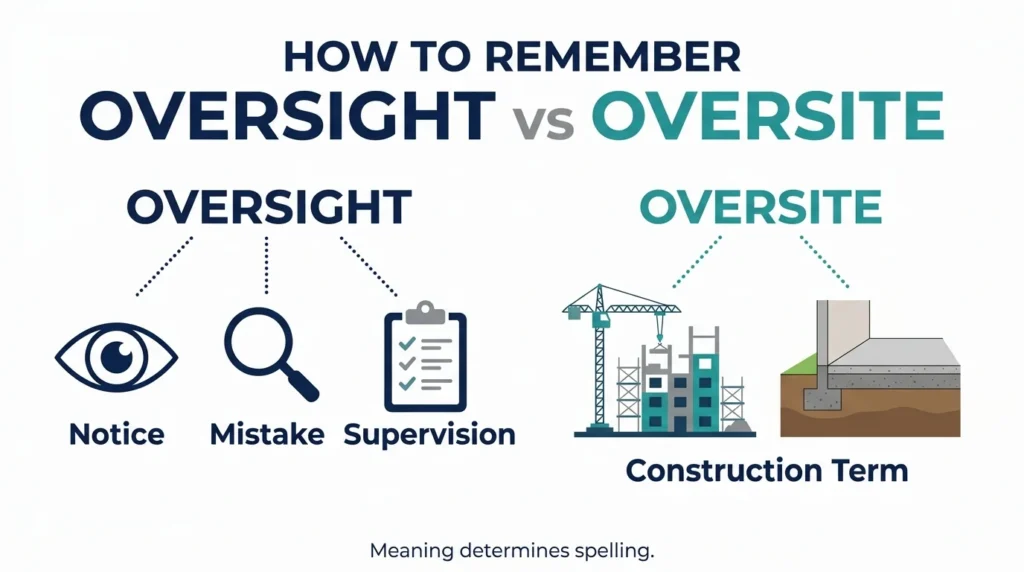
Oversight → sight → seeing or noticing
If you failed to notice a missing attachment, you made an oversight.
Oversite → site → construction site
If you are discussing a specialized layer or prepared surface in building work, oversite may be the correct term.
Remember that this is a memory aid, not a complete explanation of the word’s history. The reliable test is always the intended meaning.
Read More: Appendices vs Appendixes: Which Is Correct?
Real-Life Situations
Situation 1: A Missed Attachment in an Email
You send a proposal to a client but forget to attach the file.
Correct: “Apologies for the oversight. I have attached the proposal now.”
Why: You unintentionally left something out.
Situation 2: A Mistake in a School Assignment
You submit an essay and later notice that you omitted an important reference.
Correct: “I corrected the oversight in my revised assignment.”
Why: The missing reference was an accidental omission.
Situation 3: A Company Meeting
A manager explains who monitors the company’s spending.
Correct: “The finance committee provides oversight of the budget.”
Why: The committee supervises or monitors financial activity.
Situation 4: A Job Interview
An interviewer asks how you respond to errors.
Correct: “If I discover an oversight, I acknowledge it, correct it, and improve my checking process.”
Why: Oversight describes an unintentional mistake.
Situation 5: A Construction Inspection
A building professional reviews the prepared layer beneath a floor.
Potentially correct: “The inspector checked the oversite before work continued.”
Why: This uses the specialized construction meaning. Confirm that oversite is the term used in the relevant project documentation.
Expert Tips for Choosing the Right Word
- Decide what the sentence means before checking its spelling. If it concerns a missed detail or supervision, use oversight.
- Remember that oversight can be positive or negative in context. An accidental oversight is a mistake; independent oversight is a supervisory function.
- Use oversee when describing the action. Write “The director oversees the project,” not “The director oversights the project.”
- Check the whole sentence, not just the word. Spellcheck tools may not understand whether you intend a common word or a specialized technical term.
- Use technical terminology carefully. In construction writing, verify the intended meaning of oversite against the relevant specifications rather than assuming it refers to any construction site.
- Do not confuse a rare word with a spelling variant. A specialized term can be valid in one context without being interchangeable with a common word.
Read More: Sence vs Sense: Which Spelling Is Correct?
Quick Summary
Oversight and oversite look and sound similar, but they have different uses. Oversight is the standard English noun for an accidental mistake, omission, or act of supervision. It belongs in everyday conversations, business emails, academic papers, and professional reports. Oversite is a rare technical term used in some construction contexts to describe a prepared surface or layer beneath a building floor. It is not a replacement for oversight when describing a mistake or supervisory responsibility. To remember the distinction, connect oversight with noticing or monitoring and oversite with construction terminology. When in doubt, identify the meaning first, then choose the spelling that fits.
Frequently Asked Questions
Is oversite a real word?
Yes. Oversite is used as a specialized construction term in some building contexts. It is not the standard spelling when you mean an accidental mistake or supervision; those meanings require oversight.
Is oversight or oversite correct when referring to a mistake?
Oversight is correct. For example, “Leaving the date off the form was an oversight.” The word describes something unintentionally missed, forgotten, or omitted.
Can oversight mean both a mistake and supervision?
Yes. Oversight has both meanings. “The missing signature was an oversight” describes an accidental omission, while “The board provides oversight” describes supervision or monitoring.
How do you spell oversight in the plural?
The plural is oversights. For example, “The editor identified three oversights in the report.” The spelling does not change to oversites when you mean multiple mistakes.
What is the difference between oversight and oversee?
Oversight is a noun, while oversee is a verb. You provide oversight of a project, but you oversee the project. The past tense of oversee is oversaw, and its past participle is overseen.
Is oversight a positive or negative word?
It depends on the meaning. When oversight means an accidental omission, it generally describes a problem. When it means supervision, as in “independent oversight,” it can describe a useful process that promotes accountability.
Is oversite correct in British English?
Oversite appears in some British construction terminology, but it is not a general British alternative to oversight. British writers use oversight for both accidental omissions and supervision.
Can I use oversite in a business report?
Only if the report genuinely concerns the specialized construction meaning and the terminology is appropriate. If you mean a missed detail, a mistake, or supervision, use oversight.
Why does spellcheck sometimes miss this mistake?
Spellcheck tools do not always understand the meaning of a sentence. A specialized word may be valid in one context but incorrect in another. Proofread the sentence to ensure the spelling matches your intended meaning.
What is the easiest way to remember oversight vs oversite?
Connect oversight with sight and noticing something. Connect oversite with a construction site. This memory aid helps you distinguish the everyday word from its specialized technical counterpart.
Mini Quiz: Oversight vs Oversite
Choose the correct word or correct the sentence in each question. The answers and explanations are included so you can check your understanding.
| No. | Question | Answer and explanation |
|---|---|---|
| 1 | Forgetting to include the invoice was an (oversight / oversite). | Answer: oversight. The missing invoice is an accidental omission. |
| 2 | The board provides financial (oversight / oversite). | Answer: oversight. The board monitors financial activities. |
| 3 | Fill in the blank: “Please accept my apologies for the ____ in the report.” | Answer: oversight. The sentence refers to a mistake or omission. |
| 4 | Correct the sentence: “The manager oversights the project.” | Answer: “The manager oversees the project.” Oversee is the verb meaning to supervise. |
| 5 | The contractor inspected the prepared construction layer, referred to in the project documents as the (oversight / oversite). | Answer: oversite. The technical construction meaning supports this spelling. |
| 6 | True or false: Oversight always means a mistake. | Answer: False. It can also mean supervision or monitoring. |
| 7 | Fill in the blank: “The editor found several ____ in the final draft.” | Answer: oversights. Oversights is the plural when referring to multiple omissions or mistakes. |
| 8 | Correct the sentence: “The committee is responsible for regulatory oversite.” | Answer: “The committee is responsible for regulatory oversight.” The sentence concerns supervision, not a construction element. |
| 9 | Which spelling belongs in a normal apology for forgetting an appointment detail: oversight or oversite? | Answer: oversight. It describes an unintentional mistake. |
| 10 | Choose the best sentence: (A) “The agency provides independent oversite.” (B) “The agency provides independent oversight.” | Answer: B. Oversight is the established term for independent supervision. |