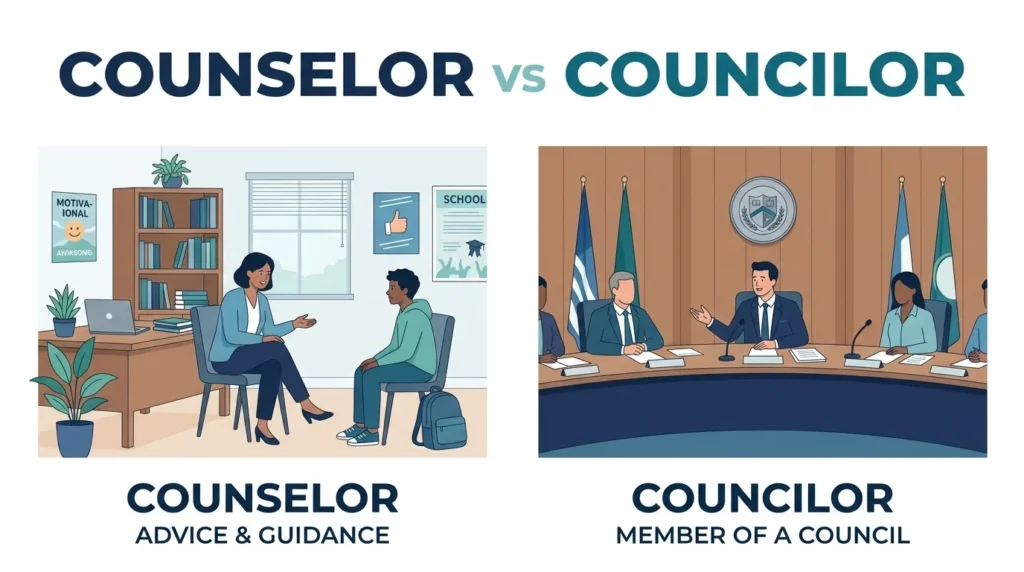

The difference between counselor and councilor is their meaning. A counselor gives advice, guidance, or professional support, while a councilor is a member of a council, often in local government. Both spellings are correct in American English, but they describe different roles. Remember this simple rule: counselor is connected with counsel (advice), while councilor is connected with council (a governing or advisory group).
What Is the Difference Between Counselor and Councilor?
A counselor is a person who provides advice, guidance, or counseling. Depending on the context, the word can describe a school counselor, career counselor, mental health counselor, or legal counselor.
A councilor is a person who serves on a council. The word commonly refers to an elected representative who helps make decisions for a town, city, or other local government.
The two words look and sound similar, but their meanings are different. Choosing the wrong one can change the meaning of your sentence.
Consider these examples:
- The school counselor helped Mia choose her college courses.
- The city councilor proposed a new public park.
In the first sentence, the person provides educational guidance. In the second, the person serves on a council and participates in public decisions.
Why the Difference Matters
Using the correct word helps readers understand someone’s job, responsibilities, and professional role.
This distinction is especially important in these situations:
- Education: A school counselor helps students with academic planning and personal concerns.
- Mental health: A counselor may provide professional support for emotional or psychological difficulties.
- Government: A councilor may vote on local policies, budgets, and community projects.
- Business writing: Correct job titles make reports, emails, and proposals more precise.
- Journalism: Confusing a counselor with a councilor can misrepresent someone’s role in a news story.
- Academic writing: Accurate terminology makes explanations and arguments clearer.
Both words are legitimate English nouns. The mistake is not using an unusual spelling; it is using the word that describes the wrong role.
The Core Rule
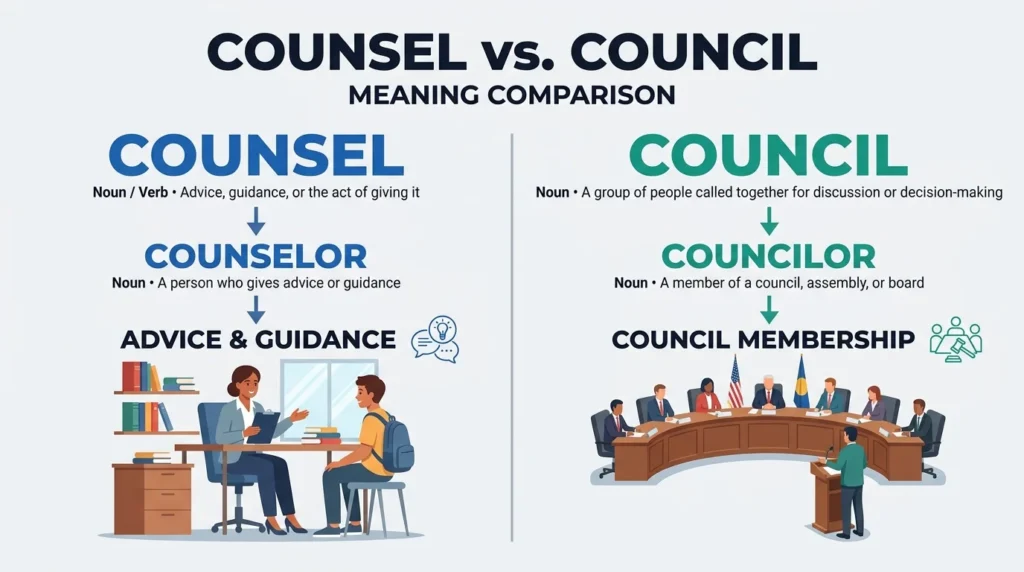
Counselor = advice or guidance
A counselor helps, advises, or supports someone.
Example: The counselor helped the student manage exam stress.
Councilor = member of a council
A councilor serves on a group that makes decisions or provides official advice.
Example: The councilor supported the new road-safety proposal.
The fastest way to choose is to identify what the person actually does. If the person provides counseling, use counselor. If the person belongs to a council, use councilor.
Read More: Nominator vs Nominee Differences: Meaning, Examples & Correct Usage.
How to Use Counselor and Councilor
When to Use Counselor
Use counselor when referring to someone whose role involves giving advice, guidance, or counseling. In American English, this spelling is standard.
Common examples include:
- School counselor: Helps students with educational choices and related concerns.
- Mental health counselor: Provides counseling and emotional support within their professional scope.
- Career counselor: Helps people explore careers and employment options.
- Camp counselor: Supervises or supports participants at a camp.
- Legal counselor: Provides legal advice or representation, depending on the context and jurisdiction.
Examples:
- The school counselor recommended three suitable university programs.
- I booked an appointment with a mental health counselor.
- A career counselor helped him prepare for his first interview.
- Each camp counselor was assigned a group of children.
- The company sought advice from its legal counselor.
The exact responsibilities depend on the person’s position and qualifications. The word itself does not guarantee a particular license or professional credential.
When to Use Councilor
Use councilor when referring to a person who serves on a council. In American English, this is a standard spelling for a council member.
Common examples include:
- City councilor: A member of a city council.
- Town councilor: A member of a town council.
- Local councilor: A representative serving on a local council.
- Councilor at a public meeting: A council member participating in official discussion.
- Councilor reviewing a proposal: A council member considering a local policy or project.
Examples:
- The councilor attended the public hearing.
- Our city councilor answered questions about the new budget.
- The councilor proposed improvements to the public library.
- Residents contacted their councilor about waste collection.
- The councilor voted against the proposed development.
A councilor’s specific powers depend on the council and its legal responsibilities. The essential point is that the person is a member of a council, not simply someone who gives advice.
Correct Examples of Counselor and Councilor
The following examples show how each word works in everyday, professional, academic, and public settings.
Examples Using Counselor
- Conversation: “I think you should speak to a counselor about the stress you’re experiencing.”
- Email: “Dear Ms. Ahmed, could you please arrange an appointment with the school counselor?”
- School: The counselor helped the student choose subjects for the next academic year.
- Workplace: Employees can contact the counselor for guidance on managing work-related concerns.
- Social media: Our school counselor shared practical tips for preparing for final exams.
- Academic writing: The study examined how counselors support students during major educational transitions.
- Career planning: A career counselor helped Daniel identify jobs suited to his interests.
- Family support: The couple decided to consult a marriage counselor.
- Summer camp: Every counselor received instructions about supervising outdoor activities.
- Legal setting: The attorney addressed the court as “Your Honor” and was referred to as counsel in the proceedings.
Examples Using Councilor
- Conversation: “Our councilor is attending the neighborhood meeting tonight.”
- Email: “Dear Councilor Malik, I am writing to raise concerns about the condition of our street.”
- Government: The councilor voted in favor of improving public transport.
- Workplace: The planning team presented its proposal to the councilor.
- Social media: The councilor announced a public meeting to discuss the new recycling program.
- Academic writing: The report examined how councilors participate in local decision-making.
- Community service: A councilor met residents to discuss access to public facilities.
- Public meeting: The councilor requested more information before voting on the proposal.
- Local development: The councilor supported a plan to renovate the community center.
- Journalism: The councilor answered questions about the municipality’s proposed budget.
Notice that both words can appear in formal and informal sentences. The difference is the role being described, not the seriousness of the situation.
Incorrect vs. Correct: 10 Common Mistakes
Both counselor and councilor are real words, so spell-check software may accept the wrong choice. Use the meaning and context to identify the correct form.
| ❌ Incorrect | ✅ Correct | Why |
|---|---|---|
| I spoke to a councilor about my anxiety. | I spoke to a counselor about my anxiety. | The person provides support, not council membership. |
| The counselor voted on the city budget. | The councilor voted on the city budget. | Voting as a council member points to councilor. |
| Our school councilor helped us select courses. | Our school counselor helped us select courses. | In the usual American usage, educational guidance is provided by a counselor. |
| The mental health councilor listened to her concerns. | The mental health counselor listened to her concerns. | A mental health professional provides counseling. |
| The city counselor proposed a new traffic policy. | The city councilor proposed a new traffic policy. | The person is acting as a member of the city council. |
| Please contact your councilor for career advice. | Please contact your counselor for career advice. | A career counselor provides professional guidance. |
| The councilor helped me deal with exam stress. | The counselor helped me deal with exam stress. | The intended role is counseling and support. |
| The counselor represented the neighborhood at the council meeting as an elected member. | The councilor represented the neighborhood at the council meeting as an elected member. | The sentence identifies an elected council member. |
| The councilor scheduled a therapy session with the student. | The counselor scheduled a therapy session with the student. | In the intended context, the person is providing counseling. |
| The counselor introduced a motion at the city council meeting in her official role as an elected member. | The councilor introduced a motion at the city council meeting in her official role as an elected member. | The official council role determines the word. |
Important: Some sentences can describe unusual but possible situations. For example, a councilor might also be a trained counselor. The correction depends on which role the sentence intends to identify.
Why People Confuse Counselor and Councilor
1. They Sound Almost Identical
In common American pronunciations, counselor and councilor are pronounced very similarly and may be indistinguishable in ordinary speech.
When you hear either word, you may not know which spelling the speaker intends. This is why the meaning of the sentence is often more useful than pronunciation.
2. Counsel and Council Look Similar
The base words differ by one letter:
- Counsel: Advice or guidance; it can also mean to give advice.
- Council: An organized group that discusses issues or makes decisions.
The endings -or create the names of people associated with these words, but the distinction between the base words remains important.
3. Spell-Checkers Accept Both Words
A spell-checker generally identifies recognized words, not necessarily the meaning intended in a sentence.
If you write, “The counselor voted on the municipal proposal,” a spelling checker may not flag the sentence. The word is spelled correctly, but it may not describe the person’s role.
4. Learners Overgeneralize Spelling Rules
English has many words that differ by only one letter yet carry different meanings. Learners sometimes assume that two similar-looking words are interchangeable or that one must be a spelling mistake.
Here, neither word is inherently incorrect. The correct choice depends on meaning.
5. Translation Can Hide the Difference
In some languages, one word may cover both advising someone and serving as an official adviser or representative. Translating that word directly into English can create confusion.
The safest approach is to identify the person’s actual duties before choosing an English term.
Common Mistakes Checklist
Use this checklist before publishing an article, sending an email, or completing an exam.
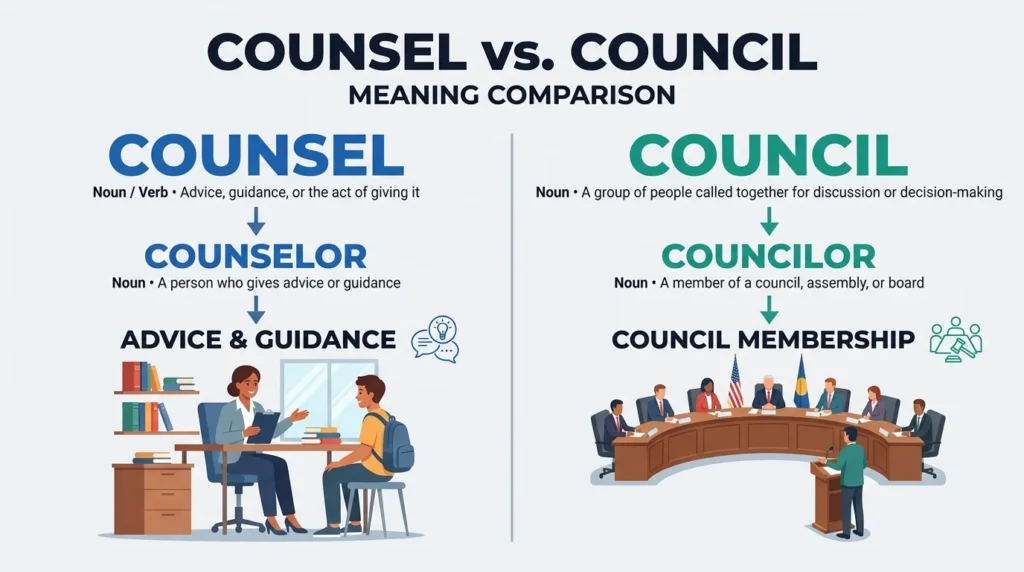
- Check the person’s job. If the person gives advice or professional support, counselor is usually right in American English.
- Check council membership. If the person serves as a member of a council, use councilor in American English.
- Do not rely on sound. The words are pronounced similarly, so pronunciation alone may not reveal the spelling.
- Check regional spelling. British English commonly uses counsellor and councillor.
- Read the entire sentence. The words surrounding the noun often reveal whether the person is advising someone or participating in government.
- Check official titles. If an organization uses a particular official title, reproduce it accurately.
- Do not trust spell-check alone. A correctly spelled word can still be the wrong word for the sentence.
Counselor vs Councilor in Real English
Grammatically Correct
Both counselor and councilor are grammatically correct nouns in American English. Use counselor when the intended meaning is someone who gives advice or provides counseling, and use councilor for a member of a council. For example, “The counselor met the student” and “The councilor met the residents” are both correct. Their correctness depends on the role each sentence describes.
Grammatically Possible but Unnatural
A sentence can be grammatically possible yet misleading or unusual in context. “The councilor helped the student with anxiety” is grammatically sound, because a councilor could offer informal support. However, if the sentence identifies a professional responsible for counseling, counselor is the more precise choice. The issue is not grammar alone; it is whether the selected noun accurately represents the person’s role.
Natural, Everyday English
In everyday American English, people commonly use school counselor, career counselor, and mental health counselor for guidance or counseling roles. They use city councilor or local councilor for elected council members. In British English, school counsellor and local councillor are common equivalents. These familiar word combinations help readers identify the intended role quickly, even when the two words sound almost identical.
American vs. British English
There is a genuine regional spelling difference. American English typically uses one l in both words, while British English commonly uses two.
| Meaning | American English | British English |
|---|---|---|
| Person who provides advice or counseling | Counselor | Counsellor |
| Member of a council | Councilor | Councillor |
| Advice or guidance | Counsel | Counsel |
| Governing or advisory group | Council | Council |
Examples:
- American: The school counselor met with the student.
- British: The school counsellor met with the student.
- American: The city councilor attended the meeting.
- British: The city councillor attended the meeting.
The regional spelling pattern does not change the underlying distinction between the two roles.
When writing for an international audience, follow the spelling conventions of the publication or organization. Consistency matters more than mixing regional variants within the same document.
Formal vs. Informal Usage
The distinction between counselor and councilor is not a formal-versus-informal distinction. Both are appropriate in professional writing when used correctly.
Counselor appears in school reports, workplace policies, mental health discussions, legal settings, and career guidance materials. Councilor appears in news reports, municipal documents, public meeting records, and discussions of local government.
In informal conversation, people may describe either person’s duties without using the job title. In formal writing, however, the correct title makes the meaning more precise.
Counselor vs Councilor: Comparison Table
| Feature | Counselor | Councilor |
|---|---|---|
| Part of speech | Noun | Noun |
| Main meaning | A person who advises or provides counseling | A member of a council |
| Related base word | Counsel | Council |
| Typical setting | Schools, careers, counseling, camps, some legal contexts | Local government and other councils |
| American spelling | Counselor | Councilor |
| Common British spelling | Counsellor | Councillor |
| Can refer to a professional adviser? | Yes | Not by this word alone |
| Can refer to a local elected official? | Not usually | Yes |
| Easy association | Advice | Council membership |
| Best way to choose | Identify the advising or counseling role | Identify membership in a council |
Memory Trick: Counsel Gives Advice; Council Has Members
Remember the base word hidden inside each term.
- Counsel → Counselor: Think of advice, guidance, or counseling.
- Council → Councilor: Think of a group that meets to discuss or decide matters.
Try this two-part memory test:
- Is the person helping someone with a problem, decision, or concern? Choose counselor.
- Is the person serving as a member of a council? Choose councilor.
The letter s in counsel can remind you of support. The word council reminds you of a group, meeting, or public decision.
This trick works best when you focus on the base word rather than trying to memorize the whole spelling.
Real-Life Situations
Situation 1: A Student Choosing University Courses
Sara is unsure which subjects she should study next year. She meets a school counselor, who discusses her interests and academic options.
Why? The person helps Sara make an educational decision.
Situation 2: A Neighborhood Needs Better Roads
Residents attend a public meeting to request safer streets. Their elected councilor listens to their concerns and discusses possible improvements.
Why? The person represents residents as a council member.
Situation 3: Writing a Professional Email
A manager wants to provide employees with access to confidential support.
Correct: “Employees may arrange a meeting with a qualified counselor.”
Why? The sentence refers to someone providing counseling, not a member of a governing council.
Read More: Reining vs Reigning: Meaning, Examples, and the Right Spelling.
Situation 4: Reporting a Local Government Decision
A journalist writes about a vote on a new community park.
Correct: “The councilor supported the proposal during the meeting.”
Why? The person participates in council business.
Situation 5: Preparing for an English Exam
A student must complete this sentence:
“The school ______ helped me explore different career options.”
The best answer is counselor, because the sentence describes career guidance.
Expert Tips: How to Choose the Right Word
- Identify the person’s actual role before spelling the title. A person’s responsibilities are more reliable than the sound of the word.
- Remember that one person can have two roles. Someone could be a counselor by profession and a councilor by public office. Use the word that matches the role being discussed.
- Be careful with legal contexts. In American legal usage, counselor can refer to a lawyer. Councilor does not mean lawyer merely because it contains similar letters.
- Distinguish job titles from official titles. If an organization formally names a position, use its official spelling rather than automatically changing it to match your preferred English variety.
- Use the base word to check your choice. If the sentence concerns counsel or advice, think counselor. If it concerns a council or its membership, think councilor.
- Proofread for meaning, not just spelling. Read the whole sentence and ask whether the noun accurately describes the person.
Quick Summary
Counselor and councilor are both correct words, but they have different meanings. A counselor provides advice, guidance, or professional support, while a councilor serves as a member of a council, often in local government. In American English, these are the usual spellings. British English commonly uses counsellor for an adviser and councillor for a council member. The easiest way to remember the distinction is to connect counselor with counsel, meaning advice, and councilor with council, meaning an organized group. Because the words sound similar, always check the person’s role and the meaning of the sentence instead of relying on pronunciation or spell-check alone.
Frequently Asked Questions
1. Is counselor or councilor correct?
Both are correct, but they mean different things. A counselor provides advice or counseling, while a councilor is a member of a council. Choose the word that matches the person’s role.
2. Is a counselor the same as a therapist?
Not necessarily. A counselor provides guidance or counseling, and some counselors specialize in mental health. A therapist may have a different professional title, training, or scope of practice. The terms can overlap, but they are not universally interchangeable.
3. Can a councilor give advice?
Yes. A councilor can give advice to residents, colleagues, or other officials. However, the word councilor identifies the person’s membership in a council, not a professional counseling role.
4. Is counselor a noun or a verb?
Counselor is a noun. It names a person who provides advice or counseling. The related verb is counsel, as in “The adviser will counsel the student.”
5. What is the plural of counselor and councilor?
In American English, the plurals are counselors and councilors. In common British spelling, they are counsellors and councillors, respectively.
6. Are counselor and councilor pronounced the same?
They are pronounced very similarly and are often indistinguishable in everyday speech, particularly in American English. Pronunciation varies by accent, so the sentence’s context is the best guide to the intended meaning.
7. Is a school counselor or school councilor correct?
School counselor is the usual term in American English for someone who supports students with educational planning and related concerns. In British English, school counsellor is common. School councilor would ordinarily suggest a member of a school-related council, if that is the intended role.
8. Is counselor used for lawyers?
Yes. In American legal contexts, counselor can refer to a lawyer, and counsel is also widely used to mean a lawyer or legal representation. The precise title depends on the legal context and jurisdiction.
9. Is councilor the same as councillor?
Generally, yes. Councilor is the usual American spelling, while councillor is the common British spelling. Both refer to a member of a council.
10. Is counsellor a misspelling of counselor?
No. Counsellor is a standard British spelling of counselor. The spelling difference is regional and does not normally change the word’s basic meaning.
11. How do I remember counselor vs councilor in an exam?
Connect counselor with counsel and advice, and councilor with council membership. Then check what the person does in the sentence. This method is more reliable than trying to distinguish the words by sound.
12. Can the same person be a counselor and a councilor?
Yes. A person could work professionally as a counselor and also serve as a councilor. If the sentence describes the person’s counseling work, use counselor. If it describes the person’s role on a council, use councilor.
Mini Quiz: Counselor vs Councilor
Test your understanding with these 10 questions. Answers and explanations are included in the table.
| No. | Question | Answer | Explanation |
|---|---|---|---|
| 1 | The school ______ helped Amir plan his academic future. (A) councilor (B) counselor | B — counselor | The sentence describes someone providing educational guidance. |
| 2 | The elected ______ attended the town meeting. (A) counselor (B) councilor | B — councilor | An elected member of a council is a councilor in American English. |
| 3 | Fill in the blank: She booked an appointment with a mental health ______. | counselor | The role involves counseling and professional support. |
| 4 | Fill in the blank: The city ______ voted on the new public transport plan. | councilor | The person is participating in council business. |
| 5 | Correct this sentence: “I asked the councilor for career guidance from a professional adviser.” | I asked the counselor for career guidance. | The intended role is providing career advice. |
| 6 | Correct this sentence: “The counselor proposed a new municipal policy in her role as an elected council member.” | The councilor proposed a new municipal policy in her role as an elected council member. | The person’s official role as a council member determines the noun. |
| 7 | Which spelling is common in British English for a person who provides counseling? (A) Counselor (B) Counsellor | B — counsellor | British English commonly uses the double-l spelling. |
| 8 | Which spelling is common in American English for a member of a council? (A) Councilor (B) Councillor | A — councilor | American English generally uses the single-l spelling. |
| 9 | Complete the pair: Counsel → ______; Council → ______. | Counselor; councilor | The first connects to advice; the second connects to membership in a council. |
| 10 | “The counselor voted at the city council meeting.” Is it always incorrect? | No. It depends on the intended role. | The sentence may be possible if the person is also a council member, but councilor is more precise if the vote is part of that official role. |
Your Score
- 9–10 correct: Excellent! You understand the difference.
- 7–8 correct: Good work. Review the base-word memory trick.
- 5–6 correct: Practice identifying the person’s role in each sentence.
- 0–4 correct: Revisit the core rule and try the quiz again.