
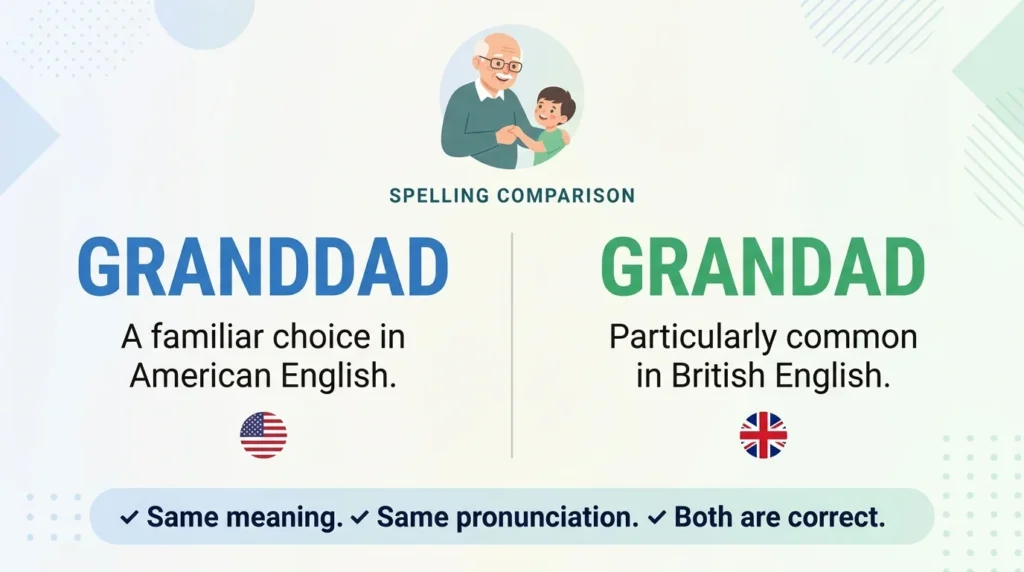
Both granddad and grandad are correct spellings of the informal word for a grandfather. They have the same meaning and pronunciation, so neither is automatically a spelling mistake. The main difference is regional preference: grandad is particularly common in British English, while granddad is a familiar choice in American English. You can use either spelling, but if you are writing for a specific audience, follow its usual spelling conventions and remain consistent.
What Do Granddad and Grandad Mean?
Granddad and grandad are informal nouns that mean grandfather—the father of your mother or father.
Both words describe the same family relationship. They can refer to your mother’s father or your father’s father. Neither spelling tells readers which side of the family the person belongs to.
For example:
- My granddad taught me how to ride a bicycle.
- My grandad taught me how to ride a bicycle.
Both sentences are correct. The spelling changes, but the meaning stays the same.
These words are common in family conversations, personal messages, children’s stories, birthday cards, and other everyday situations. They often sound warmer and more familiar than the word grandfather, although the tone also depends on the speaker and the family’s habits.
Why Does the Difference Matter?
Choosing between granddad and grandad is rarely a serious grammar problem. However, the spelling you choose can affect how natural and consistent your writing looks.
Consider three situations:
- Writing for an American audience: Granddad is a familiar choice and is generally the safer option if you follow American English conventions.
- Writing for a British audience: Grandad is particularly familiar and is a natural choice in British English.
- Writing a formal document: Grandfather is often more suitable than either informal term.
The distinction is especially useful for students, bloggers, editors, teachers, and people creating content for international audiences.
You do not need to correct every occurrence of grandad to granddad, or vice versa. First, check whether the spelling is actually wrong in context. Since both forms are established, the decision is usually about regional preference and consistency rather than grammatical correctness.
Read More: Reining vs Reigning: Meaning, Examples, and the Right Spelling.
The Core Rule: Granddad vs Grandad
Granddad
Correct spelling. Particularly familiar in American English.
Grandad
Correct spelling. Particularly common in British English.
Grandfather
A more neutral term, suitable for formal and informal contexts.
The simplest rule is this: Both spellings are correct, and the extra d in granddad does not change the meaning.
Use the spelling that suits your audience, your family’s preferred wording, or the English style you are following.
How to Use Granddad and Grandad
1. Use the spelling that suits your audience
If you are writing for readers in the United States, granddad is a practical choice. If your readers are mainly in the United Kingdom, grandad is equally natural.
These are preferences, not absolute restrictions. British writers can use granddad, and American readers can understand grandad.
2. Use the word naturally in a sentence
Both words can function as the subject or object of a sentence.
As a subject:
- My granddad lives near the beach.
- My grandad makes excellent apple pie.
As an object:
- I visited my granddad last weekend.
- We bought a present for our grandad.
Both forms also work with possessive words:
- Her granddad is a retired teacher.
- Their grandad tells wonderful stories.
3. Use the correct plural form
To talk about more than one person, add -s to the chosen spelling.
- One granddad; two granddads.
- One grandad; two grandads.
The plural spelling is granddads for both forms. The word has two d’s in its plural form even when the singular form is grandad.
For example:
- Both granddads attended the school celebration.
- Her two grandads helped organise the family reunion.
4. Use the possessive form when showing ownership
To show that something belongs to a granddad or grandad, add an apostrophe and s.
- My granddad’s watch is very old.
- My grandad’s garden looks beautiful.
- We celebrated our granddad’s birthday.
- I found my grandad’s photographs in a drawer.
For plural possessives, the usual form is granddads’ when referring to something belonging to multiple granddads.
Example: Both granddads’ stories were included in the family book.
5. Capitalise the word when it functions as a name
When you use Granddad or Grandad as a name while speaking directly to someone, capitalisation is often appropriate.
- Happy birthday, Granddad!
- Thank you for helping me, Grandad.
- I love you, Granddad.
However, keep the word lowercase when it simply describes a family relationship.
- My granddad lives in Manchester.
- Her grandad works in a small shop.
This distinction concerns capitalisation, not the spelling difference.
Correct Examples of Granddad and Grandad
The following examples show how both spellings work in everyday English.
| Situation | Example sentence |
|---|---|
| Conversation | My granddad is coming over for lunch today. |
| Family message | Hi, Grandad! I’ll call you after work. |
| Dear Granddad, thank you for the lovely birthday gift. | |
| School assignment | My grandad taught me how to plant vegetables. |
| Workplace conversation | My granddad worked in the same industry for 40 years. |
| Social media | Spending Sunday with my grandad is always special. |
| Birthday card | Happy birthday, Granddad! I hope you have a wonderful day. |
| Family history | My granddad moved to the city when he was young. |
| Academic or research writing | The participant described his granddad as an important influence on his childhood. |
| Personal story | Whenever I felt worried, my grandad knew how to make me smile. |
| Travel diary | My granddad took me to the coast during the summer holidays. |
| Children’s story | The little girl visited her grandad every Saturday. |
These examples use both forms naturally. Neither spelling requires a different sentence structure or changes the underlying meaning.
For formal academic work, however, grandfather may be preferable when a neutral tone is important. The informal word is not automatically incorrect in academic writing; its suitability depends on the subject, purpose, and style requirements.
Incorrect vs Correct: Granddad and Grandad
Because both spellings are correct, many apparent errors are actually matters of consistency, capitalisation, punctuation, or sentence construction. The examples below distinguish genuine mistakes from acceptable alternatives.
| ❌ Incorrect or less suitable | ✅ Correct or preferred | Why |
|---|---|---|
| My grandad is visiting. (in a US-style document using granddad consistently) | My granddad is visiting. | The first spelling is valid, but granddad better matches the chosen US spelling preference. |
| My granddad is visiting. (in a British-style document using grandad consistently) | My grandad is visiting. | The original is also correct English; the revision simply maintains the chosen British spelling style. |
| I visited my grand dads yesterday. | I visited my granddads yesterday. | The plural is written as one word, without a space. |
| My granddad’s are coming over. | My granddads are coming over. | No apostrophe is needed for an ordinary plural. |
| I borrowed my grandads book. | I borrowed my grandad’s book. | An apostrophe is needed to show that the book belongs to one grandad. |
| Both granddads’s cars are old. | Both granddads’ cars are old. | For a plural noun ending in s, add the apostrophe after the final s. |
| Happy birthday, my granddad. (when directly addressing him) | Happy birthday, Granddad! | Capitalise the family term when using it as a name in direct address. |
| My Granddad lives nearby. (ordinary descriptive use) | My granddad lives nearby. | Lowercase is usual when the word describes a relationship rather than functioning as a name. |
| My grandad teach me chess. | My grandad teaches me chess. | The singular subject my grandad takes teaches in the simple present. |
| My granddad have a blue car. | My granddad has a blue car. | The verb must agree with the singular subject. |
| I spoke to granddad’s yesterday. | I spoke to my granddad yesterday. | The possessive apostrophe cannot replace the missing possessive determiner my in this sentence. |
| My granddad and my grandad are the same spelling. | Granddad and grandad are different spellings of the same word. | The forms differ in spelling, even though they share a meaning. |
Important: A spelling preference is not the same as a spelling error. For example, writing grandad in an American context does not automatically make the sentence incorrect. Use an alternative only when it better matches the intended style or corrects a genuine grammatical problem.
Why People Confuse Granddad and Grandad
1. The words look almost identical
The two spellings differ by just one letter. Both begin with grand and end with ad, so it is easy to overlook the extra d.
Because the difference is so small, writers may assume one form must be a typo. In reality, both spellings are established.
2. Pronunciation does not help
Granddad and grandad are pronounced the same way in ordinary speech. You cannot reliably identify which spelling someone intends simply by hearing the word.
This makes the distinction a spelling choice rather than a pronunciation rule.
3. English spelling is not always predictable
English has many words with alternative spellings, and regional preferences are not always consistent across every word.
Writers sometimes assume that one form must be universally correct because it looks more logical. However, familiar usage and accepted spelling conventions matter more than a spelling’s apparent logic.
4. Spellcheck may not identify the intended preference
Many spellcheckers accept both granddad and grandad. That is appropriate because neither form is inherently wrong.
A spellchecker may detect a genuine typo, but it cannot always determine which spelling best suits your audience or a particular publication’s style guide.
5. Translation can create uncertainty
Learners translating from another language may know a single standard equivalent for the English word grandfather. When they encounter two English spellings, they may assume the forms have different meanings.
The solution is to learn them as alternative spellings of one informal term, rather than as separate family relationships.
Common Mistakes Checklist
Use this checklist whenever you are editing a sentence containing granddad or grandad.
- Treating one spelling as universally wrong. Both are accepted. Choose according to regional preference or house style.
- Mixing spellings without a reason. Decide which form suits your audience and use it consistently in the same document.
- Adding an apostrophe to an ordinary plural. Write granddads, not granddad’s, when simply referring to multiple people.
- Forgetting the possessive apostrophe. Write my grandad’s hat when the hat belongs to your grandad.
- Capitalising every family term. Use lowercase in my granddad, but capitalise Granddad when it functions as a name in direct address.
- Assuming the words sound different. Their ordinary pronunciation is the same.
- Using an informal term where a neutral one is needed. Consider grandfather for formal reports, official records, and research writing.
- Relying entirely on spellcheck. Check audience, consistency, and context even when the software accepts both forms.
Granddad vs Grandad in Real English
Understanding real English means recognising the difference between what is correct, what is possible but unusual in a particular context, and what people naturally use in everyday situations.
Grammatically correct
Both spellings are grammatically correct when used as nouns in a sentence. For example, “My granddad visits every Sunday” and “My grandad visits every Sunday” are both correct. Each sentence has a singular subject and a matching verb. Neither form requires a special grammatical rule. The spelling choice depends on convention or preference, not on sentence structure.
Grammatically possible but potentially unsuitable
A sentence can be grammatically correct yet poorly suited to its audience or purpose. For example, “The participant’s grandad was interviewed” is understandable and grammatically sound, but a formal research report might use “grandfather” for a more neutral tone. Similarly, using granddad in a document that consistently follows British spelling preferences may look inconsistent. These are choices of style and register, not proof that either word is incorrect.
Natural, everyday English
Both forms are natural in everyday English. A British speaker might write, “I’m visiting my grandad this weekend,” while an American writer might choose, “I’m visiting my granddad this weekend.” These examples illustrate common regional preferences, not exclusive national rules. Family members may also prefer a particular spelling regardless of location. When writing a personal message, the spelling a family normally uses is often the most natural choice.
American vs British English
There is a real regional preference, but the distinction is not absolute.
| Feature | American English | British English |
|---|---|---|
| Familiar spelling choice | Granddad | Grandad |
| Is the alternative understood? | Yes, grandad is generally understood. | Yes, granddad is also understood. |
| Meaning | Grandfather | Grandfather |
| Pronunciation | Generally the same | Generally the same |
| Formal alternative | Grandfather | Grandfather |
| Main consideration | Follow US spelling preferences | Follow UK spelling preferences |
For American English, granddad is a familiar choice. For British English, grandad is particularly common. Both spellings are used in British English, so it would be misleading to claim that British English permits only grandad.
If your website serves readers in multiple countries, select one form for the article and maintain that spelling consistently. If your website targets a particular country, follow the conventions familiar to that audience.
Formal vs Informal Usage
Granddad and grandad are both informal family terms. They are suitable for friendly conversations, personal letters, social media captions, family histories, and many stories.
Grandfather is more neutral and is often preferable in formal contexts.
Compare these examples:
- Informal: My granddad taught me to swim.
- Informal: My grandad is visiting us this week.
- More formal: My grandfather taught me to swim.
- Research writing: The participant described his grandfather as a major influence on his education.
The informal forms are not inherently unprofessional or grammatically incorrect. Their suitability depends on the context. A personal essay can naturally use granddad, while a formal report may benefit from grandfather.
Granddad vs Grandad: Comparison Table
| Feature | Granddad | Grandad |
|---|---|---|
| Meaning | Grandfather | Grandfather |
| Spelling | Two d’s in the final d-d sequence | One d after grand before ad |
| Pronunciation | Same | Same |
| Grammatical category | Noun | Noun |
| Common regional association | American English | British English |
| Informal use | Yes | Yes |
| Formal suitability | Grandfather may be preferable | Grandfather may be preferable |
| Plural | Granddads | Grandads |
| Singular possessive | Granddad’s | Grandad’s |
| Is it accepted? | Yes | Yes |
The table highlights the key point: the spelling changes, but the meaning, pronunciation, and basic grammatical function remain the same.
Memory Trick: Remember the Extra D
Use this simple mnemonic:
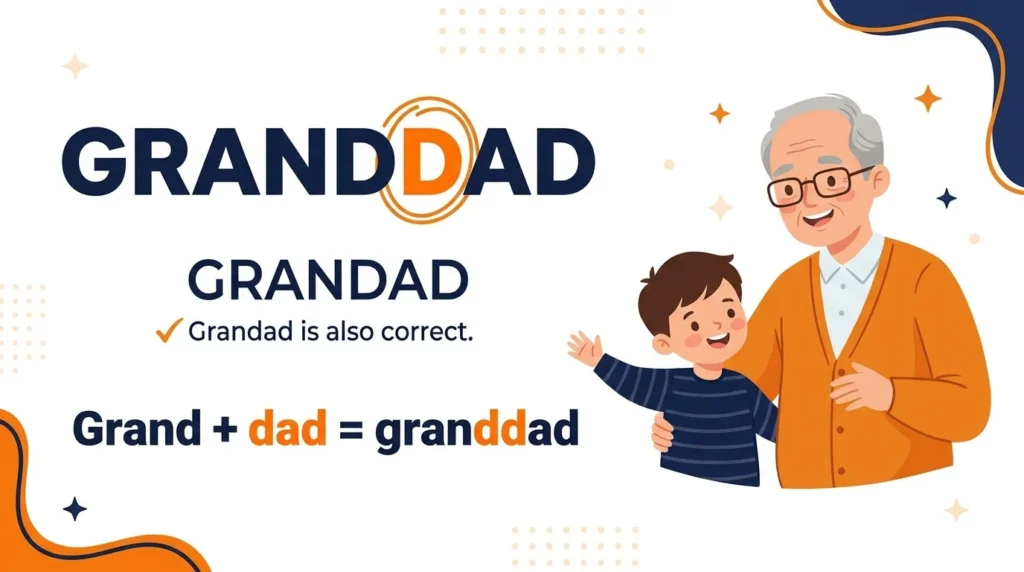
“Grand + dad = granddad; British grandad can drop one d.”
Think of granddad as combining the familiar words grand and dad, with both d’s retained where they meet. Think of grandad as the established alternative spelling that uses one fewer d.
This is a memory aid, not a rule about how every English compound must be spelled. Both forms are accepted, so you do not need to force the spelling into one pattern.
If you are still unsure, remember three points:
- Both forms mean grandfather.
- Both are pronounced the same way.
- Choose the spelling that fits your audience and use it consistently.
Granddad vs Grandad in Real-Life Situations
Situation 1: Writing a text message
You live in the United Kingdom and want to ask a family member about a visit.
“Is Grandad coming for dinner tonight?”
This is natural British English. If the family normally spells the word granddad, that form would also be acceptable.
Situation 2: Writing a school assignment
You are describing an important person in your life.
“My granddad taught me to appreciate nature.”
This is correct. A student using grandad instead would also be correct.
Situation 3: Writing an American blog post
You are telling a story about a childhood memory.
“My granddad used to take me fishing every summer.”
Granddad is a familiar choice for an American audience. It does not imply anything different about the family relationship.
Situation 4: Writing a formal biography
You are documenting a person’s family background.
“His grandfather encouraged him to pursue an education.”
Here, grandfather offers a neutral tone. It is often more suitable for formal biographies than either informal spelling.
Situation 5: Writing a birthday card
You want to express appreciation for a family member.
“Happy birthday, Grandad! Thank you for always being there for me.”
Capitalising Grandad is appropriate when the word functions as a name in direct address. The same applies to Granddad.
These situations show that spelling preference, capitalisation, and formality are separate issues. Knowing which one matters in a particular sentence makes the choice much easier.
Expert Tips for Choosing the Right Spelling
1. Follow the style guide, not a guess
If your employer, school, publisher, or website follows a particular English style, use its preferred form. Consistency is more useful than repeatedly switching between two accepted spellings.
2. Respect a person’s preferred family term
Some people prefer Grandad, while others prefer Granddad. If you are writing a personal tribute, invitation, or family biography, use the form the person or family normally uses.
3. Do not confuse spelling with grammar
A sentence containing grandad is not automatically incorrect in American English. Likewise, granddad is not automatically incorrect in British English. Evaluate the sentence as a whole.
4. Remember the difference between a plural and a possessive
- Plural: My granddads live in different cities.
- Possessive: My granddad’s house is near the station.
- Plural possessive: My granddads’ houses are both near the station.
The apostrophe changes the grammatical meaning. It does not indicate a regional spelling preference.
5. Use grandfather when clarity or formality calls for it
Grandfather is a good choice in official family records, academic research, formal biographies, and other contexts where an informal nickname may be unsuitable.
6. Avoid unnecessary corrections
If you are proofreading someone else’s writing, do not mark grandad as a spelling mistake merely because you prefer granddad. Correct genuine errors, and make style changes only when they serve a clear purpose.
Read More: Alot vs. A Lot vs. Allot: The Spelling Mistake to Avoid.
Quick Summary
Granddad and grandad are both correct spellings of the informal word for grandfather. They have the same meaning, pronunciation, and grammatical function. Granddad is a familiar choice in American English, while grandad is particularly common in British English, although both forms are used in Britain and understood internationally. Neither spelling is automatically wrong. Choose the form that suits your audience, family preference, or publication style, and use it consistently. For formal documents, grandfather is often the more neutral choice. Remember to distinguish ordinary plurals, such as granddads, from possessives, such as granddad’s. The most important lesson is simple: the spelling differs, but the family relationship does not.
Frequently Asked Questions (FAQ)
Is granddad or grandad correct?
Both are correct. Granddad is a familiar spelling in American English, while grandad is particularly common in British English. The two forms have the same meaning.
Is grandad a misspelling of granddad?
No. Grandad is an established spelling of the informal word for grandfather. It should not automatically be treated as a typo.
Is granddad one word or two?
Granddad is written as one word. It does not require a space or hyphen in standard usage.
Do granddad and grandad sound different?
No. They are pronounced the same way in ordinary English. The difference is in their spelling, not their pronunciation.
Which spelling should I use in a US English article?
Granddad is a practical choice for US-focused writing. However, grandad is also understandable and is not inherently incorrect.
Which spelling is more common in the UK?
Grandad is particularly common in British English, but granddad is also used in Britain. Both forms are accepted.
Is granddad more formal than grandad?
No. Both are informal terms. Grandfather is generally the more neutral choice for formal writing.
What is the plural of grandad?
The plural is grandads. For example: “Both grandads attended the celebration.”
Should I write Granddad or granddad?
Use Granddad when the word functions as a name in direct address, as in “Thank you, Granddad!” Use lowercase when describing the relationship, as in “My granddad lives nearby.”
Is granddad’s grammatically correct?
Yes. Granddad’s is the singular possessive form, as in “My granddad’s car is blue.” It can also be a contraction of granddad is or granddad has in suitable sentences.
Can I use grandad in formal writing?
You can, but grandfather is often more appropriate in formal reports, academic work, and official documents. The best choice depends on the tone and purpose of the text.
Do granddad and grandad have different meanings?
No. Both mean grandfather, the father of a person’s mother or father. Neither spelling identifies a different side of the family.
Mini Quiz: Granddad vs Grandad
Test your understanding with these 10 questions.
Test your knowledge
0/10 answered
1. Which spelling is correct?Only granddadOnly grandadBoth granddad and grandad
2. Complete the sentence: My _____ taught me to ride a bicycle.grandadgranddadEither spelling works
3. Which spelling is particularly common in British English?GrandadGrandfather onlyNeither spelling
4. Choose the familiar spelling for US-focused writing.Grandad is always requiredGranddad is a practical choiceNeither is accepted
5. Fill in the blank: Both my _____ came to the party.granddad’sgranddadsgranddad
6. Correct the sentence: My grandad’s are visiting.My grandads are visiting.My grandad are visiting.My grandads’ are visiting.
7. Which sentence correctly shows possession?My grandads book is here.My grandad’s book is here.My grandads’ book is here, when only one grandad owns it.
8. Which word is generally more neutral in formal writing?GrandadGranddadGrandfather
9. Choose the correctly capitalised direct address.Thank you, granddad!Thank you, Granddad!Thank you, GRANDDAD!
10. True or false: Granddad and grandad have different meanings.TrueFalse