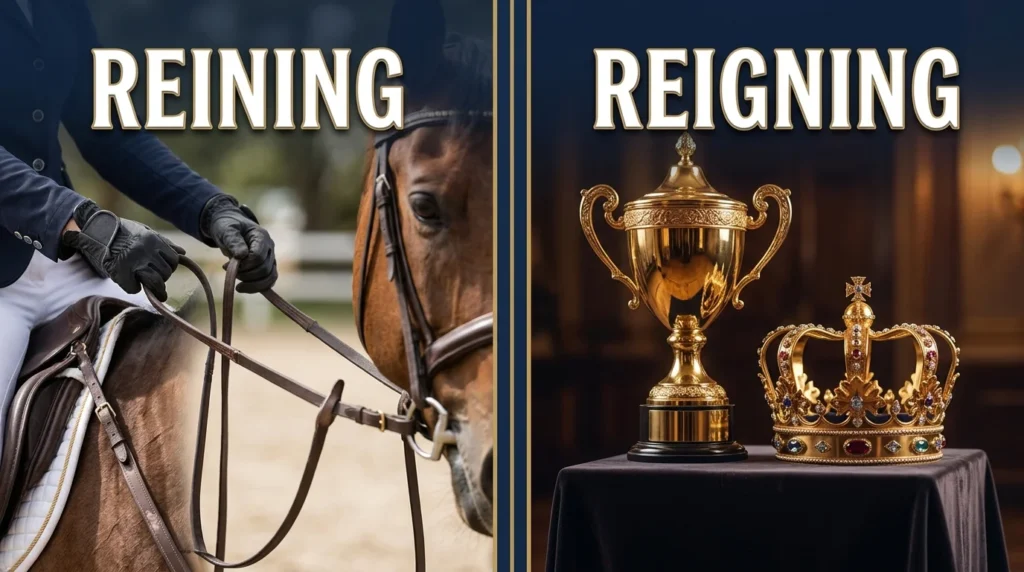

Reining means controlling, guiding, or restraining something, as in “reining in expenses.” Reigning means ruling or currently holding a title, as in “the reigning champion.” Both words are pronounced the same in standard English, but their meanings and spellings differ. Use reining when you mean control and reigning when you mean rule or current title ownership. One important exception is equestrian sport, where reining is also the name of a specific riding discipline.
What Is the Difference Between Reining and Reigning?
Reining and reigning are two different words that sound alike but have different meanings. The easiest way to distinguish them is to look at their base words: rein and reign.
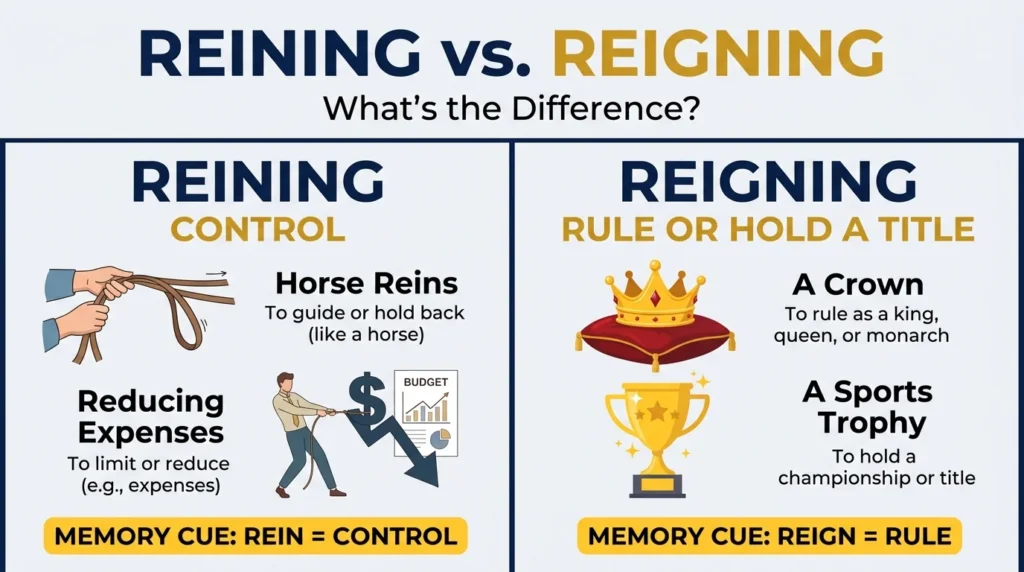
Reining comes from rein, a strap used to guide or control a horse. The verb rein also means to control, restrain, or limit something. That is why we write “reining in spending” when someone is trying to reduce expenses.
Reigning comes from reign, which means to rule or hold authority. It commonly appears in expressions such as “the reigning monarch” and “the reigning champion.”
Consider these examples:
- Reining: The manager is reining in unnecessary expenses.
- Reigning: The reigning champion returned to defend her title.
The first sentence describes controlling costs. The second describes someone who currently holds a championship title.
Although the difference is only one letter, choosing the wrong spelling can change the meaning of a sentence.
Why Does the Difference Matter?
Correct word choice helps readers understand your message without confusion. Reining and reigning are especially easy to mix up because both are valid English words, and neither necessarily triggers a spelling warning when used incorrectly.
Imagine writing a company report that says, “We are reigning in operating costs.” Your readers may understand your intention, but the expression is misspelled because you mean controlling expenses, not ruling over them.
Now imagine a sports headline that reads, “The reining champion returns.” If you mean the athlete who currently holds the title, the correct expression is “the reigning champion.”
These errors can appear in:
- Business reports and financial updates.
- Emails and professional presentations.
- School assignments and English examinations.
- Sports articles and competition announcements.
- Social media captions and marketing content.
- News stories and academic writing.
The solution is not simply to memorize both spellings. It is to understand the meaning of each base word so that you can choose correctly in any context.
The Core Rule: Reining vs Reigning
Use reining for control or restraint. Use reigning for ruling or holding a title.
Remember these two connections:
- Rein → Control → Reining
- Reign → Rule → Reigning
For example, a person can be reining in their spending because they are limiting expenses. A person can be a reigning champion because they currently hold a championship title.
This rule works for almost every ordinary writing situation involving these words. However, remember that reining also names a specific equestrian discipline, so it can be correct in horse-sport contexts that do not involve the ordinary verb meaning.
How to Use Reining Correctly
Reining is the present participle of the verb rein. A present participle is a verb form ending in -ing, used in continuous verb tenses and other grammatical constructions.
The word has two main uses: literal control, particularly of a horse, and figurative control of something such as spending, emotions, or behavior.
Reining in a Horse
In its literal sense, reining describes guiding or controlling a horse with its reins.
Examples:
- The rider was reining the horse toward the stable.
- She is reining in her horse before the sharp turn.
- The instructor demonstrated how to rein a horse gently.
- The rider kept reining the horse back onto the trail.
These sentences relate to the act of guiding or controlling a horse.
Reining in Spending and Expenses
In everyday English, the phrase rein in means to control, limit, restrain, or reduce something.
It is especially common in discussions about money, business, and public spending.
Examples:
- The company is reining in its advertising expenses.
- We are reining in unnecessary spending this month.
- The government is reining in administrative costs.
- The shop owner started reining in inventory purchases.
- The finance team is reining in the department’s budget.
In each example, the subject is trying to exercise greater control or impose limits.
Reining in Emotions and Behavior
The expression can also describe controlling reactions, habits, or behavior.
Examples:
- He is reining in his anger before responding.
- She was reining in her excitement during the interview.
- The teacher is reining in the students’ enthusiasm before the examination.
- I need to start reining in my habit of checking my phone.
- The manager is reining in unnecessary arguments during meetings.
These uses are figurative. Nobody needs to be holding actual horse reins.
Reining as an Equestrian Sport
Reining is also the name of a Western riding discipline in which horse and rider perform precise, controlled maneuvers.
For example:
“The rider trained for the reining competition throughout the summer.”
Here, reining is the name of the discipline, not a misspelling of reigning.
This distinction matters because the two words can appear in the same broad sporting context while retaining different meanings. A reining competitor participates in the equestrian discipline; a reigning champion currently holds a championship title.
How to Use Reigning Correctly
Reigning is the present participle of the verb reign. It describes ruling, exercising authority, or currently holding a title or position.
It can function as part of a verb phrase or as a modifier before a noun.
Reigning Monarchs and Leaders
A monarch is a king, queen, or another sovereign ruler. The word reigning is commonly used to describe a monarch who currently occupies the throne.
Examples:
- The reigning monarch attended the national ceremony.
- The reigning queen welcomed the visiting delegation.
- The country celebrated the birthday of its reigning king.
- The reigning ruler announced a new public initiative.
In these sentences, reigning relates to holding power or ruling.
Reigning Champions in Sports
One of the most familiar expressions using reigning is reigning champion.
A reigning champion is someone who currently holds a championship title, generally after winning the previous competition and before another competitor replaces them.
Examples:
- The reigning champion will defend her title on Saturday.
- The reigning world champion faced a difficult opponent.
- The team entered the tournament as the reigning champions.
- The reigning Olympic champion returned to competition.
- The reigning chess champion prepared for the next match.
The word identifies the competitor’s current status, not necessarily whether they will win again.
A reigning champion can lose the next competition and no longer hold the title. The description is tied to their status at the relevant time.
Reigning in Other Contexts
The verb reign is not limited to royal families. It can also describe dominance, influence, or the widespread presence of something.
Examples:
- Confusion reigned throughout the crowded station.
- Silence reigned after the announcement.
- The reigning trend in fashion favored simple designs.
- The reigning champion remained the team’s most celebrated player.
Some expressions are figurative rather than literal. For example, “silence reigned” means that everything was quiet, not that silence was a person exercising political authority.
A related expression is reign supreme, meaning to be dominant or unsurpassed in a particular context.
Example: “Customer satisfaction reigns supreme in the company’s service policy.”
Correct Examples of Reining and Reigning
The following examples show how to use each word naturally in different situations.
| Situation | Correct sentence | Why it is correct |
|---|---|---|
| Conversation | “I’m reining in my spending this week.” | The speaker is controlling expenses. |
| “We are reining in project costs.” | The team is limiting costs. | |
| School | “The rider was reining the horse carefully.” | The sentence describes horse control. |
| Workplace | “Management is reining in overtime.” | Management is limiting overtime. |
| Social media | “The reigning champions are back!” | The team currently holds the title. |
| Academic writing | “The monarch’s reign lasted several decades.” | Reign refers to a period of rule. |
| Business report | “The company is reining in its operating budget.” | The company is controlling spending. |
| Sports news | “The reigning champion won her opening match.” | The athlete currently holds the title. |
| Personal development | “He is learning to rein in his temper.” | He is learning to control his reactions. |
| History | “The reigning king introduced several reforms.” | The king currently rules in the context described. |
| Horse training | “She is reining the horse through the course.” | The rider is guiding the horse. |
| Competition | “The reigning titleholder faced a new challenger.” | The titleholder currently holds the title. |
The key is to identify what the sentence communicates. If it describes control, choose rein or reining. If it describes ruling or holding a title, choose reign or reigning.
Incorrect vs Correct: Common Reining and Reigning Mistakes
These examples illustrate how one letter can affect meaning. The incorrect versions below are wrong for the intended meaning; the words themselves are not universally incorrect.
| ❌ Incorrect | ✅ Correct | Why |
|---|---|---|
| The company is reigning in expenses. | The company is reining in expenses. | Expenses are being controlled, not ruled over. |
| She is the reining champion. | She is the reigning champion. | The athlete currently holds the title. |
| We are reigning in our budget. | We are reining in our budget. | The intended meaning is limiting spending. |
| He is reining monarch of the country. | He is the reigning monarch of the country. | A monarch reigns. |
| The government is reigning in public spending. | The government is reining in public spending. | Public spending is being restricted. |
| You should be reigning in your temper. | You should be reining in your temper. | The intended meaning is controlling anger. |
| The reigning horse was guided toward the gate. | The horse was reined toward the gate. | The sentence describes the horse being guided; reined is the past-tense form. |
| The reining world champion defended her belt. | The reigning world champion defended her belt. | The boxer currently holds the championship. |
| The business is reigning in unnecessary purchases. | The business is reining in unnecessary purchases. | Purchases are being limited. |
| The reigning in of costs improved profits. | The reining in of costs improved profits. | Reining in is the expression for controlling costs. |
| The king was reining for twenty years. | The king was reigning for twenty years. | The intended meaning concerns the king’s rule. |
| The reining champion of the tennis tournament arrived. | The reigning champion of the tennis tournament arrived. | The sentence refers to the current titleholder. |
Important exception: In a specific equestrian context, reining can be correct when describing the sport or a participant in it. For example, “She is a reining champion” can refer to a champion in the discipline of reining. Context determines the intended meaning.
Why Do People Confuse Reining and Reigning?
Several features of English make these words easy to mix up.
1. They Sound the Same
In standard English pronunciation, reining and reigning are homophones. Homophones are words that sound alike but have different meanings and spellings.
Both are commonly pronounced /ˈreɪ.nɪŋ/, approximately “RAY-ning.”
Because pronunciation does not reveal the spelling difference, listeners must rely on context when writing the words down.
2. Their Spellings Are Almost Identical
The words differ by just one letter:
- Reining
- Reigning
When typing quickly, it is easy to select the wrong spelling, particularly if you remember how the word sounds but not its base meaning.
3. Both Words Are Correct English
Many spelling errors survive proofreading because the incorrectly selected word is a real word.
A spell-checker may accept reigning in a sentence where you intended reining. The software can recognize the spelling without understanding your intended meaning.
4. The Phrase “Reining In” Is Easy to Forget
Writers may remember the sound of “reigning in” without connecting the expression to rein, meaning to control or restrain.
The correct phrase for controlling expenses, emotions, or behavior is reining in.
5. Translation Can Hide the Difference
In some languages, the same translated expression may cover several English meanings. A learner might know the general idea of control or leadership without realizing that English uses different base words.
The most reliable solution is to learn each word through a clear example rather than memorizing its translation alone.
Common Mistakes Checklist
Use this checklist when proofreading your writing.
- Writing “reigning in” when you mean controlling something. Replace it with reining in. Think about the reins used to guide a horse.
- Writing “reining champion” when you mean the current titleholder. Use reigning champion, unless you are specifically discussing the equestrian discipline of reining.
- Assuming the two words are interchangeable. They sound alike, but their meanings differ. Identify the action or status before choosing.
- Trusting spell-check alone. Both spellings are valid words, so automated tools may not catch a contextual error. Read the whole sentence.
- Forgetting the base word. If the meaning is control, start with rein. If it is rule, start with reign.
- Confusing the words with “raining.” Raining refers to rain falling from the sky. It is a third spelling with a separate meaning.
Read More: Alot vs. A Lot vs. Allot: The Spelling Mistake to Avoid.
Reining vs Reigning in Real English
1. Grammatically Correct
Both reining and reigning are grammatically correct English words. The correct choice depends on the intended meaning. “The company is reining in expenses” is correct because the company is controlling its costs. “The reigning champion returned to the tournament” is also correct because the athlete currently holds the title. The phrase reining in is an established expression, while reigning champion is an established description of a current titleholder.
2. Grammatically Possible but Unnatural
A sentence can be grammatically possible yet sound awkward or communicate an unusual idea. For example, “The king is reining the kingdom” could be interpreted as a creative metaphor about controlling something, but it is not the normal way to say that a king rules a kingdom. “The king is reigning over the kingdom” communicates the intended meaning more naturally. Choose the word that fits both the grammar and the idea you want to express.
3. Natural, Everyday English
In everyday English, “reining in spending,” “reining in your temper,” and “the reigning champion” are familiar, natural expressions. The first two describe control or restraint; the third identifies someone who currently holds a title. You will commonly encounter reining in in financial, professional, and personal contexts, while reigning champion is especially familiar in sports coverage. Learning these expressions as complete phrases is often easier than trying to remember the spelling of each word in isolation.
American vs British English
There is no standard American-versus-British spelling difference between reining and reigning. Both varieties use the same spellings and the same basic distinction in meaning.
| Meaning | American English | British English |
|---|---|---|
| Controlling expenses | Reining in expenses | Reining in expenses |
| Controlling a horse | Reining a horse | Reining a horse |
| A current champion | Reigning champion | Reigning champion |
| A current monarch | Reigning monarch | Reigning monarch |
Your choice should depend on meaning, not the country in which your audience lives.
Formal vs Informal Usage
Both words are suitable for formal and informal writing. Neither is restricted to casual conversation or specialized academic writing.
In formal writing:
- “The department is reining in discretionary spending.”
- “The reigning monarch attended the official ceremony.”
- “The reigning champion will compete in the final.”
In informal writing:
- “I’m reining in my shopping this month.”
- “The reigning champs are back!”
- “I need to rein in my temper.”
The main difference is tone, not spelling. In formal reports, use precise language and make sure the context supports the intended meaning. In casual messages, the same spelling rules still apply.
Reining vs Reigning: Comparison Table
| Feature | Reining | Reigning |
|---|---|---|
| Base word | Rein | Reign |
| Main meaning | Controlling or restraining | Ruling or holding a title |
| Common grammatical form | Present participle of rein | Present participle of reign |
| Typical expression | Reining in spending | Reigning champion |
| Horse-related use | Guiding or controlling a horse; also an equestrian discipline | Not the usual word for controlling a horse |
| Business use | Reining in costs | Reigning market leader, when describing dominance |
| Royal use | Not the usual word for ruling | Reigning monarch |
| Common error | “Reigning in expenses” | “Reining champion,” when referring to an ordinary sports titleholder |
| American/British spelling | Same in both | Same in both |
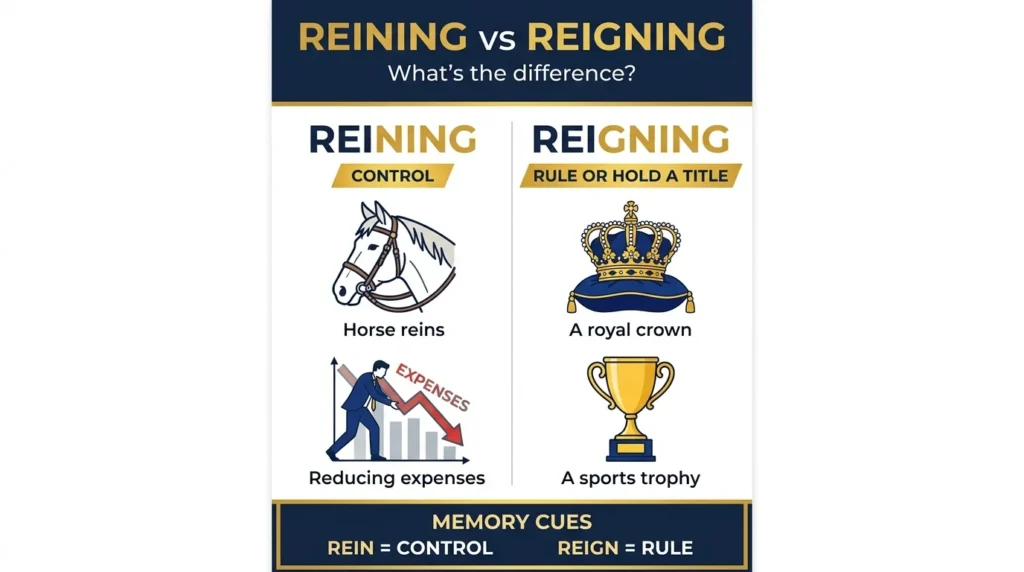
| Memory clue | Rein means control | Reign means rule |
Memory Trick: Rein for Control, Reign for Rule
The easiest way to remember the difference is to connect each spelling to a familiar image.
Reining = reins on a horse. Imagine a rider holding the reins to guide the horse. The reins help the rider control the animal. Therefore, reining in means controlling or limiting something.
Reigning = a ruler or champion. Imagine a monarch wearing a crown or a champion holding a trophy. Both images connect to authority or holding a title. Therefore, reigning is the word for ruling or being the current champion.
Try this two-question test:
- Does the sentence mean control or limit? Choose reining.
- Does it mean rule or hold a title? Choose reigning.
For example, “We are ___ in costs” needs reining. “She is the ___ champion” needs reigning.
Read More: Appendices vs Appendixes: Which Is Correct?
Real-Life Situations: Which Word Should You Choose?
Situation 1: A Business Meeting
Your manager asks why the department’s costs have increased.
You reply: “We are reining in unnecessary expenses this quarter.”
This is correct because you are describing an effort to control spending.
Situation 2: A Sports Interview
A journalist asks an athlete about the next tournament.
The journalist says: “As the reigning champion, do you feel extra pressure to win?”
This is correct because the athlete currently holds the championship title.
Situation 3: An Email to Your Team
You write: “We need to start reining in last-minute purchases.”
This is correct because the team needs to limit unnecessary buying.
Situation 4: A History Assignment
You write: “The reigning monarch introduced reforms during the early years of the new government.”
This is correct if the monarch was ruling during the period being discussed.
Situation 5: A Horse-Riding Lesson
Your instructor says: “Practice reining the horse gently through the turn.”
This is correct because the instruction concerns guiding the horse.
Situation 6: A Social Media Caption
You post: “The reigning champions are ready for another season!”
This is correct if the team currently holds the title.
Expert Tips for Choosing the Right Word
- Check the base word first. If you can replace the word with control, think rein. If you can replace it with rule, think reign.
- Learn complete expressions. Remember “reining in costs” and “reigning champion” as phrases. This reduces the need to work out the spelling every time.
- Read the sentence for meaning. Do not rely on pronunciation because the words sound alike.
- Check the surrounding noun. Words such as expenses, spending, and temper often indicate control. Words such as monarch, champion, and titleholder often indicate rule or current status.
- Do not automatically change every use of “reining.” It is a genuine word, including in equestrian sport. Correct the word only when it fails to express the intended meaning.
- Proofread homophones separately. During your final review, search for words that sound alike but have different meanings. Ordinary spell-checking may not catch the mistake.
- Use the past-tense forms correctly. Reined means controlled or guided; reigned means ruled. For example, “She reined in her horse” and “The monarch reigned for decades.”
Quick Summary
Reining and reigning sound alike, but they have different meanings. Reining comes from rein and refers to controlling, guiding, or restraining something. It appears in expressions such as “reining in expenses” and can also name a Western equestrian discipline. Reigning comes from reign and refers to ruling or currently holding a title, as in “the reigning monarch” or “the reigning champion.” Both spellings are correct English, and neither changes between standard American and British English. To remember the difference, connect reins with control and reign with rule. Always check the meaning of your sentence instead of relying on pronunciation or spell-check alone.
Frequently Asked Questions
1. Is it “reining in” or “reigning in”?
Use reining in when you mean controlling, limiting, or restraining something. For example, “The company is reining in expenses.” Reigning relates to ruling or holding a title, so it is not the standard spelling of this expression.
2. Is it “reining champion” or “reigning champion”?
For an ordinary sports champion who currently holds a title, the correct expression is reigning champion. However, reining champion can be correct when referring specifically to a champion in the equestrian discipline of reining.
3. Are reining and reigning pronounced the same way?
Yes. In standard English, they are homophones and are generally pronounced /ˈreɪ.nɪŋ/. Their pronunciation does not reveal which spelling is correct, so context determines the choice.
4. What does “reining in” mean?
Reining in means controlling, limiting, restraining, or reducing something. It can refer to spending, costs, emotions, behavior, or a horse’s movement. For example, “She is reining in her spending” means she is trying to spend less or exercise greater control over her money.
5. Can reining be used outside horse riding?
Yes. The phrase reining in is widely used figuratively. You can rein in costs, spending, anger, enthusiasm, or behavior. Reining is also the name of a specific equestrian discipline.
6. What does “reigning supreme” mean?
Reigning supreme means being dominant, highly successful, or unsurpassed in a particular area. For example, “The team has been reigning supreme in the league” means the team has been dominant.
7. Is “reigning monarch” correct?
Yes. A reigning monarch is a king, queen, or other sovereign ruler who currently occupies the throne. The word reigning describes their position as a ruler.
8. Is there a difference between reining and reigning in American and British English?
No standard spelling difference exists. Both American and British English use reining for control and reigning for ruling or holding a title.
9. Can a person be a reining champion?
Yes, in the specific context of the equestrian discipline called reining. In ordinary sports contexts, a current titleholder is called a reigning champion. The intended meaning determines which word is correct.
10. What is the difference between rein, reign, and rain?
Rein refers to a horse-control strap and can mean control or restraint. Reign means to rule or describes a period of rule. Rain refers to water falling from clouds. The three words sound alike, but their meanings and spellings differ.
11. Why doesn’t spell-check always catch reining and reigning mistakes?
Both words are correctly spelled English words. A spell-checker may recognize the word without understanding the intended meaning of the whole sentence. Grammar and context checking, followed by careful proofreading, can help catch these errors.
12. What is the easiest way to remember reining vs reigning?
Remember rein = control and reign = rule. Use reining in when something is being controlled or limited. Use reigning champion when someone currently holds a championship title.
Mini Quiz: Reining vs Reigning
Choose the correct word or correct the sentence in each question. Answers and explanations are included so you can check your understanding.
| No. | Question | Answer | Explanation |
|---|---|---|---|
| 1 | The company is ___ in its monthly expenses. (reining / reigning) | Reining | The company is controlling or limiting expenses. |
| 2 | The ___ champion will play in tomorrow’s final. (reining / reigning) | Reigning | The athlete currently holds the championship title. |
| 3 | Fill in the blank: The rider is ___ the horse through the course. | Reining | The sentence describes guiding or controlling a horse. |
| 4 | Choose the correct sentence: A. We are reigning in costs. B. We are reining in costs. | B. We are reining in costs. | The expression for controlling costs is reining in. |
| 5 | Correct this sentence: “She is the reining champion of the tennis tournament.” | She is the reigning champion of the tennis tournament. | The sentence refers to a current titleholder, not the equestrian discipline. |
| 6 | The ___ monarch addressed the nation. (reining / reigning) | Reigning | A monarch rules, so the correct word comes from reign. |
| 7 | Fill in the blank: I need to start ___ in my spending. | Reining | The phrase means controlling or limiting spending. |
| 8 | Correct this sentence: “The king was reining for twenty years.” | The king was reigning for twenty years. | Reigning refers to ruling. Depending on the intended time frame, “The king reigned for twenty years” may be even more direct. |
| 9 | A rider is competing in the Western discipline called ___. (reining / reigning) | Reining | Reining is the established name of this equestrian discipline. |
| 10 | Choose the correct sentence: A. The reigning champion returned. B. The reigning in champion returned. | A. The reigning champion returned. | Reigning champion is the standard expression for a current titleholder. |