


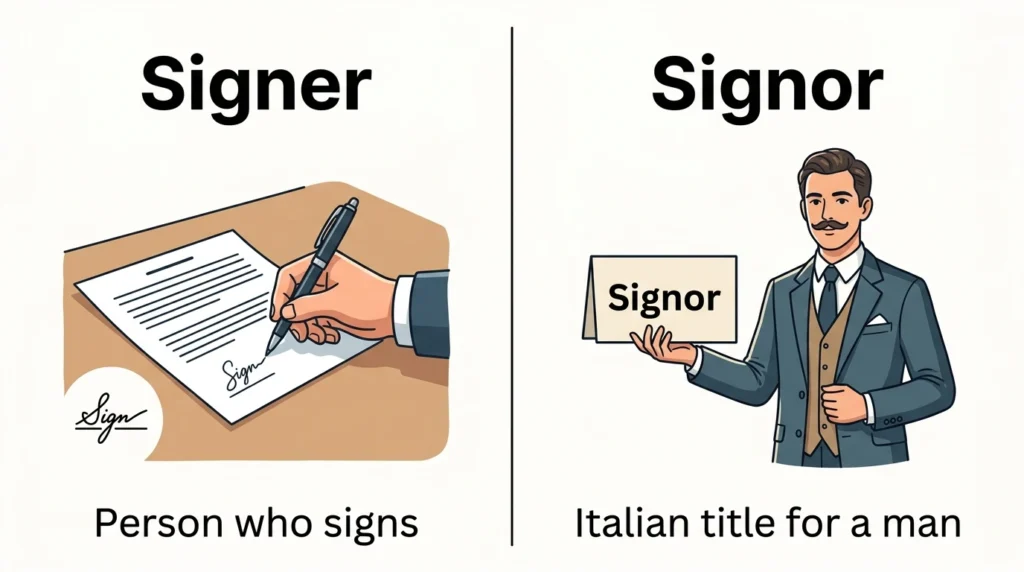
The signer vs signor difference is simple: a signer is a person who signs a document, form, letter, or agreement. Signor is an Italian title of respect for a man, similar to Mr. in English. Use signer when discussing signatures and Signor before an Italian man’s name or in an Italian cultural setting.
What Is the Signer vs Signor Difference?
Although signer and signor differ by only one letter, they have unrelated meanings.
A signer is someone who writes, draws, or applies a signature. The person may sign a contract, petition, form, letter, receipt, or digital document. In another valid use, signer can mean someone who communicates using sign language.
A signor is an Italian title used for a man. Its closest English equivalent is Mr. It may appear before a surname, especially in Italian names, translated literature, opera, historical writing, or dialogue set in Italy.
The words also sound different:
- Signer: usually pronounced “SY-ner”
- Signor: approximately pronounced “seen-YOR”
The silent g in signer follows the pronunciation of the verb sign. In signor, the letters belong to an Italian word and produce a different sound.
Why the Difference Matters
Using the wrong word can completely change a sentence.
If a contract calls someone a signor, it appears to give that person an Italian title instead of identifying the person who signed. If an Italian character is called a signer, the sentence suggests that he signs something or uses sign language.
This distinction is especially important in:
- Contracts and business forms
- Notarial and legal writing
- Professional emails
- Translated material
- Italian names and titles
- School assignments
- Historical or cultural writing
- Accessibility discussions involving sign language
A one-letter mistake may look minor, but it can make formal writing appear careless or unclear.
The Core Rule
Rule: Use signer for a person who signs. Use Signor as an Italian title for a man.
Ask one quick question: Am I describing an action or using a title?
- If the person performs the action of signing, choose signer.
- If the word means Mr. before an Italian man’s name, choose Signor.
The words are not alternative spellings of each other.
What Does Signer Mean?
Signer is a countable English noun formed from the verb sign plus the suffix -er. An -er noun often names the person who performs an action. For example, a writer writes, a speaker speaks, and a signer signs.
A signer may be:
- A person who signs a contract
- A customer who signs a receipt
- A witness who signs a form
- A person who adds a digital signature
- An individual who signs a petition
- A person who communicates in sign language
The exact responsibility of a signer depends on the document and the situation. The word itself does not always prove that the person has accepted every legal obligation in the document.
What Does Signor Mean?
Signor is an Italian title of respect for a man. In English-language writing, it usually appears in an Italian setting or before an Italian surname.
For example:
Signor Bellini welcomed the guests.
Here, Signor serves the same basic purpose as Mr. in English. It does not mean that Bellini signed anything.
In Italian, signore is the fuller form. Before a man’s surname, the shortened form signor may be used:
- Signor Rossi
- Signor Bianchi
- Signor Conti
When addressing a man without giving his name, Italian commonly uses the full form signore. English writers should avoid applying detailed Italian address rules unless they are confident about the context.
How to Use Signer and Signor
Follow these steps when choosing between the two words:
- Look for a signature, form, agreement, or document.
- If someone signs it, use signer.
- Look for a man’s Italian surname or an Italian setting.
- If the word is being used like Mr., use Signor.
- Read the sentence aloud and check the pronunciation.
- Replace the uncertain word with person who signs or Mr. to test the meaning.
Consider these two sentences:
The signer must date the form.
Person who signs fits, so signer is correct.
Signor Romano owns the restaurant.
Mr. Romano fits, so Signor is correct.
Correct Examples
The following examples show both words in natural contexts:
- The signer placed her initials at the bottom of every page.
- Each signer will receive a digital copy of the agreement.
- Please confirm the signer’s identity before accepting the form.
- My teacher asked every petition signer to provide an email address.
- The final signer submitted the document shortly before noon.
- A skilled sign-language signer interpreted the speech for the audience.
- “Has the second signer completed the online form?” Ali asked.
- Signor Lombardi greeted us at the hotel entrance.
- The novel introduces Signor Moretti as the owner of a small bookshop.
- Our guide arranged a meeting with Signor Ricci in Florence.
- In the opera, Signor Bartoli delivers the final message.
- “Good evening, Signor Conti,” Maria said.
Notice that signer can take normal English possessive and plural forms:
- One signer
- Two signers
- The signer’s name
- The signers’ details
The traditional Italian plural connected with signor is signori, although English-language writing may sometimes treat the title differently depending on style and context.
Incorrect vs. Correct Usage
| ❌ Incorrect | ✅ Correct | Why |
|---|---|---|
| The signor forgot to date the contract. | The signer forgot to date the contract. | The sentence refers to the person who signed a contract, not an Italian title. |
| Every signer Rossi entered the room. | Signor Rossi entered the room. | The word is being used as a title before an Italian surname. |
| Ask the signor to initial page four. | Ask the signer to initial page four. | Initialing a page is part of the document-signing process. |
| Signer Bellini welcomed us to Rome. | Signor Bellini welcomed us to Rome. | Signor means Mr. here; no signing action is described. |
| The form needs the signor’s address. | The form needs the signer’s address. | The form requires information about the person signing it. |
| I met Signer Moretti at the gallery. | I met Signor Moretti at the gallery. | The word is a respectful title attached to a surname. |
| All signors must show identification before signing. | All signers must show identification before signing. | The group consists of people who will sign. |
| Signor is another spelling of signer. | Signor is an Italian title, while signer names a person who signs. | The words have separate meanings and are not spelling variants. |
| The electronic signor received a security code. | The electronic signer received a security code. | A person applying an electronic signature is an electronic signer. |
| The story’s signer owned a villa in Tuscany. | The story’s Signor Bianchi owned a villa in Tuscany. | The intended meaning is an Italian title, which normally accompanies a name in this construction. |
| The signer Verdi conducted the orchestra. | Signor Verdi conducted the orchestra. | The sentence uses a title, not an occupational description. |
| Please add Signor Two’s email address. | Please add Signer Two’s email address. | Signer Two is a document-workflow label for the second person who signs. |
Read More: What Is the Difference Between Prooving or Proving?
Why People Confuse Signer and Signor
Spelling Overlap
Both words begin with sign- and contain six letters. A reader moving quickly may notice the shared letters but miss the different endings.
Misleading Pronunciation Assumptions
English speakers may try to pronounce signor according to the English word sign. That creates a false connection between the two words. Their standard pronunciations are different.
Overgeneralisation
Once learners know that -er can identify a person who performs an action, they may assume that every similar-looking form is related. Signor, however, is not an English action noun.
Autocomplete and Spellcheck Limits
Both words are correctly spelled words. A spelling tool may therefore accept either one, even when the selected word is wrong for the sentence. Spellcheck can identify a nonexistent spelling, but it cannot always identify an incorrect meaning.
Translation Interference
Someone familiar with Italian may recognise signor as a title but use it where an English document requires signer. The reverse can happen when an English speaker writes Italian dialogue by sound.
Typing Errors
The letters e and o are not next to each other on a standard keyboard, but writers may still select the wrong ending because the words look so similar on screen.
Common Mistakes Checklist
Before publishing your sentence, check for these problems:
- Using signor for every person who signs: A document is normally completed by a signer, not a signor.
- Treating the words as regional spellings: Signor is not the British, American, or formal spelling of signer.
- Assuming signor is a legal term: In English legal and business contexts, use signer or, where appropriate, signatory.
- Writing signer as a title: Do not write Signer Rossi when you mean Mr. Rossi.
- Forgetting the second meaning of signer: A person who communicates in sign language may also be called a signer.
- Using signor without an Italian context: In ordinary English, Mr. is normally more natural.
- Pronouncing both words alike: Signer begins like sign, while signor has an Italian-style pronunciation.
- Trusting spellcheck alone: Both spellings exist, so check the intended meaning yourself.
- Replacing every signer with signatory: These words overlap, but signatory often carries a more formal or binding sense.
- Using signore and signor randomly: In Italian usage, their placement and function differ. Check the complete sentence before choosing one.
Signer and Signor in Real English
Grammatically Correct
“The signer completed the form” and “Signor Rossi arrived” are both grammatically correct. In the first sentence, signer is a common noun naming the person who performed an action. In the second, Signor is a title placed before a surname. Each word has a clear grammatical role, and neither can replace the other without changing or damaging the meaning.
Grammatically Possible but Unnatural
A sentence such as “The signer of the birthday card used blue ink” is grammatically possible, but it may sound overly formal in casual conversation. Most people would say, “The person who signed the birthday card used blue ink.” Likewise, calling someone Signor Rossi in an otherwise ordinary English conversation may sound theatrical unless the Italian setting or the person’s preferred title makes it appropriate.
Natural Everyday English
In everyday English, signer is natural when documents, petitions, forms, digital signatures, or sign language are being discussed. Signor is much less common because English speakers normally use Mr. It appears naturally in Italian dialogue, cultural descriptions, translated works, opera, historical material, or established names. Context determines whether the Italian title sounds suitable or unnecessarily dramatic.
Formal and Informal Usage
Signer in Formal Writing
Signer works in formal and neutral writing:
The signer certifies that the information is accurate.
It is common in forms, instructions, electronic-signature systems, and notarial discussions. In a contract, however, a more exact role may be better, such as party, witness, authorised representative, or signatory.
Signer in Informal Writing
Signer can also appear in normal conversation:
We still need one more signer for the card.
If the object is casual and obvious, person who signed it may sound more relaxed.
Signor in Formal or Cultural Writing
Signor is appropriate when preserving an Italian title or establishing an Italian setting:
Signor De Luca addressed the committee.
Outside those situations, Mr. De Luca will usually sound more natural in English.
Read More: Vinal vs Vinyl: Which Spelling Is Correct?
Signer vs. Signor Comparison Table
| Feature | Signer | Signor |
|---|---|---|
| Basic meaning | A person who signs | An Italian title for a man |
| Language or origin | Regular English action noun | Borrowed from Italian |
| Closest replacement | Person who signs | Mr. |
| Common context | Forms, contracts, petitions, sign language | Italian names, dialogue, opera, cultural writing |
| Pronunciation | “SY-ner” | Approximately “seen-YOR” |
| Related action | To sign | Not connected to signing |
| Common plural | Signers | Signori or signors, depending on context |
| Example | The signer dated the form. | Signor Marino entered the room. |
| Frequency in everyday English | Common in relevant contexts | Uncommon outside Italian contexts |
| Capitalisation | Usually lowercase unless starting a sentence or used as a label | Often capitalised before a name in English text |
Signer, Signatory, Signee, and Signor
These related-looking terms should not be treated as exact synonyms.
| Term | Meaning | Best Use |
|---|---|---|
| Signer | Someone who signs something | General document and signature contexts |
| Signatory | A person, organisation, or state that has signed an agreement, often in a formal or binding capacity | Contracts, treaties, formal agreements |
| Signee | A less common term for a person who signs or is asked to sign | Limited specialist or workflow contexts |
| Signor | An Italian title similar to Mr. | Italian names and cultural settings |
| Signing party | A person or organisation participating in an agreement by signing it | Contracts and business documents |
| Authorised signatory | Someone officially permitted to sign for another person or organisation | Corporate, banking, and legal documents |
A signer is the broadest practical term for a person applying a signature. A signatory is often preferred when the person or organisation becomes formally associated with an agreement. The exact legal effect depends on the document, the person’s authority, and the relevant law—not merely on the label used.
Memory Trick
Remember this line:
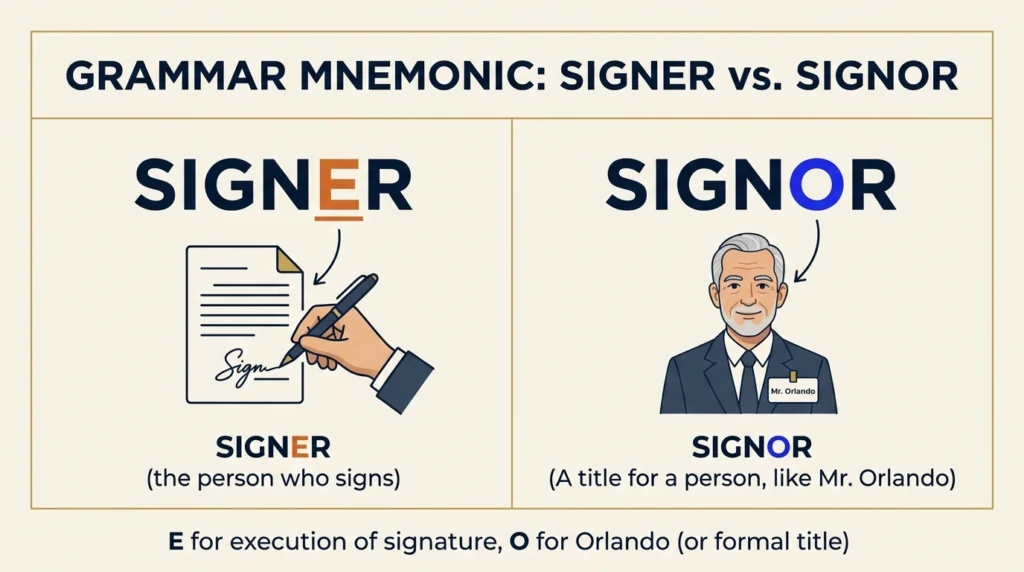
The E in signer stands for executing a signature; the O in Signor belongs before Orlando.
The mnemonic is not a word-history rule. It is simply a quick reminder:
- Signer → signature
- Signor → Italian title
You can also use the replacement test. If person who signs fits, choose signer. If Mr. fits, choose Signor.
Real-Life Situations
In an Interview
An interviewer asks whether you handled electronic agreements in your previous role.
“Yes, I checked each signer’s details before sending the agreement.”
Signer is correct because the person signs a document.
During a Meeting
A manager discusses an agreement with several parties.
“We are waiting for the final signer to approve the revised version.”
The word identifies the person who must add a signature.
In an Email
You need a client to correct a missing field.
“Please ask the signer to enter the date beside the signature.”
This is clear, neutral business English.
In a Text Message
A friend asks who wrote a message in a group card.
“I can’t recognise the signer’s name.”
The sentence is correct, although the person who signed it may sound more casual.
In an Exam
A question asks you to complete a sentence about an Italian character.
“_____ Romano invited the travellers inside.”
The answer is Signor because the blank requires a title before a surname.
In a Notarial Setting
A notary verifies the identity of the person appearing with a document.
“The signer presented valid identification.”
Signer describes the document-related role without suggesting an Italian title.
Expert Tips
- Use the replacement test instead of relying on spelling alone.
- Search your document for signor before publishing contracts or form instructions.
- In legal writing, identify the person’s exact role whenever signer is too broad.
- Do not assume that adding a signature always makes someone a party to an agreement.
- Use Signor only when the Italian connection is clear to the audience.
- Preserve a person’s preferred title when you know it.
- In interfaces, labels such as Signer 1 and Signer 2 are clearer than invented alternatives.
- When discussing sign language, add context if signer could be mistaken for a document signer.
- Do not translate names or titles mechanically when editing fiction or historical material.
- Read the sentence aloud: the different pronunciations often reveal the intended word.
Read More: Enable vs Inable: Which Is Correct?
Frequently Asked Questions
Is signor a misspelling of signer?
No. Signor is a valid Italian title for a man, while signer is an English noun for someone who signs. It is only an error when used with the wrong intended meaning.
What do you call a person who signs a document?
The general term is signer. In a formal contract or treaty, signatory may be more precise, particularly when the person or organisation is formally bound by the signed agreement.
Can an organisation be called a signer?
Yes. In business and electronic-signature contexts, signer may refer to a person or an organisation represented by an authorised individual. If precision matters, name both the organisation and its authorised representative.
Is signer a proper English word?
Yes. Signer is a standard English noun. It can mean a person who signs something or, in another context, a person who communicates through sign language.
Is signor the same as sir?
The meanings overlap, but they are not interchangeable in every sentence. Signor is an Italian title broadly corresponding to Mr. or, in some forms of address, sir. Its correct translation depends on placement and context.
Should Signor be capitalised?
In English text, it is commonly capitalised when placed directly before a name, as in Signor Romano. Lowercase may appear when the word is discussed generally rather than used as a title.
What is the feminine form related to signor?
The related Italian title is signora, commonly used for an adult woman. Its use and translation depend on the Italian sentence and social context.
Is the plural of signor signors or signori?
The traditional Italian plural is signori. Some English dictionaries also record signors as an English plural. In an Italian setting, signori is generally the more recognisably Italian form.
Can signer mean a person who uses sign language?
Yes. A person who produces signs in a sign language may be called a signer. Context normally shows whether the word refers to sign language or a written signature.
Is signatory always better than signer in legal writing?
No. Signer is a useful general term, while signatory often indicates someone formally connected to or bound by a signed instrument. Legal documents should use the term that accurately describes the person’s role.
Is signee another word for signer?
It sometimes appears with that meaning, particularly in document workflows, but it is less established and may be interpreted differently across organisations. Signer is usually the clearer general choice.
Can I use Signor instead of Mr. in ordinary English?
You can when an Italian title is intentionally being preserved. In an ordinary English setting without an Italian connection, Mr. is normally clearer and more natural.
Mini Quiz
| # | Question | Answer | Explanation |
|---|---|---|---|
| 1 | Fill in the blank: The _____ must write the date below her name. | signer | The sentence describes a person signing a document. |
| 2 | Choose the correct word: We met (Signer/Signor) Vitale in Naples. | Signor | The word is a title before an Italian surname. |
| 3 | Correct the sentence: The signor uploaded his digital signature. | The signer uploaded his digital signature. | A person applying a signature is a signer. |
| 4 | Which word is closest in meaning to Mr. in an Italian context? | Signor | Signor functions as an Italian male title. |
| 5 | Fill in the blank: Each petition _____ supplied an email address. | signer | The people signed a petition. |
| 6 | Correct the sentence: Signer Romano showed us his vineyard. | Signor Romano showed us his vineyard. | The sentence needs a title, not a document role. |
| 7 | True or false: Signor is the British spelling of signer. | False | The two words have different meanings; this is not a regional spelling difference. |
| 8 | Choose the clearest term: The bank verified the identity of the person signing the form. | signer | Signer directly names the person performing the action. |
| 9 | Fill in the blank: A fluent ASL _____ interpreted the presentation. | signer | Signer can refer to someone who communicates in sign language. |
| 10 | Which replacement test is correct? A: signer = Mr.; B: Signor = Mr. | B: Signor = Mr. | Signor is the Italian title; signer means a person who signs. |
Quick Summary
The signer vs signor difference depends on meaning, not regional spelling. A signer is someone who signs a document, form, petition, letter, or digital agreement. The word can also describe someone who communicates in sign language. Signor is an Italian title for a man and is broadly similar to Mr. in English. Use signer when a signature or signing action is involved. Use Signor before an Italian man’s name or when preserving an Italian cultural setting. The quickest test is substitution: if person who signs fits, write signer. If Mr. fits, write Signor. Because both are valid spellings, always check the sentence’s meaning instead of relying only on spellcheck.