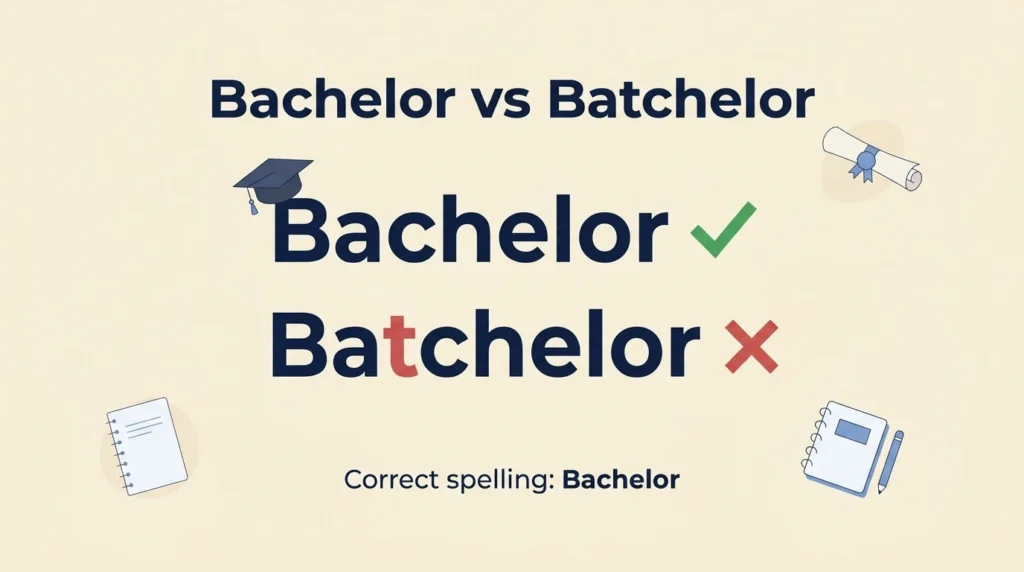

Bachelor is the correct spelling in standard modern English. Use it for an unmarried man and in academic terms such as bachelor’s degree, Bachelor of Arts, and Bachelor of Science. Batchelor is usually a spelling mistake, but it should not be changed when it is someone’s surname, an official proper name, or an intentional historical spelling.
What Is the Difference Between Bachelor and Batchelor?
The difference is mainly one of spelling.
Bachelor is the standard English word. It can describe an unmarried man and is also used in academic qualifications.
Batchelor should not replace bachelor in ordinary modern writing. The extra t makes it incorrect when you are referring to a degree, marital status, a bachelor party, or another normal use of the word.
There are two important exceptions. Batchelor exists as a family name, and the spelling can also appear in older historical material.
That means the rule is more precise than simply saying “Batchelor is never correct.”
Why the Correct Spelling Matters
A spelling error in a casual text message may be minor. The same error can be much more noticeable on a résumé, university application, professional profile, academic paper, or business document.
Consider these two lines:
- Bachelor of Science in Accounting
- Batchelor of Science in Accounting
The first looks professional because it uses the recognized degree name. The second contains a spelling error unless Batchelor happens to be part of a proper name.
The distinction matters especially when you are listing your own qualifications. A mistake in the name of your degree can make an otherwise polished document look poorly proofread.
The Core Rule for Bachelor vs Batchelor
Rule: Use bachelor in standard modern English. Use Batchelor only when it is genuinely part of a person’s name, another proper name, or an intentional historical spelling.
The easiest decision process is:
- Are you talking about an academic qualification? Use bachelor.
- Are you describing an unmarried man? Use bachelor.
- Are you writing a phrase such as bachelor party or bachelor pad? Use bachelor.
- Is the person’s actual surname Batchelor? Keep Batchelor.
- Are you reproducing an old text exactly? Preserve its original spelling if accuracy requires it.
Read More: Signer vs Signor Difference: Meanings and Correct Usage
How to Use Bachelor Correctly
Bachelor for an Unmarried Man
As a countable noun, bachelor can describe an unmarried man.
For example:
Daniel remained a bachelor well into his forties.
Because bachelor is countable, a singular example normally needs a determiner such as a, the, this, or that.
Correct:
He is a bachelor.
Incorrect in standard English:
He is bachelor.
When the exact marital history matters, however, a more precise term may be better. Single, divorced, and widowed communicate different information.
Bachelor in Academic Qualifications
The word also appears in academic terminology.
Common forms include:
- bachelor’s degree
- Bachelor of Arts
- Bachelor of Science
- Bachelor of Business Administration
- Bachelor of Engineering
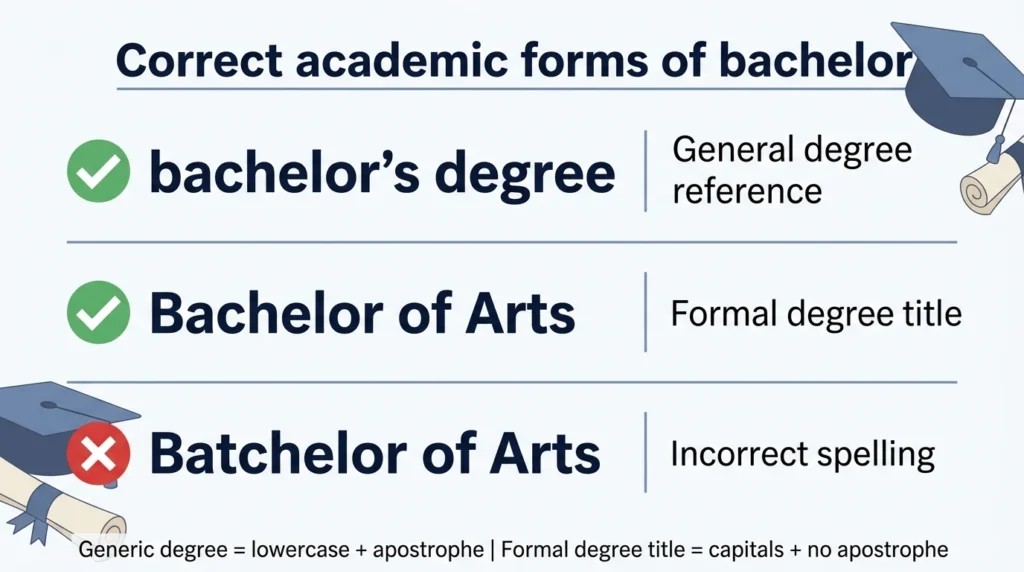
Notice the difference between a general description and a formal degree title.
General: She has a bachelor’s degree in economics.
Formal title: She earned a Bachelor of Arts in Economics.
Bachelor’s Degree and the Apostrophe
When you use the general expression, write:
bachelor’s degree
The apostrophe comes before the s.
Do not normally write:
bachelors degree
For more than one degree, the standard form is still:
bachelor’s degrees
Example:
The university offers more than 40 bachelor’s degrees.
Capitalization of Bachelor’s Degree
Generic degree descriptions are normally lowercase:
He has a bachelor’s degree in marketing.
Formal degree names are capitalized:
He earned a Bachelor of Science in Marketing.
This distinction is useful on résumés, university websites, professional biographies, and academic documents.
Exceptions Involving Batchelor
Do not automatically replace every occurrence of Batchelor with bachelor.
If someone is named Batchelor, changing the spelling would change that person’s name.
The same principle applies to official place names, organizations, titles, or other proper nouns.
You may also encounter batchelor in historical writing. If you are quoting or reproducing an older source, retaining its original spelling can be appropriate.
Correct Examples of Bachelor
These examples show how the standard spelling works in different situations.
- Conversation: My brother is still a bachelor and enjoys living on his own.
- Email: I recently completed my bachelor’s degree and would like to apply for the graduate program.
- Résumé: Bachelor of Science in Computer Science, 2025.
- Workplace: The position requires a bachelor’s degree or equivalent professional experience.
- University: Maya plans to earn a Bachelor of Arts in Psychology.
- School: Our teacher asked us to research the requirements for a bachelor’s degree.
- Social media: Finally finished my bachelor’s degree after four years of hard work!
- Academic writing: Participants were grouped according to whether they held a bachelor’s degree.
- Conversation: His friends organized a bachelor party before the wedding.
- Professional biography: Omar holds a Bachelor of Business Administration and works in financial consulting.
- News-style writing: The longtime bachelor announced his engagement on Monday.
- Career profile: Applicants with a bachelor’s degree in engineering may qualify for the program.
Read More: Signer vs Signor Difference: Meanings and Correct Usage
Incorrect vs. Correct: Bachelor or Batchelor
| ❌ Incorrect | ✅ Correct | Why |
|---|---|---|
| I earned a Batchelor of Arts. | I earned a Bachelor of Arts. | The formal academic title uses Bachelor, not Batchelor. |
| She has a batchelor’s degree. | She has a bachelor’s degree. | The standard spelling does not contain a t. |
| He is batchelor. | He is a bachelor. | Bachelor is spelled without t, and the singular countable noun needs an article here. |
| My university offers five batchelor programs. | My university offers five bachelor’s degree programs. | Batchelor is misspelled, and bachelor’s degree programs is clearer standard phrasing. |
| I completed my bachelors degree last year. | I completed my bachelor’s degree last year. | The general degree expression normally takes an apostrophe. |
| She received a bachelor’s of Science. | She received a Bachelor of Science. | Formal degree titles use Bachelor of…, without the possessive apostrophe. |
| He has a Bachelor’s degree in finance. | He has a bachelor’s degree in finance. | A generic reference is normally lowercase. |
| She earned a bachelor of science from the university. | She earned a Bachelor of Science from the university. | The full formal degree title is capitalized. |
| We planned his batchelor party for Saturday. | We planned his bachelor party for Saturday. | The standard expression is bachelor party. |
| Mr. Bachelor published the study. | Mr. Batchelor published the study. | If the person’s actual surname is Batchelor, it must not be “corrected” to Bachelor. |
Why People Spell Bachelor as Batchelor
The Pronunciation Encourages the Mistake
Bachelor contains a ch sound that can remind writers of words such as:
- batch
- catch
- match
- patch
- watch
Because many familiar English words represent a similar sound with tch, a writer may unconsciously transfer that spelling pattern to bachelor.
That produces batchelor.
The problem is that English spelling cannot always be predicted from sound alone.
Spelling Pattern Overgeneralization
Learners often discover spelling patterns and then apply them too broadly.
That strategy is useful most of the time, but English contains many words whose established spelling reflects older forms rather than the pattern a learner expects today.
Bachelor is one of those words you are better off learning as a complete spelling rather than constructing letter by letter from its pronunciation.
Visual Similarity
The forms are visually close:
bachelor
batchelor
Only one extra letter separates them. When reading quickly, the eye may focus on the beginning and ending rather than checking every letter in the middle.
That makes the mistake easy to overlook during proofreading.
Autocomplete and Spellcheck Are Not Enough
Writing software can catch many spelling errors, but it should not be your only safeguard.
A proper name such as Batchelor may appear in a system’s vocabulary, which means software cannot always determine whether you intentionally typed a surname or accidentally misspelled bachelor.
Context still matters.
Translation and Transliteration Can Influence Spelling
Some English learners first encounter the word through speech or through another writing system.
When they later spell the English word, they may reconstruct it according to the sound rather than recalling its established written form.
This varies by first language, so it is not the cause of every mistake. The safest approach is simply to memorize the standard form: bachelor.
Common Mistakes Checklist
- Adding a T: Writing batchelor because the pronunciation reminds you of batch. Avoid it by memorizing b-a-c-h-e-l-o-r.
- Removing the apostrophe from bachelor’s degree: Bachelors degree is a common error. In general prose, use bachelor’s degree.
- Adding an apostrophe to a formal degree title: Write Bachelor of Science, not Bachelor’s of Science.
- Capitalizing every use: Write bachelor’s degree when referring to the qualification generally. Reserve capitals for formal titles such as Bachelor of Arts.
- Writing “I am bachelor”: In standard English, use I am a bachelor, because bachelor is a singular countable noun.
- Correcting a surname: Never change Batchelor to Bachelor when Batchelor is someone’s actual family name.
- Trusting pronunciation alone: English spelling and pronunciation do not always match perfectly. Check the written form rather than guessing.
- Using bachelor when relationship history needs precision: If someone is divorced or widowed, single, divorced, or widowed may communicate the intended meaning more accurately.
Bachelor vs Batchelor in Real English
Grammatically Correct English
He is a bachelor is grammatically correct standard English. So are expressions such as bachelor’s degree, bachelor party, and Bachelor of Science. The word works naturally when the speaker specifically wants to describe unmarried status, an academic qualification, or an established expression. In these situations, changing bachelor to batchelor would create a spelling error unless a proper name is involved.
Grammatically Possible but Less Natural English
A sentence can be grammatical without being the wording people would normally choose. For example, He has remained a bachelor since leaving university is grammatical, but if the only point is his present relationship status, He is single may sound simpler and less marked. Likewise, I possess a bachelor’s degree in marketing is grammatical but more formal than the everyday I have a bachelor’s degree in marketing.
Natural Everyday English
In normal conversation about education, speakers commonly say I have a bachelor’s degree, I have a bachelor’s in business, or I studied for a Bachelor of Science. When talking casually about relationships, He’s single is often more straightforward than He’s a bachelor. Bachelor is still correct, but it can place more emphasis on unmarried status or a bachelor lifestyle than the neutral adjective single does.
Formal vs. Informal Usage
Formal and Professional Writing
Use precise academic wording in résumés, applications, biographies, research papers, and business documents.
Good choices include:
Bachelor of Science in Accounting
bachelor’s degree in accounting
Avoid creative spelling variations and check the institution’s official wording when naming a specific qualification.
Informal Conversation
In casual speech, shortened forms can sound natural:
I have a bachelor’s in psychology.
She’s finishing her bachelor’s this year.
When discussing relationship status, single is often a simpler everyday choice:
He’s single.
The noun bachelor remains correct when that particular idea is intended.
Read More: What Is the Difference Between Prooving or Proving?
Bachelor vs Batchelor Comparison Table
| Feature | Bachelor | Batchelor |
|---|---|---|
| Standard modern spelling | Yes | No, when used in place of bachelor |
| Part of speech | Usually a noun; also used attributively in phrases | Usually encountered as a proper name or historical variant |
| Academic use | bachelor’s degree, Bachelor of Arts | Not the standard academic spelling |
| Relationship meaning | An unmarried man | Not the standard modern spelling for this meaning |
| Bachelor party | Correct | Incorrect |
| Bachelor’s degree | Correct | Incorrect |
| Surname | Bachelor can also occur in proper names | Batchelor is an established surname |
| Historical texts | Standard modern form | Can appear as an older spelling |
| Résumé or application | Use bachelor | Avoid unless it is a proper name |
| American/British spelling | Bachelor | No modern spelling change is required |
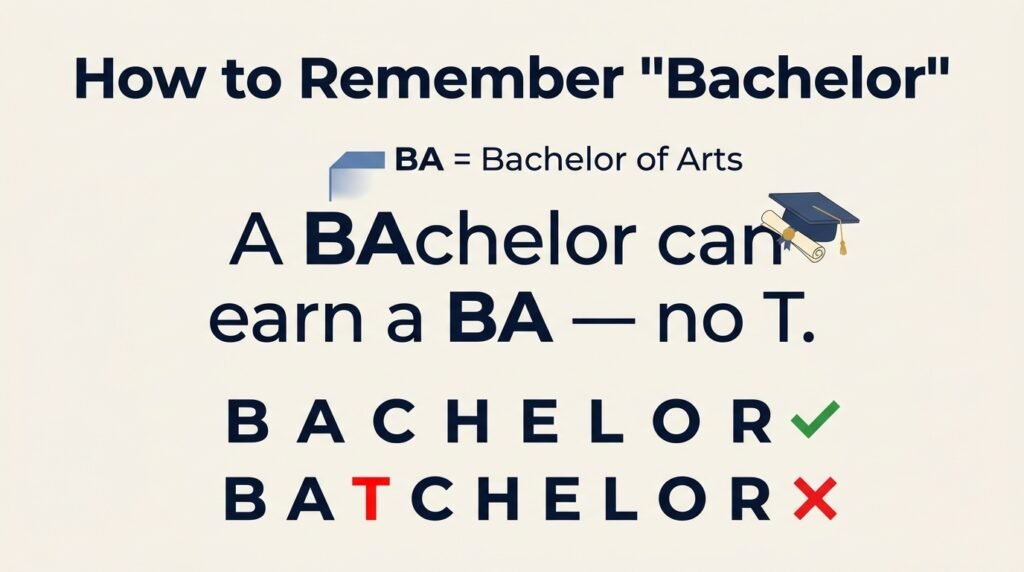
Memory Trick
Remember:
A BAchelor can earn a BA — and BA has no T.
The beginning of BAchelor matches the abbreviation BA in Bachelor of Arts.
If you find yourself writing BATchelor, ask where the T came from.
For the ordinary English word, it does not belong there.
Real-Life Situations
Interview
Interviewer: What is your highest qualification?
Candidate: I have a bachelor’s degree in mechanical engineering.
The candidate uses the generic degree expression, so lowercase bachelor’s degree is appropriate.
Meeting
Manager: What background does the new analyst have?
Colleague: She has a Bachelor of Science in Statistics.
A formal degree name is being given, so it is capitalized.
Correct: I recently completed my bachelor’s degree and am interested in the trainee position.
Using batchelor’s here would create an avoidable spelling error in professional communication.
Text Message
Correct: Ryan’s bachelor party is next weekend.
Even in informal writing, the standard spelling remains bachelor.
Exam
Question:
Choose the correct spelling: bachelor or batchelor.
Answer:
Bachelor
An exam usually expects the standard modern spelling unless the question specifically discusses surnames or historical orthography.
Expert Tips
Check the Word Around “Degree”
If degree comes immediately after the word, the form you will usually need is:
bachelor’s degree
This single phrase solves a large percentage of real-world spelling questions.
Separate Spelling From Capitalization
These are two different issues.
First ask:
Is bachelor spelled correctly?
Then ask:
Should it be capitalized here?
Trying to solve both questions at once often creates forms such as Bachelor’s Degree in ordinary prose.
Copy the Official Degree Name When Accuracy Matters
If you are preparing a résumé or application, check your diploma, transcript, or university record.
Institutions may have specific official degree names. Reproduce that official title instead of guessing.
Treat Proper Names Differently
Spellcheck rules do not override people’s names.
If an author, employee, customer, professor, or historical figure is named Batchelor, preserve that spelling exactly.
Search for the Extra T During Proofreading
When proofreading an important document, search for:
batchelor
This is faster than hoping you notice the mistake while rereading every sentence.
Read More: Vinal vs Vinyl: Which Spelling Is Correct?
FAQ
Is bachelor or batchelor correct?
Bachelor is the standard spelling in modern English. Batchelor is normally incorrect when it is intended to mean bachelor, although it can legitimately occur as a surname, proper name, or historical spelling.
Is Batchelor a real word?
It depends on what you mean by “real.” It is not the standard modern spelling of the ordinary word bachelor, but Batchelor exists as a surname and has appeared as an archaic spelling in older English texts.
Can I write batchelor on my résumé?
Not when describing your qualification. Write bachelor’s degree, Bachelor of Arts, Bachelor of Science, or the exact official name of your degree.
Keep Batchelor only when it belongs to a proper name.
Is it bachelor degree or bachelor’s degree?
In normal edited prose, bachelor’s degree is the standard form.
Example:
She earned a bachelor’s degree in finance.
A formal title uses a different construction:
She earned a Bachelor of Science.
Is it bachelors or bachelor’s?
They have different jobs.
Bachelors is the plural of bachelor:
Three bachelors rented the house.
Bachelor’s contains an apostrophe and appears in phrases such as:
bachelor’s degree
How do I write two bachelor’s degrees?
Write:
two bachelor’s degrees
Example:
She holds two bachelor’s degrees, one in mathematics and one in economics.
Should I capitalize bachelor’s degree on a résumé?
A generic reference is normally lowercase:
bachelor’s degree in accounting
Capitalize the formal title:
Bachelor of Science in Accounting
A résumé may use title-style formatting in headings, but the underlying grammar rule remains the same.
Does bachelor always mean a man who has never married?
The traditional relationship meaning refers to an unmarried man, and some dictionary definitions specifically emphasize never having married.
If you need to describe someone’s current legal or relationship status accurately, terms such as single, divorced, or widowed may be clearer.
Is bachelor spelled differently in American and British English?
No spelling change is needed for the target word. Bachelor is the standard spelling in both major varieties.
You may see regional differences in related expressions, but they do not change the spelling of bachelor itself.
Can a spellchecker accept Batchelor?
Possibly. Batchelor is a legitimate surname and proper name, so software may not always know that you intended to write bachelor.
That is why context-based proofreading remains important.
Mini Quiz
| # | Question | Answer | Explanation |
|---|---|---|---|
| 1 | Choose the correct spelling: bachelor / batchelor | bachelor | Bachelor is the standard modern English spelling. |
| 2 | Fill in the blank: She earned a ______ degree in biology. | bachelor’s | The generic phrase is bachelor’s degree. |
| 3 | Correct the sentence: “He completed his Batchelor of Arts last year.” | He completed his Bachelor of Arts last year. | Formal degree titles use Bachelor, without the extra t. |
| 4 | Which is correct? A) bachelors degree B) bachelor’s degree | B) bachelor’s degree | The general degree expression normally takes an apostrophe. |
| 5 | Correct the sentence: “I am bachelor.” | I am a bachelor. | Bachelor is a singular countable noun and needs an article here. |
| 6 | Which should be capitalized? A) bachelor’s degree B) Bachelor of Science | B) Bachelor of Science | Full formal degree names are capitalized; generic references normally are not. |
| 7 | A professor’s surname is Batchelor. Should you change it to Bachelor? | No. | A person’s proper name should retain its correct spelling. |
| 8 | Fill in the blank: The university offers 25 ______ degrees. | bachelor’s | The normal plural phrase is bachelor’s degrees. |
| 9 | Correct the sentence: “She earned a Bachelor’s of Science.” | She earned a Bachelor of Science. | Formal Bachelor of… titles do not use the possessive apostrophe. |
| 10 | True or false: Batchelor is always wrong in every possible context. | False. | It is wrong as a replacement for standard bachelor, but it can be a surname, proper name, or historical spelling. |
Quick Summary
Bachelor is the standard spelling in modern English; batchelor is usually a misspelling. Use bachelor for an unmarried man, a bachelor party, and academic expressions such as bachelor’s degree. In general prose, write bachelor’s degree with an apostrophe and lowercase letters. When giving a formal qualification, capitalize the title and remove the possessive apostrophe: Bachelor of Arts or Bachelor of Science. Do not automatically correct Batchelor when it is someone’s surname, another proper name, or an intentional spelling reproduced from a historical source. To remember the difference, think: A BAchelor can earn a BA — and BA has no T. For professional documents, always confirm your university’s exact official degree title.