
Proving is the present participle of the verb prove. It can also function as a gerund, depending on how it is used in a sentence. The verb prove means to establish that something is true, valid, genuine, or accurate by using evidence, reasoning, testing, or demonstration.
For example:
- The evidence is proving his claim.
- She is proving that the method works.
- Proving your point requires reliable evidence.
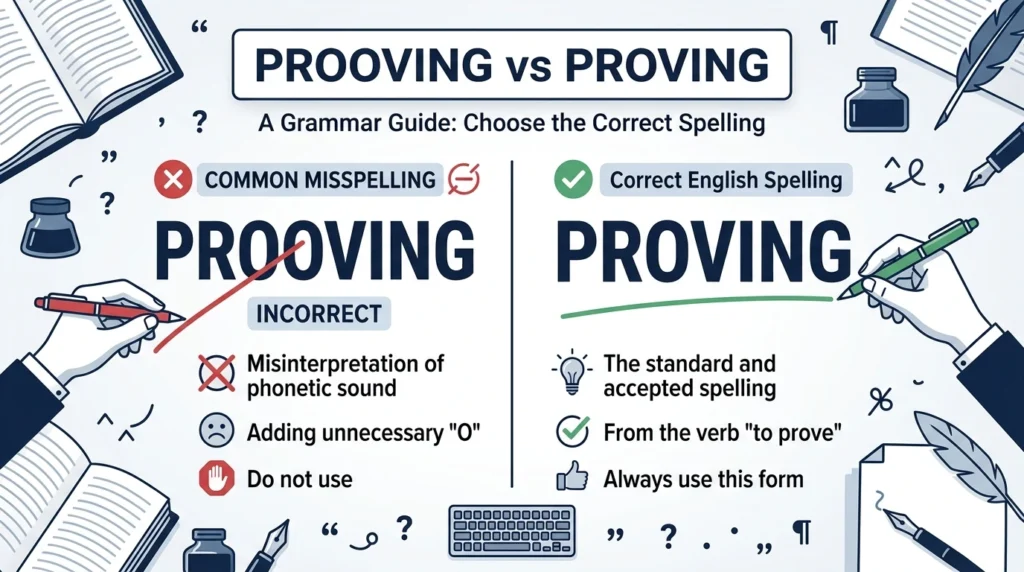
The spelling prooving contains an unnecessary extra o. It is usually produced when someone hears the long “oo” sound in prove and assumes that the spelling should contain two o letters before -ing.
That assumption is understandable, but English spelling does not work that way here.
Correct: prove → proving
Incorrect: prove → prooving
The important point is that prooving and proving are not two different forms of the same standard English word.
Why Does Proving Matter?
A single extra letter can make writing look careless, particularly when the word appears in professional, academic, technical, or formal communication.
Consider these sentences:
- “The report is proving the effectiveness of the treatment.”
- “The report is prooving the effectiveness of the treatment.”
The first sentence uses the standard spelling. The second contains a spelling error.
The mistake matters because readers generally expect standard spelling in contexts such as:
- Academic assignments
- Research papers
- Business reports
- Legal documents
- Job applications
- Professional emails
- Website content
- School examinations
- Formal presentations
- Technical documentation
In casual messaging, a reader may understand prooving immediately. However, being understandable does not make a spelling form standard.
Using proving consistently is the safer choice in virtually all ordinary English writing.
The Core Rule
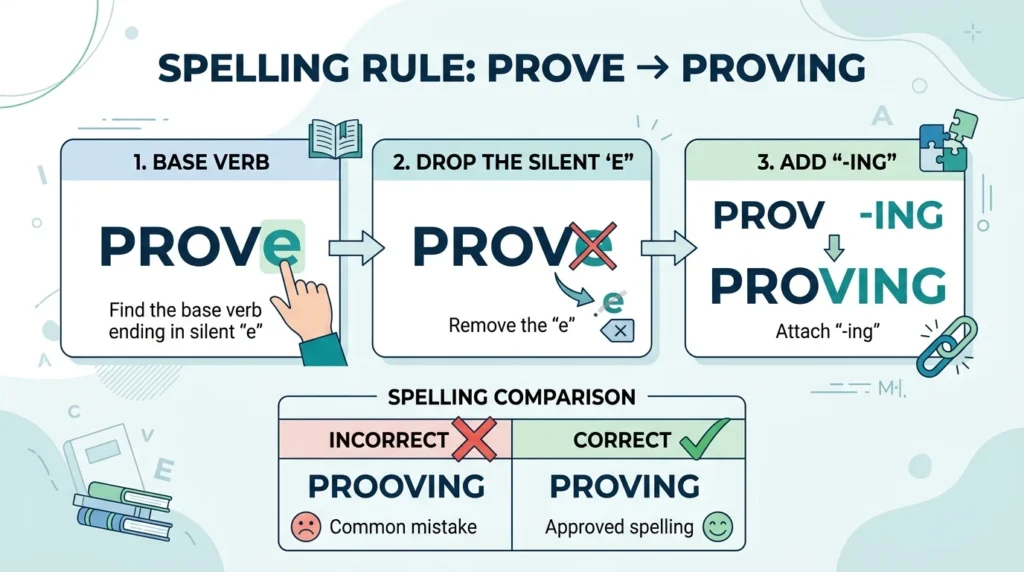
When you add -ing to the verb prove, remove the final silent e: prove → proving.
The process is:
prove + ing → proving
The final e is removed before -ing is added.
This is part of a common English spelling pattern involving verbs that end in a silent e.
Read More:Enable vs Inable: Which Is Correct?
Compare:
| Base verb | + -ing | Correct form |
|---|---|---|
| prove | prove + ing | proving |
| move | move + ing | moving |
| write | write + ing | writing |
| make | make + ing | making |
| take | take + ing | taking |
| use | use + ing | using |
So prooving is not formed by doubling the vowel in prove. The correct transformation is:
PROVE → PROVING
not:
PROVE → PROOVING
How to Use Proving Correctly
Proving is the -ing form of prove. Depending on the sentence, it can appear in several grammatical roles.
Proving in the Present Continuous
The present continuous uses am, is, or are + -ing form to describe an action in progress.
Examples:
- She is proving her argument with new evidence.
- The scientist is proving the theory through repeated experiments.
- They are proving that the system can handle heavy traffic.
- I am proving my eligibility with the required documents.
Here, proving describes an action currently happening.
Proving After Certain Verbs
The -ing form can also follow verbs or expressions that allow a gerund.
Examples:
- We discussed proving the claim with additional data.
- They focused on proving the method was reliable.
- He succeeded in proving his case.
- She is interested in proving the result independently.
Proving in Academic and Technical Writing
The word is especially common when discussing evidence, theories, mathematical arguments, experiments, and conclusions.
Examples:
- The researchers are proving the hypothesis through controlled testing.
- The final section focuses on proving the proposed theorem.
- The evidence is useful for proving the relationship between the variables.
- Several steps are required for proving the mathematical statement.
Merriam-Webster lists prove as a verb meaning, among other things, to establish truth or validity through evidence or logic, and it gives proving as its present participle.
Correct Examples
Here are original examples showing how proving works in different real-world settings.
Conversation
“I’m not trying to win the argument. I’m just proving that the information is incorrect.”
“Our latest figures are proving that the revised strategy is more effective.”
School
“Maria spent the afternoon proving her answer with the correct mathematical steps.”
University
“The researchers are proving the proposed relationship through statistical analysis.”
Workplace
“The sales data is proving that customers prefer the new service package.”
Social Media
“Another day, another example of why checking the facts matters before proving a point online.”
Academic Writing
“The study contributes to the literature by proving that the proposed model can produce consistent results under controlled conditions.”
Legal Context
“The prosecution will present additional evidence aimed at proving the allegation.”
Technical Writing
“The testing procedure is designed to assist in proving that the software meets the required specification.”
Everyday English
“You don’t need to keep proving yourself to everyone.”
Incorrect vs. Correct
| Incorrect | Correct | Why |
| ❌ She is prooving her point. | ✅ She is proving her point. | The verb is prove, and its -ing form is proving. |
| ❌ They are prooving the theory. | ✅ They are proving the theory. | The final silent e is removed before -ing is added. |
| ❌ He kept prooving that he was right. | ✅ He kept proving that he was right. | Prooving adds an unnecessary second o. |
| ❌ We are prooving the result. | ✅ We are proving the result. | The standard present participle is proving. |
| ❌ The evidence is prooving the claim. | ✅ The evidence is proving the claim. | The correct -ing form of prove is proving. |
| ❌ She enjoys prooving difficult points. | ✅ She enjoys proving difficult points. | The gerund form is also spelled proving. |
| ❌ He is prooving his ability. | ✅ He is proving his ability. | The extra o is not part of the standard spelling. |
| ❌ Scientists are prooving the hypothesis. | ✅ Scientists are proving the hypothesis. | Proving is the established form. |
| ❌ The experiment is prooving the prediction. | ✅ The experiment is proving the prediction. | Prove becomes proving, not prooving. |
| ❌ She succeeded in prooving the claim. | ✅ She succeeded in proving the claim. | The spelling remains proving regardless of its grammatical role. |
Why People Make This Mistake
Phonetic Similarity
One major reason for the mistake is pronunciation.
The vowel sound in prove is long, similar to the “oo” sound heard in words such as moon or soon. A learner may therefore assume that the sound requires two written o letters.
But pronunciation and spelling are not identical systems.
The word prove is already spelled with one o:
p-r-o-v-e
When the verb becomes proving, the spelling does not become prooving. The final silent e disappears:
p-r-o-v-i-n-g
Spelling Pattern Confusion
Learners may remember that some English words contain double vowels and apply that pattern too broadly.
For example:
- food
- moon
- room
- school
These words really do contain oo, but prove is not spelled with oo.
The sound alone cannot tell you the spelling.
Read More: Vinal vs Vinyl: Which Spelling Is Correct?
Overgeneralization
English learners often learn one spelling pattern and apply it to words that do not follow the same pattern.
Someone may mentally reason:
“Prove sounds like it contains ‘oo,’ so adding -ing should give me prooving.”
That reasoning focuses on pronunciation rather than the actual spelling of the base verb.
Autocomplete and Spellcheck
Spellcheck tools are useful, but they should not replace knowledge of spelling.
A typing tool may suggest proving after you enter prooving, but users sometimes accept suggestions without understanding why the correction is necessary.
Spellcheck can identify an error. Understanding the spelling rule helps prevent it.
Translation Interference
Learners who think in another language may mentally map pronunciation to spelling according to the spelling conventions of their first language.
English frequently creates difficulties here because letters do not always correspond to sounds in a simple one-to-one way.
That is why memorizing prove → proving as a complete word pair can be more useful than trying to reconstruct the spelling from pronunciation.
Common Mistakes Checklist
Writing “prooving”
Mistake: Adding a second o before -ing.
Why it happens: The pronunciation may suggest a long “oo” sound.
How to avoid it: Start with the written base verb prove, remove the final e, and add -ing.
Correct: proving
Writing “proveing”
Mistake: Keeping the silent e before adding -ing.
Why it happens: The writer remembers the spelling of prove but does not apply the spelling change.
How to avoid it: For this verb, use prove → proving.
Correct: proving
Writing “prooving” because of pronunciation
Mistake: Using sound as the main spelling guide.
Why it happens: The vowel sound can resemble the sound represented by oo in other words.
How to avoid it: Check the base spelling first.
Confusing proving with proofing
Mistake: Assuming proving and proofing are simply different spellings.
Why it happens: Both words relate to ideas such as testing or demonstrating, but they come from different word forms and can have different meanings.
How to avoid it: Ask what you actually mean.
Proving comes from prove.
Proofing comes from proof and can refer to processes such as checking something or allowing bread dough to rise.
Prooving vs Proving in Real English
“Proving” is the standard present participle of prove, and it is widely used in ordinary English to describe the process of establishing, demonstrating, testing, or showing something. Expressions such as “proving a point,” “proving a theorem,” and “proving yourself” are grammatically normal. Dictionary entries explicitly identify proving as the present participle of prove.
Grammatically correct: “proving”
Grammatically possible but unnatural: “prooving”
In standard modern English, prooving is not an alternative spelling of proving. A reader can normally understand it because the intended word is obvious from context, but that does not make it a natural or accepted standard spelling for ordinary writing. In formal communication, academic work, business documents, and edited content, use proving.
Natural everyday English: “proving”
Native and proficient English users routinely use proving in everyday expressions such as “proving someone wrong,” “proving a point,” “proving that something works,” and “proving yourself.” These expressions can occur in casual conversation as well as formal writing. Current dictionary examples likewise show proving in ordinary, professional, and academic contexts.
American vs. British English
There is no meaningful American-versus-British spelling difference between “proving” and “prooving.”
Both varieties use proving as the standard present participle of prove.
Some other forms of prove can have usage differences or historical variation, particularly the past participle proved/proven, but that does not create a British spelling of prooving. Merriam-Webster notes that both proved and proven are used as past participles, while its entry identifies proving as the present participle.
So:
American English: proving ✅
British English: proving ✅
Prooving: not the standard spelling ❌
Formal vs. Informal Usage
The standard spelling proving works in both formal and informal English.
In formal writing:
The experiment provides evidence for proving the proposed relationship.
In professional writing:
The latest results are proving that the revised process is more efficient.
In casual conversation:
You’re not proving anything by getting angry.
The form does not need to change according to register. What changes is usually the surrounding vocabulary and sentence structure.
Even in a text message, proving remains the correct spelling.
Prooving vs Proving Comparison Table
| Feature | Proving | Prooving |
| Standard English spelling | ✅ Yes | ❌ No |
| Derived from prove | ✅ Yes | ❌ No |
| Present participle of prove | ✅ Yes | ❌ No |
| Gerund form of prove | ✅ Yes | ❌ No |
| Suitable for academic writing | ✅ Yes | ❌ No |
| Suitable for business writing | ✅ Yes | ❌ No |
| Standard American English | ✅ Yes | ❌ No |
| Standard British English | ✅ Yes | ❌ No |
| Extra “o” required | ❌ No | ✅ Incorrectly added |
| Correct spelling to remember | proving | avoid |
Memory Trick
Use this simple rule:
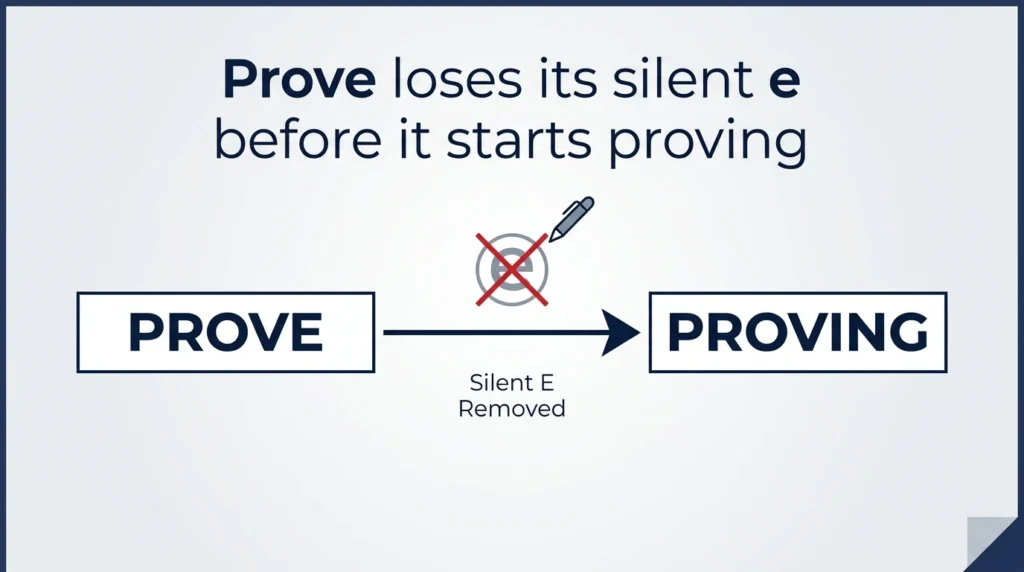
“Prove loses its silent e before it starts proving.”
Think of the transformation as:
PROVE
↓ remove E
PROV
↓ add ING
PROVING
Another useful comparison is:
move → moving
You would never normally write mooving.
Likewise:
prove → proving
not:
proove → prooving
The key is to remember the spelling of the base word first.
Real-Life Situations
Job Interview
A candidate might say:
“I’m confident that my previous results are proving my ability to manage complex projects.”
Here, proving describes evidence that demonstrates ability.
Business Meeting
A manager might say:
“The customer feedback is proving that the new process is easier to use.”
The form is completely natural in a professional context.
Academic Assignment
A student might write:
“The following calculation is useful for proving the proposed result.”
This is appropriate academic usage.
A colleague might write:
“The latest test results are proving that the original estimate was too conservative.”
Again, proving is the correct form.
Text Message
A friend might write:
“You keep proving me wrong!”
The sentence is informal, but the spelling remains the same.
Examination
A mathematics question might ask a student to explain a method for:
“Proving that the two expressions are equivalent.”
The spelling does not change simply because the context is academic.
Proving vs Proofing: Do Not Confuse Them
One especially useful distinction is between proving and proofing.
Proving comes from the verb prove.
The evidence is proving the claim.
Proofing comes from proof, and its meaning depends on context. In publishing, proofing can refer to checking a draft or proof. In baking, proofing refers to allowing dough to rise before baking.
So:
The evidence is proving the theory.
is different from:
The baker is proofing the dough.
This distinction matters because a writer who remembers that “proof” relates to evidence may accidentally select proofing when they actually mean proving.
How Is Proving Pronounced?
Proving is generally pronounced with the same core vowel sound as prove, followed by a sound like “ving.”
A useful way to think about it is:
prove + ing → proving
The pronunciation does not require you to write an additional o.
This is another reason that spelling directly from sound can cause problems. The English spelling proving represents the word correctly even though the vowel sound may feel like the “oo” sound found in other words.
What About the Word Proove?
Proove should not be used as the modern standard spelling of prove.
Historical and dictionary records may contain proove as an obsolete spelling or as a misspelling, but this does not make it the normal modern English form. Consequently, prooving, formed from proove, is not the standard modern spelling you should use.
The modern form is:
prove → proving
not:
proove → prooving
This distinction explains why searching for prooving may sometimes produce unusual historical or user-generated results. A form can appear somewhere online without being a standard modern English spelling.
Expert Tips for Remembering Proving
Start With the Base Word
Do not try to construct the word from its sound.
Start with:
prove
Then apply the spelling change:
prove → proving
Remember the Silent E
The final e in prove is not pronounced separately at the end of the word.
When -ing is added, that e is removed.
Avoid Adding Letters Based on Sound
The pronunciation may tempt you to write oo, but spelling is based on the written form prove, not simply on the vowel sound.
Learn Word Families
Remember these together:
- prove
- proving
- proved
- proven
- proof
- provable
This makes the relationship between the words clearer.
Use the Written Form in Memory Practice
Instead of repeating “prooving is wrong,” write the correct pair several times:
prove → proving
The correct form becomes easier to retrieve when you need it.
Mini Quiz
| # | Question | Answer | Explanation |
| 1 | Choose the correct form: “She is ___ her point.” A) prooving B) proving | B) proving | Proving is the present participle of prove. |
| 2 | Fill in the blank: “The evidence is ___ the claim.” | proving | The correct -ing form of prove is proving. |
| 3 | Which spelling is standard? A) prooving B) proving | B) proving | Prooving contains an unnecessary extra o. |
| 4 | Correct the sentence: “They are prooving the theory.” | They are proving the theory. | Prove becomes proving before -ing is added. |
| 5 | Complete: “He kept ___ that he was right.” | proving | The verb after kept is used in the -ing form. |
| 6 | Which is correct for academic writing? A) The researchers are prooving the hypothesis. B) The researchers are proving the hypothesis. | B | Proving is the standard spelling. |
| 7 | Correct this sentence: “I am prooving my ability to solve the problem.” | I am proving my ability to solve the problem. | The final silent e is removed before -ing. |
| 8 | Fill in the blank: “You do not need to keep ___ yourself.” | proving | The established expression uses proving. |
| 9 | True or false: “Prooving” is an American spelling of “proving.” | False | There is no standard American spelling variation called prooving. |
| 10 | Choose the correct pair: A) prove → prooving B) prove → proving | B) prove → proving | The correct spelling removes the final e and adds -ing. |
Frequently Asked Questions
Is prooving a correct spelling?
No. When you mean the -ing form of prove, the standard spelling is proving. Prooving is normally a misspelling.
Why is proving spelled with one o?
Because the base verb is prove, not proove. When -ing is added, the final silent e is removed, giving proving.
Is prooving ever acceptable in formal English?
No, not as the normal modern spelling of the -ing form of prove. Use proving in formal, academic, professional, and edited writing.
Is proving a verb?
Yes. Proving is the present participle of the verb prove. It can also function as a gerund when an -ing form acts as a noun.
Is proving a gerund?
It can be. In a sentence such as “Proving the claim required more evidence,” the -ing form functions as a noun-like subject. In “She is proving the claim,” it is part of the verb phrase rather than a gerund.
Is there a difference between proving and proofing?
Yes. Proving comes from prove and means demonstrating or establishing something. Proofing comes from proof and has different uses, including checking material and preparing dough for baking.
Is proving correct in British English?
Yes. Proving is the standard form in British English as well as American English.
Is “proveing” correct?
No. The standard form is proving. The final e in prove is removed before -ing is added.
Why does prooving look like it could be correct?
The pronunciation of prove contains a long vowel sound that resembles the sound represented by oo in words such as “moon.” That can make prooving look plausible even though the spelling of the base word is prove.
Can I use prooving in a text message?
A reader may understand what you mean, but it is still better to use proving. Informal communication does not create a standard spelling variant.
What is the easiest way to remember proving?
Remember:
PROVE − E + ING = PROVING
Or use the phrase:
“Prove loses its e before it starts proving.”
Final Rule to Remember
Prove → Proving.
Never add another “o.” Remove the silent “e,” then add “-ing.”
Additional supporting anchor targets:
- gerunds vs. present participles
- English verbs ending in silent e
- common confusing words
- English spelling rules
- common grammar mistakes
Long-tail supporting topics:
- how to add ing to verbs ending in e
- when to drop e before ing
- prove past tense and past participle
- proving meaning in English
- proofing vs proving
This keeps internal-link recommendations aligned with the article’s actual semantic relationships rather than inserting irrelevant links.
Quick Summary
Proving is the correct standard English spelling, while prooving is normally a misspelling. The correct form comes from the verb prove: remove the final silent e and add -ing, producing proving. The word can describe an action in progress, as in “She is proving her point,” or function as a gerund, as in “Proving the claim requires evidence.” The mistake often happens because prove has a long vowel sound that may make writers expect two o letters. There is no standard American or British spelling difference here. Whenever you mean the -ing form of prove, write proving, not prooving.