
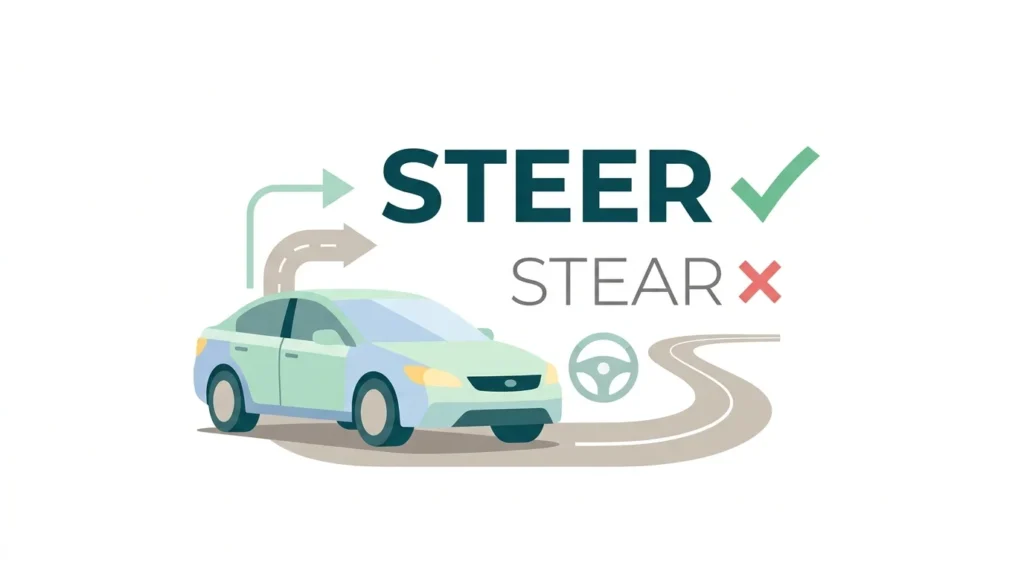

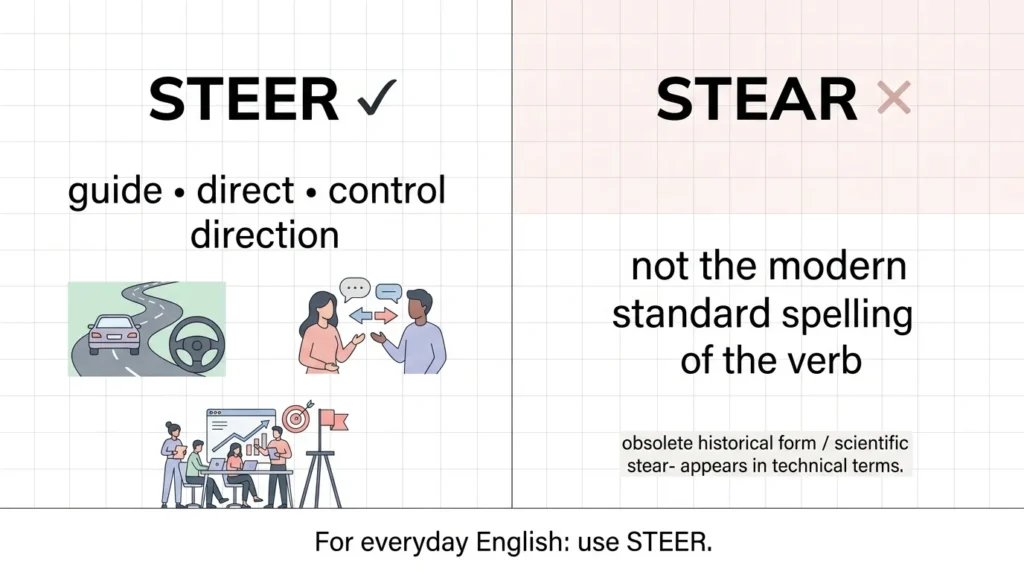
Steer is the correct spelling when you mean “to guide,” “direct,” or “control the direction of something.” Stear is not the modern standard spelling of that verb. It does exist in historical English as an obsolete form of steer, and stear- appears in scientific terms such as stearic acid, but you should not use stear instead of steer in modern everyday writing.
Correct: Please steer the car carefully.
Incorrect in modern standard English: Please stear the car carefully.
What Is the Difference Between Steer and Stear?
The difference is mainly one of modern usage and spelling.
Steer is an established modern English word. As a verb, it means to control or guide the direction of a vehicle, person, conversation, activity, or situation. It can also be a noun referring to a castrated male bovine. In British English, steer can additionally mean a piece of advice or useful information.
Stear is not the modern standard spelling of the verb steer. You may encounter it in historical texts as an obsolete form of steer. You may also see stear- in technical vocabulary connected with fats, such as stearic acid and stearate.
So, if you are writing an email, essay, report, text message, social media post, or ordinary sentence, the answer is simple:
Use “steer,” not “stear.”
Why It Matters
A one-letter spelling difference can make a sentence look incorrect even when the intended meaning is obvious.
Consider:
- ❌ Please stear the conversation toward the main issue.
- ✅ Please steer the conversation toward the main issue.
The reader will probably understand the first sentence, but stear is not the normal modern spelling. In professional, academic, or public writing, using the standard form makes your writing clearer and more credible.
This matters especially when you use steer metaphorically. The word is common in business and professional English:
- steer a meeting
- steer a discussion
- steer a project
- steer a company
- steer a decision
- steer someone toward a solution
Modern dictionaries explicitly record these extended uses of steer.
The Core Rule
If you mean “guide,” “direct,” or “control the direction,” spell it STEER.
Use:
- steer the car
- steer the boat
- steer the conversation
- steer the project
- steer the company
- steer someone toward an answer
- steer clear of trouble
Do not write stear as an alternative spelling of the modern verb.
Read More: Symptomatology vs Symptomology: Which Word Is Correct?
The One Rule to Remember
Guide = steer.
That is the spelling you need in normal modern English.
How to Use Steer
Steer a Vehicle
The most literal use of steer is controlling the direction of a vehicle.
Examples:
- She learned to steer the car before driving alone.
- He carefully steered the boat around the rocks.
- The cyclist steered around the parked truck.
- This vehicle is easy to steer.
Both major learner dictionaries describe steer as controlling the direction of a vehicle.
Steer a Person
You can also steer someone toward or away from a place, action, or choice.
- The receptionist steered us toward the correct office.
- I tried to steer him away from the argument.
- She steered the children toward the exit.
Here, steer means guide someone in a particular direction.
Steer a Conversation or Discussion
This is one of the most useful figurative meanings.
- The manager steered the discussion back to the budget.
- She steered the conversation away from personal issues.
- He tried to steer the meeting toward a practical solution.
This use is well established in modern English, not merely an informal metaphor.
Steer a Project, Organization, or Situation
You can also use steer when someone influences how something develops.
- The director steered the project through several difficult stages.
- Strong leadership helped steer the company through the crisis.
- The committee is trying to steer the policy in a new direction.
In these sentences, nobody is physically driving anything. The meaning is metaphorical: to guide development or direction.
Correct Examples
Here are examples from different real-life contexts.
| Context | Correct sentence |
|---|---|
| Conversation | Can you steer the conversation back to the main topic? |
| Driving | She learned to steer the car confidently. |
| Boating | The captain steered the boat toward the harbor. |
| Workplace | We need someone to steer the project through its final stage. |
| Could you steer me toward the right person for this request? | |
| School | The teacher steered the discussion toward the central question. |
| Academic writing | The evidence helped steer the research in a new direction. |
| Social media | Try to steer the discussion away from personal attacks. |
| Business | The CEO successfully steered the company through a difficult year. |
| Everyday speech | I don’t know which option to choose. Can you give me a steer? |
The final example deserves special attention. In British English, a steer can be a noun meaning useful advice or information.
Also Read: Noteable vs Notable
Incorrect vs. Correct
| ❌ Incorrect | ✅ Correct | Why |
|---|---|---|
| Please stear the car slowly. | Please steer the car slowly. | The modern verb is spelled steer. |
| He tried to stear the boat toward shore. | He tried to steer the boat toward shore. | Steer means control the direction of a vehicle or boat. |
| We need to stear the meeting back to the agenda. | We need to steer the meeting back to the agenda. | The figurative verb is also spelled steer. |
| She stears the team toward its goals. | She steers the team toward its goals. | The third-person singular form is steers. |
| They steared the project carefully. | They steered the project carefully. | The past tense is steered. |
| He is stearing the conversation away from the issue. | He is steering the conversation away from the issue. | The -ing form is steering. |
| Can you stear me toward the right department? | Can you steer me toward the right department? | The verb remains steer in this figurative use. |
| The driver could not stear around the obstacle. | The driver could not steer around the obstacle. | Steer is the standard spelling. |
| She wants to stear the company in a new direction. | She wants to steer the company in a new direction. | Steer means guide or influence development. |
| Try to stear clear of the argument. | Try to steer clear of the argument. | The established idiom is steer clear. |
Why Do People Make This Mistake?
1. The spelling feels logical
English has many words containing ear, including hear, near, clear, and fear. When someone hears the pronunciation of steer, it is understandable that they may guess stear.
But English spelling does not work as a simple sound-to-letter system.
2. Pronunciation can mislead you
Steer is pronounced approximately /stɪr/ in American English and /stɪə(r)/ in British English. The exact pronunciation varies by accent.
Because the vowel sound does not clearly tell you whether to write ee, ea, or another spelling pattern, a writer may choose the wrong letters.
3. English contains many inconsistent spelling patterns
Compare:
- steer
- hear
- dear
- clear
- fear
- near
The presence of ea in several familiar words can make stear look plausible.
But plausible-looking does not mean standard spelling.
Read More: Distress vs Duress: Meaning, Differences, and Correct Usage
4. Fast typing creates errors
When people type quickly, they often spell a word according to what they expect to see rather than consciously checking every letter.
This is particularly likely with words that:
- sound familiar,
- have unusual vowel patterns,
- have a common misspelling,
- are rarely written by the person.
5. Spellcheck is not a substitute for knowledge
A spellchecker may identify stear as an error, but automated tools are not perfect. A word can also appear in a dictionary for a specialized or historical reason without being the word you need in ordinary writing.
That is why understanding the meaning and usage is more useful than relying entirely on autocorrect.
Common Mistakes Checklist
Mistake 1: Writing “stear the car”
Problem: The spelling is wrong for the modern verb.
Fix: Write steer the car.
Mistake 2: Writing “stearing”
Problem: The -ing form is incorrectly built from stear.
Fix: The correct form is steering.
Mistake 3: Writing “steared”
Problem: The past tense is incorrectly formed.
Fix: Write steered.
Mistake 4: Forgetting the figurative meaning
Some writers know steer only as a driving word.
But you can also steer a conversation, project, team, organization, or situation.
Mistake 5: Assuming “stear” must be correct because you have seen it
Seeing a spelling online does not establish it as the standard modern form.
Search results can contain:
- typos,
- historical texts,
- technical terms,
- user-generated content,
- names,
- obsolete forms.
Context matters.
Steer in Real English
Everyday English
In ordinary conversation, steer is completely natural when talking about physically guiding something or someone.
“Can you steer the boat?” sounds normal and direct.
“Can you stear the boat?” does not represent a normal alternative pronunciation or spelling. The expected written form is steer.
Professional English
Steer is also natural in professional contexts when talking about direction, leadership, or decision-making.
For example, “She helped steer the project toward completion” is standard business English. It does not sound like an unusual literary expression. Dictionaries record steer for influencing how an activity or situation develops.
Grammatically Possible vs. Natural
A sentence can be grammatically structured correctly but still use the wrong lexical form.
For example:
“He tried to stear the discussion toward the budget.”
The sentence structure is fine. The problem is the spelling of the verb.
Replace stear with steer:
“He tried to steer the discussion toward the budget.”
Now the sentence is standard and natural.
Also Read: Seal vs Seel
When “stear” Really Appears
This is where a simple “stear is not a word” explanation becomes incomplete.
Stear occurs as an obsolete historical form of steer. Historical dictionaries and texts may therefore contain it. Wiktionary, for example, records stear as an obsolete English verb and gives a historical quotation.
The sequence stear- also appears in scientific vocabulary associated with fats. Collins lists stear- as a combining form related to stearo-, with examples such as stearate.
So the precise rule is not:
“The letters stear can never occur in English.”
The better rule is:
Do not use “stear” as the modern everyday spelling of “steer.”
American vs. British English
There is no American-versus-British spelling difference between steer and stear in the sense discussed here.
Both varieties use steer for the verb meaning “guide or control direction.” Cambridge gives both UK and US pronunciations and definitions for the word.
There is, however, a small vocabulary difference worth knowing.
In British English, a steer can mean a piece of advice or useful information:
“Can you give me a steer on which course to choose?”
This noun is marked as British and informal in learner-dictionary sources.
That does not make stear a British spelling variant. It remains steer.
Formal vs. Informal Usage
Steer works in both formal and informal English.
Formal
- The committee will steer the project toward implementation.
- The new policy is intended to steer investment toward renewable energy.
Informal
- Can you steer me toward the right person?
- Let’s steer clear of that topic.
The spelling does not change with register.
The specialized scientific form stear-, however, belongs to technical vocabulary rather than ordinary conversational English.
Read More: Attornies vs Attorneys: Which Spelling Is Correct?
Comparison Table
| Feature | Steer | Stear |
|---|---|---|
| Modern standard English verb? | ✅ Yes | ❌ No |
| Meaning “guide/direct”? | ✅ Yes | ❌ No |
| Used for vehicles? | ✅ Yes | ❌ No |
| Used figuratively? | ✅ Yes | ❌ No |
| Can be a noun? | ✅ Yes | Not as the modern everyday noun in this comparison |
| Historical English form? | Modern form | ✅ Obsolete form |
| Scientific combining form? | No | ✅ stear- occurs in technical terms |
| American English spelling | steer | Not an alternative spelling |
| British English spelling | steer | Not an alternative spelling |
| Correct for everyday writing? | ✅ Yes | ❌ No |
The key distinction is between stear as a historical/technical element and stear as an attempted spelling of the modern verb steer. Those are not the same thing.
Memory Trick
Use this simple mnemonic:
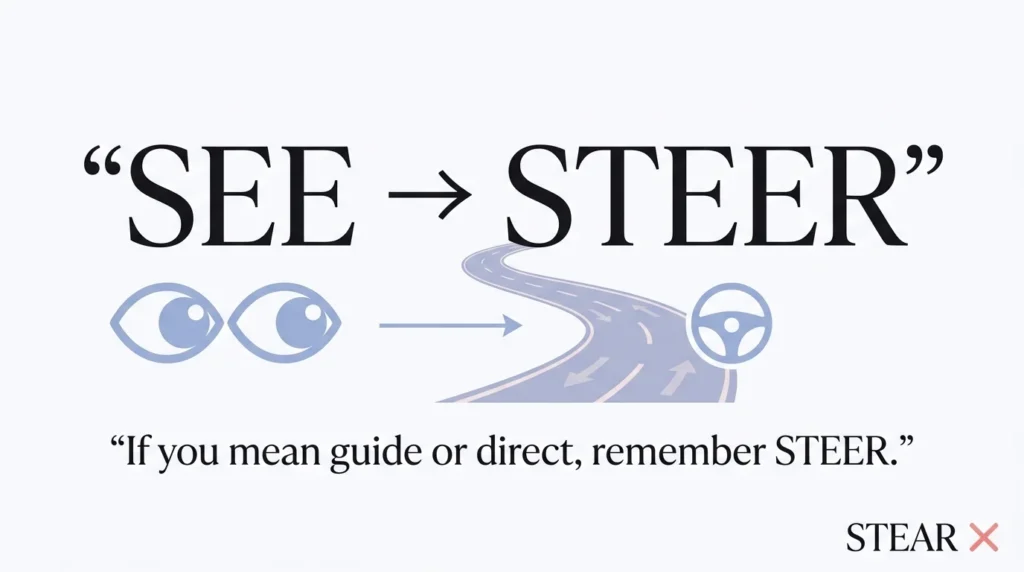
STEER has EE because you need to SEE where you’re going.
SEE → STEER
If you are guiding a car, boat, conversation, project, or person, think:
SEE → STEER
Not:
STEAR
Real-Life Situations
At a Driving Lesson
Your instructor says:
“Steer slightly to the left.”
You are controlling the direction of the car, so steer is correct.
In a Meeting
The discussion moves far away from the agenda.
You might say:
“Let’s steer the conversation back to the main issue.”
This is figurative guidance.
In an Email
You do not know who handles a particular request.
You could write:
“Could you steer me toward the appropriate department?”
Here, steer means guide or direct you to the right person.
In an Academic Essay
You are describing how evidence affected a research project:
“The findings steered the researchers toward a different hypothesis.”
Again, the meaning is “guided.”
In a Text Message
A friend asks which route to take.
You might write:
“Steer toward the main road and I’ll meet you there.”
The same spelling applies in casual writing.
Also Read: Dysregulated vs Disregulated
Expert Tips
1. Learn the word family
Once you know steer, remember its common forms:
- steer
- steers
- steered
- steering
- steerer
- steerable
The spelling changes in predictable ways, but none becomes stear. Merriam-Webster lists steered, steering, steerable, and steerer among the word’s forms and derivatives.
2. Remember “steer clear”
One of the most familiar expressions containing the word is:
steer clear of something
It means to avoid something that may cause trouble.
Example:
We decided to steer clear of unnecessary arguments.
Cambridge and Oxford both record this idiom.
3. Don’t confuse spelling with pronunciation
A familiar sound does not guarantee an obvious spelling.
English contains many words whose spelling cannot be reliably predicted from pronunciation alone. Treat steer as a vocabulary item to remember rather than trying to reconstruct its spelling from sound.
4. Don’t overcorrect scientific vocabulary
If you encounter:
- stearic acid
- stearate
- stearyl
do not automatically change stear- to steer-.
The letters belong to a different technical word family. Collins identifies stear- as a scientific combining form.
5. Be precise when teaching this distinction
Instead of telling learners:
“Stear isn’t a word.”
A more accurate explanation is:
“Stear is not the modern standard spelling of the verb steer, although the form occurs historically and the sequence stear- appears in scientific terminology.”
That explanation prevents learners from incorrectly assuming that the letter sequence stear can never occur anywhere in English.
FAQ
Is “stear” a correct spelling of “steer”?
No. Steer is the standard modern spelling when the verb means to guide, direct, or control direction. Stear is not an alternative modern spelling of that verb.
Is “stear” ever a real English word?
Yes, but this requires context. Stear is recorded as an obsolete English form of steer. It can therefore appear in historical texts.
Is “stear” used in science?
The sequence stear- occurs in scientific terminology connected with fats. Examples include stearic acid and stearate. In these words, stear- is a technical combining form, not the everyday verb steer.
Should I write “steared” or “steered”?
Write steered.
Example:
She steered the boat toward the shore.
The standard past tense of steer is steered.
Should I write “stearing” or “steering”?
Write steering.
Example:
He was steering the car through heavy traffic.
Steering is the standard -ing form.
Is “steer” only used for driving?
No. It can refer to guiding boats, people, conversations, projects, teams, organizations, and situations.
What does “steer clear” mean?
Steer clear of something means to avoid it because it may be unpleasant, dangerous, or problematic.
Example:
We decided to steer clear of the crowded area.
Can “steer” be a noun?
Yes. It has several noun uses. It can refer to a castrated male bovine. In British English, a steer can also mean a piece of advice or useful information.
Do Americans and British people spell “steer” differently?
No. Both American and British English use steer for the standard verb. The pronunciation differs somewhat between the varieties, but the spelling does not.
Why does “stear” look like it could be correct?
Because English uses several different spelling patterns for similar vowel sounds. Words such as hear, near, and clear can make stear look plausible. But the standard spelling of the verb is steer.
What is the easiest way to remember steer vs. stear?
Remember:
SEE where you’re going → STEER.
If you mean guide or direct, choose steer.
Mini Quiz
| # | Question | Answer | Explanation |
|---|---|---|---|
| 1 | Choose the correct spelling: “Please ___ the boat toward the shore.” | steer | Steer means control the direction of a boat. |
| 2 | Choose: “She tried to ___ the discussion back to the main issue.” | steer | The verb is used figuratively to mean guide a discussion. |
| 3 | Correct the sentence: “He steared the car around the corner.” | He steered the car around the corner. | The past tense is steered, not steared. |
| 4 | Choose: “The manager is ___ the team toward its goal.” | steering | The -ing form of steer is steering. |
| 5 | True or false: “Stear” is the British spelling of “steer.” | False | British English also uses steer. |
| 6 | Which is correct? A) stear clear B) steer clear | B) steer clear | The established idiom is steer clear. |
| 7 | Fill in the blank: “Could you ___ me toward the correct department?” | steer | Here steer means guide or direct someone. |
| 8 | Is “stearic acid” evidence that “stear” is the normal spelling of “steer”? | No | Stear- belongs to a scientific word family connected with fats. |
| 9 | Correct the sentence: “They were stearing the project in a new direction.” | They were steering the project in a new direction. | The standard present participle is steering. |
| 10 | Which spelling should you use in an ordinary email when you mean “guide”? | steer | Steer is the standard modern form. |
Quick Summary
Steer is the correct modern English spelling when you mean to guide, direct, or control the direction of something. You can steer a car, boat, person, conversation, project, team, or organization. Stear should not be used as an alternative spelling of this verb in ordinary modern writing. However, the distinction is slightly more nuanced than simply saying that stear “does not exist”: it survives as an obsolete historical form and the combining form stear- occurs in scientific vocabulary such as stearic acid. For everyday English, remember the simple rule: if you mean guide or direct, write STEER.
Also Read: Unkept vs Unkempt