


Quantify means to determine, measure, or express the amount, number, size, or extent of something. Qualify usually means to meet a requirement, become eligible, gain the necessary credentials, or limit or modify a statement.
A simple test works in most situations: if you are asking “How much?”, use quantify. If you are asking “Does it meet the requirements?” or “What limitation should I add?”, use qualify.
What Do Quantify and Qualify Mean?
Although quantify and qualify look similar, they do very different jobs.
Quantify is a verb connected with quantity. When you quantify something, you determine or express how much, how many, or to what measurable extent it exists. The thing being measured does not have to be easy to count. Costs, risks, benefits, damage, performance, and even abstract ideas can be quantified when they can be expressed in measurable terms.
For example:
We need to quantify the financial impact of the delay.
The speaker wants to know how large the impact is in measurable terms.
Qualify has several standard meanings. It can mean meeting a required standard, becoming eligible, gaining the skills or legal authority needed for something, or limiting the meaning of a statement.
For example:
Maya qualified for the scholarship.
Here, Maya met the necessary requirements.
But consider:
I should qualify my earlier statement.
Here, qualify does not mean becoming eligible. It means adding a limitation, condition, or clarification so the statement is less absolute.
That second meaning is especially useful in professional and academic writing.
Why the Difference Matters
Confusing quantify and qualify can change your meaning completely.
Imagine a manager saying:
We need to qualify the financial damage.
If the manager wants an estimated dollar amount, quantify is the clearer word.
Now consider:
Do I quantify for the employee discount?
Here, the intended meaning is eligibility, so the correct word is qualify.
The distinction matters in business reports, research papers, applications, meetings, interviews, emails, financial discussions, and school assignments. Precise word choice makes your message easier to understand and prevents readers from having to guess what you intended.
It is especially important because both words are legitimate English verbs. A spelling checker may recognize both words as correctly spelled even when you have chosen the wrong one for your sentence.
The Core Rule
RULE BOX
Quantify = measure the amount or extent.
Qualify = meet conditions or add conditions.
Use this four-part test:
- How much or how many? → Quantify
- Does someone meet the requirements? → Qualify
- Did someone earn the necessary status or credentials? → Qualify
- Are you limiting or softening a statement? → Qualify
This rule reflects the standard senses of both verbs. Quantify concerns quantity, while qualify can concern modification, standards, competence, eligibility, or certification.
Read More: Courtesy vs Curtesy: What’s the Difference?
How to Use Quantify
Use Quantify When You Need Measurement
Use quantify when you want to determine or express an amount, number, size, degree, or measurable effect.
Common things people quantify include:
- costs
- losses
- profits
- risks
- growth
- benefits
- environmental effects
- customer satisfaction
- performance
- time savings
- productivity
- damage
- demand
- uncertainty
The standard definition includes determining, expressing, or measuring the quantity of something. This means quantify is broader than simply “count.”
Quantify Does Not Always Mean an Exact Number Is Already Known
A common misunderstanding is that you can use quantify only after you have an exact figure.
That is not necessary.
You can say:
It is difficult to quantify the long-term effect.
The sentence is correct even though the exact measurement is still unknown. The point is that someone is trying to determine the extent in measurable terms.
You can also say:
The team is developing a model to quantify the risk.
Again, the measurement is the goal, not something that must already exist.
Common Sentence Patterns With Quantify
Quantify + noun
Can we quantify the benefit?
Quantify + effect/impact/risk
Researchers attempted to quantify the impact of the policy.
Difficult/impossible/hard to quantify
The value of personal trust can be difficult to quantify.
These patterns work naturally because quantify is normally a transitive verb: it takes an object—something that is being measured.
How to Use Qualify
Qualify requires a little more attention because it has several meanings.
Qualify for Something
Use qualify for when someone meets the requirements for a benefit, opportunity, position, competition, program, or similar outcome.
She qualifies for the reduced membership fee.
Our team qualified for the final round.
Will this income qualify me for assistance?
Meeting a required standard and advancing after meeting a competition standard are established senses of qualify.
Qualify as Something
Use qualify as when someone or something meets the conditions to have a particular status, description, or role.
He qualified as an electrician last year.
Would that result qualify as a success?
The first sentence concerns professional status. The second asks whether something meets the conditions for a particular description.
Qualify Someone for Something
A skill, credential, result, or experience can qualify a person for an opportunity.
Her experience qualifies her for the senior position.
The experience gives her the necessary suitability or eligibility.
Qualify Someone to Do Something
A credential or achievement may also qualify someone to perform an action.
The certification qualifies her to conduct the inspection.
This construction focuses on what the person is authorized, competent, or eligible to do.
Qualify a Statement or Claim
In careful writing, to qualify a statement means to limit or modify it rather than present it as completely unrestricted.
I agree with the conclusion, but I would qualify it in one respect.
The speaker is not rejecting the conclusion. The speaker is adding a limitation.
This sense of qualify—to restrict or modify meaning—is well established.

Correct Examples of Quantify and Qualify
The following examples show how both words work across different situations.
Conversation
- “It’s hard to quantify how much time the new route actually saves.”
The speaker wants to measure the amount of time saved.
- “Do I qualify for the student price if I take an online course?”
The speaker is asking about eligibility.
- “Could you quantify the expected savings before Friday’s meeting?”
The writer wants measurable information about the savings.
- “Based on the requirements you sent, I believe our company qualifies for the program.”
The company appears to meet the stated conditions.
School
- “The class used survey results to quantify changes in students’ study habits.”
The students converted observations into measurable results.
- “A score above 80 percent will qualify you for the advanced class.”
The score is a condition for entry.
Read More: Excited vs Exited: What Is the Difference?
Workplace
- “Before approving the project, management wants to quantify the financial risk.”
Management wants a measurable estimate of the risk.
- “Her five years of supervisory experience qualify her for the role.”
Her experience meets an important requirement.
Social Media
- “You can’t easily quantify the value of one helpful comment, but it can still matter.”
The value is difficult to express measurably.
Academic Writing
- “The researchers qualified their conclusion by acknowledging the limited sample size.”
They made their conclusion less absolute by adding an important limitation.
Professional Discussion
- “Can we quantify the reduction in processing time after the software update?”
The speaker wants a measurable before-and-after result.
- “I would qualify that recommendation because it may not apply to very small businesses.”
The recommendation is being limited by a condition.
Incorrect vs. Correct Usage
| ❌ Incorrect | ✅ Correct | Why |
|---|---|---|
| We need to qualify the total financial loss at the warehouse. | We need to quantify the total financial loss at the warehouse. | The goal is to determine the amount of the loss. |
| Sara quantified for the final round yesterday. | Sara qualified for the final round yesterday. | She met the conditions needed to advance. |
| Can you qualify how much electricity the new system saves? | Can you quantify how much electricity the new system saves? | The question asks for a measurable amount. |
| I don’t quantify for the employee discount. | I don’t qualify for the employee discount. | The issue is eligibility, not measurement. |
| His degree quantifies him for the position. | His degree qualifies him for the position. | The degree helps him meet the job requirements. |
| Researchers tried to qualify the increase in average temperature numerically. | Researchers tried to quantify the increase in average temperature numerically. | A numerical measurement requires quantify. |
| We should quantify that claim by adding an exception. | We should qualify that claim by adding an exception. | Adding a limitation to a claim is qualifying it. |
| Does six years of experience quantify me for the senior role? | Does six years of experience qualify me for the senior role? | The question asks whether a requirement has been met. |
| The report qualified the reduction in costs as 14 percent. | The report quantified the reduction in costs as 14 percent. | The 14 percent figure expresses the size of the reduction. |
| She quantified as a licensed technician last month. | She qualified as a licensed technician last month. | The sentence concerns achieving professional status. |
| We cannot yet qualify the economic effect in dollar terms. | We cannot yet quantify the economic effect in dollar terms. | Dollar terms indicate measurement. |
| I support the proposal, although I should quantify my support by adding one concern. | I support the proposal, although I should qualify my support by adding one concern. | The concern limits an otherwise broad statement of support. |
Why People Confuse Quantify and Qualify
Their Spellings Are Similar
Both words begin with qua- and end with -ify.
On a quick read, a writer may notice the overall shape of the word rather than the important middle letters.
Their Pronunciations Have a Similar Rhythm
The two verbs have a similar overall sound pattern, but they are not pronounced identically. Quantify contains the quant sound, while qualify contains qual. Their dictionary pronunciations reflect that distinction.
People Associate Qualify Too Strongly With “Quality”
Seeing qualify can make learners assume that it simply means “describe the quality of something.”
That association is unreliable.
Modern qualify has several important uses involving requirements, competence, eligibility, certification, and limiting meaning.
Quantitative and Qualitative Add to the Confusion
Learners often know the pair quantitative vs. qualitative and then assume quantify vs. qualify must be the matching verb pair.
They are not exact equivalents.
Quantitative relates to quantity or numerical measurement.
Qualitative relates to qualities or characteristics.
But qualify commonly means meeting requirements or limiting a statement. Therefore, replacing qualitative with qualify creates a false connection.
Spellcheck Cannot Always Solve a Word-Choice Problem
Both quantify and qualify are correctly spelled English words.
If your sentence is grammatically possible but uses the wrong word for your intended meaning, basic spellcheck may not identify the problem. You still need to check the meaning.
Translation Can Encourage Direct Word Matching
Some English learners first think of a word in another language and then search for a one-word English equivalent.
That method can cause trouble with verbs that have several meanings, especially qualify. Instead of translating one word in isolation, identify the idea first: measurement, eligibility, certification, or limitation.
Common Mistakes Checklist
- Using qualify whenever “quality” is involved:
Do not choose qualify simply because you are discussing quality. If you are measuring quality with ratings or scores, you may actually be quantifying it. - Using quantify only for physical objects:
You can quantify abstract concepts when you have a reasonable way to measure their amount or extent. - Treating qualify as a synonym for quantify:
The two verbs are not interchangeable. - Forgetting the “limit a statement” meaning of qualify:
This is especially important in academic, legal, analytical, and professional writing. - Writing “quantify for” when discussing eligibility:
The normal pattern is qualify for: “qualify for a discount,” “qualify for admission,” or “qualify for the final.” - Assuming quantify requires certainty:
You can attempt to quantify something even when the eventual measurement is approximate or difficult to establish. - Confusing qualify with qualitative:
Qualify is a verb with several senses. Qualitative is an adjective connected with qualities or characteristics. - Choosing by sound instead of meaning:
Pause and ask what the sentence is actually trying to communicate.
Quantify vs Qualify in Real English
Grammatically Correct
A sentence can be grammatically well formed and still express an unintended idea. For example, “We need to qualify the conclusion” is perfectly correct when you mean that the conclusion needs a limitation or condition. “We need to quantify the conclusion” would require a different context—one in which some measurable aspect of that conclusion is being expressed. Word choice depends on meaning, not grammar alone.
Grammatically Possible but Unnatural
English allows many theoretically understandable combinations that native and proficient speakers would normally replace with simpler wording. For example, “Please quantify your happiness” is understandable in a research setting with a rating scale, but it sounds unusually technical in casual conversation. A friend would more naturally ask, “How happy are you?” Use quantify when measurement is genuinely part of the situation, not merely because an amount could theoretically exist.
Natural Everyday English
In everyday speech, qualify for is completely natural when discussing eligibility: “Do we qualify for the discount?” Quantify is also normal English, but it appears especially often when people discuss data, business results, research, costs, risks, or measurable effects. In a casual conversation, speakers may choose simpler phrases such as measure, work out how much, or put a number on it when technical precision is unnecessary.
Formal vs. Informal Usage
Quantify
Quantify works particularly well in business, academic, scientific, financial, analytical, and professional contexts because those settings often require measurable evidence.
More formal/professional:
We need to quantify the productivity improvement.
More conversational:
We need to figure out how much productivity improved.
Neither sentence is automatically better. The correct choice depends on the audience.
Qualify
Qualify works naturally in both formal and everyday English when it means meeting requirements.
Everyday:
Do I qualify for the offer?
Professional:
Applicants must qualify for the certification before beginning independent work.
The “limit a statement” meaning tends to appear more often in careful professional, analytical, and academic writing:
The authors qualified their conclusion by identifying two limitations.
In casual speech, people may instead say:
They added an important exception.
Quantify vs Qualify Comparison Table
| Feature | Quantify | Qualify |
|---|---|---|
| Part of speech | Verb | Verb |
| Central idea | Measurement | Conditions, eligibility, modification |
| Main question | How much? How many? To what extent? | Does it meet the requirement? Under what condition? |
| Common object | cost, impact, risk, benefit, growth | claim, statement, conclusion |
| Common preposition | Usually takes a direct object | for, as |
| Example with eligibility | Not normally used | qualify for a scholarship |
| Example with professional status | Not normally used | qualify as an accountant |
| Example with measurement | quantify the damage | Not the normal choice |
| Example with a statement | Only if measuring some aspect | qualify a statement |
| Related idea | quantity | qualification / condition |
| Common professional use | Measuring results | Establishing eligibility or limiting claims |
| Can involve numbers? | Usually measurable information | Sometimes requirements may contain numbers, but measurement is not the verb’s purpose |
Memory Trick
Remember this question:
“Number or Line?”
QuaNtify gives you a Number.
QuaLify draws a Line.
The “line” represents a requirement or boundary.
If you quantify a result, you put a measurable number or extent on it.
If you qualify for something, you cross the line required for eligibility. If you qualify a statement, you draw a line around how far that statement should apply.
Real-Life Situations
Job Interview
Interviewer: Can you quantify the impact you had in your previous role?
A strong answer includes measurable evidence:
I reduced average response time by 22 percent over six months.
The interviewer is asking for scale, not simply a description.
Team Meeting
Before we expand the program, we need to quantify its benefits.
The team needs measurable evidence before deciding.
Could you confirm whether our organization qualifies for the reduced rate?
The writer is asking whether the organization meets the eligibility requirements.
Text Message
Do you think my ticket qualifies for a refund?
The person wants to know whether the ticket meets the refund conditions.
Exam
The researchers quantified the difference between the groups using test scores.
Quantified is correct because the difference was expressed through measurable data.
Academic Paper
These findings are promising, although the conclusion should be qualified because the sample was small.
The conclusion needs a limitation, not a numerical measurement.
Expert Tips
1. Find the Hidden Question
Before choosing either word, convert your sentence into a simple question.
How much? → quantify
How many? → quantify
How large is the effect? → quantify
Am I eligible? → qualify
Does this meet the standard? → qualify
What limitation should be added? → qualify
This method is more reliable than memorizing isolated definitions.
2. Look for the Object After the Verb
Words such as cost, effect, risk, growth, reduction, value, damage, benefit, and impact often point toward quantify when measurement is intended.
Words such as discount, scholarship, program, job, final, license, status, or benefit often appear with qualify when eligibility is intended.
Context is still more important than the noun itself.
3. Pay Attention to “For”
When discussing eligibility, qualify for is a strong signal:
qualify for admission
qualify for assistance
qualify for a refund
qualify for the playoffs
4. Pay Attention to “As”
Qualify as often concerns status, classification, or professional standing:
qualify as a teacher
qualify as evidence
qualify as a legitimate expense
5. Do Not Force Quantify Into Casual Writing
Quantify is precise, but precision does not require sounding unnecessarily technical.
Instead of:
Can you quantify how annoyed you were?
a casual conversation will usually sound better as:
How annoyed were you?
Use quantify when measurable information genuinely matters.
6. Remember That Qualifying a Claim Is Not Weak Writing
Adding a condition to a statement can make writing more accurate.
Compare:
This method always improves performance.
with:
This method generally improves performance under the conditions tested.
The second statement is more limited. In analytical writing, that limitation may make the claim more defensible.
Read More: Submission vs Submittion: Which Spelling Is Correct?
Quick Summary
Quantify and qualify are both verbs, but they express different ideas. Use quantify when you want to determine or express an amount, number, size, effect, or measurable extent. Use qualify when someone meets requirements, becomes eligible, gains a professional status, or when a writer limits or modifies a statement. The easiest test is to ask what your sentence means. “How much?” points to quantify. “Does it meet the requirements?” or “What condition limits this statement?” points to qualify. Remember: QuaNtify gives a Number; quaLify draws a Line. Choosing by meaning rather than spelling will prevent most mistakes.
FAQ
Is quantify the same as calculate?
Not exactly. Calculate often suggests using mathematics to obtain a result. Quantify is broader: it means determining or expressing the amount or extent of something. A calculation can be one method of quantifying something.
Can you quantify something without knowing the exact number?
Yes. You can attempt to quantify a risk, benefit, cost, or effect even when the final figure will be an estimate. The important idea is that you are trying to determine or express its measurable extent.
Can feelings be quantified?
They can be quantified when a measurement system is defined. For example, a survey may ask people to rate satisfaction from 1 to 10. The score does not turn the feeling itself into a physical object; it provides a measurable representation of the response.
Does qualify always mean “eligible”?
No. Qualify can also mean fitting someone through training or skill, becoming professionally competent, being certified, or limiting or modifying a statement.
What does “qualify a statement” mean?
It means adding a restriction, limitation, condition, or clarification so that the statement is less broad or absolute.
For example:
The plan is effective.
could be qualified as:
The plan is effective for small teams working on short projects.
What is the difference between “qualify for” and “qualify as”?
Qualify for normally introduces an opportunity, benefit, competition, or result:
qualify for a scholarship
Qualify as often introduces a role, status, classification, or description:
qualify as an engineer
Is qualify related to qualitative?
The words are historically related to the idea of qualities or characteristics, but you should not treat qualify as the normal verb equivalent of qualitative. In modern usage, qualify has important meanings involving requirements, competence, eligibility, and limitations.
What is the difference between quantify and quantitative?
Quantify is a verb:
We quantified the improvement.
Quantitative is an adjective:
We collected quantitative data.
The first describes an action. The second describes information or methods concerned with quantities.
Can you quantify risk?
Yes. Risk is commonly discussed in measurable terms when analysts estimate factors such as probability, frequency, financial exposure, or expected loss. Saying “quantify the risk” means determining or expressing its measurable extent.
Can a person be quantified?
Grammatically, a group of people can be quantified when the topic is their number—for example, determining how many people belong to a population. However, when discussing whether an individual meets requirements for a job, benefit, or competition, the correct verb is normally qualify.
Is “quantify the impact” correct?
Yes. It means determining or expressing the size or extent of the impact in measurable terms. This matches the standard meaning of quantify.
What is the fastest way to choose between quantify and qualify?
Ask one question:
Am I measuring something or checking conditions?
Measurement → quantify
Conditions, eligibility, certification, or limitations → qualify
Mini Quiz
| # | Question | Answer | Explanation |
|---|---|---|---|
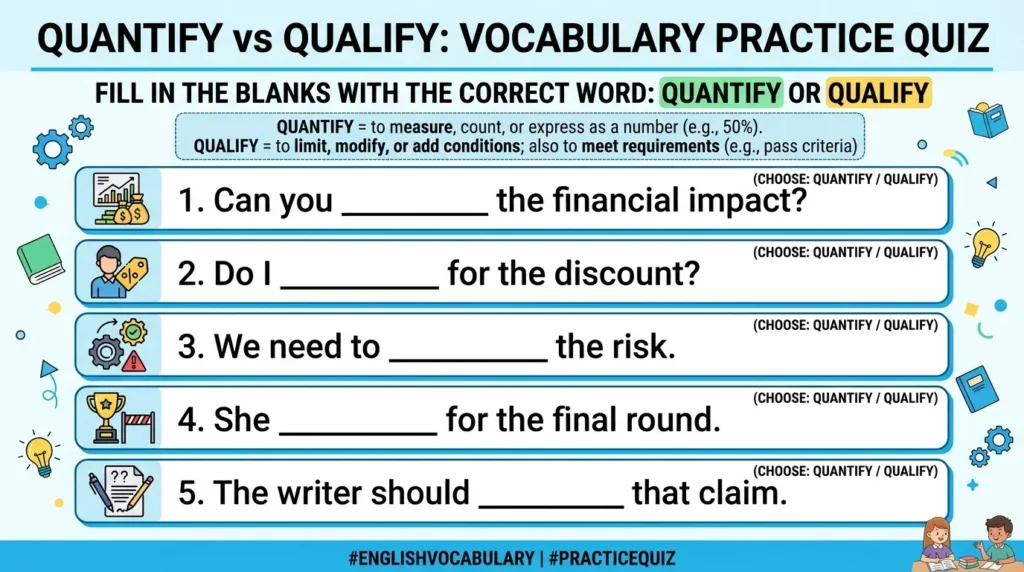
| 1 | Fill in the blank: “We need to ___ the financial impact of the outage.” | quantify | The speaker wants to determine the measurable size of the impact. |
| 2 | Fill in the blank: “Do part-time employees ___ for this benefit?” | qualify | The question is about eligibility. |
| 3 | Choose the correct word: “The researchers quantified / qualified the reduction at 18 percent.” | quantified | Eighteen percent expresses a measurable amount. |
| 4 | Choose the correct word: “Her training quantifies / qualifies her to operate the equipment.” | qualifies | The training makes her competent or eligible to perform the task. |
| 5 | Correct the sentence: “Can you qualify how much revenue we lost?” | Can you quantify how much revenue we lost? | The speaker wants to measure the loss. |
| 6 | Correct the sentence: “Our team quantified for the semifinals.” | Our team qualified for the semifinals. | The team met the competition standard needed to advance. |
| 7 | Fill in the blank: “I should ___ my earlier statement because there are two important exceptions.” | qualify | Adding exceptions limits the scope of a statement. |
| 8 | Multiple choice: Which sentence is correct? A) “He quantified for financial aid.” B) “He qualified for financial aid.” | B | Financial aid has eligibility requirements, so qualify for is appropriate. |
| 9 | Multiple choice: Which sentence means “measure the size of the benefit”? A) “Qualify the benefit.” B) “Quantify the benefit.” | B | Quantify expresses measurement or measurable extent. |
| 10 | Fill in the blank: “After completing the required examinations, she ___ as an architect.” | qualified | Qualify as is used for achieving or meeting the conditions for a status or professional role. |