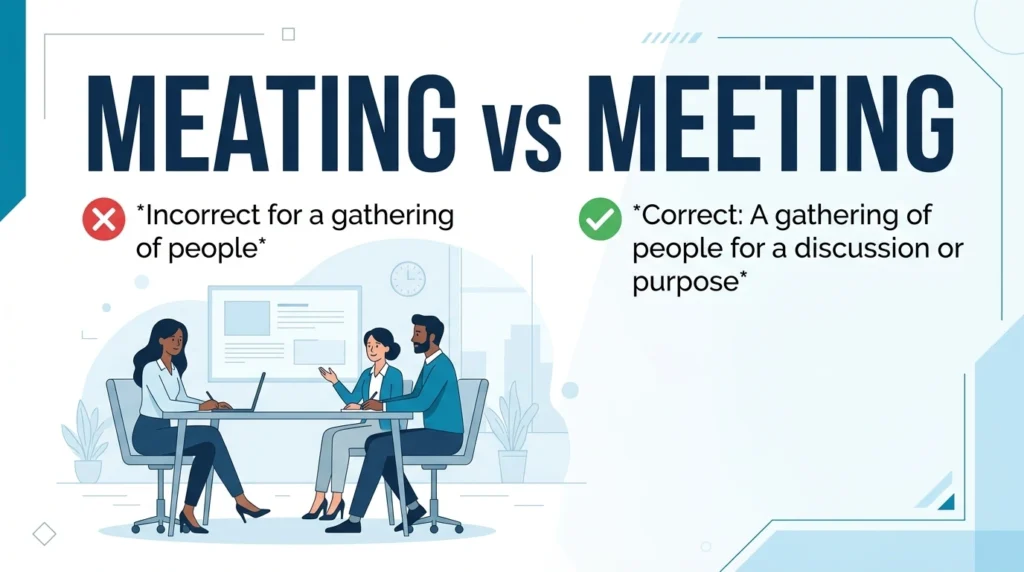

Meeting is the correct spelling when you mean a gathering, appointment, discussion, encounter, or the act of coming together. Meating is not an alternative spelling of meeting. It has appeared historically as a rare food-related word, but in normal modern English, writing meating for a business, school, social, or online gathering is a spelling mistake.
What Is the Difference Between Meating and Meeting?
The difference between meating vs meeting is mainly a spelling and meaning issue.
Meeting comes from the verb meet, meaning to come together, encounter someone, or be present with another person or group. It can be a noun, as in a staff meeting, or part of a verb phrase, as in We are meeting the client tomorrow.
Meating should not be used when you mean people gathering. Historical dictionaries record rare uses of meating connected with food, but those uses do not make it a standard alternative to meeting in present-day communication.
So:
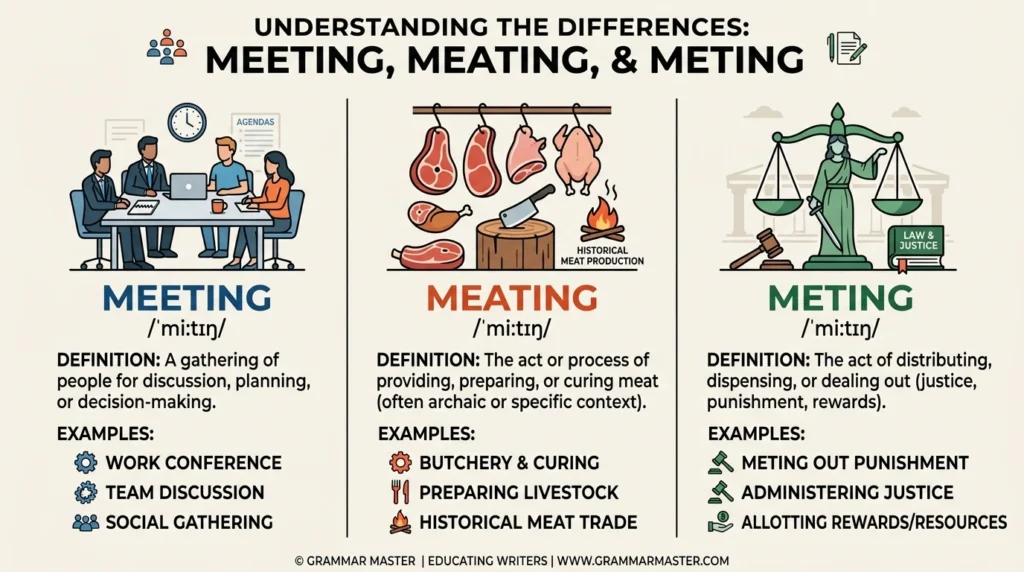
- meeting = people or things coming together
- meating = rare historical form associated with food; normally an error if you mean a gathering
- meting = a different word from mete, usually seen in expressions such as meting out punishment
Why the Correct Spelling Matters
A sentence such as “I have a client meating at 3 p.m.” is easy to understand, but the spelling can make an otherwise professional message look careless.
The difference matters most in situations where readers expect polished writing, including:
- client emails
- job applications
- business documents
- school assignments
- university papers
- meeting invitations
- reports
- professional social media posts
The mistake can also create unintended humor because meat and meet are different words even though they share the same pronunciation in standard English. Both are pronounced with the long ee sound /miːt/.
The Core Rule
Rule: If people are coming together, use meeting.
Think meet + ing = meeting.
The verb is meet, and its -ing form is meeting. Standard dictionaries list meeting as the inflected form of meet.
Never change meet to meat simply because the two words sound alike.
Read More: Submission vs Submittion: Which Spelling Is Correct?
The Three-Second Test
- Ask whether someone is meeting another person or group.
- If yes, start with the base word meet.
- Add -ing to get meeting.
Meet + ing = meeting
That simple check solves almost every everyday case.
How to Use Meeting Correctly
Meeting as a Noun
As a noun, meeting commonly refers to an occasion when people come together for a purpose.
Examples include:
- a team meeting
- a board meeting
- a parent-teacher meeting
- an online meeting
- a planning meeting
- a committee meeting
It can also refer more broadly to an encounter or a point where things come together. Standard dictionary definitions include gatherings, encounters, and junctions such as the meeting of two rivers.
Example:
The budget meeting starts at 11 a.m.
Here, meeting is a noun naming an event.
Meeting as Part of a Verb
Meeting is also the present participle of meet.
Example:
We are meeting the supplier tomorrow.
Here, meeting describes an action rather than naming an event.
Compare:
Noun: Our meeting starts tomorrow.
Verb: We are meeting tomorrow.
The spelling remains meeting in both cases.
Meeting Can Mean an Encounter
A meeting does not always have to be a formal business event.
You can write:
Their first meeting was completely unexpected.
Here, meeting means an encounter between people rather than a scheduled conference. This sense is also standard English.
Meeting Can Describe Things Coming Together
The word can also describe a junction or point of contact.
Example:
The village lies near the meeting of two rivers.
This meaning is less common in everyday conversation, but it is standard.
Is Meating a Real Word?
Meating has existed as a real word, but that does not make it the correct spelling of meeting.
Historical dictionary records include the noun meating with rare or obsolete food-related meanings. This explains why it is more accurate to call meating a rare historical word than to claim that it has never existed at all.
For practical modern writing, however, the distinction is simple:
If you mean a gathering, appointment, encounter, conference, or act of coming together, write meeting.
Do not write:
business meating
team meating
Zoom meating
school meating
client meating
Use meeting in all of those expressions.
Correct Examples of Meeting
Here are original examples from different types of everyday writing.
- Conversation: I have a meeting with Daniel after lunch.
- Email: Could we move tomorrow’s meeting to 2:30 p.m.?
- Workplace: The sales team has a planning meeting every Friday.
- School: Our teacher scheduled a meeting with the students’ parents.
- University: The research group held a meeting to review the new data.
- Social media: Great meeting everyone at the workshop today.
- Text message: I’m meeting Zara outside the café at seven.
- Remote work: Please join the online meeting five minutes early.
- Client communication: Thank you for meeting with our team this morning.
- Academic writing: The committee discussed the proposal during its final meeting.
- Community setting: Residents attended a meeting about the new park.
- Personal context: Their first meeting happened during a train journey.
In each example, the spelling comes directly from meet, not meat.
Incorrect vs. Correct Examples
| ❌ Incorrect | ✅ Correct | Why |
|---|---|---|
| We have a staff meating at nine. | We have a staff meeting at nine. | A staff gathering comes from the verb meet. |
| I am meating my manager tomorrow. | I am meeting my manager tomorrow. | The action is meet + ing. |
| Please join the online meating. | Please join the online meeting. | An online gathering is a meeting. |
| The meating was cancelled. | The meeting was cancelled. | The sentence refers to a scheduled event. |
| She arranged a client meating. | She arranged a client meeting. | Business appointments use meeting. |
| Our school meating begins at noon. | Our school meeting begins at noon. | People are gathering at school. |
| Thanks for meating with us. | Thanks for meeting with us. | The base verb is meet. |
| The board meating lasted two hours. | The board meeting lasted two hours. | A board discussion is a meeting. |
| I’m meating Sarah for coffee. | I’m meeting Sarah for coffee. | This describes two people coming together. |
| We discussed it during yesterday’s meating. | We discussed it during yesterday’s meeting. | A discussion event is correctly called a meeting. |
Read More: Dought vs Doubt: Which Is Correct?
Why People Confuse Meating and Meeting
Meet and Meat Sound the Same
The biggest reason is pronunciation.
Meet and meat are homophones: words that sound alike but have different spellings and meanings. Both are pronounced /miːt/ in standard English.
Because the base words sound identical, a writer who relies mainly on pronunciation may choose ea instead of ee.
The Spellings Look Very Similar
Compare:
meeting
meating
Only one letter changes.
That small visual difference makes the typo especially easy to overlook when someone is typing quickly.
English Uses Both “ee” and “ea” for Similar Sounds
English learners often encounter the long /iː/ sound in words containing either ee or ea:
- see
- green
- meet
- team
- read
- meat
The sound alone therefore does not tell you whether to write ee or ea.
You have to remember the base word and meaning.
Writers Sometimes Overgeneralize Spelling Patterns
A learner may remember words such as eating and assume that a similar-sounding word should contain ea.
But spelling follows the base word:
eat → eating
meet → meeting
The meanings and spellings remain separate.
Spellcheck Cannot Replace Context
Spellcheck is useful, but it should not be your only check.
A spelling tool may be less helpful when a typed form resembles an obscure or historically recorded word. Context still determines whether meeting is the form you need.
Before sending an important message, check the root word yourself:
Do I mean meet or meat?
Translation Can Add Another Layer of Confusion
For some English learners, the first language has a more predictable relationship between spelling and pronunciation than English does.
In that situation, spelling a word according to sound can feel natural. With meet and meat, however, pronunciation cannot distinguish the two. The sentence’s meaning has to guide the spelling.
Common Mistakes Checklist
- Writing “meating” for a work event: Use meeting whenever colleagues or clients come together.
- Changing “meet” to “meat” before adding -ing: Keep the original spelling: meet + ing = meeting.
- Assuming similar pronunciation means similar meaning: Meet and meat sound alike but belong to different meanings.
- Using “meting” instead: Meting comes from mete and usually means distributing something, especially in meting out punishment or rewards.
- Trusting autocorrect without rereading: Always check important emails, applications, and reports yourself.
- Thinking “meeting” only means a formal conference: It can also describe an encounter or the act of seeing someone.
- Using “appointment” as a perfect substitute every time: An appointment is an arrangement to meet; it is not interchangeable with meeting in every sentence.
- Correcting every historical “meating” to “meeting”: In historical material, meating may genuinely have a food-related meaning. Check the context before editing it.
Meating vs Meeting in Real English
Grammatically Correct English
In standard modern English, meeting is correct when you mean a gathering or the action of coming together: We have a meeting today and We are meeting today are both correct. The first uses meeting as a noun; the second uses it as part of the verb meet. Historical uses of meating exist, but they do not replace meeting in these normal contexts.
Grammatically Possible but Unnatural English
A sentence can be grammatically acceptable and still sound too formal for its situation. For example, “I have a meeting with my friend for lunch” is possible, but it may sound unnecessarily businesslike if two friends are simply having lunch together. In everyday conversation, “I’m meeting a friend for lunch” usually expresses that idea more naturally. Word choice depends on the purpose and tone of the encounter.
Natural Everyday English
Common natural patterns include “I have a meeting at three,” “I’m meeting Sam after work,” “Can we move the meeting?” and “Thanks for meeting with me.” Notice that English speakers switch easily between the noun meeting and the verb form meeting. You do not need a special spelling for casual, online, business, or social situations. The form remains meeting.
Formal vs. Informal Usage
Meeting is a neutral word, so it works naturally in both formal and informal English.
Formal examples:
- board meeting
- committee meeting
- annual meeting
- consultation
- conference
- business meeting
Informal situations may use expressions such as:
- quick chat
- catch-up
- get-together
These alternatives are not exact synonyms in every context. A conference, for example, usually describes a particular kind of organized gathering rather than any ordinary meeting.
There is no need to replace meeting simply because a sentence is formal or informal.
Read More: Bachelor vs Batchelor: Which Spelling Is Correct?
Meating vs Meeting Comparison Table
| Feature | Meeting | Meating |
|---|---|---|
| Normal modern spelling for a gathering | Yes | No |
| Base word | Meet | Historically related to meat/food |
| Common in everyday English | Very common | Extremely rare |
| Correct in “business ___” | Meeting | Incorrect |
| Correct in “team ___” | Meeting | Incorrect |
| Correct in “online ___” | Meeting | Incorrect |
| Can function as a noun | Yes | Historically, yes |
| Can be part of a modern verb phrase | Yes: We are meeting | Not when you mean coming together |
| Meaning related to people coming together | Yes | No |
| Safe choice for normal modern writing | Yes | No, unless discussing the rare historical word |
The important distinction is that meeting is a standard everyday word for coming together, whereas historical meating belongs to a very different and rare area of usage.
Meeting vs Meting
There is another spelling worth knowing: meting.
Meting is the -ing form of the verb mete, meaning to distribute or give something out. It commonly appears with out.
Example:
The committee was meting out penalties.
It does not mean that people are gathering.
Compare:
- meeting = coming together
- meting = distributing or giving out
- meating = rare historical food-related word; normally a typo for meeting in everyday writing
Standard dictionaries list meting as the inflected form of mete.
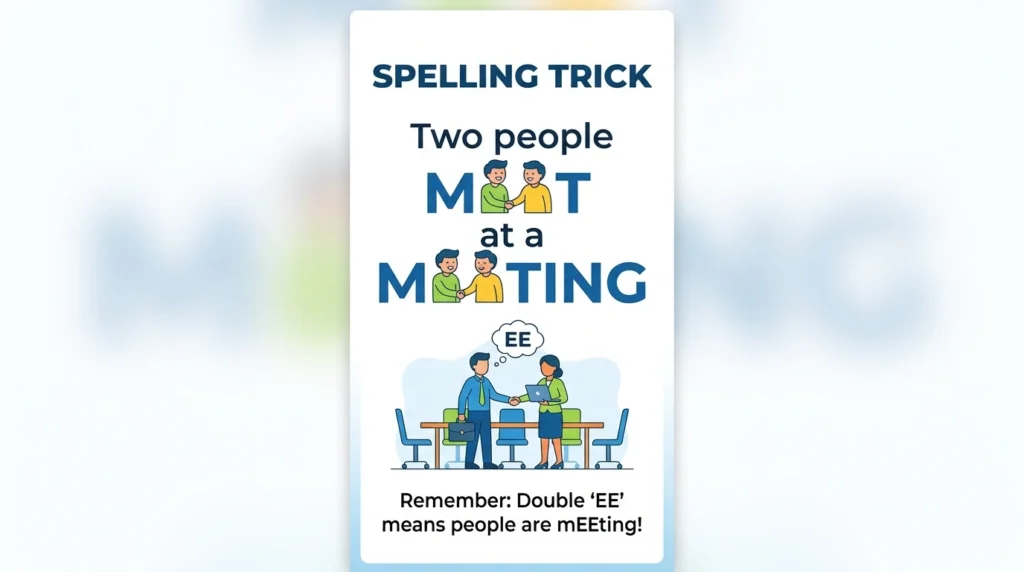
Memory Trick
Use this mnemonic:
Two people mEEt at a mEEting.
The EE in meet stays inside meeting.
You can also picture the two e’s as two people standing together:
m + EE + ting
Two E’s meet in the middle of meeting.
If the sentence involves people coming together, keep the two e’s.
Real-Life Situations
Interview
Correct:
I have a meeting with the hiring manager at 10 a.m.
You are describing an arranged discussion, so meeting is correct.
Workplace Meeting
Correct:
We’re meeting the design team after lunch.
Here, meeting is part of the verb phrase are meeting.
Correct:
Thank you for attending yesterday’s meeting.
The word names an event, so it functions as a noun.
Text Message
Correct:
I’m meeting Ali near the station at six.
A casual context does not change the spelling.
Exam
Suppose the question says:
Choose the correct sentence.
A. We have a meating tomorrow.
B. We have a meeting tomorrow.
Choose B because the event comes from the verb meet.
Expert Tips
Find the Root Word First
When you are unsure about an -ing spelling, identify the original verb.
For this word:
meet → meeting
That is more reliable than trying to spell from pronunciation.
Replace the Word With “Meet”
Try changing the sentence temporarily.
We have a meeting tomorrow.
Can you express the basic idea as:
We will meet tomorrow.
Yes. That confirms that meeting is the right family of words.
Watch for the Third Word, Meting
A spellchecker might not solve every confusion because meting is itself a legitimate word.
Remember:
mete → meting
meet → meeting
Do Not Treat Appointment and Meeting as Identical
You can make an appointment for a meeting, but the words emphasize different things.
An appointment focuses on the arrangement or scheduled time. A meeting focuses on the occasion when people come together.
Check Compound Expressions as Complete Units
Learn frequent phrases together:
- team meeting
- staff meeting
- business meeting
- meeting room
- meeting agenda
- meeting minutes
- meeting invitation
Learning whole expressions makes the spelling easier to remember. The established expressions meeting room and meeting minutes both use meeting.
Read More: Signer vs Signor Difference: Meanings and Correct Usage
Use Meaning, Not Sound
Because meet and meat sound alike, pronunciation alone cannot solve the problem.
Ask:
Are people coming together?
If yes, use meet or meeting.
FAQ
Is meating a word?
Yes, historical dictionaries record meating as a rare word with food-related meanings. However, it is not the correct spelling when you mean a gathering or appointment. In normal modern writing, use meeting.
Which is correct, meating or meeting?
Use meeting when referring to people coming together, an appointment, an encounter, or a discussion.
What is the correct spelling of meeting?
The correct spelling is m-e-e-t-i-n-g. It comes from meet + ing.
Why does meeting have two e’s?
Because its base word is meet. Adding -ing produces meeting, so the ee in meet remains.
Is meeting always a noun?
No. It can be a noun in “The meeting starts soon” or part of a verb phrase in “We are meeting soon.”
What is the plural of meeting?
The plural is meetings.
Example:
We have three meetings scheduled this week.
What is the difference between meeting and meting?
Meeting comes from meet and relates to coming together. Meting comes from mete and means distributing or giving something out, especially in the phrase mete out.
Can meeting refer to an online call?
Yes. A meeting can take place in person or online.
Is appointment another word for meeting?
Sometimes the meanings overlap, but they are not identical. An appointment is an arrangement to meet at a particular time, while meeting usually names the actual occasion or gathering.
Can “meating” be used as a joke or brand name?
It can be deliberately used as wordplay involving meat, but that does not make it the standard spelling of meeting. In ordinary professional, academic, or everyday writing about people gathering, use meeting.
Mini Quiz
| # | Question | Answer | Explanation |
|---|---|---|---|
| 1 | Fill in the blank: We have a team ___ at 10 a.m. | meeting | A team gathering comes from meet. |
| 2 | Choose: I am meeting / meating the client tomorrow. | meeting | The verb is meet + ing. |
| 3 | Correct the sentence: “Please join today’s meating.” | Please join today’s meeting. | A scheduled gathering is a meeting. |
| 4 | Which word means distributing something: meeting / meting? | meting | Meting comes from mete, often used with out. |
| 5 | Fill in the blank: Their first ___ happened at university. | meeting | Here, meeting means an encounter. |
| 6 | Choose the correct phrase: business meeting / business meating | business meeting | Business gatherings use meeting. |
| 7 | Correct the sentence: “Thanks for meating with us.” | Thanks for meeting with us. | The action comes from the verb meet. |
| 8 | True or false: “Meeting” can function as both a noun and part of a verb phrase. | True | Compare a meeting with we are meeting. |
| 9 | Fill in the blank: The judge was ___ out penalties. | meting | This comes from mete out, meaning to distribute. |
| 10 | Which spelling should normally appear in an email invitation: meeting or meating? | meeting | An invitation brings people together, so meeting is correct |
Quick Summary
Meeting is the correct modern spelling when people come together for a discussion, appointment, encounter, class, online call, business event, or social purpose. It comes directly from meet, so remember meet + ing = meeting. Meating has existed in rare historical food-related usage, but it is not an alternative spelling for a gathering and should normally be corrected to meeting in modern writing. Do not confuse either word with meting, which comes from mete and means distributing something, usually in expressions such as meting out punishment. The easiest memory trick is simple: two people mEEt at a mEEting. If your sentence involves people coming together, keep the two e’s.