
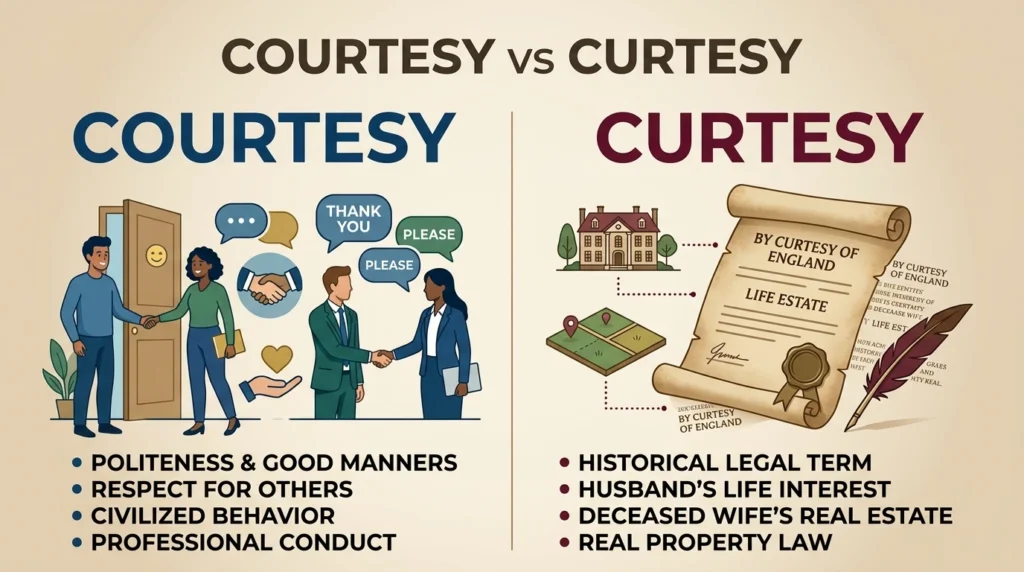

Courtesy means politeness, respect, consideration, or a polite action. Curtesy is also a real English word, but it is a rare legal term connected with a historical husband’s interest in his deceased wife’s property. The words are not interchangeable. If you are talking about manners, kindness, respectful behavior, emails, work, school, or everyday conversation, courtesy is almost always the word you need.
What Is the Difference Between Courtesy and Curtesy?
The difference between courtesy vs curtesy is meaning, not simply spelling.
Courtesy is the familiar noun used for polite, respectful, or considerate behavior. Holding a door open, replying politely to an email, letting someone finish speaking, or giving advance notice can all be acts of courtesy.
Curtesy, without the first o, belongs mainly to legal and historical writing. Traditionally, it referred to a particular common-law property interest that a husband could acquire in land belonging to his deceased wife under specified conditions.
That means calling curtesy a spelling error in every situation would be inaccurate. It is a real word. It is simply the wrong word when you mean politeness.
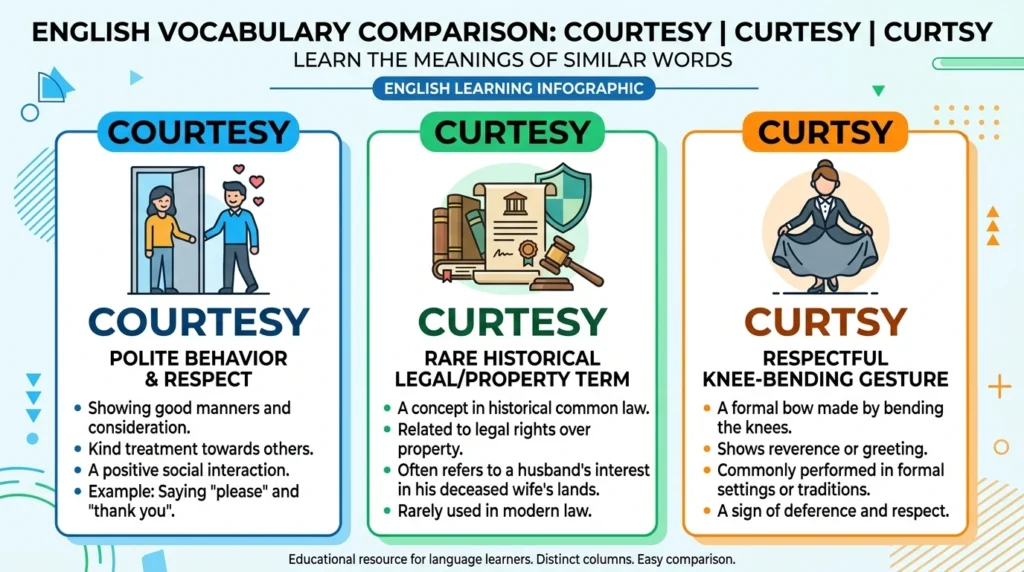
A third word, curtsy, creates additional confusion. A curtsy is the physical gesture made by bending the knees and lowering the body, traditionally as a sign of respect.
Why the Difference Matters
Most people who search for courtesy or curtesy are trying to write about manners, politeness, or professional behavior.
In those situations, accidentally writing curtesy can make a normal sentence look like a spelling mistake. Worse, a knowledgeable reader may recognize curtesy as a legal term and wonder why a property-law word appears in an email, essay, résumé, or social media post.
The distinction matters in:
- business emails and customer service
- academic assignments and exams
- job applications and professional communication
- workplace policies
- articles about etiquette or manners
- legal and historical writing
A spellchecker may not always rescue you because curtesy is an actual word. Context matters.
The Core Rule
Rule: Use courtesy when you mean politeness, respect, consideration, a polite gesture, or something provided as a favor. Use curtesy only when you specifically mean the specialized historical or legal property concept.
The easiest decision is usually this:
- Ask whether the sentence is about manners or respectful behavior.
- If yes, choose courtesy.
- Choose curtesy only when the surrounding topic is property, estates, inheritance, or legal history.
For ordinary English, courtesy is overwhelmingly the useful word.
Read More: Excited vs Exited: What Is the Difference?
How to Use Courtesy Correctly
Courtesy Meaning Politeness or Respect
The most familiar meaning of courtesy is polite or considerate behavior.
Example:
The receptionist treated every visitor with courtesy.
Here, courtesy describes the respectful manner in which the receptionist behaved.
You can also use it for a specific polite action.
Example:
Sending a short message before arriving is a simple courtesy.
In this sentence, the message itself is viewed as a considerate act.
Common Courtesy
Common courtesy refers to the basic politeness that people generally expect in ordinary social situations.
Example:
It is common courtesy to let someone know when you are running late.
The phrase is established and natural. You do not need to replace it with common politeness, although that expression can also make sense in some contexts.
As a Courtesy
The phrase as a courtesy means that something is done as a polite, helpful, or considerate gesture rather than because it is strictly required.
Example:
As a courtesy, we contacted the customers before changing the schedule.
This expression is especially common in professional and customer-service writing.
Courtesy Of
Courtesy of can indicate that somebody provided, supplied, or made something available.
Example:
Refreshments were provided courtesy of the local business association.
It can also be used more loosely to identify the cause of something, sometimes with an ironic tone.
Example:
We spent another hour in traffic, courtesy of the roadworks.
The surrounding context tells the reader whether the phrase is appreciative, neutral, or ironic.
Courtesy Used Before Another Noun
English also uses courtesy before certain nouns.
Common combinations include:
- courtesy call
- courtesy notice
- courtesy copy
- courtesy phone
- courtesy vehicle
- courtesy visit
For example:
The clinic made a courtesy call to remind patients about the holiday schedule.
Here, courtesy describes the purpose or helpful nature of the call.
How to Use Curtesy Correctly
Curtesy is a specialized noun rather than an alternative spelling for everyday courtesy.
Historically, the term was used in common law for a husband’s particular interest in real property belonging to his deceased wife when the legal requirements for that interest were satisfied.
You are most likely to encounter the word in:
- older legal documents
- discussions of property law
- historical legal textbooks
- material comparing curtesy and dower
- discussions of inheritance-law history
A sentence such as the following can therefore be correct:
The textbook compared the traditional doctrines of dower and curtesy.
In an ordinary sentence about manners, however, using curtesy would be incorrect.
Incorrect: The employee spoke with curtesy.
Correct: The employee spoke with courtesy.
The exact application or continuing legal relevance of historical property doctrines can depend on jurisdiction, so a legal question about curtesy should be treated separately from an English-usage question.
Correct Examples of Courtesy and Curtesy
Here are examples across different types of English.
- Conversation: She had the courtesy to call before visiting.
- Email: Thank you for your courtesy and patience while we investigated the issue.
- School: Students should show courtesy when classmates are presenting.
- Workplace: Professional courtesy helps teams handle disagreements more effectively.
- Customer service: As a courtesy, the company waived the replacement fee.
- Social media: A little courtesy can prevent an online disagreement from becoming personal.
- Academic writing: The study examines how expectations of courtesy vary between social settings.
- Meeting: Please extend the same courtesy to others by allowing them to finish speaking.
- Everyday life: Holding the elevator for the person behind you is a small courtesy.
- Professional communication: The manager sent a courtesy reminder one day before the deadline.
- Legal history: The chapter explains the historical relationship between dower and curtesy.
- Property-law discussion: The researcher examined older cases involving claims of curtesy.
Notice the pattern: courtesy fits normal English situations, while curtesy appears only when the subject itself is legal or historical.
Incorrect vs Correct
| ❌ Incorrect | ✅ Correct | Why |
|---|---|---|
| Thank you for your curtesy. | Thank you for your courtesy. | The sentence expresses appreciation for polite behavior, so courtesy is required. |
| She treated the customer with curtesy. | She treated the customer with courtesy. | Respectful treatment is courtesy, not the legal term curtesy. |
| Please show some curtesy to your classmates. | Please show some courtesy to your classmates. | The intended meaning is consideration and good manners. |
| It is common curtesy to reply. | It is common courtesy to reply. | Common courtesy is the established phrase for basic politeness. |
| He sent a curtesy email before arriving. | He sent a courtesy email before arriving. | The email is a considerate gesture, not a property right. |
| As a curtesy, we extended the deadline. | As a courtesy, we extended the deadline. | As a courtesy means as a helpful or considerate gesture. |
| The hotel offered a curtesy shuttle. | The hotel offered a courtesy shuttle. | Courtesy can describe a service provided for customers. |
| The legal historian discussed traditional courtesy rights of husbands. | The legal historian discussed traditional curtesy rights of husbands. | In this specific historical property-law context, curtesy is the technical term. |
| The book compares dower and courtesy. | The book compares dower and curtesy. | When referring to the paired historical property concepts, curtesy is appropriate. |
| She made a curtesy before the monarch. | She made a curtsy before the monarch. | The knee-bending gesture is curtsy, which is different from both courtesy and curtesy. |
Why People Confuse Courtesy and Curtesy
They Look Almost Identical
The most obvious problem is spelling.
Courtesy: c-o-u-r-t-e-s-y
Curtesy: c-u-r-t-e-s-y
Only one letter separates them: the first o in courtesy.
When people type quickly, that letter is easy to omit.
Their Pronunciations Can Be Very Similar
For many speakers, courtesy and curtesy can sound the same or extremely similar.
That makes pronunciation an unreliable way to choose the spelling. You need to think about meaning instead.
If the sentence concerns politeness, use courtesy.
Curtesy Looks Like a Plausible Simplified Spelling
English spelling does not always match pronunciation directly. Because the first o in courtesy may not sound prominent, a learner may reasonably assume that curtesy is simply a shorter spelling.
It is not. The shorter-looking form already belongs to a different word.
Spellcheck May Not Flag It
Spellcheck is excellent at finding combinations of letters that are not recognized as words.
The problem is that curtesy exists.
A basic spellchecker may therefore accept:
Thank you for your curtesy.
The spelling may be recognized even though the word is wrong for the sentence.
Grammar and context checking are still necessary.
Learners May Spell the Word by Sound
English learners often meet the spoken form of a word before they become completely familiar with its spelling.
Because courtesy contains letters that may not all be strongly reflected in pronunciation, spelling it from sound alone can lead to curtesy.
The safest approach is to connect the spelling with the meaning rather than pronunciation alone.
Curtsy Adds a Third Similar Word
The confusion becomes greater because curtsy is also a real word.
Remember:
courtesy = politeness
curtesy = legal/property term
curtsy = respectful knee-bending gesture
They belong to different contexts.
Common Mistakes Checklist
- Using curtesy whenever you mean politeness: Replace it with courtesy unless you are genuinely discussing the legal concept.
- Assuming curtesy is never a word: It is a real specialized term, so saying that it is always a misspelling is too broad.
- Confusing curtesy with curtsy: Curtsy describes the physical gesture. Curtesy belongs to legal history.
- Trusting spellcheck without checking context: A correctly spelled word can still be the wrong word.
- Writing “common curtesy”: The standard phrase for basic politeness is common courtesy.
- Writing “as a curtesy”: When you mean a considerate favor, use as a courtesy.
- Forgetting the first “o” in courtesy: If the subject is manners or respect, double-check that you wrote c-o-u-r-t-e-s-y.
- Using curtesy in ordinary business writing: Unless your business communication is specifically about the legal doctrine, courtesy is the appropriate word.
Courtesy vs Curtesy in Real English
Grammatically Correct
“Thank you for your courtesy during the meeting” is grammatically correct and natural, especially in professional or formal communication. “The legal text discusses curtesy” is also correct because the subject is the specialized property-law concept. Correctness depends on meaning. Neither spelling can automatically replace the other simply because the words may sound similar when spoken.
Grammatically Possible but Less Natural
A sentence such as “She demonstrated courtesy toward me during lunch” is grammatically possible, but in relaxed conversation it can sound more formal than necessary. A speaker might naturally say “She was really polite to me” or “She was very considerate.” This does not make courtesy incorrect. It simply shows that everyday speakers often choose simpler adjectives or verbs instead of an abstract noun.
Natural Everyday English
In normal English, courtesy commonly appears in phrases such as common courtesy, as a courtesy, professional courtesy, and have the courtesy to. You may also hear simpler alternatives such as be polite, be respectful, or be considerate. Curtesy, by contrast, is not an everyday substitute for these expressions. Most people will encounter it only in specialized legal or historical material.
Formal vs Informal Usage
Courtesy
Courtesy works in both formal and informal English, although some constructions sound more formal than others.
Formal or professional:
We appreciate your patience and courtesy during the review process.
Neutral:
Please show the same courtesy to everyone in the group.
Conversational:
He could at least have had the courtesy to text me.
In casual conversation, speakers may prefer polite, nice, respectful, or considerate, but courtesy itself is not limited to formal writing.
Read More: Submission vs Submittion: Which Spelling Is Correct?
Curtesy
Curtesy belongs to specialized legal or historical language.
You would not normally use it casually unless you were specifically discussing that legal concept.
It would therefore be unusual to encounter curtesy in an ordinary personal email, meeting, social media caption, customer-service message, or school conversation.
Courtesy vs Curtesy vs Curtsy Comparison Table
| Feature | Courtesy | Curtesy | Curtsy |
|---|---|---|---|
| Part of speech | Noun | Noun | Noun or verb |
| Main meaning | Politeness, respect, considerate behavior | Historical/common-law property interest | A respectful knee-bending gesture |
| Everyday use | Very common | Rare | Occasional |
| Business writing | Common | Only in relevant legal material | Rare |
| Legal/historical use | Possible in ordinary meaning | Main specialized context | Usually unrelated |
| Connected with manners? | Yes | No | The gesture may express respect |
| Example | She showed great courtesy. | The text discusses dower and curtesy. | She made a curtsy. |
| Safe choice for “politeness”? | Yes | No | No |
| Key spelling clue | Contains cour- | Begins cur- | Ends -tsy |

Memory Trick
Think of the word OUR inside cOURtesy.
COURTESY is how we treat OUR people.
If you are talking about how people treat one another—with politeness, respect, patience, or consideration—keep OUR inside cOURtesy.
Curtesy does not contain our, and it belongs to a much narrower legal context.
For the gesture, remember the unusual ending in curTSY.
Real-Life Situations
Job Interview
You want to describe someone’s professional manners.
Correct:
The interviewer’s courtesy helped me feel comfortable.
You are describing considerate behavior, so courtesy is correct.
Workplace Meeting
Someone keeps interrupting coworkers.
Natural response:
Please extend the same courtesy to everyone and let them finish speaking.
Again, the meaning is respect and good manners.
Professional Email
You want to explain that your company is offering something voluntarily.
Correct:
As a courtesy, we have extended your payment deadline by five days.
The extension is a helpful gesture, so use courtesy.
Text Message
A friend arrived without warning.
Natural:
You could at least have had the courtesy to text me first.
The phrase have the courtesy to means showing enough consideration to perform a polite action.
Exam Question
The sentence says:
Basic ___ requires students to listen while others are speaking.
The answer is courtesy because the sentence concerns manners.
If the exam instead discusses historical rights in a deceased wife’s real property, curtesy may be the required technical term.
What Courtesy Does Not Mean
Understanding nearby concepts can make the distinction easier.
Courtesy is not exactly the same as kindness. A courteous person follows standards of polite and respectful behavior. A kind person may go further by actively helping or caring for someone. The ideas often overlap, but they are not identical.
Courtesy is not exactly the same as respect. Respect may describe an attitude, feeling, or recognition of someone’s value or authority. Courtesy often refers to how that consideration appears in behavior.
Courtesy is not a curtsy. Courtesy is a broad idea or behavior. A curtsy is one specific physical gesture.
And curtesy belongs to a completely different specialized legal context.
Courtesy, Courteous, and Courteously
Another useful distinction involves the related forms courteous and courteously.
Courtesy is a noun:
Her courtesy impressed the visitors.
Courteous is an adjective:
She was courteous to the visitors.
Courteously is an adverb:
She answered the visitors courteously.
Do not assume that courteous is formed by simply adding -ous to the complete spelling of courtesy. The correct adjective is courteous, not courtesyous or courtesious.
Singular and Plural Forms
Courtesy can function as an uncountable noun when it means politeness in general.
Courtesy is important in customer service.
It can also be countable when it means a particular polite action or convention.
The host extended several courtesies to the visitors.
The plural is courtesies, with the final y changing to ies.
Curtesy also has the plural form curtesies in dictionary treatment, although learners are unlikely to need the plural outside specialized legal material.
Context therefore remains essential because the plural forms can look remarkably similar.
Expert Tips
Check the Meaning Before the Spelling
Do not begin by asking, “Which spelling looks right?”
Ask:
Am I talking about politeness or property law?
Meaning solves the problem faster than pronunciation.
Search Your Draft for “Curtesy”
If you are proofreading an ordinary article, email, school assignment, or business document, use the search function to look for curtesy.
Unless the content discusses the legal term, it probably needs to become courtesy.
Do Not Let a Dictionary Entry Fool You
Seeing curtesy in a dictionary does not mean it can substitute for courtesy.
Dictionaries tell you whether a word exists. They do not mean that every recognized word fits every context.
Learn Complete Phrases
Instead of memorizing only the isolated spelling, learn natural phrases:
- common courtesy
- professional courtesy
- as a courtesy
- courtesy call
- courtesy notice
- have the courtesy to
- courtesy of
Phrase-based learning makes spelling easier because you connect the word to situations in which it naturally appears.
Read More: Dought vs Doubt: Which Is Correct?
Remember the Third Word
When proofreading, do not reduce the choice to only courtesy vs curtesy.
Ask whether you actually mean curtsy.
That extra check prevents sentences such as:
She made a courtesy before the queen.
The intended word there is curtsy.
FAQ
Is curtesy a misspelling of courtesy?
Not always. Curtesy is a real word with a specialized legal meaning. However, if someone writes curtesy when talking about politeness, manners, respectful behavior, or consideration, then it is the wrong word for that context and should normally be changed to courtesy.
Is courtesy the correct spelling for good manners?
Yes. Use courtesy when referring to polite, respectful, or considerate behavior.
For example:
He treated the staff with courtesy.
Not:
He treated the staff with curtesy.
What does curtesy mean in law?
Curtesy traditionally refers to a common-law property interest associated with a husband and certain real property of his deceased wife. It is mainly encountered in legal history, older legal writing, and discussions of traditional property or inheritance doctrines.
Because modern property and inheritance rules vary by jurisdiction, the term’s legal relevance should be checked within the applicable legal system.
What is the difference between curtesy and curtsy?
They are completely different words.
Curtesy is a specialized legal term.
Curtsy is a noun or verb describing a gesture in which a person bends the knees and lowers the body as a sign of respect.
For example:
She gave a curtsy.
What is the difference between courtesy and courteous?
Courtesy is a noun.
Her courtesy impressed everyone.
Courteous is an adjective.
She was courteous to everyone.
Use courtesy for the quality or behavior and courteous to describe a person, action, manner, or response.
Is “common courtesy” correct?
Yes. Common courtesy is a standard English expression referring to basic politeness or consideration that people generally expect in everyday situations.
For example:
It is common courtesy to tell someone if you are going to be late.
Is “as a courtesy” correct?
Yes. As a courtesy is a common phrase meaning that something is being done as a helpful, polite, or considerate gesture.
For example:
As a courtesy, the hotel allowed us to check out an hour later.
Can courtesy be plural?
Yes. When courtesy refers to individual polite actions, privileges, or gestures, the plural can be courtesies.
For example:
The host extended several courtesies to the visiting delegation.
When courtesy means politeness in general, it is commonly used as an uncountable noun.
Is professional courtesy a correct phrase?
Yes. Professional courtesy describes polite, respectful, or considerate behavior between people in a professional environment.
The exact behavior depends on the situation, but examples can include giving reasonable notice, communicating respectfully, acknowledging messages, or allowing colleagues to speak without unnecessary interruption.
How can I remember how to spell courtesy?
Look for OUR inside cOURtesy.
Think:
Courtesy is how we treat OUR people.
That helps you remember the extra o when you mean politeness. Reserve curtesy for the unusual legal term.
Mini Quiz
| # | Question | Answer | Explanation |
|---|---|---|---|
| 1 | Fill in the blank: “It is common ___ to thank your host.” | courtesy | The sentence refers to ordinary politeness. |
| 2 | Which word is a specialized legal term? A) courtesy B) curtesy C) courteous | B) curtesy | Curtesy belongs mainly to historical and legal property terminology. |
| 3 | Correct the sentence: “Thank you for your curtesy.” | Thank you for your courtesy. | The intended meaning is considerate or polite behavior. |
| 4 | Fill in the blank: “The textbook compared dower and ___.” | curtesy | The context is historical property law. |
| 5 | Which is correct? A) courtesy call B) curtesy call | A) courtesy call | A courtesy call is made as a polite or helpful gesture. |
| 6 | Correct the sentence: “She made a curtesy when she greeted the royal guest.” | She made a curtsy when she greeted the royal guest. | The physical knee-bending gesture is a curtsy. |
| 7 | Fill in the blank: “As a ___, we have removed the service charge.” | courtesy | As a courtesy means as a helpful or considerate gesture. |
| 8 | Which sentence is correct? A) He showed great curtesy to the waiter. B) He showed great courtesy to the waiter. | B | Respectful treatment requires courtesy. |
| 9 | True or false: Curtesy is always a spelling mistake. | False | It is a real specialized word, although it is wrong when used to mean politeness. |
| 10 | Fill in the blank: “Her calm and ___ response prevented the discussion from becoming hostile.” | courteous | The blank modifies response, so the adjective courteous is needed rather than the noun courtesy. |
Quick Summary
Courtesy and curtesy are both real words, but they have very different uses. Courtesy is the normal word for politeness, respect, considerate behavior, or a helpful gesture. It appears in phrases such as common courtesy, as a courtesy, and courtesy call. Curtesy is a specialized historical and legal term connected with a husband’s property interest in his deceased wife’s real estate under common law. It should not replace courtesy in ordinary writing. Also avoid confusing either word with curtsy, the respectful knee-bending gesture. The easiest memory trick is to notice OUR inside cOURtesy: courtesy describes how we treat our fellow people.