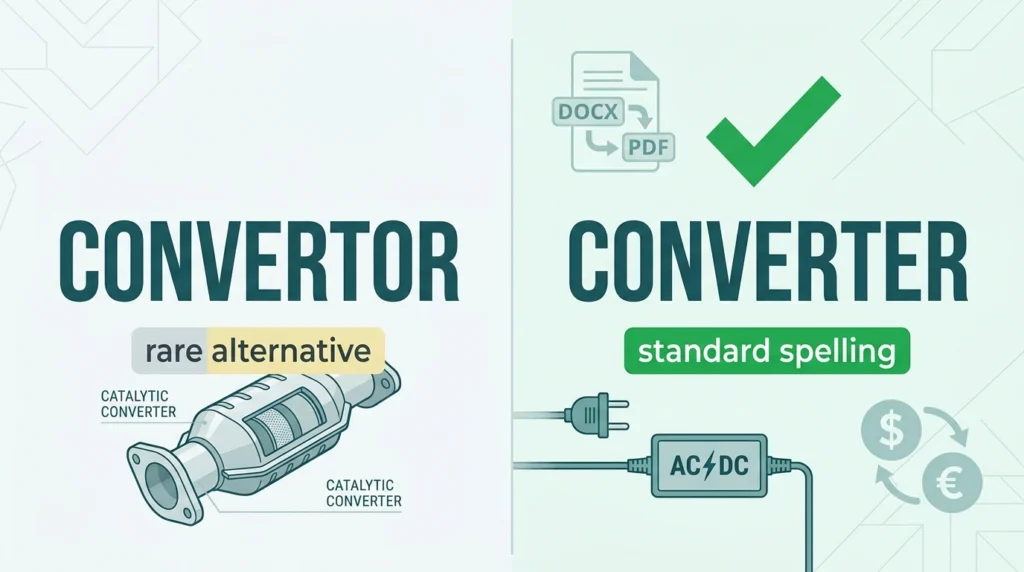

Converter is the standard and preferred spelling in modern English. Convertor is also a recognized spelling, but it is much less common and may look unusual in general writing. For school, business, technology, academic work, websites, and everyday communication, converter is usually the safest choice. Use convertor mainly when preserving an official name, quotation, or established specialized terminology.
What Is a Converter?
A converter is a person, device, program, machine, or system that changes something from one form into another.
For example, a file converter changes one file format into another. A currency converter changes an amount from one currency value to another. A power converter changes electrical energy into a different usable form.
Common examples include:
- file converter
- video converter
- currency converter
- unit converter
- power converter
- frequency converter
- analog-to-digital converter
- catalytic converter
- image converter
- document converter
The important point is that converter describes something that performs a conversion.
Why Does the Spelling Matter?
The difference between convertor and converter usually does not change the meaning. However, spelling affects how natural and professional your writing looks.
Most readers expect converter. Using convertor in a business email, school paper, software interface, product description, or technical article may make some readers wonder whether you made a spelling mistake.
That does not mean convertor is automatically incorrect. It means the two spellings do not have equal status in modern everyday writing.
Choosing converter also keeps terminology consistent with familiar phrases such as currency converter, file converter, power converter, and catalytic converter.
The Core Rule
Rule: Use converter by default. Treat convertor as a recognized but uncommon alternative rather than the normal spelling.
Both forms can refer to something that converts. However, major modern dictionary entries place converter in the primary position, while convertor appears as an alternative form or in narrower technical senses.
The easiest decision process is:
- Use converter in normal writing.
- Keep convertor if it is part of an official product name, quoted text, or established terminology you must reproduce exactly.
- Do not switch randomly between converter and convertor in the same document.
How to Use Converter and Convertor
Use Converter in Normal Writing
For most situations, choose converter.
You would normally write:
- currency converter
- video converter
- file converter
- power converter
- voltage converter
- catalytic converter
- digital converter
- signal converter
- PDF converter
- unit converter
This applies to everyday English, professional communication, academic writing, software, technology, engineering, and online content.
When Convertor May Appear
Convertor is not simply a meaningless typo. It appears as an alternative spelling in established dictionaries and can occur in specialized material. Some technical terminology has historically used the form, particularly in certain electrical or radio-related contexts.
You may therefore encounter phrases such as:
frequency convertor
or
rotary convertor
in older documents, equipment names, technical references, or organization-specific terminology.
That does not create a general rule that electrical devices should always be called convertors. Converter remains standard and widely accepted in technical English as well.
Preserve Official Terminology When Necessary
If a manufacturer calls a product the ABC Signal Convertor, do not silently rename the product when reproducing its official title.
Likewise, if you are quoting historical material, preserve the original spelling:
“The manual describes the unit as a frequency convertor.”
Outside that quotation or official title, you can normally return to converter.
Correct Examples
Here are original examples showing how converter works across different situations.
- Conversation: I need a plug converter before my trip.
- Email: Please confirm whether the new power converter is compatible with the equipment.
- School: The student used a unit converter to change kilometers into miles.
- Workplace: Our technician replaced the damaged voltage converter this morning.
- Technology: This file converter supports PDF, DOCX, and TXT formats.
- Social media: Does anyone know a reliable video converter for large files?
- Academic writing: The experiment used an analog-to-digital converter to process the signal.
- Automotive: The mechanic inspected the vehicle’s catalytic converter.
- Finance: I checked the exchange rate using an online currency converter.
- Engineering: The converter regulates the electrical output before power reaches the device.
- Software: The image converter reduced the file size without changing the dimensions.
- Travel: Pack a voltage converter if your appliance cannot handle the local voltage.
- Meeting: We need a converter that works with both connection standards.
- Instructions: Connect the converter before turning on the monitor.
In all these sentences, converter sounds normal and requires no special explanation.
Incorrect vs. Correct
In the table below, the ❌ form represents wording you should generally avoid in standard modern English. Remember that convertor can still be a recognized alternative in specific contexts.
| ❌ Incorrect or Best Avoided | ✅ Correct or Preferred | Why |
|---|---|---|
| I downloaded a PDF convertor. | I downloaded a PDF converter. | Converter is the normal spelling for software and digital tools. |
| Open the currency convertor. | Open the currency converter. | Currency tools are conventionally called converters. |
| My catalytic convertor needs replacing. | My catalytic converter needs replacing. | Catalytic converter is the standard automotive term. |
| We installed a voltage convertor. | We installed a voltage converter. | Converter is standard modern technical wording unless a specific source uses the alternative. |
| Try this online video convertor. | Try this online video converter. | Software and web tools normally use converter. |
| The convertor changes JPG files to PNG. | The converter changes JPG files to PNG. | The standard spelling is clearer for general readers. |
| Please order another signal convertor. | Please order another signal converter. | Use converter unless the equipment’s official terminology specifies otherwise. |
| The convereter stopped working. | The converter stopped working. | Convereter contains an extra syllable and is a spelling error. |
| The convertter became hot. | The converter became hot. | Convertter incorrectly doubles the t. |
| The conversioner processes the data. | The converter processes the data. | Conversioner is not the normal noun formed from convert. |
| We need two convertors and one converter. | We need three converters. | Randomly mixing spellings makes terminology inconsistent. |
| This website contains an image convertor. | This website contains an image converter. | Converter matches normal digital-product terminology. |
Why Do People Confuse Convertor and Converter?
Several factors make this spelling surprisingly easy to question.
The -er and -or Endings Look Plausible
English contains many nouns ending in -er and -or.
Examples include:
- teacher
- printer
- driver
- editor
- actor
- creator
- operator
- translator
Because actor, creator, and operator end in -or, a learner may reasonably assume that something that converts should be a convertor.
English word formation, however, is not controlled by one universal spelling rule. Established usage determines which form becomes standard.
For this word, converter became the normal form.
Both Forms Actually Exist
This confusion is different from a simple typo such as convertter.
Someone searching for convertor will find genuine examples of the spelling. Dictionaries also record it as an alternative form.
That makes the question more difficult because the answer is not simply “one exists and one does not.”
The better distinction is:
Both exist, but converter is the standard choice.
Technical Documents Can Reinforce the Alternative
Older manuals and specialized terminology sometimes contain convertor. A learner may see those examples and conclude that convertor is the technical spelling.
That conclusion is too broad.
Modern technical writing also uses converter extensively, including terms involving power, signals, data, and electrical systems.
Pronunciation Does Not Solve the Problem
The two spellings are pronounced the same way in normal English.
You cannot reliably hear whether someone intends converter or convertor. The difference appears in writing rather than speech.
Autocomplete and Spellcheck Have Limits
A spellchecker may recognize convertor because the form exists.
That does not mean it is recommending it as the best spelling for your sentence.
Spellcheck tools usually answer a basic question: “Can this sequence of letters be a word?”
Writers need to answer a more useful question: “Which accepted spelling will sound most natural to my readers?”
For most contexts, that answer is converter.
Translation Can Influence the Choice
English learners may also transfer spelling patterns from another language.
If their first language commonly uses a noun ending that resembles English -or, convertor may feel more logical.
The solution is to learn converter as a complete word rather than trying to rebuild it from a general suffix rule every time.
Common Mistakes Checklist
Treating Convertor as Always Wrong
Saying convertor is never a word goes too far.
It is recorded as an alternative spelling. The more accurate advice is to prefer converter unless you have a specific reason to preserve the alternative.
Treating Both Forms as Equally Common
They may share a meaning, but that does not make them equally natural choices.
Converter is the form readers are much more likely to expect.
Assuming Convertor Is the Technical Version
Technical context does not automatically require convertor.
Modern technical writing regularly uses converter.
Read More: Cheer vs Chear: Which Spelling Is Correct?
Writing Catalytic Convertor by Default
You may occasionally encounter the alternative spelling, but catalytic converter is the familiar standard expression.
Write:
The mechanic replaced the catalytic converter.
Switching Spellings in One Document
Do not write converter in one paragraph and convertor in another simply for variation.
Terminology is not like descriptive vocabulary. Consistency helps readers know you are referring to the same thing.
Changing an Official Product Name
If a company deliberately uses Convertor in a trademark, model name, or official title, reproduce that name accurately.
Trusting Spellcheck Without Checking Usage
A spellchecker may accept both spellings.
When multiple spellings are accepted, consider frequency, context, audience, and established terminology.
Convertor vs. Converter in Real English
Grammatically Correct English
Both converter and convertor can function as countable nouns meaning something that converts. For example, a dictionary may recognize a converter and a convertor. The grammatical structure is therefore not the main issue. The important difference is conventional spelling: converter is the standard form readers normally expect, while convertor is an alternative that occurs much less often.
Grammatically Possible but Unnatural English
A sentence such as “I downloaded a video convertor” can be structurally grammatical because convertor can function as a noun. However, the spelling is unusual for a modern digital tool. Many readers would expect “video converter” and might assume convertor was a typo. This is why grammatical possibility alone does not always tell you which wording sounds most natural.
Natural Everyday English
In ordinary modern English, people normally encounter phrases such as currency converter, file converter, video converter, power converter, and catalytic converter. If you are writing for customers, students, colleagues, general website visitors, or an international audience, choosing converter avoids unnecessary distraction. The reader can concentrate on your meaning instead of wondering whether your spelling is intentional.
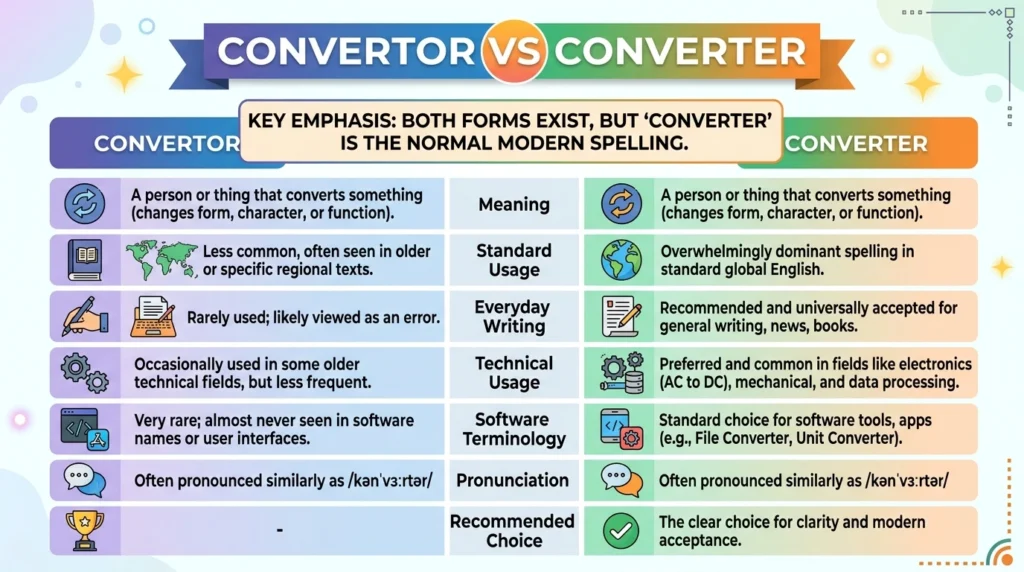
Convertor vs. Converter Comparison Table
| Feature | Converter | Convertor |
| Is it a real word? | Yes | Yes, as an alternative form |
| Basic meaning | Something or someone that converts | Usually the same |
| Standard modern spelling | Yes | Usually no |
| General writing | Preferred | Uncommon |
| Business writing | Preferred | Usually avoid |
| Academic writing | Preferred | Use only with a specific reason |
| Software and apps | Standard | Unusual |
| Engineering | Standard | Can occur in specialized terminology |
| Automotive phrase | Catalytic converter | Alternative spelling occasionally appears |
| Pronunciation | Same | Same |
| Best default choice | Yes | No |
| Official names or quotations | Use normally | Preserve if officially written this way |
Memory Trick
Remember:
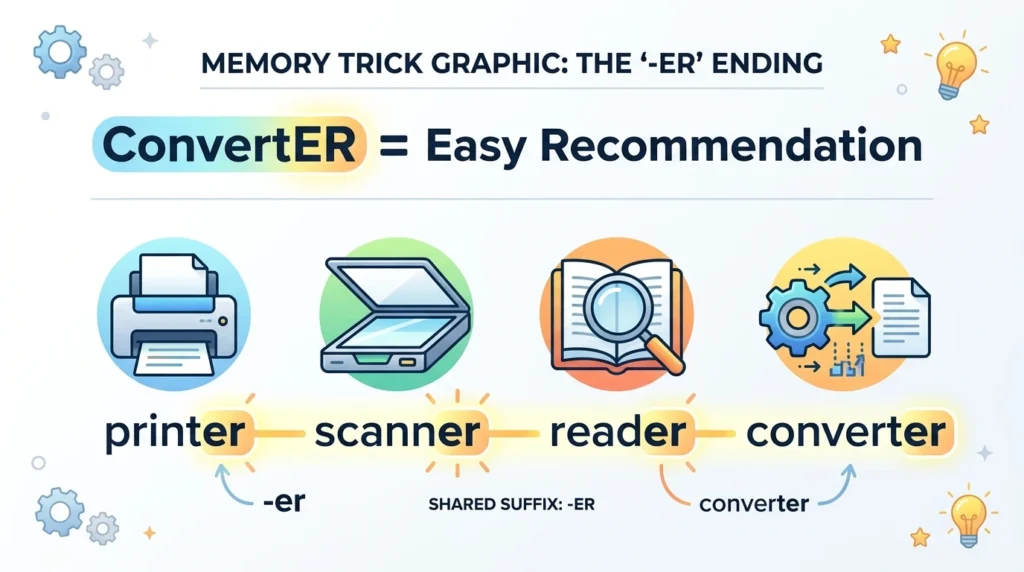
ConvertER = Easy Recommendation.
The final letters ER remind you that converter is the easy recommended choice when you do not have a special reason to use another spelling.
You can also connect it with familiar tool words:
printer → scanner → reader → converter
They all commonly use -er.
Real-Life Situations
Interview
You are explaining an engineering project:
“I designed a power converter that reduced energy loss in the system.”
Using the standard spelling in your written portfolio keeps the terminology familiar and professional.
Meeting
Your team is discussing new equipment:
“We should test the converter before replacing the entire power unit.”
No alternative spelling is needed.
You are requesting a replacement part:
“Could you confirm whether this converter is compatible with the older model?”
Again, converter is the safest default.
Text Message
You ask a friend:
“Do you know a good video converter?”
This is the spelling most people expect for software.
Exam
A question asks you to describe a circuit component.
Write:
“The analog-to-digital converter changes the analog signal into digital data.”
Unless your course materials deliberately prescribe another term, converter is the safest form.
Historical Document
You quote an old manual containing convertor:
“The handbook identifies the component as a ‘rotary convertor.’”
Here, retaining the original spelling is appropriate because you are reproducing someone else’s terminology.
Expert Tips
Choose Usage, Not Just Dictionary Validity
A dictionary telling you that a form exists is only part of the answer.
Good writing also considers which form readers expect.
That is why converter should normally win even though convertor is recognized.
Search the Exact Technical Term
If you are writing highly specialized documentation, check the terminology used by the manufacturer, industry standard, academic field, or organization.
Do not assume convertor is automatically more technical.
Preserve Names Exactly
Never “correct” the spelling inside a registered product name, software name, company name, historical quotation, or cited document unless you clearly indicate that you changed it.
Be Consistent
If you choose converter, continue using converter throughout the document.
Changing spellings can make readers wonder whether you are discussing different components.
Use Converter for International Audiences
For content aimed at readers from multiple English-speaking regions, converter is the safest choice because it is widely understood and standard across major varieties of English.
Do Not Create a False US-UK Rule
Converter and convertor should not be treated like color/colour or center/centre.
The practical default remains converter for both American and British readers. Current dictionary treatment supports converter as the primary form rather than presenting the two spellings as a simple regional split.
FAQ
Is Convertor a Correct Word?
Yes. Convertor is a recognized alternative spelling of converter. However, it is much less common, so converter is usually the better choice for modern general writing.
Which Is Correct, Convertor or Converter?
Both forms exist, but converter is the standard and preferred spelling for most situations.
Use convertor only when there is a specific contextual reason, such as preserving official or specialized terminology.
Is Convertor the British Spelling of Converter?
No. This is not a normal British-versus-American spelling distinction.
Converter is standard in both major varieties of English. Convertor may occur as an alternative, but it is not simply “the British version.”
Is Converter the American Spelling?
Converter is standard in American English, but it is not exclusively American.
British English also uses converter.
Should I Write Catalytic Converter or Catalytic Convertor?
Use catalytic converter in normal modern writing.
It is the familiar automotive term and the safest spelling for general readers.
Is It Power Converter or Power Convertor?
Use power converter by default.
Power convertor can occur in some specialized or legacy terminology, but technical subject matter alone does not require the -or spelling.
Is It Currency Converter or Currency Convertor?
Currency converter is the normal expression.
For example:
“I used a currency converter before exchanging my money.”
Is It File Converter or File Convertor?
Use file converter.
The same pattern applies to video converter, image converter, audio converter, and PDF converter.
Can Converter Refer to a Person?
Yes. At its broadest, converter means one that converts, so it can refer to a person or organization as well as a machine, device, or program.
In everyday modern usage, however, the word is especially familiar for tools, machines, software, and technical devices.
Can I Use Convertor in Academic Writing?
You can encounter the spelling in sources, but converter is normally the safer choice for your own academic prose.
If a technical field, quoted source, historical document, or official terminology uses convertor, preserve it where accuracy requires.
Why Does Spellcheck Accept Convertor?
Because convertor is a recognized variant rather than pure nonsense.
Spellcheck acceptance does not necessarily mean two forms are equally common or equally advisable.
What Is the Plural of Converter?
The plural is converters.
Example:
“The laboratory uses three signal converters.”
The alternative spelling would form convertors, but converters remains the preferred general form.
Mini Quiz
| # | Question | Answer | Explanation |
| 1 | Multiple choice: Which is the best default spelling? A) Convertor B) Converter C) Convertter | B) Converter | Converter is the standard modern spelling. |
| 2 | Fill in the blank: I used a currency ______ to check the exchange rate. | converter | Currency converter is the normal expression. |
| 3 | Correct the sentence: “The catalytic convertor was replaced yesterday.” | The catalytic converter was replaced yesterday. | Catalytic converter is the standard form in general automotive writing. |
| 4 | True or false: Convertor is always a meaningless misspelling. | False | It is recognized as an alternative spelling, although it is uncommon. |
| 5 | Multiple choice: Which phrase sounds most natural for software? A) File convertor B) File converter | B) File converter | Digital tools normally use converter. |
| 6 | Fill in the blank: The analog-to-digital ______ processes the incoming signal. | converter | Converter is standard technical terminology. |
| 7 | True or false: Convertor is simply the British spelling of converter. | False | Converter is standard in both British and American English. |
| 8 | Correct the sentence: “Connect the convertter to the power supply.” | Connect the converter to the power supply. | Convertter incorrectly doubles the t. |
| 9 | Multiple choice: When might you preserve “convertor”? A) Official product name B) Historical quotation C) Established specialist terminology D) All three | D) All three | Exact terminology should be preserved when context requires it. |
| 10 | Fill in the blank: For general writing, the safest choice is ______. | converter | It is the form most readers expect. |
Quick Summary
Converter is the standard and preferred spelling in modern English. It describes a person, device, program, machine, or system that converts something from one form into another. Common phrases include currency converter, file converter, power converter, video converter, and catalytic converter. Convertor is not automatically a spelling error; established dictionaries recognize it as an alternative form, and it can appear in specialized, historical, or official terminology. However, it is much less common and can look unusual to general readers. This is not a simple American-versus-British spelling difference. When you are unsure, use converter, remain consistent throughout your document, and preserve convertor only when a specific source or official name requires it.