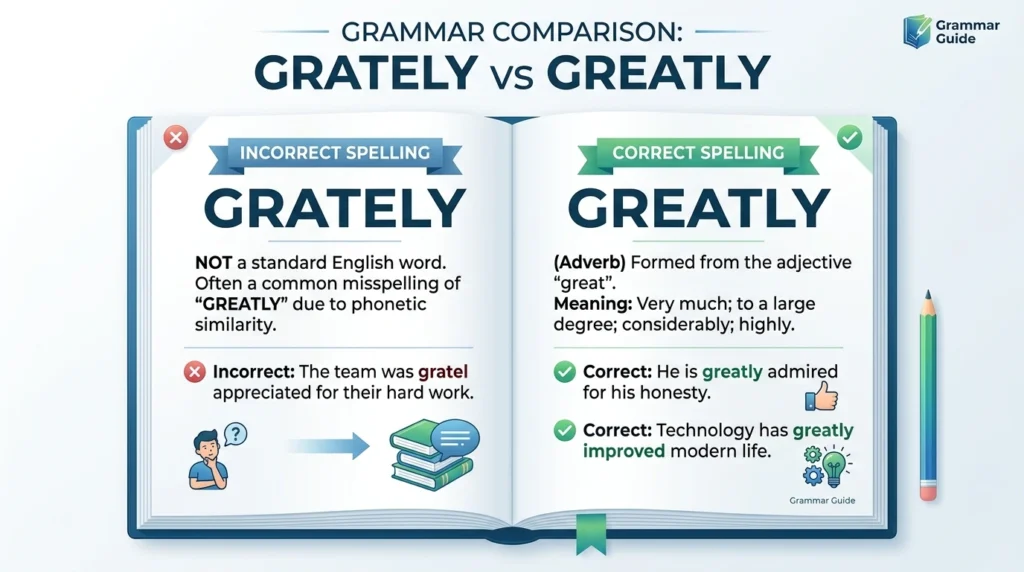

Greatly is the correct English word, while grately is not a standard English word. Use greatly when you mean “very much,” “to a large degree,” or “in an important way.” For example, “I greatly appreciate your help” means “I appreciate your help very much.” The confusion happens because many people add -ly to “grate” or “great” incorrectly, but only greatly is accepted in modern English.
What Is the Difference Between Grately and Greatly?
The difference is simple:
- Greatly is a correct adverb used to describe a strong degree or effect.
- Grately is not a recognized standard English word and should not be used in formal or everyday writing.
The confusion comes from the similarity in spelling. Both words look like they could follow the same pattern:
- great → greatly
- grate → grately
However, English does not create adverbs by simply adding -ly to every word. The resulting form must already exist and have an accepted meaning.
Greatly
Greatly is the adverb form of great.
It means:
- very much
- to a high degree
- significantly
- strongly
Examples:
- I greatly appreciate your support.
- The new system greatly improved productivity.
- She was greatly affected by the news.
Grately
Grately is not a standard English word.
Although grate is a real word, its adverb form is not grately.
For example:
❌ I grately appreciate your help.
✅ I greatly appreciate your help.
The correct expression is always greatly appreciate.
Why Does It Matter?
Using the wrong word can make your writing look careless, especially in professional situations.
A single incorrect word may affect how readers judge:
- emails
- academic assignments
- business documents
- job applications
- online content
For example:
❌ We grately appreciate your cooperation during this project.
A reader may immediately notice that the word choice is incorrect.
✅ We greatly appreciate your cooperation during this project.
This version sounds natural, professional, and correct.
Grammar mistakes involving commonly confused words are especially noticeable because they can change the perceived quality of your writing.
The Core Rule
Rule: Use greatly when you want to say “very much” or “to a large degree.” Do not use grately, because it is not a standard English word.
Remember:
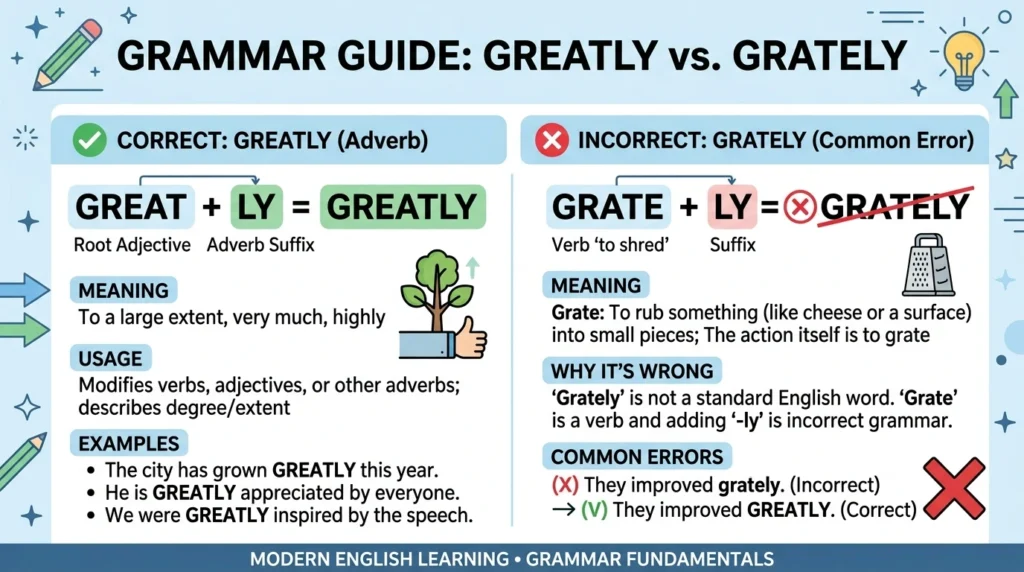
Great + ly = Greatly
The word comes from great, meaning large, important, or impressive.
Examples:
- greatly improved
- greatly appreciated
- greatly increased
- greatly influenced
How to Use Greatly Correctly
1. Use Greatly to Show a Strong Degree
Greatly often describes how much something happens.
Examples:
- The price has greatly increased.
- Technology has greatly changed communication.
- His confidence greatly improved after practice.
Here, greatly means “by a large amount.”
2. Use Greatly With Feelings and Appreciation
One of the most common uses of greatly is in polite expressions.
Examples:
- I greatly appreciate your assistance.
- We greatly value your feedback.
- Your support is greatly appreciated.
These phrases are common in:
- business emails
- customer service messages
- professional communication
3. Use Greatly When Describing Influence or Impact
Greatly can describe something that creates a major effect.
Examples:
- The decision greatly influenced the company’s future.
- Exercise can greatly improve your health.
- The teacher greatly inspired her students.
Correct Examples of Greatly
| Situation | Example Sentence |
|---|---|
| Conversation | I greatly enjoyed spending time with you. |
| We greatly appreciate your quick response. | |
| Workplace | This update greatly improved our workflow. |
| School | The research greatly expanded our knowledge of the topic. |
| Academic Writing | Climate change has greatly affected ecosystems worldwide. |
| Social Media | I greatly appreciate everyone who supported this project. |
| Customer Service | Your patience is greatly appreciated. |
| Interview | This experience greatly helped me develop professional skills. |
| Formal Writing | The policy greatly reduced unnecessary costs. |
| Everyday Speech | I greatly admire her dedication. |
Incorrect vs Correct Examples
| ❌ Incorrect | ✅ Correct | Why |
|---|---|---|
| I grately appreciate your help. | I greatly appreciate your help. | “Grately” is not a standard English word. |
| Your support is grately valued. | Your support is greatly valued. | The correct adverb comes from “great.” |
| The results grately improved. | The results greatly improved. | Greatly describes the degree of improvement. |
| We grately enjoyed the event. | We greatly enjoyed the event. | Enjoyment can be increased greatly, not grately. |
| She was grately influenced by her mentor. | She was greatly influenced by her mentor. | “Greatly” shows a strong effect. |
| The company grately benefited from the change. | The company greatly benefited from the change. | “Greatly benefited” is the accepted phrase. |
| I grately respect your opinion. | I greatly respect your opinion. | Respect can be felt to a high degree. |
| This discovery grately changed science. | This discovery greatly changed science. | Greatly describes the level of change. |
| His work was grately appreciated. | His work was greatly appreciated. | Common phrase is “greatly appreciated.” |
| The project grately succeeded. | The project greatly succeeded. | “Greatly” modifies the degree of success. |
Why People Make This Mistake
Many English learners and even native speakers occasionally create incorrect words because English spelling patterns can feel predictable. The mistake with grately vs greatly usually happens for several reasons.
1. Phonetic Similarity
Greatly and grately sound almost identical when spoken quickly.
The pronunciation difference is very small:
- Greatly → /ˈɡreɪt.li/
- Grately → would naturally be pronounced similarly, but the word itself is not standard English.
Because the sound feels correct, people may write the wrong spelling without noticing.
Example:
Someone hears:
“I greatly appreciate your help.”
They may remember the sound and later write:
“I grately appreciate your help.”
The pronunciation memory is correct, but the spelling pattern is wrong.
Read More: Conex or Connex: What Is the Difference?
2. Spelling Pattern Overgeneralization
English learners often learn a useful rule:
Add -ly to an adjective to create an adverb.
Examples:
- quick → quickly
- careful → carefully
- slow → slowly
- great → greatly
The problem occurs when people apply this rule to words where the result does not exist.
For example:
- grate → grately ❌
Although grate is a real word, grately is not its accepted adverb form.
English has many exceptions because words develop through usage over time.
3. Confusion Between “Great” and “Grate”
The words great and grate look similar but have completely different meanings.
Great
Means:
- large
- important
- excellent
- impressive
Examples:
- She is a great leader.
- That was a great idea.
Grate
Usually means:
- a metal frame with bars
- to shred food into small pieces
- to annoy someone
Examples:
- Use a cheese grater to grate the cheese.
- The noise began to grate on my nerves.
Because these words look similar, people sometimes create grately by mistake.
4. Spellcheck and Autocomplete Limitations
Modern writing tools are helpful, but they are not perfect.
Some typing systems may:
- fail to correct uncommon mistakes
- suggest similar-looking words
- allow incorrect words if they appear in some databases
For example, if someone types:
I grately appreciate your support.
A spellchecker may not always catch it immediately.
Writers should understand the rule instead of depending only on software.
5. Translation Interference
People learning English from another language may translate directly.
Some languages create adverbs more regularly than English does. A learner may think:
great + ly = greatly
grate + ly = grately
However, English depends on established usage, not only logical word formation.
The correct approach is:
- Learn common English patterns.
- Check whether a word actually exists.
- Pay attention to examples from real writing.
Grately vs Greatly in Real English
Understanding grammar rules is important, but knowing how people actually use English is even more useful.
✅ Correct and Natural: Greatly
Greatly is completely natural English. It appears frequently in both everyday communication and professional writing.
Examples:
- I greatly appreciate your kindness.
- The experience greatly improved my skills.
- Your advice has greatly helped me.
It is especially common in polite expressions such as:
- greatly appreciate
- greatly valued
- greatly improved
- greatly affected
- greatly influenced
These combinations are widely accepted and sound natural.
⚠️ Grammatically Possible but Unnatural: Grately
Grately is not simply an uncommon alternative. It is not considered a standard English word.
A reader may understand what someone means because the context is clear, but it will look like a spelling mistake.
Example:
❌ I grately appreciate your assistance.
Most readers will understand the intended meaning, but they will expect:
✅ I greatly appreciate your assistance.
❌ Incorrect Usage: Grately as a Replacement for Greatly
Using grately in formal writing, professional communication, or academic work is incorrect.
Avoid it in:
- emails
- reports
- essays
- applications
- website content
Always replace it with greatly.
American vs British English
There is no difference between American and British English regarding greatly vs grately.
Both varieties use:
✅ greatly
Both varieties reject:
❌ grately
Examples:
American English:
We greatly appreciate your feedback.
British English:
We greatly appreciate your feedback.
The spelling and usage are the same.
Formal vs Informal Usage
Formal Usage
Greatly is very common in formal writing.
Examples:
- We greatly appreciate your cooperation.
- The findings greatly contribute to current research.
- The new process greatly reduced operational costs.
Common areas:
- business emails
- academic papers
- professional reports
- official statements
Informal Usage
Greatly can also appear in casual communication, although everyday speakers may sometimes choose simpler words.
Examples:
Formal:
I greatly appreciate your help.
Casual alternatives:
I really appreciate your help.
Thanks so much for helping me.
Both are correct, but greatly sounds slightly more polished.
Grately vs Greatly Comparison Table
| Feature | Greatly | Grately |
|---|---|---|
| Is it a real English word? | Yes | No |
| Correct spelling | ✅ Yes | ❌ No |
| Word type | Adverb | Not a standard word |
| Comes from | Great | Incorrectly created from grate |
| Meaning | Very much, to a large degree | No accepted meaning |
| Used in formal writing | Yes | No |
| Used in conversation | Yes | No |
| Common phrase | Greatly appreciate | None |
| Example | I greatly value your support. | I grately value your support. ❌ |
Memory Trick
Use this simple memory trick:
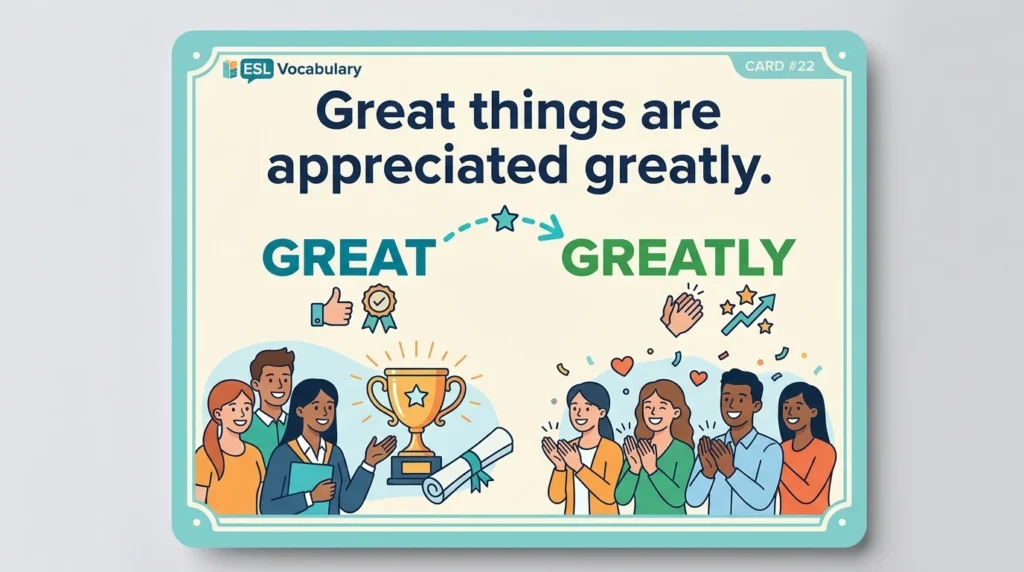
“Great things are appreciated greatly.”
Remember:
Great → Greatly
The extra t stays:
- great
- greatly
Do not replace the t with the spelling from grate.
Another way:
If you mean “very much,” think of something GREAT, not a GRATE.
Real-Life Situations
1. Job Interview
Incorrect:
I grately appreciate this opportunity.
Correct:
I greatly appreciate this opportunity.
Why?
Job interviews require professional language, and “greatly appreciate” is the standard phrase.
2. Business Email
Incorrect:
We grately appreciate your continued partnership.
Correct:
We greatly appreciate your continued partnership.
Why?
Companies commonly use this phrase in professional communication.
3. School Assignment
Incorrect:
Technology has grately changed education.
Correct:
Technology has greatly changed education.
Why?
Academic writing requires standard vocabulary.
4. Text Message
Incorrect:
I grately enjoyed the movie!
Correct:
I greatly enjoyed the movie!
Why?
Even casual writing should use real English words.
5. Customer Reply
Incorrect:
Your feedback is grately appreciated.
Correct:
Your feedback is greatly appreciated.
Why?
This phrase is commonly used in customer service.
Expert Tips
1. Learn Words in Phrases
Instead of memorizing only:
greatly = very much
Learn common combinations:
- greatly appreciate
- greatly improve
- greatly increase
- greatly reduce
- greatly influence
These phrases help you recognize correct usage faster.
2. Do Not Create Words Based Only on Logic
English is not always mathematically predictable.
A word may look possible but still not exist.
Examples:
- greatly ✅
- grately ❌
The best test is actual usage.
3. Pay Attention to Common Patterns
When you see professional writing, notice repeated expressions.
You will often find:
- greatly appreciated
- greatly valued
- greatly affected
You will not normally find:
- grately appreciated
- grately valued
- grately affected
4. Use Context Instead of Spelling Guessing
Ask yourself:
“Am I talking about something being large, important, or strongly affected?”
If yes, the word is probably related to great.
Use:
✅ greatly
Common Mistakes Checklist
| Mistake | Why It Happens | Solution |
|---|---|---|
| Writing grately instead of greatly | Sounds similar | Remember great + ly |
| Thinking every word accepts -ly | Overgeneralizing grammar rules | Check real usage |
| Confusing great and grate | Similar spelling | Learn their meanings separately |
| Trusting spellcheck completely | Tools can miss errors | Understand vocabulary |
| Translating directly | Different languages form words differently | Learn English expressions |
Frequently Asked Questions (FAQ)
Is grately a real English word?
No, grately is not a standard English word. It is usually a spelling mistake caused by confusing it with greatly. If you want to express the meaning of “very much” or “to a large degree,” use greatly.
Example:
❌ I grately appreciate your help.
✅ I greatly appreciate your help.
What does greatly mean?
Greatly is an adverb that means “very much,” “to a high degree,” or “significantly.”
Examples:
- I greatly appreciate your support.
- The new system greatly improved performance.
- She was greatly influenced by her teacher.
It shows that something happens with strong effect or intensity.
Read More: Offered vs Offerred: Which Spelling Is Correct?
Why do people write grately instead of greatly?
People usually write grately because it looks like a logical spelling pattern.
They know:
- great → greatly
- quick → quickly
- slow → slowly
They may assume:
- grate → grately
However, not every word creates a valid adverb by adding -ly.
Can I use grately in informal writing?
No. Even in casual writing, grately is considered incorrect.
Although readers may understand what you mean, it will appear as a spelling error.
Use:
✅ greatly
instead of:
❌ grately
Is greatly the same in American and British English?
Yes. There is no difference between American and British English for this word.
Both use:
- greatly ✅
- grately ❌
The spelling and meaning remain the same.
Is “greatly appreciate” grammatically correct?
Yes. Greatly appreciate is one of the most common and natural uses of greatly.
Examples:
- We greatly appreciate your support.
- I greatly appreciate your time.
- Your help is greatly appreciated.
It is especially common in professional and polite communication.
What is the difference between great and greatly?
Great is usually an adjective.
It describes a noun.
Examples:
- She is a great writer.
- That was a great experience.
Greatly is an adverb.
It describes the degree of an action or condition.
Examples:
- She greatly improved her writing.
- The experience greatly affected him.
Can greatly be replaced with very?
Sometimes, but not always.
Examples:
✅ I greatly appreciate your help.
✅ I really appreciate your help.
However:
✅ The company greatly increased sales.
Replacing it with “very” would not sound natural:
❌ The company very increased sales.
The correct replacement depends on the sentence.
Is greatly used in formal writing?
Yes. Greatly is common in formal writing.
Examples:
- The results greatly contributed to the study.
- We greatly value your feedback.
- The changes greatly improved efficiency.
It works well in professional, academic, and business contexts.
What is an easy way to remember greatly?
Remember:
Great things are appreciated greatly.
The word comes from:
great + ly = greatly
Keep the t from great.
Mini Quiz: Test Your Knowledge
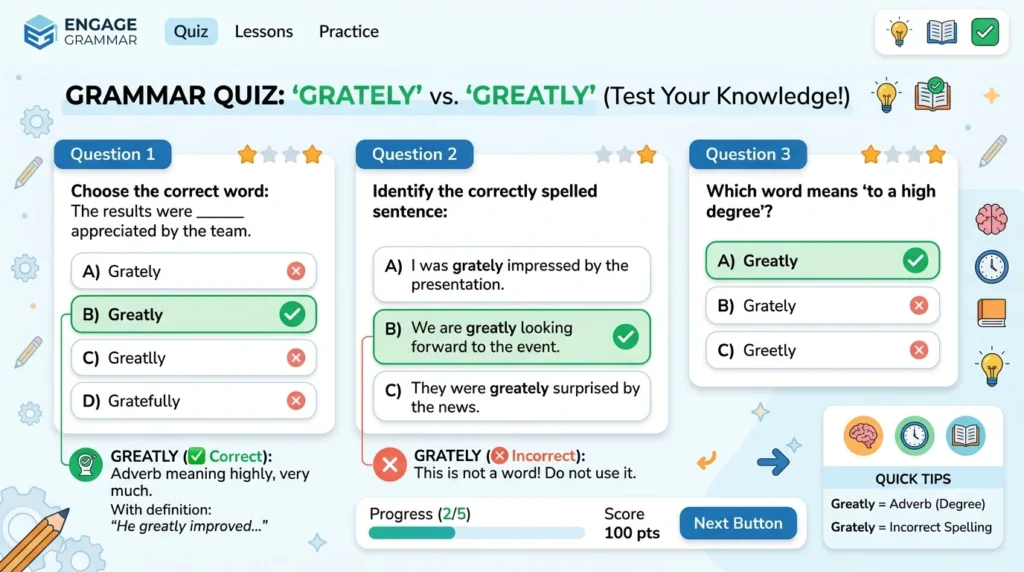
| Question | Answer | Explanation |
|---|---|---|
| 1. Which spelling is correct? A) Grately B) Greatly | ✅ Greatly | Greatly is the accepted English adverb. |
| 2. Complete the sentence: We ___ appreciate your support. | ✅ greatly | “Greatly appreciate” is the correct phrase. |
| 3. True or False: Grately is another spelling of greatly. | ❌ False | Grately is not a standard English word. |
| 4. Correct this sentence: I grately enjoyed the event. | ✅ I greatly enjoyed the event. | Replace the incorrect word with greatly. |
| 5. Which word comes from “great”? A) Greatly B) Grately | ✅ Greatly | Great + ly creates greatly. |
| 6. Complete: The new method ___ improved results. | ✅ greatly | It shows a large degree of improvement. |
| 7. Is there a British English version called grately? | ❌ No | Both varieties use greatly. |
| 8. Correct this sentence: Your help is grately appreciated. | ✅ Your help is greatly appreciated. | This common phrase uses greatly. |
| 9. Greatly means: A) Very much B) Slowly C) Quietly | ✅ Very much | Greatly describes a high degree. |
| 10. Which sentence is correct? | ✅ The change greatly affected sales. | Greatly correctly modifies the verb “affected.” |
Quick Summary
Greatly is the correct English word, while grately is not a standard word. Use greatly when you want to describe something happening to a high degree, such as “greatly appreciate,” “greatly improve,” or “greatly influence.” The confusion happens because people often apply spelling patterns incorrectly and assume every word can become an adverb by adding -ly. However, English depends on established usage, not only logical patterns. Remember the simple rule: great + ly = greatly. If you mean “very much” or “significantly,” choose greatly every time.