


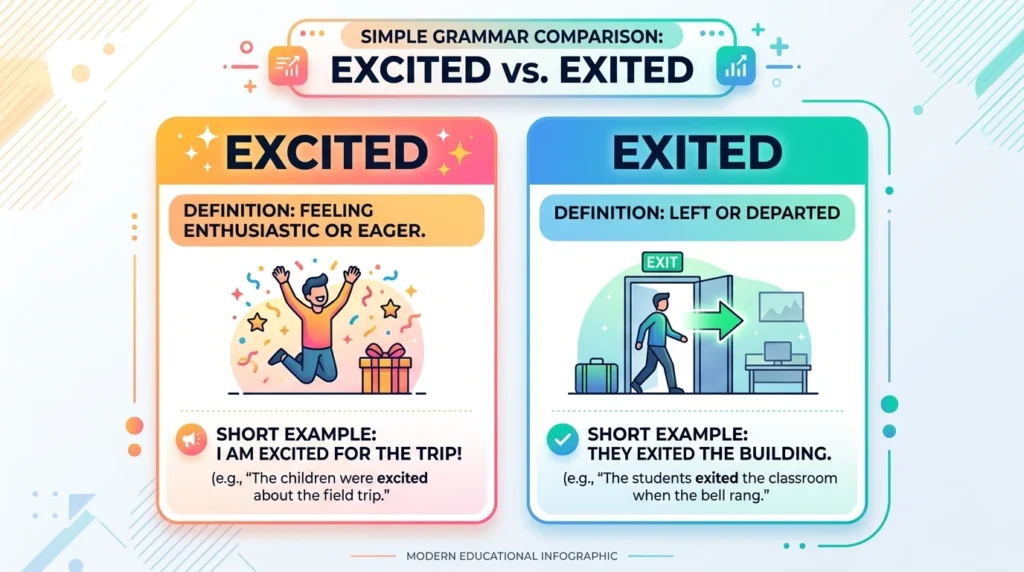
Excited usually describes a feeling of enthusiasm, eagerness, or heightened emotion. Exited is the past tense or past participle of exit, meaning that someone or something left a place, situation, or system. Write “I’m excited about the trip” when describing a feeling, but “I exited the building” when describing the action of leaving.
What Is Excited vs Exited?
Excited and exited are both correct English words, but they come from different verbs and express different ideas.
Excited comes from excite. In its most familiar everyday use, it describes someone who feels enthusiastic, eager, energetic, or emotionally stirred. It can function as an adjective, as in “She is excited,” or as a verb form, as in “The announcement excited the students.”
Exited comes from exit. It is the simple past and past participle form of a verb meaning to leave, depart, or go out. You can exit a room, a building, a highway, a competition, a market, or even a computer process.
The extra c in excited is small, but it completely changes the word.
Why the Difference Matters
Mixing up excited and exited can make an otherwise simple sentence confusing.
Imagine writing this in a job email:
“I am exited to join your team.”
The reader can probably guess that you mean excited, but exited literally points toward leaving rather than enthusiasm.
The mistake matters most in:
- professional emails
- job applications
- school assignments
- business reports
- social media captions
- customer messages
- academic writing
A spell-checker may not always save you because exited is a correctly spelled word. The problem is choosing the wrong word, not necessarily producing a nonexistent spelling.
The Core Rule
Excited = a feeling or state.
Exited = left or went out.
Use this three-step test:
- Ask whether the sentence is about enthusiasm, eagerness, or emotional energy. If yes, choose excited.
- Ask whether someone or something left, departed, or went out. If yes, choose exited.
- If you can replace the word with left without changing the basic meaning, exited is probably the word you need.
For example:
She was excited about the concert.
She was enthusiastic about the concert.
She exited the concert hall.
She left the concert hall.
How to Use Excited
Excited as an Adjective
This is the most common pattern learners need.
Excited describes someone’s state or reaction:
- I am excited.
- She looks excited.
- We were excited about the news.
- The children became excited.
- He seems excited to begin.
In these sentences, excited tells us how someone feels.
Excited About Something
Use excited about + noun or -ing form when identifying the thing or activity causing the excitement.
Examples:
- I am excited about the new project.
- She is excited about traveling abroad.
- They are excited about their graduation.
Excited to Do Something
Use excited to + base verb when someone is eager to perform an action.
Examples:
- I am excited to meet the team.
- We are excited to begin.
- She was excited to hear the results.
Both excited about starting and excited to start can be correct. The first focuses more on the activity as a topic; the second directly expresses eagerness to perform the action.
Excited for Someone
Excited for you is natural when you mean that you are happy or enthusiastic on another person’s behalf.
Example:
“You got the scholarship? I’m so excited for you!”
Excited for + event is also common in contemporary informal English, though excited about is a safe, widely accepted choice when referring to an event or thing.
Excited Does Not Always Mean Happy
Although excited often describes positive enthusiasm, its broader meaning can involve heightened energy or agitation rather than simple happiness. It also has specialized scientific meanings.
For example, physics uses excited state for a physical system such as an atom or molecule at an energy level above its ground state.
For most everyday learners, however, enthusiasm and eagerness are the meanings that matter most.
How to Use Exited
Exited as a Past-Tense Verb
Use exited when an action of leaving happened in the past.
- She exited the room.
- The passengers exited the bus.
- He exited through the rear door.
- The actor exited the stage.
Here, exited performs the job of a verb.
Exited With a Direct Object
The verb exit can take a direct object:
He exited the building.
The building is the thing he left.
Exited Without a Direct Object
It can also appear without one:
He exited quietly.
Both patterns are standard because exit can function as either a transitive verb, which takes an object, or an intransitive verb, which does not.
Exited as a Past Participle
Exited also appears with auxiliary verbs such as has, have, and had:
- She has exited the building.
- The final passenger had already exited.
- Several companies have exited the market.
So it is incomplete to say that exited is only the past tense. It can also be a past participle.
Exited Does Not Have to Mean Physical Movement
The idea of leaving can be extended beyond walking out of a room.
For example:
- The company exited the market.
- The player exited the tournament.
- The process exited with an error.
In every case, the core idea is still departure or termination rather than emotional enthusiasm.
Correct Examples of Excited and Exited
Here are original examples across everyday situations.
- Conversation: I’m excited to see you this weekend.
- Email: We are excited to welcome you to the new department.
- School: Maya was excited about presenting her science project.
- Workplace: The design team is excited to test the new prototype.
- Social media: So excited about tomorrow’s announcement!
- Academic context: The researchers examined the behavior of electrons in an excited state.
- Conversation: Daniel exited the café before the rain started.
- Travel: We exited the highway at the next junction.
- Workplace: The manager exited the meeting after giving her update.
- News-style writing: The passengers exited the aircraft safely.
- Business: The firm exited the market after changing its strategy.
- Technology: The program exited before the file could be saved.
Read More: Submission vs Submittion: Which Spelling Is Correct?
Incorrect vs. Correct Examples
| ❌ Incorrect | ✅ Correct | Why |
|---|---|---|
| I am exited about my birthday. | I am excited about my birthday. | The sentence describes enthusiasm, not leaving. |
| She was exited to meet her new teacher. | She was excited to meet her new teacher. | “Excited to + verb” expresses eagerness to do something. |
| We are exited about the vacation. | We are excited about the vacation. | A vacation is causing an emotional reaction. |
| He excited the building at noon. | He exited the building at noon. | He left the building, so the verb must come from “exit.” |
| The passengers excited the plane quickly. | The passengers exited the plane quickly. | The passengers were leaving the plane. |
| I have exited about this opportunity all week. | I have been excited about this opportunity all week. | The sentence describes an emotional state continuing over time. |
| She is exited for the interview tomorrow. | She is excited about the interview tomorrow. | The intended meaning is eagerness, not departure. |
| The actor excited through the side door. | The actor exited through the side door. | Going through a door to leave requires “exited.” |
| Everyone looked exited when the results arrived. | Everyone looked excited when the results arrived. | “Looked excited” describes an emotional appearance. |
| The company excited the European market last year. | The company exited the European market last year. | The company stopped operating in or withdrew from the market. |
Why People Confuse Excited and Exited
The Spellings Look Very Similar
The biggest visual difference is one letter:
excited
exited
When people type quickly, the c is easy to omit.
They Are Not Actually Homophones
These words are sometimes incorrectly described as homophones.
They are not.
Excited is pronounced with the sound pattern heard in excite, while exit has a different vowel and consonant pattern. Standard dictionary pronunciations clearly distinguish them.
A learner may still perceive them as similar because both begin with ex-, contain it, and end in -ed.
The Words Have Heavy Spelling Overlap
Readers often recognize words by overall shape rather than checking every letter individually.
That makes:
excited
easy to misread as:
exited
especially in fast digital communication.
Spell-Check May Accept the Mistake
Spell-checking systems are good at spotting strings that are not valid words.
But exited is valid English.
If you type:
“I’m exited about the concert,”
a basic spelling tool may see every word as correctly spelled even though exited is wrong for the intended meaning.
Autocomplete Can Reinforce the Wrong Choice
Predictive keyboards work from patterns and context, but they are not perfect. If exited is accepted or selected once, a user may keep repeating it without noticing the missing c.
Learners May Overgeneralize the Similarity
A learner may see two nearly identical forms and assume they belong to the same word family.
They do not:
excite → excited
exit → exited
Checking the base verb immediately makes the distinction clearer.
Translation Interference Is Usually Secondary
Translation can complicate expressions such as excited about, excited to, or excited for because languages do not always express enthusiasm with the same grammatical patterns.
However, translation interference is usually not the main reason people type exited instead of excited. The spelling similarity is a much more direct cause.
Common Mistakes Checklist
- Dropping the c in excited: Check whether you are describing enthusiasm. If so, make sure the word contains c.
- Assuming exited is always a typo: It is a real word when someone or something leaves.
- Thinking excited is only an adjective: It can also be a form of the verb excite.
- Thinking exited is only simple past: It can also appear as a past participle: “has exited.”
- Calling the pair homophones: Their pronunciations are different.
- Using exited after “I am” to describe enthusiasm: Write “I am excited,” not “I am exited.”
- Ignoring context because spell-check approves the sentence: A correctly spelled word can still be the wrong word.
- Assuming exit must refer to a door or building: Companies can exit markets, contestants can exit competitions, and computer processes can exit.
- Writing “excited for to start”: Use “excited to start” or “excited about starting.”
- Overcorrecting every use of “excited for”: “I’m excited for you” is perfectly natural, and “excited for the weekend” is also common in modern informal usage.
Read More: Dought vs Doubt: Which Is Correct?
Excited vs Exited in Real English
Grammatically Correct English
A sentence is grammatically correct when the chosen word matches both its meaning and sentence role. “She is excited about the promotion” uses excited as an adjective describing her state. “She exited the office at five” uses exited as a past-tense verb describing her departure. Both are ordinary, correct English. The important question is whether the sentence describes emotion or leaving.
Grammatically Possible but Less Natural English
A sentence can be grammatical without being the wording most people would choose in casual conversation. For example, “After dinner, I exited my friend’s apartment” is grammatically acceptable, but in an everyday story many speakers would simply say “I left my friend’s apartment.” Exited often feels more precise, procedural, dramatic, or report-like than left when no special emphasis on the act of exiting is needed.
Natural Everyday English
In normal conversation, excited is extremely natural: “I’m excited to go,” “She’s excited about college,” and “We’re excited for you.” For ordinary departures, left is often simpler: “He left the room.” Exited becomes especially useful when the manner, route, or act of leaving matters: “He exited through the rear door.” Choosing natural English means considering not only grammatical correctness but also the situation and tone.
Formal vs. Informal Usage
Both excited and exited are standard words suitable for formal writing.
Excited is common across almost every register:
- “I’m excited to see you.” — conversational
- “We are excited to announce the launch.” — professional
- “Participants were excited by the result.” — more formal
Exited is also standard, but left may sound more natural in casual speech.
Compare:
Casual: Sarah left the restaurant early.
More precise/report-like: Sarah exited the restaurant through the rear entrance.
In business and technical writing, exit is especially useful when describing withdrawal from a market, system, investment, process, or defined environment.
Excited vs Exited Comparison Table
| Feature | Excited | Exited |
|---|---|---|
| Base word | excite | exit |
| Main everyday meaning | enthusiastic or emotionally energized | left or departed |
| Common grammar role | adjective | verb |
| Other grammar role | past tense/past participle of excite | past participle of exit |
| Main idea | feeling/state | leaving/action |
| Common pattern | excited about something | exited the building |
| Another pattern | excited to do something | has exited |
| Can refer beyond everyday meaning? | Yes, including scientific excited states | Yes, including markets, competitions, and systems |
| Easy replacement test | enthusiastic/eager | left/departed |
| Key spelling clue | contains c | no c |
Memory Trick
Remember:
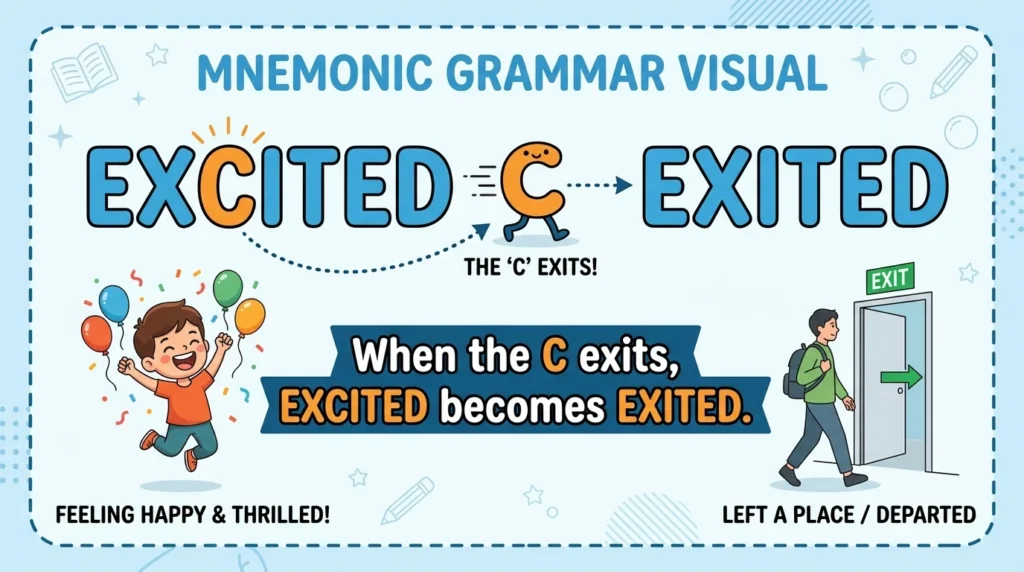
The C gets you exCited. When the C exits, you get exited.
Picture the letter C walking out of the word:
EXCITED → remove C → EXITED
Then attach meaning to the picture:
- C still inside = EXCITED = feeling
- C has exited = EXITED = leaving
The spelling difference itself becomes the memory trick.
Real-Life Situations
Job Interview
You want to show enthusiasm:
“I’m excited about the opportunity to work with your team.”
Do not write exited, because you are not talking about leaving the opportunity.
Business Meeting
Someone leaves before the meeting ends:
“Mr. Khan exited the meeting at 3:30 p.m.”
Here, exited records an action.
Professional Email
You want to welcome a new client:
“We’re excited to begin working with you.”
The sentence expresses positive anticipation.
Text Message
Your friend receives great news:
“That’s amazing! I’m so excited for you!”
Here, for you means that you share enthusiasm on your friend’s behalf.
Exam
The sentence says:
“After finishing the test, the students ___ the hall.”
The answer is exited because they left the hall.
Read More: Bachelor vs Batchelor: Which Spelling Is Correct?
Expert Tips
Check the Base Word
Strip away -ed:
excited → excite
exited → exit
If excite matches your meaning, choose excited.
If exit matches your meaning, choose exited.
Use the “Left” Test
Replace the uncertain word with left.
She ___ the room quietly.
“She left the room quietly” works.
Therefore:
She exited the room quietly.
Now try:
I am ___ about graduation.
“I am left about graduation” makes no sense.
You need:
I am excited about graduation.
Check the Word After It
Certain patterns can give you a strong clue.
You often see:
- excited about
- excited to
- excited by
- excited for
You often see exited followed by:
- the room
- the building
- the highway
- the market
- through the door
- from the competition
These are patterns rather than absolute rules, but they make proofreading faster.
Do Not Trust Spell-Check Alone
Always read for meaning.
A sentence can contain correctly spelled words and still be wrong:
I’m exited about starting university.
Every word exists, but excited is the correct choice.
Proofread for the Letter C
When enthusiasm is intended, stop at the word and check:
e-x-c-i-t-e-d
That one-second check eliminates the most common spelling error in this pair.
FAQ
Is “exited” a real word?
Yes. Exited is a correct form of the verb exit, meaning to leave or depart. “She exited the building” and “She has exited the building” are both possible.
Is “I am exited for the trip” correct?
Not if you mean that you feel enthusiastic. Write “I am excited about the trip” or, in common contemporary usage, “I am excited for the trip.”
Can “excited” be a verb?
Yes. Excited can be the past tense or past participle of excite.
For example:
“The announcement excited everyone.”
It is also very commonly used as an adjective:
“Everyone was excited.”
Can I say “I’m excited to meet you”?
Yes. Excited to + base verb is a normal pattern.
Examples include:
excited to meet
excited to begin
excited to learn
Is “excited for you” correct?
Yes. “I’m excited for you” naturally expresses happiness or enthusiasm on someone else’s behalf.
Can exited be used without saying what someone exited?
Yes.
“When the alarm sounded, everyone exited.”
Exit can function without a direct object as well as with one.
Does exited always mean physically walking out?
No. The idea can extend to leaving a market, competition, system, investment, or similar situation.
For example:
“The company exited the market.”
Why doesn’t spell-check always change exited to excited?
Because exited is correctly spelled. Spell-check may therefore accept it even when the surrounding sentence shows that excited was intended.
Are excited and exited pronounced the same?
No. They are not true homophones. Their standard pronunciations are different even though their spellings look similar.
Should I use exited or left in everyday conversation?
Both can be correct, but left is often simpler and more conversational.
“He left the room” sounds completely ordinary.
“He exited the room” can sound more deliberate, precise, dramatic, or report-like.
Mini Quiz
| # | Question | Answer | Explanation |
|---|---|---|---|
| 1 | Fill in the blank: “I’m ___ about starting my new job.” | excited | The speaker is describing enthusiasm. |
| 2 | Fill in the blank: “The audience ___ the theater after the show.” | exited | The audience left the theater. |
| 3 | Choose: “We are (excited / exited) to announce the winner.” | excited | “Excited to + verb” expresses eagerness or enthusiasm. |
| 4 | Correct the sentence: “She exited about her birthday party.” | She was excited about her birthday party. | The sentence describes an emotional state. |
| 5 | Choose: “The driver (excited / exited) the highway at Junction 8.” | exited | The driver left the highway. |
| 6 | Fill in the blank: “They have already ___ the building.” | exited | “Have exited” uses the past participle of exit. |
| 7 | Correct the sentence: “I am exited for you!” | I am excited for you! | The speaker is happy on another person’s behalf. |
| 8 | Multiple choice: Which word can mean “departed”? A) excited B) exited | B) exited | Exited comes from exit, meaning to leave or depart. |
| 9 | Multiple choice: Which sentence is correct? A) “The news exited her.” B) “The news excited her.” | B | Here “excited” is the past tense of excite. |
| 10 | Correct the sentence: “The students were exited to receive their results.” | The students were excited to receive their results. | Their emotional reaction is being described. |
Quick Summary
Excited and exited are separate words with different meanings. Use excited when describing enthusiasm, eagerness, heightened emotion, or something that has been stimulated. Use exited when someone or something has left, departed, or gone out of a place or situation. A simple test is to replace the word with left: if the sentence still makes sense, exited may be correct. Remember that exited is a real word, so spell-check may not catch the mistake when you intended excited. Also, the two words are not true homophones. The easiest spelling trick is simple: the C makes you exCited; when the C exits, you get exited.