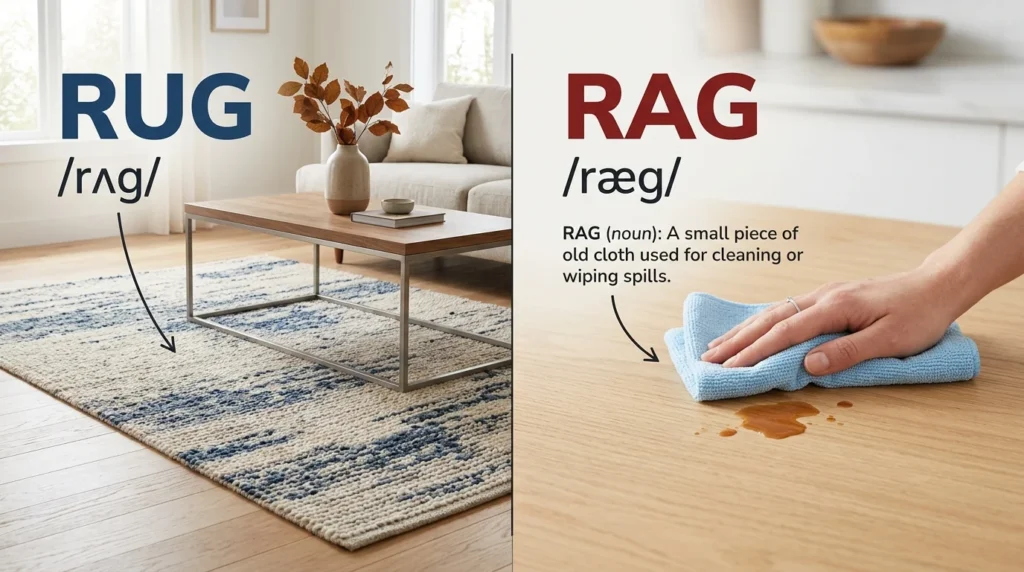

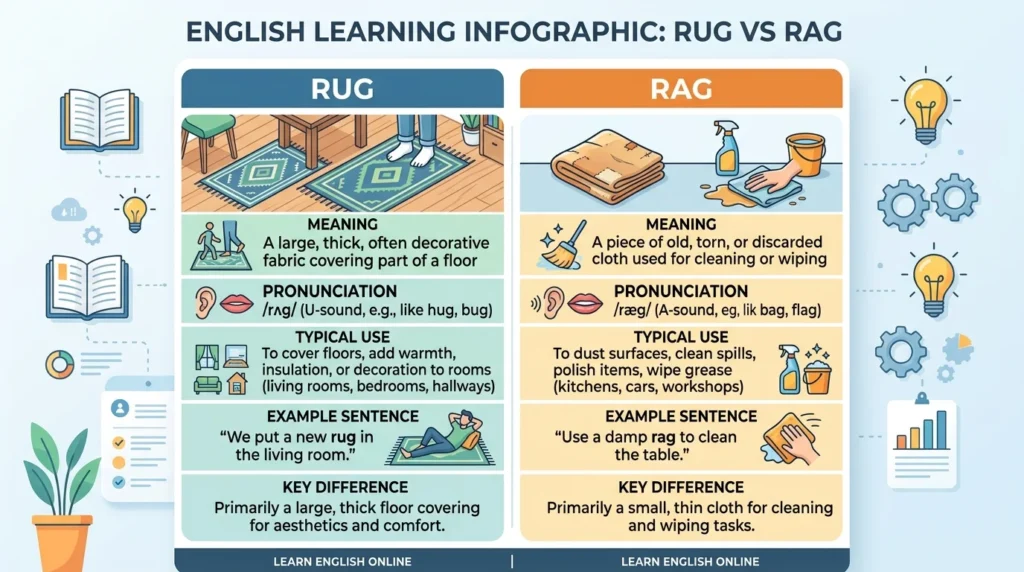
A rug is usually a thick or substantial piece of material placed on a floor for comfort, protection, warmth, or decoration. A rag is a piece of cloth, often old, worn, or set aside for practical jobs such as wiping and cleaning. In everyday household English, remember: you walk on a rug, but you clean with a rag.
What Do Rug and Rag Mean?
What Is a Rug?
A rug is a movable floor covering. It may sit beside a bed, beneath a coffee table, in a hallway, or in another part of a room.
Unlike wall-to-wall carpeting, a rug normally covers only part of the floor and can usually be moved from one place to another.
Rugs may be decorative, practical, or both. They can make a hard floor more comfortable, protect part of a surface, or add texture and design to a room. Standard dictionary definitions describe a rug primarily as a substantial piece of fabric used as a floor covering.
What Is a Rag?
A rag is a piece of cloth, especially one that is worn, torn, unwanted, or used for practical work.
In everyday household situations, people commonly use rags to:
- wipe spills
- remove dust
- polish objects
- clean tools
- wipe dirty hands
- handle messy jobs
A rag does not have to be old. A new piece of cloth can be called a cleaning rag if that is the purpose assigned to it. However, the word often carries the idea of scrap, worn, or low-value cloth.
Why the Difference Matters
Confusing rug and rag does not usually create a grammatical sentence error. It creates a vocabulary error: you have chosen a real English word, but it expresses the wrong meaning.
Compare:
Please put the rug under the table.
This means you want a floor covering beneath the table.
Please put the rag under the table.
This sounds as though you want someone to place a cleaning cloth or piece of scrap fabric there.
The difference matters in shopping, cleaning instructions, workplace messages, interior-design discussions, school assignments, and ordinary conversation. Spellcheck may not catch the mistake because both words are spelled correctly.
The Core Rule
RUG = a floor covering
RAG = a piece of cloth, commonly used for cleaning or wiping
That rule handles most everyday situations.
There is one important expression to remember: a rag rug is a genuine type of rug made from strips or pieces of fabric or rags. The first word describes the material; the second tells you what the finished object is.
Read More: Quantify vs Qualify: What’s the Difference?
Rug vs Rag Pronunciation
The words differ by only one vowel sound.
| Word | IPA | Simple Pronunciation Guide | Key Vowel |
|---|---|---|---|
| rug | /rʌɡ/ | roughly “rug” with the vowel in cup | /ʌ/ |
| rag | /ræɡ/ | “rag” with the vowel in cat | /æ/ |
The beginning r and ending g are the same. The middle vowel carries the contrast. Standard pronunciation references give rug as /rʌɡ/ and rag with /æ/.
For pronunciation practice, say:
cup → rug
cat → rag
Then alternate:
rug — rag — rug — rag
Do not depend only on spelling. Train your ear to hear the vowel.
How to Use Rug and Rag Correctly
Use Rug for Floor Coverings
Choose rug when talking about an object placed on a floor:
- area rug
- bedroom rug
- bathroom rug
- Persian rug
- prayer rug
- wool rug
- woven rug
Example:
We placed a small rug beside the bed.
Use Rag for Cleaning or Scrap Cloth
Choose rag when referring to a piece of cloth used for wiping, cleaning, polishing, repairs, or another rough practical purpose.
Example:
Use a clean rag to wipe the paint from the handle.
Do Not Assume Every Cloth Is a Rag
A cloth is a broader word. A tea towel, washcloth, polishing cloth, napkin, and carefully folded piece of fabric are not automatically called rags.
Calling something a rag can suggest that it is worn, low-value, scrap material, or intended for dirty work.
Remember the Rag Rug Exception
A rag rug is not a contradiction.
It means a rug constructed from fabric strips or pieces of rag material. The finished object is still a rug because it functions as a floor covering.
Correct Examples of Rug and Rag
- Conversation: We found a beautiful rug for the living room.
- Conversation: Grab a rag before that juice reaches the floor.
- Email: The new rug for the reception area will arrive on Thursday.
- Email: Please keep a clean rag beside the maintenance supplies.
- School: The children sat together on the classroom rug.
- School: Maya used a rag to wipe paint from the desk.
- Workplace: The patterned rug makes the waiting area feel warmer.
- Workplace: The technician wiped the equipment with a dry rag.
- Social media: This vintage rug completely changed my bedroom.
- Social media: An old cotton shirt makes a useful cleaning rag.
- Academic writing: The study recorded dust samples taken from the surface of each rug.
- Instructions: Remove the excess polish with a soft, clean rag.
- Interior design: A larger rug would visually connect the sofa and chairs.
- DIY: She braided strips of old fabric to create a rag rug.
Incorrect vs Correct: Rug or Rag?
| ❌ Incorrect | ✅ Correct | Why |
|---|---|---|
| I wiped the counter with a rug. | I wiped the counter with a rag. | A handheld cleaning cloth is normally a rag, not a floor covering. |
| We bought a new rag for the living room. | We bought a new rug for the living room. | A decorative floor covering is a rug. |
| Put the rag underneath the coffee table. | Put the rug underneath the coffee table. | The sentence describes a floor covering beneath furniture. |
| Take a rug and clean the oil from the tool. | Take a rag and clean the oil from the tool. | Cleaning or wiping calls for rag. |
| The dog sleeps on the soft rag by the fireplace. | The dog sleeps on the soft rug by the fireplace. | A substantial floor covering is a rug. |
| She polished the metal with an old rug. | She polished the metal with an old rag. | A piece of old cloth used for polishing is a rag. |
| The designer chose a blue rag for the bedroom floor. | The designer chose a blue rug for the bedroom floor. | Interior floor décor is normally called a rug. |
| Keep several rugs in the garage for wiping grease. | Keep several rags in the garage for wiping grease. | Cloths kept for messy cleaning jobs are rags. |
| The hotel placed a decorative rag beside the bed. | The hotel placed a decorative rug beside the bed. | A decorative floor covering is a rug. |
| She turned the old shirts into a rug rag. | She turned the old shirts into a rag rug. | Rag rug is the established compound: the rug is made from rag material. |
| He dried the wet surface with a rug. | He dried the wet surface with a rag. | The object is being used as a wiping cloth. |
| This rag matches our sofa perfectly. | This rug matches our sofa perfectly. | When discussing coordinated floor décor, rug is the natural word. |
Read More: Courtesy vs Curtesy: What’s the Difference?
Why Do People Confuse Rug and Rag?
Similar Spelling
The words contain three letters each and have the same first and last letters:
r-u-g
r-a-g
Only the vowel changes.
That makes the difference easy to miss when reading quickly or typing without proofreading.
Similar Sound Structure
Both words begin with /r/ and end with /ɡ/. Only the vowel distinguishes them.
For learners whose first language does not clearly separate English /ʌ/ and /æ/, the contrast may take practice.
Meaning Overlap Through Fabric
Both objects can involve fabric. A learner may therefore remember “piece of material” but forget the important difference in function.
Focus on what the object is doing, not simply what it is made from.
Overgeneralization
Learners sometimes learn a shortcut such as “rag means old fabric” and assume every old textile is a rag.
That is too broad.
An old rug can still be a rug because it remains a floor covering. Age alone does not determine the word.
Autocomplete and Spellcheck
Software cannot always rescue you from this error.
Both rug and rag are correctly spelled English words. If you type the wrong one, ordinary spellcheck may see nothing technically wrong with the spelling.
Translation Interference
Some languages may use one broader word for several kinds of cloth, mats, coverings, or cleaning materials.
When translating directly into English, the learner may choose a word based on material rather than function.
A safer method is to ask:
Is this covering the floor, or is it a piece of cloth being used for a practical task?
Common Mistakes Checklist
- Using rag for any piece of fabric: Remember that cloth is the broader term.
- Using rug for anything thick: Thickness alone does not make an object a rug; its normal purpose matters.
- Calling every floor covering a rug: Carpet, mat, and rug overlap, but they are not always interchangeable.
- Thinking a rag must be old: A new cloth can be designated as a cleaning rag.
- Thinking an old rug becomes a rag: If it is still being used as a rug, age does not change its name.
- Writing rug rag instead of rag rug: The established term is rag rug.
- Ignoring pronunciation: Practice /ʌ/ versus /æ/, not just the spelling.
- Trusting spellcheck: Proofread for meaning because both spellings are valid.
- Using rag when you mean towel: Towels have their own normal name unless one has been repurposed as a rag.
- Applying the basic rule to every dictionary meaning: Both words have additional senses beyond household vocabulary.
Rug vs Rag in Real English
Grammatically Correct and Natural
Sentences such as “There is a rug under the table” and “Wipe it with a rag” are both grammatical and completely natural. They match the ordinary meanings of the nouns and the actions English speakers commonly associate with them. These are the safest patterns for learners: rugs are normally placed, laid, spread, bought, cleaned, or walked on; rags are grabbed, used, washed, wiped with, or thrown away.
Grammatically Possible but Unnatural
A sentence can follow English grammar while still sound strange because the noun does not fit the situation. “She decorated the room with a cleaning rag on the floor” is grammatical, but it would be unusual unless the speaker truly means that a cleaning rag was intentionally used as decoration. Grammar controls sentence structure; natural word choice depends on meaning, context, and ordinary usage.
Natural Everyday English
In casual speech, people often identify these objects by function rather than by technical material. Someone cleaning a garage might say “Pass me a rag” even if the cloth began life as an old T-shirt. Someone discussing a room might simply say “I like that rug” without describing its fiber or construction. Everyday English usually favors the familiar object name that best matches what the item is being used as.
Read More: Excited vs Exited: What Is the Difference?
American vs British English
The main household meanings of rug and rag do not reverse between American and British English. A floor rug is still a rug, and a piece of scrap or cleaning cloth can still be a rag.
There are, however, genuine related differences.
A small movable decorative rug may be called a throw rug in American English and a scatter rug in British English.
British English also has an additional use of rug for a blanket or covering used on an animal such as a horse.
These differences do not change the basic rug-versus-rag rule for normal household use.
Formal vs Informal Usage
As names for household objects, rug and rag are ordinary neutral words. You can use them in conversation, instructions, emails, and most professional writing.
However, rag has additional informal meanings.
It can refer dismissively to a newspaper or publication, and rag can also function as a verb meaning to tease, criticize, or bother someone. Those meanings are separate from the cleaning-cloth sense.
For formal writing, use the word that precisely describes the object. If the material is not worn or intended for rough cleaning, cloth, cleaning cloth, wipe, or another specific term may sometimes be more precise than rag.
Rug vs Rag Comparison Table
| Feature | Rug | Rag |
|---|---|---|
| Main meaning | A floor covering | A piece of cloth |
| Typical purpose | Comfort, protection, decoration | Wiping, cleaning, polishing, practical work |
| Usual position | On a floor | Usually held or stored for use |
| Typical condition | New, used, valuable, decorative, or ordinary | Often old, worn, scrap, or work-oriented |
| Must it be old? | No | No |
| Common interior-design term? | Yes | No |
| Common cleaning term? | Not normally | Yes |
| Pronunciation | /rʌɡ/ | /ræɡ/ |
| Plural | rugs | rags |
| Example | bedroom rug | cleaning rag |
| Can the words combine? | Yes: rag rug | Yes: rag rug |
| Same as carpet? | Not always | No |
| Same as cloth? | No | A rag is a type/use of cloth |
Rug vs Carpet: Are They the Same?
Not exactly.
A rug commonly refers to a movable floor covering that covers part of a floor.
Carpet can refer to floor-covering material more broadly and is especially common for material fitted across much or all of a room. Standard definitions also allow some overlap, so the distinction is not absolute in every context.
Compare:
We put a rug beneath the coffee table.
The bedroom has wall-to-wall carpet.
For learners, movable partial floor covering = rug is a useful practical distinction.
Rag vs Cloth: Are They the Same?
A rag is a kind of cloth or a way cloth is being used, but cloth is the broader and more neutral term.
For example:
Use a soft cloth to clean the camera lens.
sounds more appropriate than:
Use a rag to clean the camera lens.
The second sentence may suggest a rough, old, or ordinary cleaning cloth that could be unsuitable for a delicate surface.
Likewise, a beautiful piece of unused fabric is cloth or fabric, not automatically a rag.
What Is a Rag Rug?
A rag rug is a rug created using strips or pieces of fabric, traditionally including recycled or discarded cloth.
This phrase is particularly useful because it shows why the simple rule must be understood rather than memorized too literally.
In rag rug:
rag describes the material or construction.
rug identifies the finished object.
Established dictionary definitions describe a rag rug as a woven rug made using strips of rag material.
Memory Trick
Remember this sentence:
U goes Under your feet; A gets Action on the mess.
R-U-G → U = Under your feet
R-A-G → A = Action when you wipe or clean
It is not a dictionary rule. It is simply a memory tool for the most common meanings.
Real-Life Situations
Interview
Interviewer: How did you help prepare the showroom?
Natural answer: “I rearranged the furniture and placed a new rug in the display area.”
Here, rug is correct because you are discussing interior presentation.
Meeting
“The maintenance team needs more clean rags for the workshop.”
Use rags because the pieces of cloth are work supplies.
“Could you confirm the dimensions of the rug before we place the order?”
Rug fits purchasing and interior-design language.
Text Message
“I spilled coffee. Bring me a rag!”
This is natural informal English when asking for something to wipe up the spill.
Exam
Sentence: “The children sat on the colorful ___ during story time.”
Correct answer: rug
The context describes something on the floor that people sit on.
Expert Tips
Focus on Function Before Material
Do not ask only, “Is it made of fabric?”
Ask what role the item has.
If it is functioning as a movable floor covering, rug is normally the answer.
If it is functioning as scrap or cleaning cloth, rag is normally the answer.
Learn Collocations
A collocation is a combination of words that commonly appear together.
Useful combinations include:
Rug: area rug, wool rug, prayer rug, Persian rug, soft rug, patterned rug
Rag: cleaning rag, dirty rag, oily rag, old rag, damp rag
Learning whole combinations is often easier than memorizing definitions alone.
Use Verbs as Clues
Certain verbs make the choice easier.
You often:
- lay, place, vacuum, or walk on a rug
- wipe with, grab, rinse, or throw away a rag
These are patterns, not absolute grammatical rules, but they are useful clues.
Do Not Turn a Shortcut Into an Absolute Rule
“Rug = floor; rag = cleaning” is excellent for beginners.
It is not the entire dictionary.
Words develop additional senses and appear inside compounds such as rag rug. Learn the core distinction first, then add exceptions.
FAQ
Is a rug the same as a rag?
No. In normal household English, a rug is a floor covering, while a rag is a piece of cloth often used for cleaning, wiping, polishing, or other practical work.
Is a rag always dirty?
No. A rag may be perfectly clean. The word describes the type, condition, or practical use of the cloth, not necessarily whether dirt is currently on it.
Can a new cloth be called a rag?
Yes. A new piece of cloth may be called a cleaning rag if it has been set aside for that purpose. Rags are often old or reused, but being old is not an absolute requirement.
Can an old rug be called a rag?
Not simply because it is old. If it remains a floor covering, it is still a rug. It might be described as an old rug, worn rug, or damaged rug.
What does rag rug mean?
A rag rug is a rug made from strips or pieces of cloth or rag material. Rag describes what it is made from; rug tells you what the finished item is.
Is a rug the same as a mat?
Not always. Both can cover part of a floor, but mat is often used for smaller functional coverings, such as bath mats, door mats, or exercise mats. Rug is especially common for decorative or substantial textile floor coverings.
Is rug another word for carpet?
They overlap, but they are not always interchangeable. A rug is commonly movable and covers only part of the floor, while carpet often refers to fitted or more extensive floor covering.
What is the plural of rug and rag?
The plurals are regular:
rug → rugs
rag → rags
Why do rug and rag sound similar?
They have the same initial /r/ and final /ɡ/ sounds. The important difference is the vowel: rug has /ʌ/, while rag has /æ/.
Can rag have other meanings?
Yes. Among other uses, rag can informally refer to a newspaper, and it can function as a verb related to teasing or criticizing someone. Context tells you which meaning is intended.
Mini Quiz: Rug vs Rag
| # | Question | Answer | Explanation |
|---|---|---|---|
| 1 | Fill in the blank: “Please put the new ___ beside the sofa.” | rug | A floor covering beside furniture is a rug. |
| 2 | Fill in the blank: “Use a clean ___ to wipe the glass.” | rag | The cloth is being used for wiping. |
| 3 | Choose one: Which word normally has the pronunciation /rʌɡ/? A) rag B) rug | B) rug | Rug contains /ʌ/; rag contains /æ/. |
| 4 | Correct the sentence: “The mechanic wiped his hands on a rug.” | “The mechanic wiped his hands on a rag.” | A work cloth used for wiping is normally a rag. |
| 5 | Fill in the blank: “The children gathered on the classroom ___.” | rug | The object is a floor covering used as a sitting area. |
| 6 | True or false: A rag must always be old. | False | A new cloth can be designated as a cleaning rag. |
| 7 | Choose the correct phrase: A) rug rag B) rag rug | B) rag rug | Rag rug is the established term for a rug made using rag or fabric strips. |
| 8 | Correct the sentence: “We bought a patterned rag for the dining room floor.” | “We bought a patterned rug for the dining room floor.” | Interior floor décor is a rug. |
| 9 | Fill in the blank: “Keep a ___ nearby in case the paint spills.” | rag | A rag is useful for wiping accidental spills. |
| 10 | Choose the best answer: “The hotel replaced the worn floor covering with a new ___.” A) rag B) rug | B) rug | The context describes a floor covering, not a cleaning cloth. |
Quick Summary
Rug and rag are separate English words with different meanings. A rug is normally a movable floor covering used for comfort, decoration, or protection. A rag is a piece of cloth commonly used for cleaning, wiping, polishing, or messy practical work. Pronunciation also separates them: rug uses /ʌ/, while rag uses /æ/. Do not assume that every rag must be old, and remember that an old rug remains a rug if it is still used as a floor covering. The phrase rag rug is also correct: it means a rug made from strips or pieces of cloth. For everyday use, remember: rug under your feet; rag for the mess.