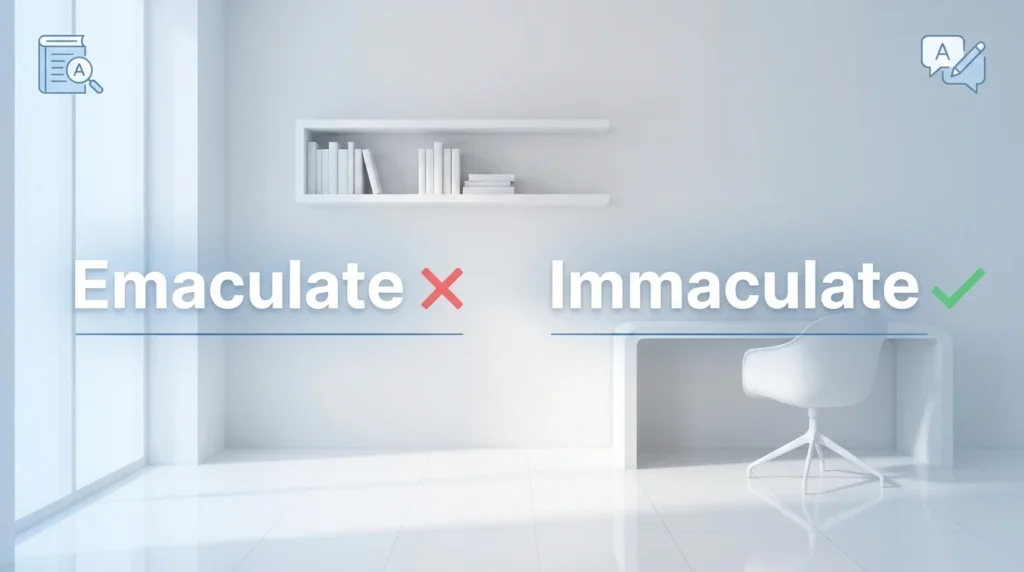

Immaculate is the correct modern spelling when you mean perfectly clean, exceptionally neat, flawless, pure, or free from mistakes. Emaculate should not replace it in ordinary writing. Although emaculate once existed as a rare verb meaning to remove stains or imperfections, that historical use is obsolete. Write an immaculate room, not an emaculate room.
What Does Immaculate Mean?
Immaculate is an adjective used to describe something exceptionally clean, neat, pure, accurate, or free from visible flaws.
In its most literal sense, it refers to physical cleanliness:
The kitchen was immaculate.
In a figurative sense, it can describe work, behaviour, performance, or reputation that appears flawless:
She delivered an immaculate presentation.
The word is stronger than ordinary adjectives such as clean, tidy, or good. An immaculate room is not merely acceptable. It appears so clean and well organised that finding dirt or disorder would be difficult.
Modern dictionaries recognise several connected meanings, including spotlessly clean, free from flaws or mistakes, morally pure, and without coloured spots or markings in certain scientific descriptions. ate a Real Word?
The accurate answer requires an important distinction.
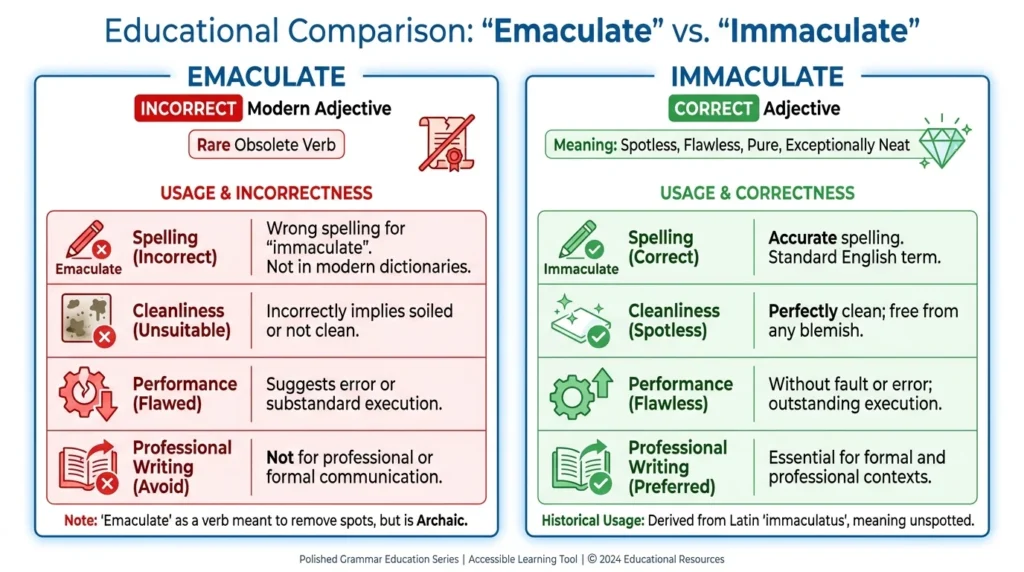
When someone writes emaculate to mean clean, perfect, or flawless, it is a spelling mistake. The intended word is immaculate.
However, emaculate has appeared historically as an obsolete verb meaning to clear something of spots, stains, or imperfections. It is not the normal modern adjective and should not be used in place of immaculate. An emaculate kitchen is incorrect.
- An immaculate kitchen is correct.
- A historical use of to emaculate a text may be found in old writing, but modern readers are unlikely to recognise it.
Why This Spelling Matters
A spelling mistake involving a common descriptive word can weaken an otherwise strong sentence.
Writing emaculate in a job application, client proposal, school assignment, business email, property listing, or published article may make the work appear insufficiently proofread. The reader can usually guess the intended meaning, but the error may distract attention from the message.
Correct spelling matters particularly when the sentence praises accuracy or perfection:
The report was emaculate.
The mistake becomes more noticeable because the writer is attempting to describe something flawless while using a flawed spelling.
Choosing immaculate protects clarity and helps your writing appear careful, credible, and professional.
The Core Rule
Rule: Use immaculate when you mean exceptionally clean, perfectly neat, flawless, pure, or free from mistakes. Do not use emaculate as an alternative adjective.
The standard spelling is:
I-M-M-A-C-U-L-A-T-E
Notice these two features:
- It begins with I, not E.
- It contains two consecutive M letters.
How to Use Immaculate
Use Immaculate for Exceptional Cleanliness
Use immaculate when a place, object, surface, or item is far cleaner than expected.
- an immaculate bathroom
- an immaculate uniform
- an immaculate car
- an immaculate white tablecloth
- an immaculate office
The word suggests that no dirt, stain, dust, or disorder is visible.
Use Immaculate for a Neat Appearance
You can describe a person’s clothing, grooming, or overall presentation as immaculate.
Despite the long journey, he arrived looking immaculate.
This does not necessarily mean the person is physically perfect. It means the person looks exceptionally neat, polished, clean, or well dressed.
Use Immaculate for Flawless Work
Immaculate can also describe work completed without visible errors.
- immaculate handwriting
- immaculate editing
- an immaculate performance
- an immaculate service record
- immaculate execution
This meaning is figurative. The work is not literally clean. It is precise, excellent, or apparently free from mistakes.
Use Immaculate for a Reputation or Record
An immaculate reputation or record is one that has not been damaged by misconduct, failure, or scandal.
She maintained an immaculate professional record throughout her career.
Here, immaculate carries the idea of being unblemished.
Also Read: Unenroll vs Disenroll: Meaning and Key Difference
Avoid Using It for Anything Merely Good
Immaculate is a strong adjective. It can sound exaggerated when the subject is simply satisfactory.
Less natural:
The bus arrived at an immaculate time.
Better:
The bus arrived at the perfect time.
Less natural:
I had an immaculate sandwich.
Better:
I had an excellent sandwich.
In playful modern slang, someone may describe music, food, an atmosphere, or “vibes” as immaculate. This use means outstanding or exactly right, but it belongs mainly in casual conversation and social media rather than formal writing. Published examples show that “the vibes were immaculate” has become recognisable as informal praise. ion of Immaculate
Immaculate is commonly pronounced:
ih-MAK-yuh-luht
IPA:
/ɪˈmæk.jə.lət/
The main stress falls on the second syllable: MAK.
Break it into four spoken parts:
- ih
- MAK
- yuh
- luht
The beginning is short and unstressed. That weak opening sound is one reason some writers mistakenly begin the word with e or fail to remember the im- prefix. The standard pronunciation is substantially the same in mainstream American and British English. amples of Immaculate
| Context | Correct example |
|---|---|
| Conversation | Your apartment looks immaculate after the renovation. |
| Thank you for returning the equipment in immaculate condition. | |
| School | The student submitted an immaculate final copy with no visible corrections. |
| Workplace | Her immaculate record made her a strong candidate for the promotion. |
| Meeting | Daniel gave an immaculate explanation of the new reporting process. |
| Social media | The lighting, music, and decorations were immaculate. |
| Academic writing | The manuscript was not immaculate, but its central argument was persuasive. |
| Customer review | Our hotel room was immaculate when we arrived. |
| Fashion | He wore an immaculate navy suit to the ceremony. |
| Property listing | The home features an immaculate kitchen with polished stone surfaces. |
| Sports | The goalkeeper produced an immaculate first-half performance. |
| Technology | The restoration team returned the device in immaculate condition. |
Incorrect vs Correct Examples
| ❌ Incorrect | ✅ Correct | Why |
| The hotel room was emaculate. | The hotel room was immaculate. | Immaculate is the modern adjective meaning exceptionally clean. |
| She wore an emaculate white dress. | She wore an immaculate white dress. | The intended meaning is spotless and perfectly presented. |
| His attendance record is emaculate. | His attendance record is immaculate. | A record free from problems or absences can be described as immaculate. |
| The editor produced an emaculate final draft. | The editor produced an immaculate final draft. | Emaculate is not the standard adjective for error-free work. |
| Your handwriting is absolutely emaculate. | Your handwriting is absolutely immaculate. | The correct adjective begins with im- and has two consecutive m letters. |
| The garden looked emaculate in spring. | The garden looked immaculate in spring. | A perfectly maintained garden can be immaculate. |
| She gave a completely emaculate performance. | She gave a completely immaculate performance. | A flawless performance is described as immaculate. |
| He keeps his desk emaculately organised. | He keeps his desk immaculately organised. | The correct adverb is immaculately. |
| The car’s emaculate condition increased its value. | The car’s immaculate condition increased its value. | The adjective modifies condition and must use the standard spelling. |
| Please return the studio in emaculate condition. | Please return the studio in immaculate condition. | This is a standard phrase used for exceptional cleanliness. |
| The report was immaculate written. | The report was immaculately written. | An adverb is needed to modify the past participle written. |
| She completed the task immaculately perfect. | She completed the task perfectly. | Immaculately perfect is redundant and unnatural in this sentence. |
Also Read: Comment vs Coment
Why People Write Emaculate Instead of Immaculate
Phonetic Similarity
Many spelling mistakes begin with pronunciation. The first syllable in immaculate is weak and unstressed, so it may sound closer to a quick “ih” or “uh” than a clearly pronounced “im.”
A learner who spells entirely by sound may therefore produce emaculate.
The Double-M Pattern
Writers sometimes remember the main sound, maculate, but forget that the word starts with the prefix im-.
When im- appears before a base beginning with m, the letters meet:
im + maculate = immaculate
That creates the double m.
Confusion With Emaciated
Some people incorrectly assume that emaculate is related to emaciated, which means abnormally thin or weak.
These words should not be confused:
- Immaculate: spotless, flawless, or exceptionally neat
- Emaciated: extremely thin or weak, often because of illness or insufficient food
Calling a frail person emaculate is not a correct modern substitute for emaciated.
Overgeneralising From Similar Words
English contains many words beginning with e, ex, and em, including emerge, embody, eliminate, and evacuate. A writer may unconsciously apply one of those familiar openings to immaculate.
The result looks believable even though it is incorrect for the intended adjective.
Autocomplete and Spellcheck Limitations
A spelling checker can catch emaculate in many situations, but digital tools are not infallible.
Historical words, names, user-added dictionary entries, specialised databases, and copied online errors can prevent a warning from appearing. Autocomplete may also suggest a word based on previous typing rather than verified usage.
Use writing tools as a second check, not as a replacement for knowing the correct form.
Translation Interference
English learners often transfer spelling expectations from another language. A language may represent the initial vowel differently or avoid doubled consonants in the same position.
This does not indicate poor language ability. It simply means the English spelling must be learned as a complete visual pattern: immaculate.
Also Read: Emersion vs Immersion: Difference and Which One Is Correct?
Common Mistakes Checklist
Writing Emaculate as an Adjective
Mistake: The office was emaculate.
Why it happens: The writer follows the sound rather than the established spelling.
How to avoid it: Memorise the opening unit imm- rather than trying to reconstruct the word letter by letter.
Writing Emmaculate With an E
Mistake: The office was emmaculate.
Why it happens: The writer remembers the double m but chooses the wrong first vowel.
How to avoid it: Remember that the word begins with the complete prefix im-.
Using Only One M
Mistake: The office was imaculate.
Why it happens: One m belongs to the prefix and the other begins the following part of the word.
How to avoid it: Visualise the spelling as im + maculate.
Confusing Immaculate With Emaciated
Mistake: The abandoned animal looked immaculate after weeks without food.
Why it happens: The words share several letters and have a vaguely similar rhythm.
How to avoid it: Use emaciated for extreme thinness and immaculate for cleanliness or flawlessness.
Using Immaculate as an Adverb
Mistake: The room was immaculate cleaned.
Why it happens: The adjective is placed where an adverb is needed.
How to avoid it: Use immaculately before a participle: immaculately cleaned.
Overusing Immaculate
Mistake: The meal, weather, chair, timetable, price, and journey were all immaculate.
Why it happens: The writer treats immaculate as a general synonym for good.
How to avoid it: Reserve the word for exceptional cleanliness, presentation, flawlessness, purity, or strongly approving informal praise.
Combining It With Redundant Adjectives
Mistake: The surface was immaculately spotless.
Why it happens: The writer adds multiple intensifiers without checking whether they repeat the same meaning.
How to avoid it: Choose one precise expression: immaculate, spotless, or perfectly clean.
Emaculate vs Immaculate in Real English
Grammatically Correct Usage
In standard modern English, immaculate functions mainly as an adjective. It can appear before a noun, as in “an immaculate uniform,” or after a linking verb, as in “the uniform was immaculate.” The adverb is immaculately, while the less common noun immaculacy refers to the state or quality of being immaculate. These forms are grammatically established. ally Possible but Unnatural Usage
A sentence can follow grammar rules and still sound unnatural. “The soup was immaculate” is structurally correct, but many readers may find it unusual if the speaker only means that the soup tasted delicious. Immaculate does not normally mean tasty. The sentence works better as deliberate exaggeration, humorous slang, or praise for flawless presentation rather than as a neutral description of flavour.
Natural Everyday Usage
In everyday English, immaculate sounds most natural with words connected to cleanliness, condition, appearance, organisation, performance, records, and reputation. Common combinations include immaculate condition, immaculate home, immaculate appearance, and immaculate record. Informally, younger speakers may extend it to experiences or atmospheres, especially in phrases such as “the vibes were immaculate,” meaning everything felt exceptionally good.
Also Read: Protestors or Protesters: Which Spelling Is Correct?
Formal vs Informal Usage
Formal Usage
Immaculate is appropriate in professional, academic, journalistic, and business writing when its meaning is precise.
Formal examples include:
- an immaculate service record
- an immaculate restoration
- immaculate presentation standards
- an immaculate copy of the document
- an immaculate professional reputation
Formal writing should avoid exaggerated uses where a more exact word would communicate the intended meaning better.
Informal Usage
In informal speech and social media, immaculate may express enthusiastic approval.
That concert was immaculate.
The café’s autumn atmosphere is immaculate.
Her timing was immaculate.
These sentences stretch the meaning from flawless or perfect to something closer to excellent, impressive, or exactly right. They are understandable in casual contexts but may sound imprecise in a report, academic paper, or formal client email.
Emaculate vs Immaculate Comparison Table
| Feature | Emaculate | Immaculate |
| Normal modern role | Usually a misspelling | Standard adjective |
| Modern meaning | No accepted adjective meaning equivalent to immaculate | Spotless, flawless, pure, or exceptionally neat |
| Historical status | Rare obsolete verb | Established modern word |
| Part of speech | Historically a verb | Adjective |
| Correct for a clean room | No | Yes |
| Correct for a flawless performance | No | Yes |
| Correct for a perfect record | No | Yes |
| First letter | E | I |
| Double consonant | Usually written with one m in the obsolete form | Contains two consecutive m letters |
| Suitable for business writing | Avoid unless discussing the historical verb | Yes |
| Suitable for academic writing | Only in a historical or linguistic discussion | Yes |
| Related adverb | Not used in ordinary modern English | Immaculately |
| Example | Historical: to emaculate a text | The final text was immaculate. |
Similar Words You Should Not Confuse
| Word | Meaning | Example |
| Immaculate | Exceptionally clean, flawless, or unblemished | The laboratory was immaculate. |
| Emaciated | Extremely thin and weak | The rescued horse was badly emaciated. |
| Impeccable | Without fault, especially in behaviour, quality, or style | Her professional conduct was impeccable. |
| Pristine | In an original, fresh, or unspoiled condition | The beach remained pristine. |
| Spotless | Completely free from dirt or stains | The windows were spotless. |
| Meticulous | Extremely careful about details | He kept meticulous financial records. |
| Unblemished | Not damaged physically or figuratively | She had an unblemished career. |
| Flawless | Containing no fault or imperfection | The singer gave a flawless performance. |
Memory Trick
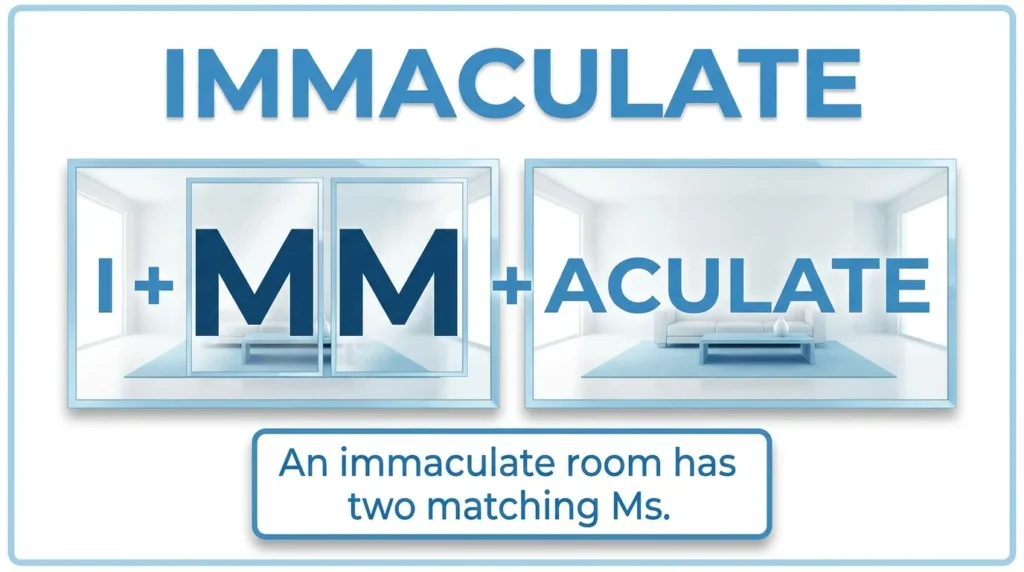
Picture an immaculate room with two matching mirrors.
The two mirrors represent the two M letters:
I + MM + ACULATE
Then repeat this sentence:
An immaculate room has two matching Ms.
This image reminds you of all three important details:
- The word begins with I.
- It contains MM.
- It describes something impressively clean or flawless.
Also Read: Finaly vs Finally
Real-Life Situations
Job Interview
Interviewer: How would your previous manager describe your work?
Candidate: She would probably mention my immaculate attendance record and attention to detail.
The word works because the candidate is describing a record without faults or absences.
Workplace Meeting
Manager: Was the data ready for the client presentation?
Analyst: Yes. Priya checked every figure and prepared an immaculate final report.
Here, immaculate means carefully prepared and apparently free from errors.
Professional Email
The equipment arrived in immaculate condition, and no damage was visible during inspection.
This is a natural formal use because it describes the physical condition of an item.
Text Message
Your place looks immaculate! How long did the cleaning take?
The word expresses strong praise for exceptional cleanliness.
Examination
Question: Choose the correct word: “The museum displayed an _____ nineteenth-century manuscript.”
Answer: immaculate
The adjective describes a manuscript preserved in exceptional condition.
Expert Tips
Learn the Entire Word Shape
Do not memorise only the pronunciation. Store the visual pattern:
immaculate
The unusual-looking imm beginning is the part most likely to prevent future mistakes.
Check the Meaning Before Choosing a Synonym
Immaculate, flawless, spotless, pristine, and impeccable overlap, but they are not always interchangeable.
- Use spotless mainly for cleanliness.
- Use flawless for an absence of faults.
- Use pristine for an original or unspoiled condition.
- Use impeccable for extremely high standards, behaviour, or style.
- Use immaculate when cleanliness, precision, purity, or unblemished condition is central.
Watch the Word That Follows
Natural word partnerships can help you identify correct usage.
Common combinations include:
- immaculate condition
- immaculate appearance
- immaculate record
- immaculate home
- immaculate kitchen
- immaculate uniform
- immaculate performance
- immaculate reputation
An unusual noun does not automatically make the sentence wrong, but it may signal that another adjective would sound more natural.
Use the Adverb Carefully
The adverb immaculately modifies verbs, adjectives, and participles.
Correct:
The room was immaculately maintained.
She was immaculately dressed.
Incorrect:
She was immaculate dressed.
Do Not Trust Search Results Blindly
A misspelling can appear on websites, social media posts, user comments, product listings, and automatically generated pages. Repetition online does not turn an error into the standard spelling.
When accuracy matters, verify the word’s part of speech and modern meaning rather than relying only on the number of search results.
Also Read: Studder vs Stutter
Final Words
Immaculate is the correct modern adjective when you want to describe something spotlessly clean, exceptionally neat, flawless, pure, or free from errors. Write an immaculate room, an immaculate record, or an immaculate performance. Emaculate is normally a spelling mistake in this context, although it appeared historically as an obsolete verb meaning to remove stains or imperfections. Remember that immaculate begins with I and contains two consecutive M letters. Use it naturally with condition, appearance, cleanliness, performance, reputation, and records. In casual English, it may also express strong approval, as in “the vibes were immaculate,” but this playful meaning is less suitable for formal writing. you can more read here Worddifferences.com
Frequently Asked Questions
Is emaculate an acceptable spelling of immaculate?
No. When you mean spotlessly clean, flawless, pure, or exceptionally neat, the correct spelling is immaculate. Emaculate should not be used as an alternative adjective.
Why does immaculate have two M letters?
The spelling can be understood as im + maculate. The prefix ends in m, while the following element begins with m, creating the double m in immaculate.
Is emmaculate correct?
No. Emmaculate is another common misspelling. It remembers the double m but incorrectly begins the word with e. The standard spelling is immaculate.
Can immaculate describe a person?
Yes, but it usually describes the person’s appearance, clothing, grooming, reputation, or record rather than the entire person.
She looked immaculate in her tailored suit.
Can immaculate describe food?
It can, especially in enthusiastic slang, but it may sound playful or exaggerated. For neutral writing about flavour, words such as delicious, excellent, balanced, or perfectly prepared are usually clearer.
Is immaculate the same as perfect?
The meanings can overlap, but they are not identical in every context. Perfect is broader. Immaculate often carries an additional sense of cleanliness, purity, precision, or freedom from blemishes.
What is the adverb form of immaculate?
The adverb is immaculately.
The historic property was immaculately maintained.
What is the noun form of immaculate?
Immaculacy is a recognised noun meaning the state or quality of being immaculate, though it is much less common than the adjective.
Does immaculate have a different British spelling?
No. Immaculate is spelled the same way in standard British and American English. Its mainstream pronunciation is also very similar in both varieties.
Should Immaculate Conception be capitalised?
Capitalise Immaculate Conception when referring to the specific Roman Catholic doctrine or observance. In ordinary descriptions, immaculate remains lowercase.
Is very immaculate correct?
It is grammatically possible, but often unnecessary. Because immaculate already expresses an extreme degree of cleanliness or flawlessness, absolutely immaculate or simply immaculate usually sounds stronger and more natural.
What is the opposite of immaculate?
The best opposite depends on context. Possible antonyms include dirty, stained, messy, flawed, imperfect, blemished, corrupt, and untidy.
Mini Quiz
| No. | Question | Answer | Explanation |
| 1 | Choose the correct spelling: emaculate / immaculate | Immaculate | This is the standard adjective meaning spotless or flawless. |
| 2 | Fill in the blank: “The surgeon maintained an _____ record.” | immaculate | A record free from faults or misconduct can be described as immaculate. |
| 3 | Correct the sentence: “The apartment was emaculate.” | The apartment was immaculate. | Replace the misspelled adjective with immaculate. |
| 4 | Which word means extremely thin and weak: immaculate or emaciated? | Emaciated | Emaciated refers to severe thinness; immaculate refers to cleanliness or flawlessness. |
| 5 | Choose the correct sentence: A) She was immaculate dressed. B) She was immaculately dressed. | B | The adverb immaculately modifies dressed. |
| 6 | Fill in the blank: “Please return the vehicle in _____ condition.” | immaculate | Immaculate condition is a natural phrase for an exceptionally clean or well-preserved state. |
| 7 | Correct the spelling: “His emmaculate uniform impressed the officer.” | His immaculate uniform impressed the officer. | The word begins with i and contains two consecutive m letters. |
| 8 | Is “The vibes were immaculate” formal or informal? | Informal | It is a playful modern extension meaning that the atmosphere was excellent. |
| 9 | Choose the more natural word: “The rescued dog was _____ after weeks without food.” A) immaculate B) emaciated | B) emaciated | The sentence concerns extreme thinness, not cleanliness or perfection. |
| 10 | Fill in the blank with the correct form: “The gallery was _____ maintained.” | immaculately | An adverb is required to modify maintained. |