
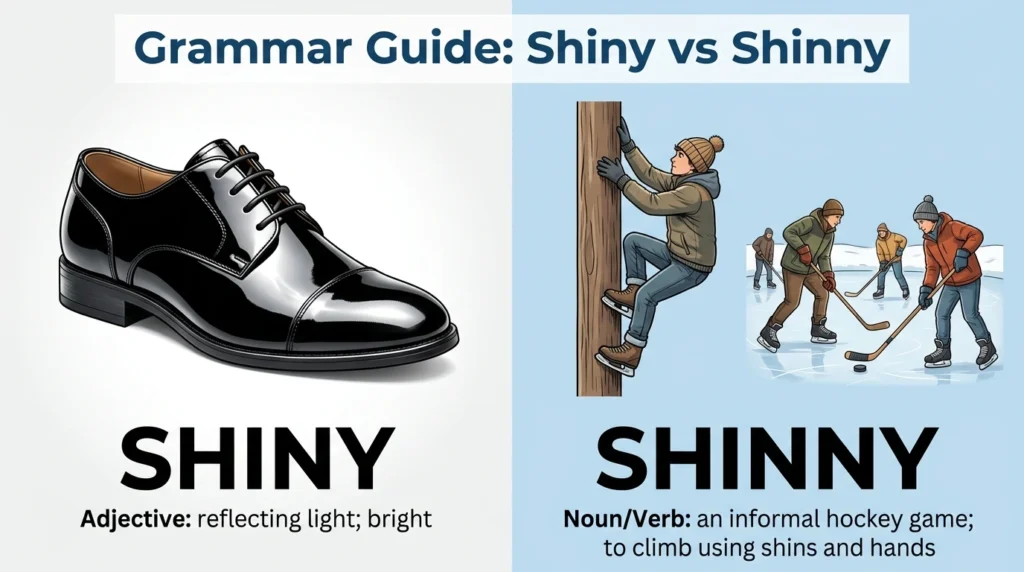

Shiny and shinny are both real English words, but they have completely different meanings. Shiny is an adjective describing something bright, smooth, polished, or reflective. Shinny is a much less common noun or verb connected with informal hockey or climbing with the arms and legs. If you mean something that reflects light, shiny is the correct word.
The easiest distinction is:
- Shiny = something that shines
- Shinny = hockey or climbing
- Shiney = normally a misspelling of shiny
What Is the Difference Between Shinny and Shiny?
The difference between shinny and shiny is primarily one of meaning and grammatical function.
Shiny is an adjective, which means it describes a person, object, surface, or appearance. A polished car, glossy hair, metal surface, or clean floor may look shiny.
Shinny can function as a verb meaning to climb by gripping something with the arms and legs. It can also function as a noun for an informal form of hockey, particularly in North American and Canadian usage.
That means writing “shinny car” when you mean a polished car is not simply choosing an alternative spelling. You are using a different word with the wrong meaning.
Why the Difference Matters
A one-letter spelling difference can completely change what your sentence communicates.
Imagine a product description saying:
Our new watch has a smooth, shinny finish.
The intended meaning is obvious, but shinny does not mean reflective or polished. The correct wording is shiny finish.
Small errors like this matter in:
- Professional emails and reports
- School assignments and exams
- Product descriptions
- Marketing content
- Social media captions
- Academic writing
- Job applications
Readers may still understand your meaning, but repeated spelling mistakes can make otherwise strong writing look less careful.
The Core Rule
Use “shiny” when you mean bright, glossy, polished, or reflective. Use “shinny” only when you mean informal hockey or the action of climbing by gripping with your arms and legs.
Think about the meaning before checking the spelling.
Something shines → shiny.
Someone climbs or plays informal hockey → shinny.
Read More: Convertor vs Converter: Which Spelling Is Correct?
How to Use Shiny
Shiny is an adjective. Its most common meaning describes a surface that appears bright because it reflects light. Standard dictionaries record pronunciations around /ˈʃaɪni/, approximately “SHY-nee.”
Examples include:
- shiny shoes
- shiny hair
- shiny metal
- shiny jewelry
- shiny paint
- shiny floors
- shiny fabric
- shiny glass
Shiny Before a Noun
You can place shiny directly before the noun it describes.
Example: She bought a shiny silver bracelet.
Here, shiny describes the bracelet.
Shiny After a Linking Verb
You can also use shiny after verbs such as look, become, seem, or appear.
Example: The floor looks shiny after polishing.
Comparative and Superlative Forms
The comparative form is shinier and the superlative is shiniest.
Examples:
- This table is shinier than the old one.
- That was the shiniest car at the exhibition.
Notice that these forms contain one n, not two.
How to Use Shinny
Unlike shiny, shinny normally does not describe appearance.
Shinny as a Verb
As a verb, shinny means to climb up, down, or along something while gripping it with the arms and legs. The pronunciation is /ˈʃɪni/, roughly “SHIN-ee.”
Example: The boy shinnied up the pole to retrieve the kite.
Its main verb forms are:
| Form | Word |
|---|---|
| Base form | shinny |
| Third-person singular | shinnies |
| Past tense | shinnied |
| Past participle | shinnied |
| Present participle | shinnying |
Shinny as a Noun
Shinny can also refer to informal or pickup hockey, often played outdoors. This use is particularly associated with Canadian and North American English.
Example: The children played shinny at the outdoor rink after school.
This meaning is much less common internationally than the everyday adjective shiny.
Correct Examples of Shinny and Shiny
Here are original examples from different types of English.
Everyday Conversation
- Your new phone case looks really shiny.
- The children played shinny at the rink after lunch.
- The replacement panels have a shiny finish rather than a matte one.
School
- The student described the beetle as having a shiny black shell.
- In the story, the character shinnied up the tree to escape the dog.
Workplace
- Please avoid using shiny paper because the overhead lights create glare.
Social Media
- That freshly polished motorcycle looks incredibly shiny in the sunlight.
Academic Writing
- The sample developed a shiny surface after repeated polishing.
Shopping
- I prefer the matte handbag because the shiny version shows fingerprints easily.
Sports
- Several neighbors met at the frozen rink for an informal game of shinny.
Incorrect vs. Correct Examples
| ❌ Incorrect | ✅ Correct | Why |
|---|---|---|
| Her shoes were shinny after polishing. | Her shoes were shiny after polishing. | The sentence describes reflected light, so the adjective shiny is required. |
| The new car looks shinny. | The new car looks shiny. | Shinny does not mean polished or reflective. |
| He wore a shinny jacket. | He wore a shiny jacket. | The jacket’s appearance is being described. |
| The floor became shinny after cleaning. | The floor became shiny after cleaning. | A reflective surface is shiny. |
| Her hair looked shinny in the photo. | Her hair looked shiny in the photo. | Hair that reflects light can be described as shiny. |
| They played shiny on the frozen pond. | They played shinny on the frozen pond. | Informal hockey can be called shinny. |
| He shinied up the pole. | He shinnied up the pole. | The past tense of the climbing verb shinny is shinnied. |
| The polished metal was shiney. | The polished metal was shiny. | Standard spelling removes the final e from shine in shiny. |
| This necklace is more shinny than mine. | This necklace is shinier than mine. | The comparative form of shiny is shinier. |
| That is the shinniest trophy here. | That is the shiniest trophy here. | Shiniest comes from shiny, so it keeps only one n. |
Why People Confuse Shinny and Shiny
Several factors cause the shinny vs shiny spelling mistake.
Visual Similarity
The words differ by only one additional n:
shiny
shinny
When someone reads or types quickly, that small difference is easy to overlook.
Pronunciation Confusion
The pronunciations are actually different:
- shiny: /ˈʃaɪni/ — “SHY-nee”
- shinny: /ˈʃɪni/ — “SHIN-ee”
However, learners who have difficulty distinguishing these vowel sounds may still confuse them.
Spelling by Analogy
Writers sometimes associate the word with shin and accidentally double the n.
That creates:
shin + ny → shinny
when the intended word actually comes from shine.
Confusion About Shine + Y
Because the base word is shine, some learners expect the adjective to be spelled shiney.
Standard spelling is:
shine → shiny
not:
shine → shiney
The final e disappears in this particular adjective formation.
Autocomplete and Spellcheck Limits
Spellcheck may fail to flag shinny because it is a legitimate English word.
That is an important difference from a simple typo. Software can recognize the spelling without understanding that you intended to describe a polished surface.
Translation Interference
Some languages use one adjective for ideas such as bright, polished, glowing, glossy, or reflective. An English learner translating directly may therefore focus on pronunciation rather than the exact English spelling.
The safest solution is to connect shiny directly with the verb shine.
Common Mistakes Checklist
Before using either word, check these common errors:
- Using shinny for a reflective object: If the object catches or reflects light, use shiny.
- Writing shiney: The standard spelling is shiny, despite the base word shine.
- Assuming shinny is always a typo: It is a genuine word when talking about climbing or informal hockey.
- Pronouncing both words identically: Shiny begins like shy, while shinny begins like shin.
- Writing shinnier or shinniest: The correct comparison forms are shinier and shiniest.
- Writing shinied for the climbing verb: The correct past form of shinny is shinnied.
- Trusting spellcheck without checking meaning: Both shiny and shinny can pass a spelling checker because both exist.
Shinny vs Shiny in Real English
Grammatically Correct English
A sentence such as “The countertop is shiny” is grammatically correct because shiny functions as an adjective describing the countertop. Likewise, “He shinnied up the pole” is grammatically correct because shinnied is the past-tense form of the verb shinny. The words are therefore both legitimate, but they belong in very different semantic contexts.
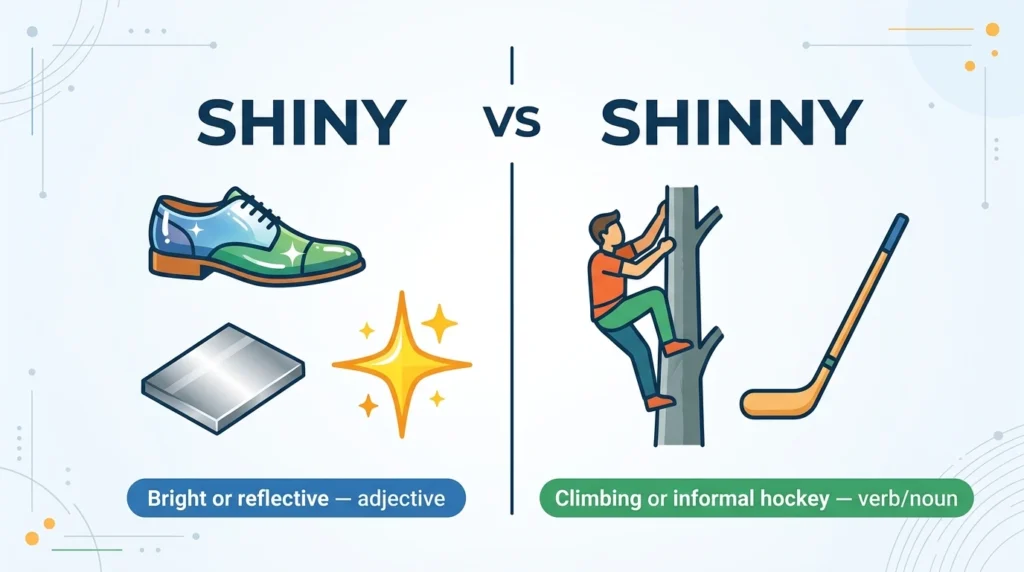
Grammatically Possible but Unnatural English
A phrase can be grammatically structured yet sound unusual because the vocabulary does not fit the situation naturally. For example, using the climbing verb shinny in highly formal technical instructions would usually sound unnecessarily informal or regional. A writer would normally choose climb, ascend, or a more precise movement verb instead, depending on what actually happened.
Natural Everyday English
In everyday English, shiny is by far the word most people are likely to need. People naturally talk about shiny hair, shiny shoes, shiny cars, shiny metal, and shiny surfaces. Shinny appears in much narrower situations. A speaker familiar with Canadian hockey vocabulary may naturally say play shinny, while someone describing a physical climb may use shinny up a pole.
American vs. British English
There is no meaningful American-versus-British spelling difference for shiny. Both varieties use shiny for something bright or reflective.
There is, however, a usage difference involving shinny.
The climbing verb shinny is especially associated with North American English. British English can use shin instead, as in “shin up a tree.”
The hockey meaning of shinny is particularly associated with Canadian and North American usage.
| Meaning | American/Canadian English | British English |
|---|---|---|
| Bright or reflective | shiny | shiny |
| Climb using arms and legs | shinny / shin | often shin |
| Informal hockey | shinny, especially Canadian usage | uncommon term |
Formal vs. Informal Usage
Shiny works in both formal and informal English when it accurately describes a surface or appearance.
Formal:
The coating produced a smooth, shiny surface.
Informal:
Your new shoes are so shiny!
The climbing meaning of shinny tends to sound more informal and conversational.
Informal:
He shinnied up the tree.
In formal writing, climbed, scaled, or another precise verb may fit better.
The hockey noun shinny is naturally informal because it refers to informal or pickup hockey.
Shinny vs Shiny Comparison Table
| Feature | Shiny | Shinny |
|---|---|---|
| Correct English word? | Yes | Yes |
| Pronunciation | SHY-nee | SHIN-ee |
| Main part of speech | Adjective | Noun or verb |
| Main meaning | Bright, glossy, reflective | Informal hockey or climbing |
| Related idea | Shine | Shin / climbing / hockey |
| Common in everyday English? | Very common | Much less common |
| Describes polished shoes? | Yes | No |
| Describes reflective metal? | Yes | No |
| Can describe hockey? | No | Yes |
| Can describe climbing? | No | Yes |
| Comparative form | shinier | Not applicable in the same sense |
| Superlative form | shiniest | Not applicable in the same sense |
Shiny, Glossy, Bright, and Reflective: Are They the Same?
These words overlap, but they are not perfect synonyms.
| Word | Main Idea | Example |
|---|---|---|
| Shiny | Reflects noticeable light | shiny shoes |
| Glossy | Smooth with a polished or coated sheen | glossy magazine cover |
| Bright | Produces or contains much light or vividness | bright room |
| Reflective | Sends light or an image back | reflective safety strip |
| Polished | Made smooth or glossy through treatment | polished silver |
Something can be shiny without being glossy in every technical sense. Likewise, something bright is not necessarily shiny.
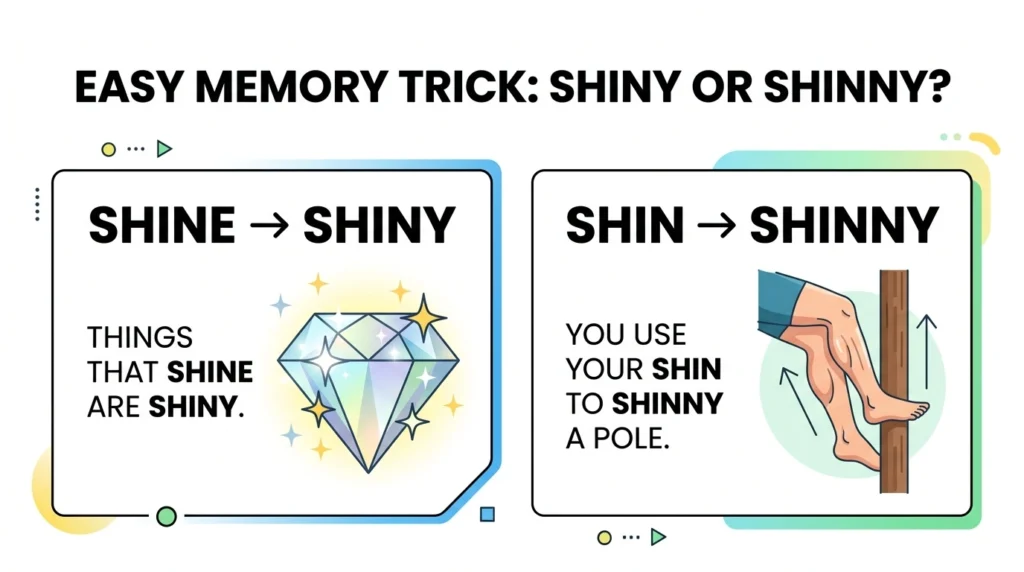
Memory Trick
Remember this sentence:
If it can SHINE, spell it SHINY. If you’re using your SHINS to climb, think SHINNY.
The spelling connection is simple:
SHINE → SHINY
SHIN → SHINNY
The first relates to appearance. The second helps remind you of climbing.
Real-Life Situations
Job Interview
You describe your appearance afterward:
Correct: “I wore polished, shiny black shoes.”
Using shinny would be incorrect because you are describing how the shoes looked.
Workplace Meeting
Your team is choosing packaging.
Correct: “The shiny finish creates too much glare under the lights.”
Here, shiny describes the reflective finish.
Professional Email
You write:
Correct: “Could we replace the shiny laminate with a matte finish?”
This is natural and professional.
Text Message
Your friend sends a picture of a newly cleaned car.
Natural reply: “That car looks so shiny now!”
Exam
The sentence says:
“The child _____ up the pole.”
If the choices include shiny and shinnied, the correct answer is shinnied because the sentence describes climbing.
Expert Tips
Check Meaning Before Spelling
Do not ask only, “Which spelling looks right?”
Ask:
Am I describing reflected light, hockey, or climbing?
Meaning immediately solves most cases.
Connect Shiny to Shine
The word shiny belongs to the same word family as shine.
- shine
- shiny
- shinier
- shiniest
- shininess
Seeing these words as a family makes the single n easier to remember.
Do Not Let Spellcheck Make the Decision
If you type:
The car looks shinny.
a spellchecker may recognize shinny as a valid word and leave it untouched.
Grammar and spelling software helps, but meaning still matters.
Learn the Pronunciations Separately
Say them clearly:
SHY-nee → shiny
SHIN-ee → shinny
Pronunciation reinforces the spelling difference.
Treat Shinny as a Separate Vocabulary Word
Do not learn shinny as a “wrong version” of shiny.
Learn it separately:
shinny = climb / informal hockey
That prevents you from incorrectly assuming it is always a typo.
Read More: Cheer vs Chear: Which Spelling Is Correct?
Frequently Asked Questions
Is shinny a real word?
Yes. Shinny is a legitimate English word. It can describe climbing with the arms and legs, and it can refer to informal hockey. It is not simply an alternative spelling of shiny.
Is shinny another spelling of shiny?
No. They are separate words with different meanings.
Use shiny for reflective or polished surfaces. Use shinny for its climbing or hockey meanings.
Is it shiny or shiney?
The standard spelling is shiny.
Shiney is generally a spelling error when you mean the adjective derived from shine.
Why does shiny have only one n?
Because shiny comes from shine, not shin.
The spelling develops as:
shine → shiny
Adding another n creates the separate word shinny.
How do you pronounce shiny?
Shiny is pronounced approximately “SHY-nee”, /ˈʃaɪni/.
How do you pronounce shinny?
Shinny is pronounced approximately “SHIN-ee”, /ˈʃɪni/.
What does shinny mean in hockey?
Shinny can refer to an informal form of hockey or pickup hockey, often associated with outdoor play and Canadian usage.
What does shinny mean when climbing?
As a verb, shinny means to move up, down, or along something while gripping it with your arms and legs.
For example:
He shinnied up the pole.
What is the past tense of shinny?
The past tense is shinnied.
Correct: She shinnied down the rope.
The -ing form is shinnying.
What are the comparative forms of shiny?
The comparative form is shinier, and the superlative form is shiniest.
Example:
This countertop is shinier than that one.
Example:
That is the shiniest trophy in the cabinet.
Can shiny describe a person?
Yes, but usually it describes a person’s physical appearance rather than their personality.
For example:
His forehead looked shiny under the studio lights.
Calling an entire person “shiny” without context may sound unusual.
Can shiny be used figuratively?
Yes. Expressions such as “shiny new technology” can emphasize that something is new, attractive, or exciting rather than literally polished enough to reflect light. This use is established in modern English.
Mini Quiz: Shinny vs Shiny
| # | Question | Answer | Explanation |
|---|---|---|---|
| 1 | Choose the correct word: “The freshly polished car looked ___.” A) shinny B) shiny | B) shiny | The sentence describes a reflective appearance. |
| 2 | Fill in the blank: “The children played ___ at the outdoor rink.” | shinny | Informal hockey can be called shinny. |
| 3 | Correct the sentence: “Her new boots are very shinny.” | Her new boots are very shiny. | Boots that reflect light are shiny. |
| 4 | Choose the correct pronunciation for shiny: A) SHY-nee B) SHIN-ee | A) SHY-nee | Shiny contains the vowel sound heard in shy. |
| 5 | Fill in the blank: “He ___ up the pole to reach the flag.” | shinnied | Shinnied is the past tense of the climbing verb shinny. |
| 6 | Which spelling is standard? A) shiney B) shiny | B) shiny | The adjective is spelled shiny. |
| 7 | Correct the sentence: “This table is shinnier than the other one.” | This table is shinier than the other one. | The comparative of shiny is shinier. |
| 8 | Choose the correct word: “The scientist observed a smooth, ___ coating.” A) shiny B) shinny | A) shiny | The coating’s appearance is being described. |
| 9 | True or false: “Shinny is always a spelling mistake.” | False | Shinny is a real noun and verb with hockey and climbing meanings. |
| 10 | Fill in the blank: “Of the three trophies, the gold one was the ___.” | shiniest | Shiniest is the superlative form of shiny. |
Quick Summary
Shiny and shinny are both real English words, but they are not interchangeable. Shiny is the common adjective meaning bright, polished, glossy, or reflective, as in shiny shoes or a shiny surface. Shinny is much less common. As a verb, it can mean climbing something while gripping it with the arms and legs. As a noun, particularly in Canadian and North American usage, it can refer to informal hockey. Their pronunciations also differ: shiny sounds like “SHY-nee,” while shinny sounds like “SHIN-ee.” Remember: if something can shine, describe it as shiny. If the context involves climbing or informal hockey, shinny may be the word you need.