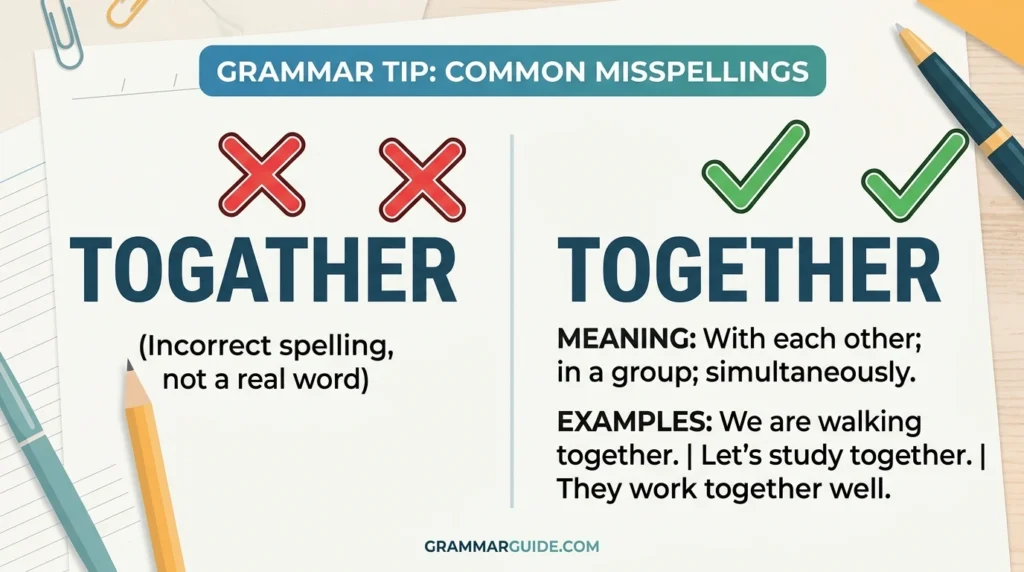

Together is the correct spelling in modern standard English. “Togather” should not be used when you mean “with each other,” “in one place,” “combined,” or “jointly.” Write “We worked together,” not “We worked togather.” However, to gather is correct as two separate words when gather is a verb, as in “We plan to gather outside.”
What Does “Together” Mean?
Together usually means that people or things are with each other, combined, connected, cooperating, or acting at the same time.
It is most commonly an adverb, which means it describes how an action happens.
For example:
The students worked together on the presentation.
Here, together explains how the students worked: they worked with one another rather than separately.
The word can express several closely related ideas:
- being with another person
- being in the same place
- joining separate things
- cooperating on an activity
- forming one whole
- being in a relationship
- happening at the same time
You may also hear together used informally as an adjective to describe someone who seems organized, confident, calm, or in control.
Why the Correct Spelling Matters
Writing togather instead of together may look like a small spelling error, but it can affect how readers judge your writing.
The mistake is especially noticeable in:
- job applications
- professional emails
- school assignments
- examinations
- reports
- business proposals
- academic writing
- published website content
A typo in a casual text may not cause much trouble. The same error in a résumé, client email, essay, or professional article can make the writing appear less carefully edited.
Correct spelling also prevents confusion with to gather, which is a completely valid but grammatically different expression.
The Core Rule
RULE: Use “together” as one word when you mean jointly, with each other, combined, connected, or in the same place. Use “to gather” as two words when “gather” is the verb. Do not replace “together” with “togather.”
Compare:
✅ We worked together.
✅ We decided to gather after class.
❌ We worked togather.
The difference becomes easy once you stop treating together and to gather as versions of the same expression.
How to Use “Together”
1. When People Do Something Jointly
Use together when two or more people take part in the same activity.
Example:
Maya and Luis prepared the report together.
The sentence means they both participated in preparing it.
2. When People Are in the Same Place
Together can describe people spending time in one another’s company.
Example:
Our family rarely gets to eat together during the week.
3. When Things Are Joined or Combined
You can use together when separate objects or ideas become connected.
Example:
Glue the two pieces together.
The word shows that two separate pieces become one connected unit.
4. When People Cooperate
Together frequently appears when people combine their efforts.
Example:
If we work together, we can finish before Friday.
5. When Events Happen at the Same Time
The word can also describe actions happening simultaneously.
Example:
The audience stood and applauded together.
6. When Talking About Relationships
Together can describe people who are in a romantic relationship.
Example:
They have been together for three years.
7. In Expressions Such as “Get Together”
Get together commonly means to meet socially or arrange to spend time with someone.
Example:
We should get together for coffee next week.
When used as a noun before another noun or by itself, get-together is normally hyphenated.
Example:
We are planning a family get-together.
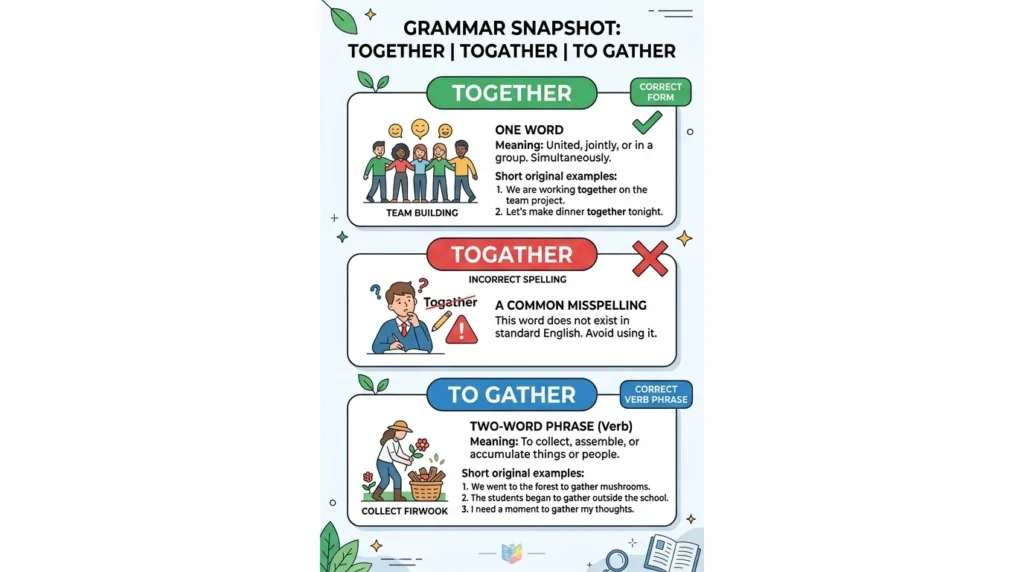
“Together” vs “To Gather”
This distinction explains much of the confusion around togather vs together.
Together is one word.
To gather is a two-word verb phrase consisting of the infinitive marker to plus the verb gather.
Gather can mean to collect things or to bring people into one place.
Compare:
Together:
We studied together after class.
To gather:
We asked everyone to gather after class.
The first sentence describes how people studied. The second describes the action of assembling.
Never remove the space from to gather to create togather in ordinary modern writing.
Correct Examples of “Together”
The following examples show how together works across different situations.
| Context | Correct Example |
|---|---|
| Conversation | We can walk home together after dinner. |
| Text message | Are we still studying together tonight? |
| I have attached the documents together with the revised schedule. | |
| Workplace | The design and engineering teams worked together on the prototype. |
| Meeting | We need to bring these ideas together before making a decision. |
| School | The students read the instructions together before starting. |
| Academic writing | Taken together, the findings suggest a consistent pattern. |
| Social media | Nothing beats spending the weekend together with good friends. |
| Family | We try to have breakfast together every Sunday. |
| Project work | The two departments came together to solve the problem. |
| Relationship | Noah and Emma have been together since college. |
| Practical instruction | Hold the edges together while the glue dries. |
Notice that together does not always mean physically standing beside someone. It can also describe cooperation, relationships, combination, agreement, or ideas considered as one whole.
Incorrect vs Correct: Togather or Together
| ❌ Incorrect | ✅ Correct | Why |
| We should work togather. | We should work together. | Together is the standard word meaning jointly. |
| They traveled togather. | They traveled together. | The sentence describes two people traveling with each other. |
| Let us study togather tonight. | Let us study together tonight. | The intended meaning is doing the activity jointly. |
| Please keep these papers togather. | Please keep these papers together. | The papers are being kept as one group. |
| Our families celebrated togather. | Our families celebrated together. | The families participated in the celebration with one another. |
| We need to pull everything togather. | We need to pull everything together. | Pull together is the correct expression. |
| The pieces fit togather perfectly. | The pieces fit together perfectly. | The pieces connect to form a whole. |
| They have been togather for years. | They have been together for years. | Together can describe a romantic relationship. |
| The students answered togather. | The students answered together. | The actions happened jointly or at the same time. |
| Can we put our ideas togather? | Can we put our ideas together? | Put together means combine or organize separate things. |
Why People Write “Togather” Instead of “Together”
The error is understandable because several features of English can push writers toward the wrong spelling.
Phonetic Similarity
People often learn words by hearing them before seeing them written.
In normal speech, unstressed vowels can sound less distinct than they appear on the page. A learner who knows the verb gather may therefore interpret the middle of together as if it contained the same spelling.
Read More: Cheer vs Chear: Which Spelling Is Correct?
Spelling Overlap With “Gather”
The words together and gather are related historically and their meanings can overlap.
People gather at a location and once they arrive, they are together.
That semantic connection makes the incorrect spelling togather feel surprisingly logical.
Modern spelling, however, does not follow that logic.
Confusion With “To Gather”
English already contains the correct phrase to gather.
For example:
We plan to gather outside the theater.
Someone writing quickly may remove the space and accidentally produce togather.
The meanings may seem connected but the grammatical structures are different.
Overgeneralization
Learners naturally look for recognizable patterns.
If someone knows gather, they may assume that adding to produces togather. However, together is an established independent word. You cannot determine its modern spelling simply by combining to and gather.
Autocomplete and Spellcheck Limitations
Spellcheckers catch many errors but they should not replace proofreading.
A spelling tool may overlook an unusual form under certain settings, names, custom dictionaries, or specialized software. Predictive keyboards can also learn repeated misspellings.
Always confirm uncertain words rather than assuming an unmarked word is correct.
Translation Interference
Some languages express the idea of people being together using structures that closely resemble verbs meaning join, collect, or gather.
A learner may transfer that pattern into English and produce togather. Remembering that together is a fixed English spelling prevents this transfer error.
Common Mistakes Checklist
Before submitting important writing, check for these problems:
- Writing “togather” for “together”: This is the main error. Replace it with together when you mean jointly or with each other.
- Removing the space from “to gather”: Keep the words separate when gather is functioning as a verb.
- Writing “togeather”: The extra a often appears because writers connect the spelling with gather. Standard spelling is together.
- Writing “togther”: This version drops the first e. Slow down and remember the three-part visual pattern: to-geth-er.
- Writing “togeter”: Do not drop the h. The correct spelling contains geth.
- Confusing “together” and “altogether”: Together usually involves connection or joint action. Altogether often means completely or in total.
- Confusing “get together” and “get-together”: Get together is normally a verb expression. Get-together is a noun.
- Using the informal adjective everywhere: Describing someone as “very together” is possible but informal. Choose a more precise adjective in formal documents.
“Together” in Real English
Grammatically Correct
Together naturally follows verbs such as work, live, stay, travel, study, come, bring, and put. Sentences such as “We worked together,” “They live together,” and “Put the pieces together” are standard English. The exact meaning changes with context but the central idea remains connection, combination, cooperation, or shared participation.
Grammatically Possible but Unnatural
Some sentences can contain together without technically breaking a basic grammar rule yet still sound unnecessarily heavy. For example, “We jointly worked together on the task” repeats nearly the same idea twice. In normal English, “We worked together on the task” is cleaner. Good writing depends on natural word choice as well as grammatical possibility.
Natural Everyday English
Native and fluent speakers use together constantly in simple expressions such as “Let’s go together,” “We should work together,” “Are they still together?” and “Put these together.” You usually do not need a more complicated alternative. In everyday English, placing together after the main verb or object often produces the most natural sentence.
Formal vs Informal Usage
As an adverb, together is neutral and works comfortably in both formal and informal writing.
Formal:
Taken together, the available evidence supports the conclusion.
Informal:
Let’s go together.
A more register-sensitive use appears when together functions as an adjective meaning organized, confident, emotionally composed, or in control.
Informal:
She seems really together.
That sentence is natural in conversation. In a formal report, words such as organized, composed, capable, or self-assured may communicate the intended meaning more precisely.
Togather vs Together Comparison Table
| Feature | Together | Togather | To Gather |
| Standard modern spelling? | Yes | No for the intended modern usage | Yes |
| Written as | One word | One word | Two words |
| Main grammar role | Usually adverb | Misspelling in ordinary modern English | Infinitive verb phrase |
| Basic idea | Jointly, connected, combined | No standard modern meaning as this spelling | To collect or assemble |
| Example | We worked together. | We worked togather. ❌ | We need to gather. |
| Suitable for professional writing? | Yes | No | Yes |
| Suitable for academic writing? | Yes | No | Yes |
| Common source of confusion | Resembles “to gather” | Looks similar to “gather” | May be wrongly joined into one word |
The Easiest Memory Trick
Use this original reminder:
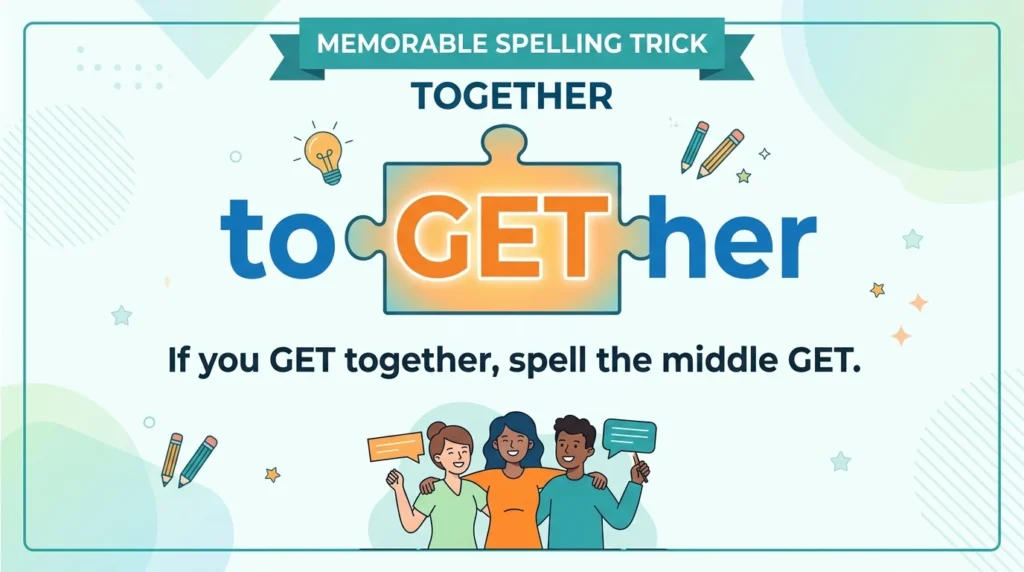
If you GET together, spell the middle GET.
Break the word visually into:
TO + GETH + ER
The important part is the e after the g.
Think:
We GET together → toGETHer
You can even highlight the letters when practicing:
together
Avoid using gather as your spelling model. Although the words are related in meaning, their modern spellings are different.
Real-Life Situations
Job Interview
You want to explain teamwork.
Say:
My previous team worked together to improve customer response times.
Do not write worked togather in your résumé or application.
Business Meeting
A manager wants several departments to cooperate.
Natural wording:
We need to work together before the product launch.
The word emphasizes joint effort.
Professional Email
You are combining information from several people.
Write:
I have brought the comments together in one document.
This means the comments have been collected and organized into a unified document.
Text Message
You want to arrange a social meeting.
Write:
We should get together this weekend.
Here, get together means meet socially.
Exam
The question asks you to complete this sentence:
The students solved the problem _____.
The correct answer is together, not togather.
Event Planning
Compare these two sentences:
We want everyone to gather in the main hall.
Once everyone arrives, we will be together in the main hall.
The first describes the action of assembling. The second describes the resulting situation.
Expert Tips
Learn the Whole Word Instead of Rebuilding It
Do not try to create together from to + gather whenever you write it.
Learn together as one fixed spelling.
This method is useful for many irregular or historically developed English spellings.
Use “To Gather” as a Grammar Test
If you are unsure which form you need, ask whether gather is actually the action.
If yes:
We need to gather more information.
If the sentence instead means jointly, combined, or with each other:
We collected the information together.
Watch for Common Related Spellings
Writers searching for togather vs together also commonly hesitate over forms such as:
- togeather
- togther
- togeter
- toghether
- togethr
The target spelling remains:
together
Check the Meaning Before Relying on Sound
English spelling cannot always be predicted accurately from pronunciation.
When a familiar word suddenly “looks wrong,” check its established spelling instead of rewriting it according to how it sounds.
Proofread High-Visibility Text Separately
Errors are easier to notice when you review titles, headings, résumé lines, email subject lines, and social media graphics separately from body text.
Misspellings in large or prominent text are especially noticeable.
Read More: Trauma vs Trama Difference: Which Spelling Is Correct?
FAQ
Is “togather” acceptable in casual texting?
If you mean together, togather is still a spelling error even in casual communication. Friends will probably understand you but the standard spelling remains together.
Can “to gather” ever be written as one word?
Not when you are using the normal English infinitive to gather.
Write:
We need to gather more evidence.
The space is required because to and gather perform separate grammatical functions.
What does “gather” mean?
Gather is a verb that commonly means to collect things or bring people into one place.
For example:
We gathered the documents.
A crowd gathered outside.
It is different from the adverb together.
Is “togeather” correct?
No. Togeather is another common misspelling of together.
The correct sequence is:
t-o-g-e-t-h-e-r
There is no a in the modern spelling.
Is “togther” correct?
No. Togther is missing an e.
Use together.
Breaking it visually into to-geth-er can help you remember the missing vowel.
Is “get together” one word or two?
The verb expression is written as two words:
We should get together soon.
When the expression functions as a noun, it is normally hyphenated:
We planned a family get-together.
What is the difference between “together” and “altogether”?
Together usually refers to people or things being connected, combined, or acting jointly.
We traveled together.
Altogether commonly means completely or in total.
The plan was altogether unrealistic.
The meanings are different even though the words look similar.
Can “together” describe a romantic relationship?
Yes.
They have been together for five years.
In this context, together means that the two people are in a romantic relationship.
Can “together” be an adjective?
Yes, although this use is informal.
Someone described as together may seem organized, confident, composed, or capable.
He seems very together for someone under so much pressure.
For formal writing, a more precise adjective is often preferable.
Does “together” always require another person?
No.
The word can connect objects, ideas, facts, or parts as well as people.
The screws hold the frame together.
Taken together, the results reveal a clear trend.
Is “together” a verb?
No. Together is primarily an adverb and it can also function informally as an adjective.
If you need a verb describing people assembling, gather may be appropriate.
The guests began to gather outside.
Why does “togather” look correct to some writers?
The spelling resembles the valid phrase to gather and the verb gather is closely associated with bringing people or things together. That connection makes togather visually believable even though together is the spelling required in modern standard English.
Mini Quiz
| # | Question | Answer | Explanation |
| 1 | Choose the correct spelling: We worked togather / together. | together | The sentence means the people worked jointly. |
| 2 | Fill in the blank: The family ate dinner _____. | together | They ate in one another’s company. |
| 3 | Correct this sentence: “We traveled togather last summer.” | We traveled together last summer. | Togather should be replaced with together. |
| 4 | Choose: We need together / to gather more information. | to gather | Gather is the action being performed. |
| 5 | Fill in the blank: Glue the two pieces _____. | together | The pieces are being joined. |
| 6 | Correct this sentence: “Let’s get togather after work.” | Let’s get together after work. | Get together is the standard verb expression meaning meet. |
| 7 | Choose: Everyone began to gather / together near the entrance. | to gather | The sentence needs a verb meaning assemble. |
| 8 | Fill in the blank: The departments worked _____ on the proposal. | together | The departments cooperated. |
| 9 | Correct this sentence: “They have been togeather for six years.” | They have been together for six years. | Togeather incorrectly adds an a. |
| 10 | Choose the noun form: We organized a get together / get-together. | get-together | As a noun meaning an informal meeting, the expression is normally hyphenated. |
Quick Summary
Together is the correct spelling in modern standard English when you mean with each other, jointly, connected, combined, or in the same place. Togather should not replace it. The confusion often occurs because together resembles the valid phrase to gather, which means to collect something or cause people to assemble. Remember the difference: “We work together,” but “We need to gather information.” Together is mainly an adverb although it can also function informally as an adjective meaning organized or composed. Common incorrect forms include togather, togeather, togther, and togeter. The easiest memory trick is to notice GET inside toGETHer: if people GET together, write together.