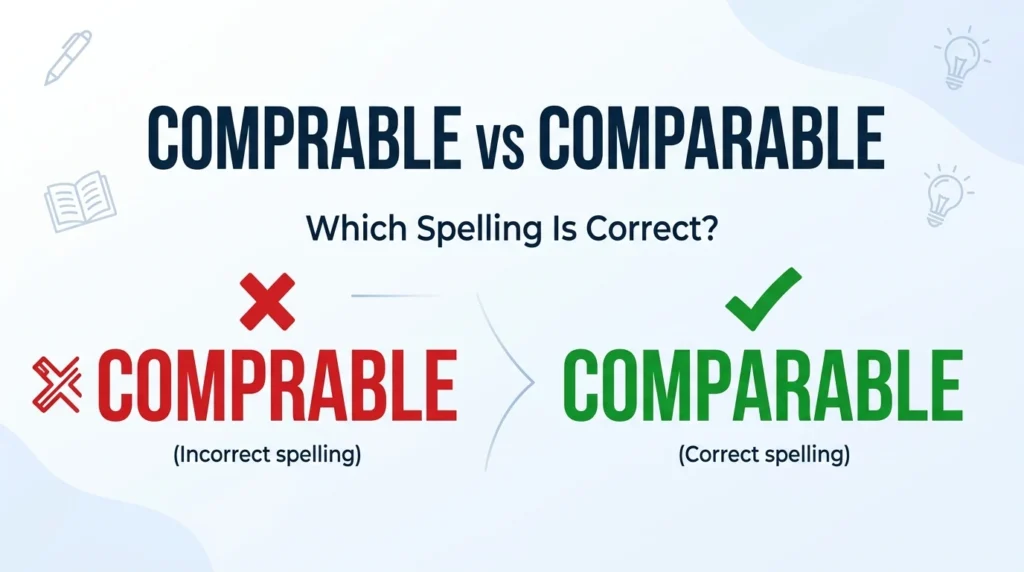

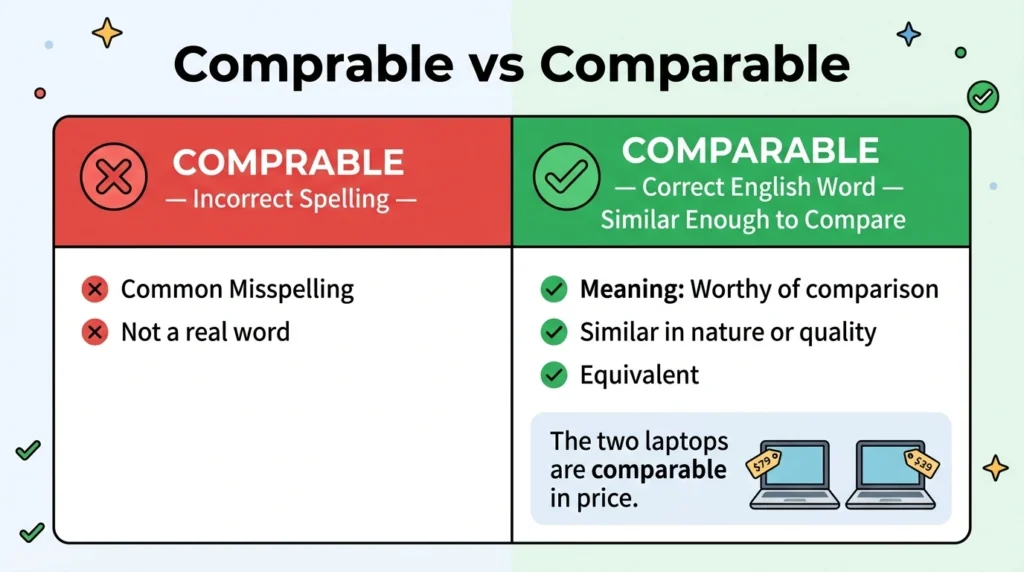
Comparable is the correct English spelling. Comprable is a common misspelling. Use comparable when two or more things are similar enough to compare or when they share a similar quality, amount, size, value, or condition.
For example:
✅ The two laptops are comparable in price.
❌ The two laptops are comprable in price.
The confusion is understandable because comparable is often pronounced with an unstressed middle vowel, making the word sound shorter than its spelling suggests. However, that pronunciation does not change the written form.
What Is Comparable?
Comparable is an adjective used when two things can reasonably be compared or when they are similar in some relevant way.
You might compare price, quality, size, performance, experience, value, results, or conditions.
For example:
The two apartments are comparable in size but very different in price.
Here, comparable does not mean the apartments are identical. It means they share enough relevant characteristics for a useful comparison.
The word commonly appears in patterns such as:
- comparable to another thing
- comparable with another thing
- comparable in size, value, quality, or another feature
- comparable results
- comparable prices
- comparable levels
- comparable performance
The central idea is meaningful comparison, not exact equality.
Why Does the Correct Spelling Matter?
Writing comprable instead of comparable usually will not prevent someone from understanding your meaning. However, it can make otherwise polished writing look careless.
That matters especially in:
- Job applications and résumés
- Business emails and reports
- Academic assignments
- Client proposals
- Professional social media posts
- Research papers
- Product comparisons
- Formal examinations
A reader may understand “These products offer comprable performance,” but the spelling error can distract from the point you are making.
The risk becomes greater in professional writing because comparable often appears in analytical sentences about prices, statistics, performance, salaries, property values, and research results.
The Core Rule
RULE: Always write COMPARABLE in standard English.
✅ comparable
❌ comprableThink of the word as compar + able: something that is able or suitable to be compared.
Do not remove the a after the p simply because the vowel may sound weak when people pronounce the word naturally.
Read More: Crier vs Cryer: The Correct Usage Explained
How to Use Comparable Correctly
Comparable can be used in several common sentence patterns.
Comparable To
Use comparable to when relating one thing to another that has a similar quality, level, value, or characteristic.
Her experience is comparable to that of a senior manager.
This phone’s camera is comparable to more expensive models.
Comparable With
Comparable with is also grammatically accepted.
This year’s figures are comparable with last year’s results.
In everyday English, many speakers naturally use comparable to. However, comparable with also appears in edited and professional English, particularly when discussing data or direct comparisons.
There is no need to force a strict rule that one construction is always correct and the other is always wrong.
Comparable In
Use comparable in + characteristic when you want to identify exactly what is similar.
The two houses are comparable in size.
The applicants are comparable in experience.
Both computers are comparable in performance.
This pattern is especially useful because it prevents vague comparisons.
Comparable + Noun
Comparable can also appear directly before a noun:
comparable prices
comparable results
comparable experience
comparable quality
comparable data
comparable conditions
This construction is common in business, academic, financial, and technical writing.
Comparable Meaning in Simple English
The easiest definition is:
Comparable means similar enough for a useful comparison.
It can also mean approximately similar in a particular feature.
Consider these examples:
The hotels charge comparable prices.
The prices are roughly similar.
The two studies produced comparable results.
The results are similar enough to discuss together.
We do not have comparable data from last year.
The available data cannot be matched fairly with the current information.
The exact meaning therefore depends slightly on context, but the idea of comparison or similarity remains central.
Correct Examples of Comparable
Here are original examples showing how comparable works across different situations.
- Conversation: The newer restaurant offers comparable food at a lower price.
- Email: We found another supplier offering comparable quality within our budget.
- School: The two novels explore comparable themes of ambition and responsibility.
- Workplace: Her previous role involved responsibilities comparable to those of this position.
- Social media: This budget microphone delivers sound quality comparable to several premium models.
- Academic writing: Researchers used comparable samples to reduce differences between the two groups.
- Business: The company wants compensation comparable to industry standards.
- Technology: Both processors deliver comparable performance during everyday tasks.
- Real estate: A comparable property nearby sold for $420,000 last month.
- Finance: Revenue remained at a level comparable to the previous quarter.
- Travel: The second hotel provides comparable amenities but is closer to the airport.
- Healthcare research: The researchers needed groups of comparable size before analyzing the results.
These examples show an important point: comparable does not require two things to be exactly the same.
Incorrect vs. Correct Examples
| ❌ Incorrect | ✅ Correct | Why |
|---|---|---|
| The prices are comprable. | The prices are comparable. | Comprable omits a required a. |
| We need a comprable product. | We need a comparable product. | The adjective is spelled comparable. |
| Her salary is comprable to mine. | Her salary is comparable to mine. | The intended meaning is similar in amount. |
| Their results were comprable. | Their results were comparable. | Pronunciation does not justify dropping a letter in writing. |
| Find a comprable apartment nearby. | Find a comparable apartment nearby. | A similar apartment is a comparable apartment. |
| These models have comprable features. | These models have comparable features. | Use the standard spelling before a noun. |
| His experience is comprable with yours. | His experience is comparable with yours. | Comparable with is valid, but comprable is not. |
| The teams are comprable in strength. | The teams are comparable in strength. | Comparable in identifies the feature being compared. |
| We received comprable offers. | We received comparable offers. | The offers are similar enough to compare. |
| No comprable data exists. | No comparable data exists. | Academic and technical writing requires the standard spelling. |
| Their service is compareable to ours. | Their service is comparable to ours. | The final e in compare is dropped before -able. |
| The devices are compairable. | The devices are comparable. | Compairable incorrectly reflects the sound of compare. |
Why Do People Write Comprable?
The mistake is more interesting than simply “someone forgot a letter.” Several features of spoken and written English make comprable look surprisingly believable.
Phonetic Similarity
The strongest reason is pronunciation.
In natural speech, unstressed vowels often become weak. Many speakers pronounce comparable in a way that sounds approximately like COM-pruh-bul rather than carefully pronouncing every written vowel.
As a result, someone spelling the word mainly from sound may not hear a clear a after the p.
They then write:
❌ comprable
instead of:
✅ comparable
The pronunciation may be acceptable while the phonetic spelling is not.
Read More: Shinny vs Shiny: What Is the Difference?
The Word Looks Longer Than It Sounds
English does not always provide a perfect one-letter-for-one-sound relationship.
Comparable contains ten letters but can be pronounced relatively compactly. That gap between sound and spelling encourages writers to remove letters they do not strongly hear.
Spelling Overlap With Compare
Writers know the related verb compare, but adding -able is not as visually straightforward as simply attaching the suffix.
It may be tempting to write:
❌ compareable
However, English uses:
✅ comparable
The final e in compare disappears.
Overgeneralization
Learners sometimes assume that every pronounced syllable must correspond clearly to a visible vowel or that weakly pronounced vowels can be removed.
English spelling does not work consistently that way.
The safe approach is to learn comparable as a complete written form rather than reconstructing it from pronunciation each time.
Autocomplete and Spellcheck Limits
Modern spellcheckers often catch comprable, but they are not perfect.
Autocomplete can also create false confidence. A tool may silently replace a misspelling, so the writer never notices which spelling was actually correct.
In other situations, specialized names, multilingual dictionaries, or disabled spellchecking may allow the error to remain.
Translation Interference
Multilingual writers sometimes spell unfamiliar English words according to their strongest audible sounds.
Because the unstressed vowel in comparable may be difficult to hear clearly, an English learner can reasonably produce comprable from speech alone.
The solution is not to pronounce every letter unnaturally. Instead, connect the spelling with the root compar-, which also appears in comparison and comparative.
Common Mistakes Checklist
Before submitting your writing, check these common errors.
- Writing “comprable.” This usually happens because the middle vowel is weak in speech. Remember that written English keeps the a: comparable.
- Writing “compareable.” The verb is compare, but the adjective is not formed by keeping the final e. Write comparable.
- Writing “comperable.” This version tries to reproduce a reduced pronunciation. Pronunciation and spelling do not always match exactly.
- Writing “compairable.” The verb compare may sound as though it contains pair, but its spelling does not.
- Assuming comparable means identical. Two things can be comparable while still having important differences.
- Making a vague comparison. “The products are comparable” may leave readers asking, “Comparable in what way?” Add the relevant feature when necessary.
- Confusing comparable with compatible. Comparable concerns comparison. Compatible usually concerns things that can work or exist together successfully.
- Using comparable when simpler wording is better. In casual conversation, similar may sometimes sound more natural.
Comprable vs Comparable in Real English
Grammatically and Orthographically Correct
Comparable is the standard form you should use in edited English. It works naturally in conversation, academic writing, reports, emails, journalism, business documents, and formal communication. Sentences such as “The two plans are comparable in cost” and “We need a comparable alternative” are both normal. The word functions as an adjective and can appear before a noun or after a linking verb such as be.
Possible but Unnatural or Unclear
A sentence can contain the correct spelling while still sounding weak or vague. For example, “These two things are comparable” is grammatical, but readers may wonder what feature makes them comparable. Price? Quality? Size? Performance? In analytical writing, “The two plans are comparable in cost” is usually stronger because the basis of comparison is explicit. Correct spelling alone does not guarantee precise communication.
Natural Everyday English
In everyday conversation, speakers often use similar where formal writing might use comparable. “The prices are pretty similar” may sound more relaxed than “The prices are comparable.” However, comparable remains completely natural when someone is evaluating alternatives: “Can you find something comparable?” or “The cheaper model has comparable performance.” The best choice depends on the situation rather than a strict formal-versus-informal rule.
Formal vs. Informal Usage
Comparable works in both formal and informal English, although its frequency and surrounding vocabulary may change.
Read More: Convertor vs Converter: Which Spelling Is Correct?
Formal English
Formal writing often uses comparable when the basis of comparison matters.
The two groups showed comparable levels of improvement.
Comparable data were unavailable for the previous reporting period.
Applicants should demonstrate experience comparable to the required standard.
The word is especially useful in analytical, financial, academic, legal, technical, and professional contexts.
Informal English
In casual speech, similar or about the same may sometimes sound simpler.
Formal:
The two phones offer comparable performance.
More conversational:
The two phones perform about the same.
Neither version is automatically better. Choose the wording that matches your audience.
Comprable vs Comparable Comparison Table
| Feature | Comprable | Comparable |
|---|---|---|
| Standard English word | No | Yes |
| Correct spelling | ❌ | ✅ |
| Part of speech | — | Adjective |
| Main meaning | — | Similar enough to compare |
| Can mean roughly similar | — | Yes |
| Suitable for professional writing | No | Yes |
| Suitable for academic writing | No | Yes |
| Used in “comparable to” | No | Yes |
| Used in “comparable with” | No | Yes |
| Used in “comparable in size” | No | Yes |
| Correct in American English | No | Yes |
| Correct in British English | No | Yes |
The comparison is simple: there are not two competing English words here. There is one standard spelling, comparable, and one common misspelling, comprable.
Comparable vs Similar
Comparable and similar overlap, but they are not perfect substitutes in every sentence.
Similar directly emphasizes resemblance.
The two designs look similar.
Comparable often emphasizes that a meaningful comparison can be made or that two things are approximately alike in a specific respect.
The two designs are comparable in cost and durability.
Something can therefore be described as comparable because it has enough shared characteristics for meaningful evaluation.
In everyday writing, similar is often the simpler choice. In analytical contexts, comparable can be more precise.
Comparable vs Compatible
These words look similar but express different ideas.
Comparable means suitable for comparison or similar in a relevant way.
The two laptops offer comparable performance.
Compatible means capable of working, operating, or existing together successfully.
This charger is compatible with my laptop.
Two products can be comparable without being compatible.
For example, two competing phone chargers may have comparable prices while only one is compatible with your device.
Comparable Pronunciation
One reason the spelling causes difficulty is that comparable has more than one accepted pronunciation.
You may hear versions resembling:
COM-pruh-bul
or
com-PAIR-uh-bul
Pronunciation varies between speakers, regions, and contexts.
The important spelling lesson is this:
Different accepted pronunciations do not create different spellings.
Whether you pronounce the middle of the word strongly or reduce it in ordinary speech, the written form remains comparable.
This is why spelling the word purely by sound can lead to comprable, comperable, or compareable.
Memory Trick
Use this simple mnemonic:
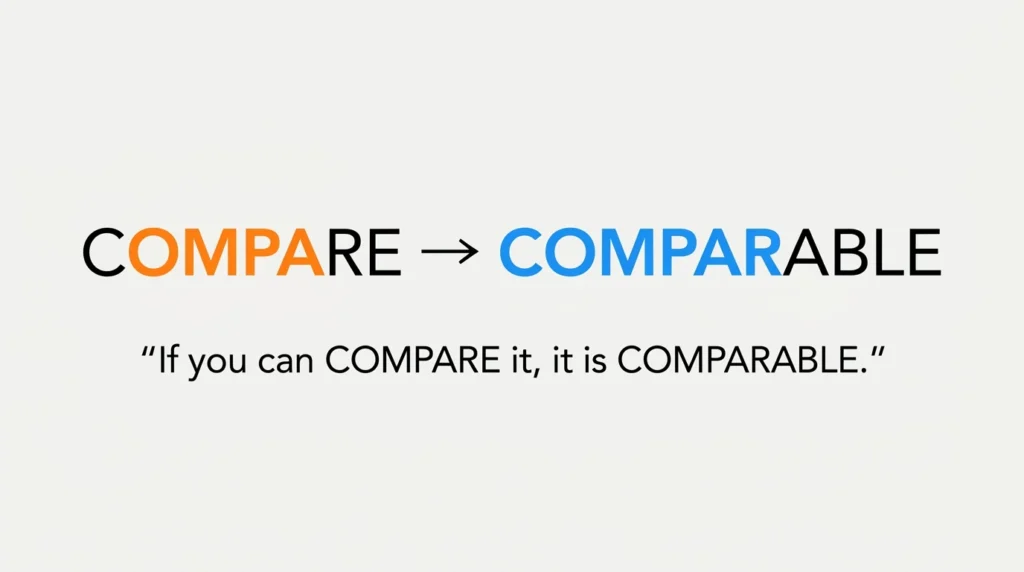
If you can COMPARE it, it is COMPARABLE.
Keep the sequence COMPAR together:
COMPARe
COMPARison
COMPARable
You can also break the word visually into:
COMPAR + ABLE
Something comparable is something able to be compared.
Do not memorize comparable as “compare + able” letter for letter because that may encourage the incorrect spelling compareable. Instead, remember the shared compar- root.
Real-Life Situations
Interview
An interviewer asks about your previous responsibilities.
You say:
My previous position involved responsibilities comparable to those described in this role.
This communicates that your experience is similar enough to be relevant.
Meeting
Your team is evaluating two software packages.
Both systems offer comparable features, but the second option costs less.
Here, comparable helps establish a fair comparison before identifying a difference.
You need an alternative supplier.
Could you find another vendor offering comparable quality at a lower price?
The sentence clearly requests a similar standard of quality.
Text Message
A friend asks whether a cheaper restaurant is just as good.
Yeah, the food is comparable and the prices are much better.
This is informal but natural.
Exam
The question asks you to compare two historical periods.
The two periods experienced comparable economic pressures but produced different political responses.
The word establishes similarity without claiming that the periods were identical.
Expert Tips for Using Comparable
Specify the Basis of Comparison
Instead of writing:
The products are comparable.
Write:
The products are comparable in price and battery life.
The second version provides useful information immediately.
Do Not Use Comparable as a Fancy Replacement for Similar Everywhere
Sometimes similar is clearer.
We bought similar shirts.
This is usually more natural than:
We bought comparable shirts.
Use comparable when an actual comparison, equivalence, or measurable similarity matters.
Watch the Word That Follows It
Common combinations include:
- comparable to
- comparable with
- comparable in size
- comparable in quality
- comparable in value
- comparable results
- comparable prices
- comparable data
- comparable performance
- comparable conditions
Learning these combinations is more useful than memorizing the word in isolation.
Be Careful With Data Comparisons
Two numbers are not automatically comparable just because they look similar.
If they were measured using different methods, populations, periods, or definitions, describing them as comparable may be misleading.
In analytical writing, comparable should communicate that the comparison is reasonably meaningful.
Remember That Similar Does Not Mean Equal
If two salaries are comparable, they may still differ.
If two products offer comparable quality, one can still be slightly better.
Avoid treating comparable as a mathematical statement of exact equality unless the context clearly supports that conclusion.
Frequently Asked Questions
Is Comprable a Real English Word?
Not as the standard English adjective people usually intend in this context. When you mean “similar enough to compare,” the correct written form is comparable.
Why Does Comparable Sometimes Sound Like Comprable?
Natural speech often reduces unstressed vowels. Because the middle vowel can be pronounced very lightly, listeners may hear a shortened form that encourages the spelling comprable. The standard written spelling remains comparable.
Is Compareable Correct?
No. Although comparable is related to the verb compare, you do not keep the final e when spelling the adjective.
Correct:
comparable
Incorrect:
compareable
Is Comperable Correct?
No. Comperable is another phonetic misspelling created when writers spell the word according to how a reduced pronunciation sounds.
Is Compairable Correct?
No. The sound in compare may remind writers of the word pair, but compairable is not the standard spelling. Use comparable.
Can Comparable Mean the Same?
It can mean roughly similar, but it does not normally mean perfectly identical.
The cars have comparable prices.
This suggests that their prices are similar enough for a useful comparison, not necessarily exactly equal.
Should I Say Comparable To or Comparable With?
Both constructions are accepted. Comparable to is extremely common when expressing similarity, while comparable with is also used when making direct comparisons, especially in professional or analytical contexts.
Can You Say Comparable In?
Yes. Comparable in is particularly useful when you name the feature being compared.
The houses are comparable in size.
Their qualifications are comparable in quality.
What Is the Opposite of Comparable?
Incomparable can mean impossible to compare, but it also commonly means exceptionally good or unequalled.
Depending on context, you might instead use phrases such as not comparable, dissimilar, or too different to compare when you simply mean that a fair comparison cannot be made.
Is Comparable Formal English?
It works in both formal and informal English. It is especially common in academic, business, financial, technical, and analytical writing because these contexts frequently involve structured comparisons.
Can People Be Comparable?
Yes, provided you explain or imply the relevant characteristic.
The candidates have comparable experience.
The two athletes are comparable in speed.
However, avoid reducing people to broad comparisons when the relevant quality is unclear.
Mini Quiz: Comprable vs Comparable
| # | Question | Answer | Explanation |
|---|---|---|---|
| 1 | Which is correct: comprable or comparable? | Comparable | Comparable is the standard English spelling. |
| 2 | Fill in the blank: The two apartments are ______ in size. | comparable | Comparable in is used to identify the feature being compared. |
| 3 | Correct the sentence: “Her experience is comprable to mine.” | Her experience is comparable to mine. | The missing a must be restored. |
| 4 | Which sentence is correct? A) These results are compareable. B) These results are comparable. | B | The adjective drops the final e found in compare. |
| 5 | Fill in the blank: We need a ______ replacement for the damaged machine. | comparable | A comparable replacement has sufficiently similar relevant qualities. |
| 6 | Correct the sentence: “The phones have compairable cameras.” | The phones have comparable cameras. | Compairable is an incorrect sound-based spelling. |
| 7 | True or false: If two prices are comparable, they must be exactly equal. | False | Comparable usually means similar enough for useful comparison, not identical. |
| 8 | Which sentence is more precise? A) The plans are comparable. B) The plans are comparable in cost. | B | Naming the feature makes the comparison clearer. |
| 9 | Fill in the blank: This charger is ______ with my phone. Comparable or compatible? | compatible | Compatible means capable of working together. |
| 10 | Correct the sentence: “Both studies produced comprable results.” | Both studies produced comparable results. | Comparable is the correct adjective describing similar results. |
Quick Summary
Comparable is the correct spelling, while comprable is a common misspelling. Comparable is an adjective used for things that are suitable for comparison or similar in a meaningful way. You can say two products are comparable in price, someone’s experience is comparable to another person’s, or two studies produced comparable results. The misspelling comprable often appears because natural pronunciation can weaken the middle vowel, making the written a difficult to hear. Other incorrect forms include compareable, comperable, and compairable. Remember the root compar- in compare, comparison, and comparable. For clear writing, specify the feature being compared whenever possible: “The two plans are comparable in cost” is more informative than simply saying “The plans are comparable.”