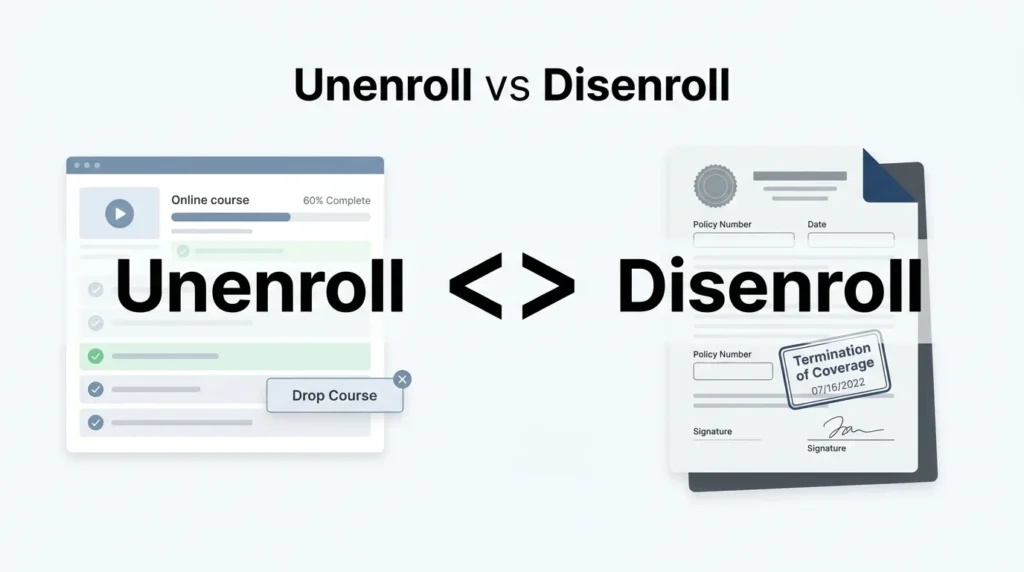

Unenroll and disenroll can both mean ending an enrollment. However, unenroll is especially common in online courses, learning platforms, and user-facing buttons. Disenroll sounds more formal and appears frequently in healthcare, insurance, government, and institutional administration. The difference is based mainly on context and house style—not a strict rule about who initiates the removal. nenroll and Disenroll?
Both words are formed from enroll, which means placing a person’s name on an official list for a course, program, organization, service, or plan.
The prefixes un- and dis- reverse or cancel that action. As a result, the meanings overlap considerably.
What Does Unenroll Mean?
Unenroll means to end an enrollment or remove someone from an enrolled status.
It is widely used in digital education, online training, classroom software, and course-management systems. A student may unenroll from a class, or a teacher or administrator may unenroll a student.
For example:
I unenrolled from the course because it conflicted with my work schedule.
Current learning platforms use the term for both self-service actions and administrative actions. Therefore, it should not be defined only as voluntarily removing yourself. Disenroll Mean?
Disenroll means to remove your own name or another person’s name from an official list, program, membership, or plan.
It is an established American English term and is especially common in formal administration, healthcare coverage, insurance plans, military organizations, and government programs.
For example:
The insurance provider disenrolled the member after confirming that she was no longer eligible.
It can function transitively, meaning it takes an object, as in “The academy disenrolled the student.” It can also describe a person leaving a plan, as in “You may disenroll during the permitted period.” fference Matters
Using the wrong term rarely makes a sentence impossible to understand. However, it can make your writing sound unfamiliar, imprecise, or inconsistent with the organization you are discussing.
The distinction matters in situations such as:
- Writing instructions for an online learning platform
- Explaining an insurance or healthcare plan
- Sending a formal university email
- Creating buttons and labels for an application
- Drafting enrollment policies
- Translating administrative documents
- Answering a vocabulary or grammar question
A course platform may use Unenroll as its official button label. An insurance provider may use Disenrollment Request on its forms. Replacing the official term can confuse users even when your alternative is grammatically understandable.
The Core Rule
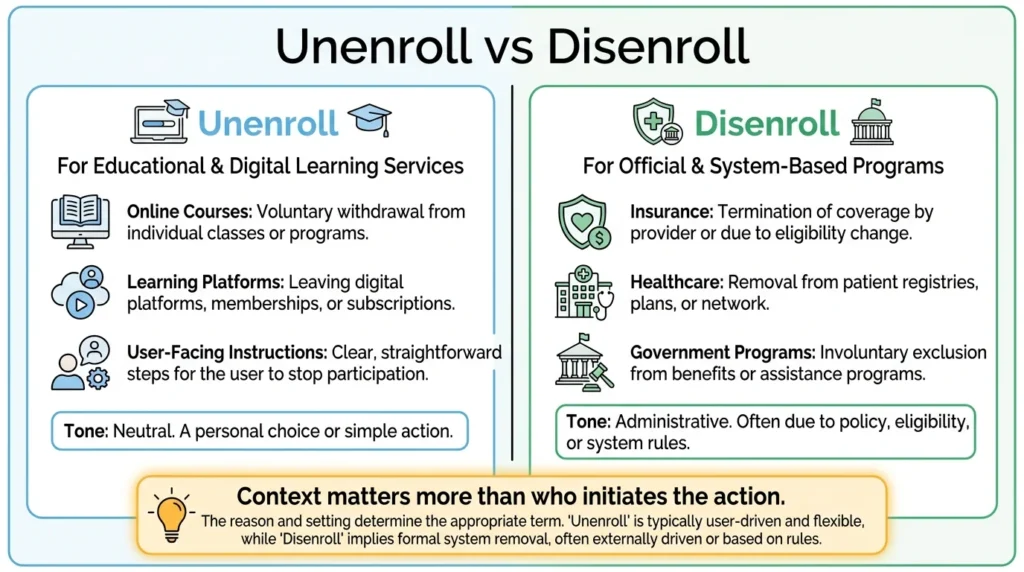
Use the terminology of the institution, platform, or policy you are discussing. Without an official term, use unenroll for user-facing education and digital-course contexts and disenroll for formal American administrative, healthcare, insurance, or government contexts.
Do not rely on the oversimplified rule that unenroll always means leaving voluntarily and disenroll always means being removed by an authority.
That pattern can be a useful memory aid, but real organizations use both verbs more flexibly. A learner may disenroll from a plan, while an administrator may unenroll a student. ose Between Unenroll and Disenroll
Follow this order when deciding which word to use:
- Check the organization’s official wording. Match the term shown in its forms, policy documents, website, or software interface.
- Identify the context. Online education often favors unenroll, while insurance and government administration commonly use disenroll.
- Consider your audience. A general reader may understand leave, remove, withdraw, or cancel more quickly.
- Check the English variant. British institutions may prefer unenrol or withdraw instead of the American forms.
- Keep the terminology consistent. Do not switch between unenroll, disenroll, and withdraw unless each word represents a different process.
How to Use Unenroll
When a Person Leaves a Course
Use unenroll from when the subject is the person ending their own participation.
I need to unenroll from the evening workshop.
Students may unenroll from the course through their dashboards.
The preposition from identifies the course or program being left.
When an Administrator Removes Someone
Unenroll can also take a direct object.
The instructor unenrolled the inactive student.
Administrators can unenroll participants who joined the wrong class.
This use appears in current education software, so it is inaccurate to claim that unenroll can only describe a voluntary action. s and Interface Labels
Unenroll works well as a short command:
- Unenroll
- Unenroll from Course
- Confirm Unenrollment
- Unenroll Student
In user-experience writing, consistency is more important than replacing a familiar product term with a supposedly more formal synonym.
Also Read: Atleast or At Least
How to Use Disenroll
When an Organization Ends Enrollment
Use disenroll + person when an organization formally removes someone.
The plan may disenroll members who lose eligibility.
The institution disenrolled three participants after reviewing their records.
The person being removed is the direct object of the verb.
When a Person Leaves an Official Plan
A person can also disenroll from a plan or program.
She decided to disenroll from the coverage plan.
Members may disenroll during the annual election period.
This construction is accepted in American English, particularly in healthcare and benefits administration. Documents
Disenroll is suitable in phrases such as:
- Notice of disenrollment
- Voluntary disenrollment
- Involuntary disenrollment
- Disenrollment request
- Effective date of disenrollment
- Grounds for disenrollment
These phrases describe a documented change in a person’s official enrollment status.
Correct Examples
The following sentences show both words in realistic settings.
- Conversation: I unenrolled from the photography class because I could not attend on Fridays.
- Student portal: Click Unenroll and confirm that you want to leave the course.
- School email: Your request to unenroll from the summer program has been approved.
- Teacher message: I accidentally unenrolled Mia while updating the class list.
- Workplace training: Employees may unenroll from an optional session before registration closes.
- Insurance letter: The provider will disenroll members who are no longer eligible for the plan.
- Healthcare form: Complete this form if you wish to disenroll from the coverage program.
- Government notice: Your disenrollment will become effective on the first day of next month.
- Academic writing: Participants who failed to complete the consent process were disenrolled from the study.
- Meeting: We should not disenroll anyone until the compliance team reviews the case.
- Text message: I’m going to unenroll from that coding course tonight.
- Social media: I unenrolled after realizing that the workshop covered material I already knew.
- Customer support: The agent confirmed that I had been disenrolled from the old benefits plan.
- Policy document: The organization may disenroll a member for submitting inaccurate eligibility information.
Also Read: Protestors or Protesters: Which Spelling Is Correct?
Incorrect vs. Correct
| ❌ Incorrect | ✅ Correct | Why |
|---|---|---|
| I unenrolled the course yesterday. | I unenrolled from the course yesterday. | When the subject is leaving a course, use from before the course or program. |
| The school disenrolled from the student. | The school disenrolled the student. | The student is the direct object being removed. |
| She has disenroll from the plan. | She has disenrolled from the plan. | The present perfect requires the past participle disenrolled. |
| We will disenrolled your account. | We will disenroll your account. | A modal verb such as will must be followed by the base form. |
| My disenroll was approved. | My disenrollment was approved. | Disenrollment is the noun form needed after the possessive adjective. |
| He submitted an unenroll yesterday. | He submitted an unenrollment request yesterday. | Unenroll is a verb. The sentence requires a noun phrase. |
| The student was unenroll by mistake. | The student was unenrolled by mistake. | A passive construction requires the past participle unenrolled. |
| You can disenrollment online. | You can disenroll online. | Can must be followed by a base-form verb, not a noun. |
| I unenrolled out of the workshop. | I unenrolled from the workshop. | From is the normal preposition for ending participation in something. |
| Her plan was disenrolling last week. | Her plan was discontinued last week. | A plan itself is normally discontinued or terminated; a person is disenrolled from it. |
| The administrator unenrolled from ten students. | The administrator unenrolled ten students. | An administrator removing other people uses the verb transitively, without from. |
| I received a disenrolled notice. | I received a disenrollment notice. | A noun modifier is required before notice. |
Why People Confuse Unenroll and Disenroll
Their Meanings Overlap
Both verbs reverse the condition created by enroll. In many sentences, replacing one with the other does not change the basic event: someone stops being enrolled.
The difference often involves industry preference, tone, and institutional style rather than a completely separate definition.
The Prefixes Seem Interchangeable
English uses both un- and dis- to reverse an action or state:
- connect → disconnect
- agree → disagree
- lock → unlock
- subscribe → unsubscribe
A learner may therefore create either unenroll or disenroll by analogy. In this case, both formations are used, although not equally in every context.
Also Read: Inexcusable vs Unexcusable
Online Platforms Have Popularized Unenroll
Users regularly encounter Unenroll as a course button or support instruction. That makes the term feel natural in digital education even to people whose dictionaries or spellcheckers do not recognize it.
Formal Programs Prefer Administrative Terminology
Insurance, healthcare, government, and eligibility programs often treat enrollment as an official status. Their documents therefore favor the more administrative-sounding noun disenrollment and verb disenroll.
Spelling Tools Have Limited Context
A spelling checker may flag unenroll because its dictionary is limited, outdated, or configured for another English variant. It may also accept both words without explaining which one fits the situation.
Spellcheck can identify an unfamiliar form, but it cannot reliably determine the official vocabulary used by a school, insurer, or software platform.
Translation Can Hide the Difference
Another language may use one verb for leaving a course, cancelling a registration, ending a membership, and losing eligibility.
When translated into English, that single verb might become withdraw, cancel, unsubscribe, unenroll, or disenroll, depending on the situation.
Common Mistakes Checklist
Treating the Words as Exact Opposites
The words are not opposites. Both describe ending enrollment.
How to avoid it: Compare the context, not just the prefixes.
Applying a Strict Voluntary-versus-Forced Rule
It is tempting to teach:
- Unenroll = you remove yourself
- Disenroll = an institution removes you
This is memorable but incomplete. Official sources use disenroll for self-removal and unenroll for administrative removal.
How to avoid it: Present the actor distinction as a tendency, not a fixed grammar rule.
Assuming Unenroll Is Always an Error
Unenroll may be absent from some dictionaries or flagged by some editors, but it is established in modern learning-platform language.
How to avoid it: Check current industry usage and the organization’s own terminology before replacing it.
Using the Wrong Preposition
A person normally unenrolls or disenrolls from a course, plan, or program.
How to avoid it: Remember the pattern:
enroll in — unenroll from — disenroll from
Confusing the Verb and Noun Forms
The verbs are unenroll and disenroll. The corresponding nouns are unenrollment and disenrollment.
How to avoid it: Use the verb for an action and the noun for the process, event, or status.
Mixing American and British Spellings
American writing normally uses enroll, while British writing often uses enrol. This difference affects related forms such as unenroll/unenrol and enrollment/enrolment. d it:** Select one English variant and apply it consistently.
Using a Technical Term Where a Simpler One Is Better
Unenroll and disenroll are not always the clearest choices.
A newsletter reader normally unsubscribes. A university student may withdraw. A gym member may cancel a membership.
How to avoid it: Choose the verb associated with the actual service or process.
Also Read: Emaculate vs Immaculate: Correct Spelling & Meaning
Unenroll vs Disenroll in Real English
Grammatically Correct
Both unenroll and disenroll can function as verbs. A person can unenroll or disenroll from a course or plan. An institution can unenroll or disenroll a participant. The forms unenrolled, disenrolled, unenrollment, and disenrollment are also used. Correct grammar depends on sentence structure, but the best word choice depends on context and institutional terminology.
Grammatically Possible but Unnatural
A sentence can follow grammatical rules and still sound poorly matched to its setting. “I disenrolled from a casual email newsletter” is understandable, but unsubscribed sounds more natural. “The university unenrolled the candidate pursuant to Regulation 8” is possible, but disenrolled, withdrew, or removed may better match formal policy language. Correct grammar alone does not guarantee natural wording.
Natural Everyday English
In everyday conversation, people often say leave the course, drop the class, cancel my membership, or unsubscribe. Unenroll sounds natural when discussing an online course or a button in an educational platform. Disenroll is more likely in conversations about insurance, benefits, eligibility, or official program status. The most natural term is usually the one already used by the relevant organization.
Also Read: Wise vs Wize
American vs. British English
A genuine regional difference exists.
American English
American English uses the spelling enroll, with two l’s. Both unenroll and disenroll appear in American contexts.
Disenroll is particularly established in healthcare, insurance, government programs, and other administrative systems. Unenroll is common in digital learning and course platforms.
British English
British English normally uses enrol, with one l. Therefore, a related form may appear as unenrol, unenrolled, or unenrolment.
| British schools and universities may also prefer withdraw from a course, leave the programme, or remove a student. The term disenroll is identified primarily as American usage, while British university guidance commonly uses withdraw. glish | British English |
| enroll | enrol |
| enrollment | enrolment |
| unenroll | unenrol |
| unenrollment | unenrolment |
| disenroll in formal US administration | withdraw, remove, or leave may be preferred |
Formal vs. Informal Usage
Formal Usage
Disenroll is generally the stronger choice in American documents concerning:
- Insurance coverage
- Healthcare plans
- Government benefits
- Eligibility decisions
- Institutional membership
- Compliance procedures
- Official notices
Formal example:
The organization may disenroll a participant who no longer meets the eligibility requirements.
Neutral or User-Facing Usage
Unenroll is well suited to:
- Online courses
- Training portals
- Learning-management systems
- Classroom applications
- Help articles
- Buttons and confirmation messages
User-facing example:
Select Unenroll from Course to remove the class from your dashboard.
Informal Usage
In casual conversation, a more specific everyday verb may sound better:
I dropped the class.
I left the program.
I cancelled my membership.
I unsubscribed from the emails.
Unenroll vs Disenroll Comparison Table
| Feature | Unenroll | Disenroll |
| Basic meaning | End or remove an enrollment | End or remove an enrollment |
| Common context | Courses, digital learning and training platforms | Insurance, healthcare, government and formal administration |
| Typical tone | Neutral, operational or user-facing | Formal, institutional or administrative |
| Can describe self-removal? | Yes | Yes |
| Can describe removing another person? | Yes | Yes |
| Common construction | Unenroll from a course | Disenroll from a plan |
| Transitive example | The teacher unenrolled the student. | The provider disenrolled the member. |
| Noun form | Unenrollment | Disenrollment |
| American usage | Common in educational technology | Established in formal administration |
| British alternative | Unenrol or withdraw | Withdraw or remove is often more natural |
| Best selection method | Follow platform terminology | Follow policy or institutional terminology |
Memory Trick
Remember:
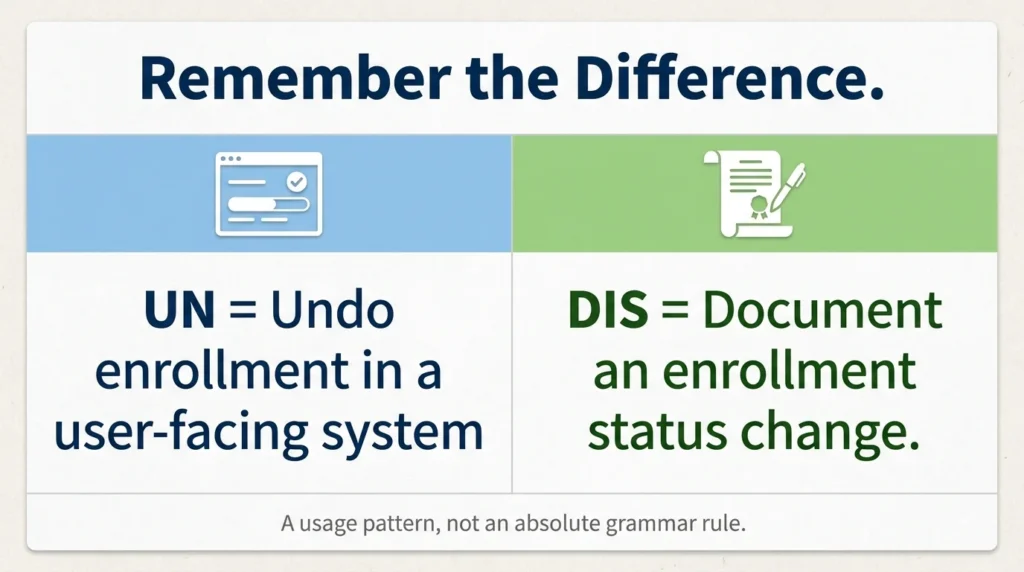
UN = undo enrollment in a user-facing system.
DIS = document an enrollment status change.
This mnemonic reflects common usage, not an absolute rule.
A course button is likely to say Unenroll. A formal insurance notice is likely to discuss Disenrollment. Always follow the actual organization’s terminology when it is available.
Real-Life Situations
In an Interview
I unenrolled from one optional course so I could focus on completing my professional certification.
Why it works: The speaker voluntarily left a course, and the sentence uses natural educational language.
In a Team Meeting
We should contact the employee before we unenroll her from the training session.
Why it works: The administrator is removing someone from a digital or workplace course.
In a Formal Email
Please confirm the effective date of my disenrollment from the health plan.
Why it works: Disenrollment matches the formal insurance context.
In a Text Message
I’m going to unenroll from that class because the schedule changed.
Why it works: Unenroll is understandable and natural when referring to a course.
In an Exam
Question: Choose the most appropriate formal term for removing an ineligible member from a government benefits program.
Answer: Disenroll
Why it works: Government eligibility processes commonly use formal administrative language.
Also Read: Emersion vs Immersion: Difference and Which One Is Correct?
Expert Tips
Match the Official Interface
When writing instructions, reproduce the button or menu label exactly.
Write:
Select Unenroll.
Do not change it to:
Select Disenroll.
Users need to find the label displayed on their screens.
Separate Word Choice from Grammar
“I disenrolled from the course” may be grammatically correct even when “I unenrolled from the course” sounds more typical for that particular platform.
Do not label a sentence ungrammatical merely because another word is more common.
Use Specific Alternatives
Sometimes neither word is the best option:
| Situation | More Natural Verb |
| University class | Withdraw or drop |
| Newsletter | Unsubscribe |
| Gym membership | Cancel |
| Competition | Withdraw |
| Email list | Unsubscribe or remove |
| Employee benefits plan | Disenroll |
| Online course dashboard | Unenroll or leave |
| School discipline | Remove, dismiss or expel |
Be Careful With Expel
Expel is not a general synonym for unenroll or disenroll.
Expulsion normally involves disciplinary removal. A person can be disenrolled because of relocation, eligibility, scheduling, nonpayment, or a voluntary choice without being expelled.
Preserve Legal and Policy Language
Do not casually replace disenrollment in an official policy with unenrollment. The organization may have defined the term precisely in its rules.
Clarify Who Performed the Action
When the actor matters, name it directly:
The student unenrolled from the class.
The administrator unenrolled the student.
The insurance provider disenrolled the member.
Clear sentence structure is more reliable than expecting the prefix alone to reveal who initiated the action.
Quick Summary
Unenroll and disenroll both refer to ending an enrollment, and their meanings overlap. Unenroll is especially common in online courses, classroom software, training platforms, and user-facing instructions. Disenroll has a more formal, administrative tone and is widely used in American healthcare, insurance, benefits, and government programs. However, the difference is not governed by a strict voluntary-versus-forced rule. Also you can visit for more spell correction Worddifferences.com
People can disenroll themselves, and administrators can unenroll students. Use from when someone leaves a course or plan, as in “unenroll from the class.” Most importantly, follow the terminology used by the relevant organization. In British English, unenrol or withdraw may sound more appropriate.
Mini Quiz
| No. | Question | Answer | Explanation |
| 1 | Fill in the blank: I decided to ___ from the online course. | unenroll | Unenroll is natural in a digital-course context. |
| 2 | Choose the best formal term: The insurance company may ___ members who lose eligibility. A) unsubscribe B) disenroll C) drop | B) disenroll | Disenroll fits formal insurance and eligibility language. |
| 3 | Correct the sentence: “I unenrolled out of the workshop.” | I unenrolled from the workshop. | Use from for the course or program being left. |
| 4 | True or false: Only an institution can disenroll someone. | False | A person may also disenroll from a plan or program. |
| 5 | Fill in the blank: Your ___ request has been approved. | disenrollment | The sentence requires a noun rather than the verb disenroll. |
| 6 | Choose the correct sentence. A) She has disenroll. B) She has disenrolled. | B) She has disenrolled. | The present perfect requires the past participle. |
| 7 | Correct the sentence: “The administrator unenrolled from three students.” | The administrator unenrolled three students. | The students are direct objects, so from is unnecessary. |
| 8 | Which button label is most natural on a course platform? A) Unenroll B) Discontinuation of Registration | A) Unenroll | A short action verb is clearer in a user interface. |
| 9 | Fill in the blank: British students may be asked to ___ from a university course. | withdraw | Withdraw is a common formal choice in British academic contexts. |
| 10 | True or false: Unenroll always means voluntary removal. | False | Administrators and teachers may also unenroll participants. |
Also Read: Courtesy vs Curtesy