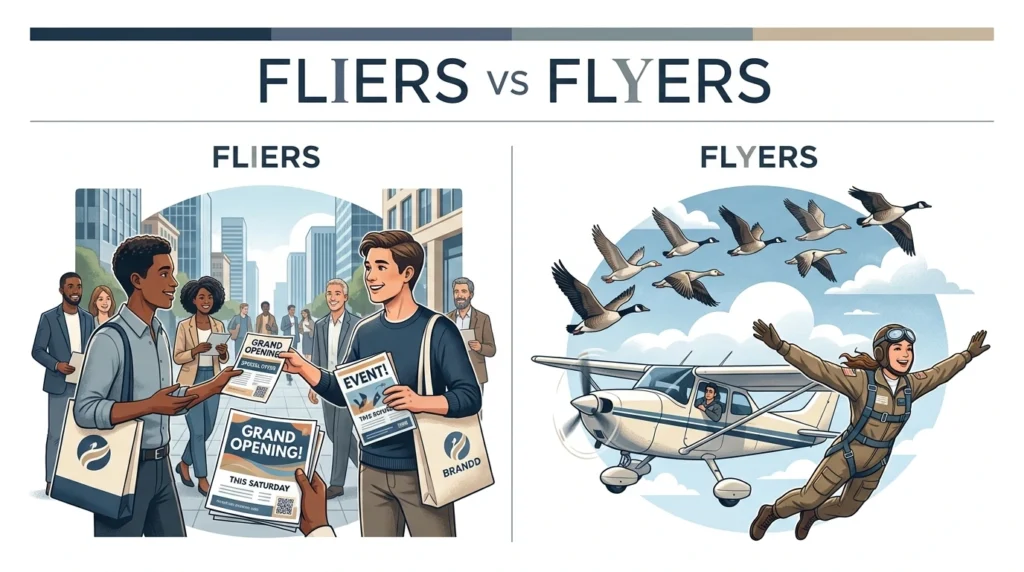

Both fliers and flyers are correct English spellings. The choice depends mainly on meaning, usage, and style. For a printed advertisement, leaflet, or promotional handout, flyers is the safest and most widely familiar choice. Fliers is also accepted and is especially common in some American usage when referring to people or things that fly. The two forms can overlap, so context matters more than a simple right-or-wrong rule.
What Are Fliers and Flyers?
Fliers and flyers are plural nouns formed from flier and flyer.
The two singular forms have overlapping meanings. They can describe:
- A person who flies or travels by aircraft
- A bird, animal, or other thing that flies
- A printed piece of information or advertising
- A person taking a risk, especially in the expression take a flier
The spelling difference does not automatically create two completely different words.
For example:
- The store printed 2,000 flyers for its new promotion.
- The airline offers special benefits to frequent flyers.
- Eagles are powerful fliers.
- She decided to take a flier on the new business.
All four sentences use established English.
Cambridge lists flier as a mainly American spelling of flyer, while its entries also recognize both forms for people who fly and for advertising material.
Why Does the Difference Matter?
The difference matters because readers often expect one spelling in particular depending on the context.
Consider these sentences:
We distributed 5,000 fliers before the concert.
This is understandable and correct. However, many readers will find flyers more immediately familiar when the word means promotional leaflets.
Now consider:
She is a frequent flier.
This is also correct. Frequent flyer is equally established and is extremely familiar in travel contexts. Cambridge explicitly lists frequent flier as a mainly U.S. spelling of frequent flyer.
So the real issue is not usually grammar. It is word choice, spelling preference, context, and consistency.
Using a less familiar form is not necessarily an error. But choosing the form most familiar to your intended readers can make your writing easier to understand.
The Core Rule
Use “flyers” as your default spelling for advertising leaflets, promotional handouts, and similar marketing material. Use “fliers” when it fits your chosen spelling style for people or things that fly. Remember that both forms are valid in many contexts.
There is no universal rule saying that fliers is wrong or that flyers is always right.
A practical approach is:
- Advertising or promotional paper: choose flyers as the safest default.
- People who fly: both flyers and fliers are possible.
- Birds or other flying things: both forms can be used.
- Established expressions: follow the spelling normally used by your style guide or publication.
- Professional writing: choose one style and use it consistently.
This approach reflects the fact that modern dictionaries recognize substantial overlap between the two spellings.
How to Use Fliers and Flyers
Use “flyers” for advertising material
When you mean printed promotional material, flyers is a particularly natural choice.
Examples include:
- advertising flyers
- event flyers
- restaurant flyers
- campaign flyers
- sales flyers
- promotional flyers
- school flyers
- business flyers
For example:
The marketing team printed 3,000 flyers for the store opening.
We left flyers at local coffee shops.
The school sent flyers home with the students.
Cambridge defines flyer as a small piece of paper containing information about a product or event and gives advertising and marketing examples.
“Fliers” is also possible for advertising material
It would be incorrect to say that fliers can never refer to advertisements.
For example:
Volunteers handed out fliers at the entrance.
This is established English. Cambridge’s American Dictionary specifically gives flier as a spelling for a piece of paper containing advertising or information.
Therefore:
We printed 500 flyers.
and
We printed 500 fliers.
can both be correct.
The first is usually the more straightforward choice for modern marketing copy.
Use either form for people who fly
Both forms can refer to people who travel by air.
Frequent flyers can earn extra miles.
Frequent fliers can earn extra miles.
Both are understandable and established.
Oxford lists frequent flyer and gives frequent flier as an alternative.
Use either form for flying animals
Both spellings can describe something that flies.
The eagle is a powerful flyer.
The eagle is a powerful flier.
The choice can depend on the writer’s preferred style and the publication’s conventions.
Correct Examples
Here are examples covering common real-world situations.
| Situation | Correct Example |
|---|---|
| Marketing | We printed 2,000 flyers for the sale. |
| Business | Please distribute the flyers before Friday. |
| Event promotion | The organizers created flyers for the concert. |
| School | The students designed flyers for the charity event. |
| Social media | We shared the event flyer on Instagram. |
| I’ve attached the promotional flyer to this email. | |
| Travel | Frequent flyers may receive additional benefits. |
| Aviation | Experienced fliers understand the importance of weather conditions. |
| Wildlife | Some birds are remarkably strong fliers. |
| Risk-taking | He decided to take a flier on the new investment. |
Notice that the examples do not establish a rigid rule. They show common patterns of use.
Read More: Affend vs Offend: Which Spelling Is Correct?
Incorrect vs. Correct
Because both spellings are legitimate, some “incorrect” examples below are not grammatically wrong. They are examples where another spelling is more natural or clearer for the intended context.
| ❌ Less suitable or unclear | ✅ Better choice | Why |
|---|---|---|
| We printed 5,000 fliers for the sale. | We printed 5,000 flyers for the sale. | Flyers is the more familiar choice for promotional material. |
| Please hand out the fliers at the entrance. | Please hand out the flyers at the entrance. | Flyers makes the advertising meaning immediately clear. |
| The company designed a new advertising flier. | The company designed a new advertising flyer. | Flyer is widely used for advertising and marketing material. |
| She is a frequent flier. | She is a frequent flyer. | Both are correct; frequent flyer is especially familiar in travel contexts. |
| The airline rewards frequent fliers. | The airline rewards frequent flyers. | Both forms work, but frequent flyer is a very established expression. |
| The eagle is a powerful flyer. | The eagle is a powerful flier. | Both are correct; the second may be preferred when the writer wants to emphasize the “one that flies” sense. |
| We handed out flyers and called the people fliers. | We handed out flyers and called the people flyers. | The original sentence creates an unnecessary spelling distinction; both forms can refer to people who fly. |
| She designed an event flier. | She designed an event flyer. | Flyer is the clearer default for promotional material. |
| The students distributed campaign fliers. | The students distributed campaign flyers. | Flyers is the more familiar modern spelling for this context. |
| I attached the event flier to the email. | I attached the event flyer to the email. | Flyer is the common default for an attached promotional document. |
The important lesson is that fliers is not automatically incorrect. Treating every use of flier as an error would oversimplify the language.
Why People Make This Mistake
The words sound exactly alike
In normal speech, flier and flyer have the same pronunciation.
That means you cannot normally solve the problem by listening to someone say the word.
You have to choose the spelling when writing.
The spelling difference is tiny
The only difference is the letter i or y after the initial fl:
- flier
- flyer
Because the words look almost identical, it is easy to switch between them without noticing.
Both spellings are legitimate
This is probably the biggest reason for the confusion.
If one spelling were correct and the other were simply a misspelling, the choice would be easy. But dictionaries recognize both.
Cambridge’s entries explicitly cross-reference the two forms and identify flier as a mainly U.S. spelling of flyer in some uses.
People overgeneralize a useful pattern
A writer may learn:
“Flyer is for advertisements.”
Then they may assume:
“Flier is always for people who fly.”
That is too strict.
The meanings overlap. A person who flies may be called a flyer or a flier, and a printed advertisement can be called a flyer or flier.
Spellcheck cannot explain context
A spelling checker may accept both forms because both are real English words.
That means spellcheck can tell you whether a form exists, but it cannot always tell you which spelling best fits your audience or publication style.
Translation can add another layer of confusion
Learners who translate from another language may have learned only one equivalent for “flyer.”
English, however, permits both flyer and flier, so translating the same word repeatedly does not always produce the most natural English spelling for every context.
Read More:Whose vs Whos: Which Is Correct? Easy Grammar Guide.
Common Mistakes Checklist
Mistake 1: Assuming “flier” is wrong
Why it happens: Many writers see flyer used more often and assume flier is a spelling mistake.
How to avoid it: Remember that flier is a legitimate English spelling.
Mistake 2: Assuming “flyer” is only for advertisements
Why it happens: Marketing is one of the most familiar uses of flyer.
How to avoid it: Remember that flyer can also refer to a person or thing that flies.
Mistake 3: Treating frequent flyer and frequent flier as different concepts
Why it happens: Writers assume the spelling changes the meaning.
How to avoid it: Both forms can describe someone who travels frequently by air.
Mistake 4: Changing spelling halfway through a document
Why it happens: Both forms look acceptable, so writers may use whichever one comes to mind.
How to avoid it: Choose a preferred style and stay consistent unless a proper name or quotation requires otherwise.
Mistake 5: Calling one spelling “American” and the other “British” too rigidly
Why it happens: Some spelling differences really do follow strong regional patterns.
How to avoid it: Do not treat flier/flyer as a simple U.S.-versus-U.K. pair. Both forms occur in both varieties, although preferences can vary.
Fliers vs Flyers in Real English
When “flyers” sounds most natural
For marketing, advertising, events, sales, promotions, and informational handouts, flyers is generally the safest everyday choice.
A business would naturally write:
Download our latest flyer.
We distributed flyers throughout the neighborhood.
The event flyers are ready for printing.
This is not because fliers is grammatically forbidden. It is because flyer is strongly associated with this type of material and is immediately recognizable to a broad audience. Cambridge uses flyer as its main entry for this advertising meaning while also recognizing flier as an alternative.
When “fliers” can feel more natural
Flier can work naturally when the focus is on something or someone that flies.
For example:
The competition attracts some of the world’s best fliers.
These birds are excellent fliers.
She is a frequent flier who travels for work every month.
This does not mean flyers would necessarily be wrong. It simply shows a context where flier is a natural and established choice.
When either spelling works equally well
Some sentences do not need a distinction at all.
The airline offers rewards to frequent flyers.
The airline offers rewards to frequent fliers.
Both communicate the same idea.
Likewise:
The eagle is a strong flyer.
The eagle is a strong flier.
Both are possible.
The most useful rule is therefore not “memorize one spelling for every meaning.” Instead, learn the common preference patterns and then consider your audience and style guide.
American vs. British English
There is not a clean American-English-versus-British-English spelling split here.
Both flyer and flier are found in English on both sides of the Atlantic. Cambridge labels flier as a mainly U.S. spelling in some of its entries, but its British-facing material also recognizes the form, while flyer is widely used in both varieties.
For advertising material, flyer is a safe international choice.
For people or things that fly, both flyer and flier remain established.
So avoid teaching this as:
American = flyer, British = flier.
That is too simple and can lead to unnecessary corrections.
Formal vs. Informal Usage
The difference between fliers and flyers is not primarily a formal-versus-informal issue.
Both can appear in professional and formal writing.
For example:
The company distributed promotional flyers to prospective customers.
This is perfectly suitable for professional writing.
Likewise:
Frequent fliers may qualify for additional travel benefits.
This can also appear in formal writing.
In professional documents, the most important consideration is consistency. If your company, publication, university, or style guide has a preferred spelling, follow it.
Comparison Table
| Feature | Fliers | Flyers |
|---|---|---|
| Correct English spelling | Yes | Yes |
| Singular form | flier | flyer |
| Plural form | fliers | flyers |
| Advertising leaflet | Yes | Yes |
| Person who flies | Yes | Yes |
| Flying animal | Yes | Yes |
| Frequent air traveler | Yes | Yes |
| Common marketing choice | Less familiar | Very common |
| Common travel expression | Frequent flier | Frequent flyer |
| Can appear in professional writing | Yes | Yes |
| Automatically wrong? | No | No |
The most important point is simple: the two spellings overlap much more than many “difference” articles suggest.
Read More: To Bad vs Too Bad: Which Is Correct?
Memory Trick
Use this simple memory aid:
Flyer = the spelling to fly with when you are promoting something.
If you are designing a promotion, event announcement, sale notice, or advertising handout, think:
marketing → flyer → flyers
For flying people or animals, remember that both spellings are available.
So you do not need to memorize a complicated rule.
Real-Life Situations
Interview
Question: “How did you advertise the job fair?”
Natural answer:
“We printed several flyers and distributed them at local colleges.”
Here, flyers clearly means promotional handouts.
Business meeting
Manager: “Are the event materials ready?”
Employee: “Yes. The flyers are ready to distribute.”
Again, flyers is the straightforward choice for promotional material.
Hi Sarah,
I’ve attached the event flyer for your review.
The singular flyer is natural when referring to one promotional document.
Text message
Can you send me the flyer for Saturday’s event?
The same spelling works naturally in informal communication.
Travel conversation
I’m a frequent flyer, so I usually book flights through the airline’s rewards program.
You could also write frequent flier. Both forms are established.
Academic writing
The researchers distributed informational flyers to participants.
Here, flyers refers to printed information material.
Wildlife writing
The eagle is an exceptionally strong flier.
Here, flier emphasizes the creature’s ability to fly, although flyer is also possible.
Risk-taking
The investor decided to take a flier on the new company.
The expression take a flier means to take a chance or make a risky choice. Take a flyer also occurs as an alternative spelling.
Expert Tips
Choose “flyers” when clarity is the priority
If you are writing marketing material for a broad audience and do not have a house style, flyers is a practical default.
Do not “correct” every flier to flyer
If you see:
The campaign distributed fliers.
Do not automatically mark it wrong.
The spelling is legitimate. The question is whether flyers better suits the style and audience.
Follow the publication’s style guide
Different organizations can choose different preferred spellings.
For example, one published editorial style guide specifically recommends flyer rather than flier when referring to a poster or brochure. (Oregon Historical Society)
That is a style decision, not proof that the alternative spelling is grammatically invalid.
Be especially careful with fixed expressions
Some phrases have a strong conventional spelling even though alternative forms exist.
Take a flier is a well-established expression meaning to take a chance, and take a flyer is also found.
When writing for a specific publication, follow its preferred form.
Remember that “pilot” can be more precise
If you specifically mean someone who operates an aircraft, pilot is often clearer than either flyer or flier.
Compare:
She is a skilled pilot.
with:
She is an experienced flier.
The first tells the reader exactly what role the person has. The second focuses more generally on the person’s relationship with flying.
FAQ
Is “fliers” a correct spelling?
Yes. Fliers is a correct plural spelling of flier. It is used for people or things that fly and can also refer to advertising material.
Is “flyers” a correct spelling?
Yes. Flyers is the plural of flyer and is widely used for advertising material as well as people or things that fly.
Which is correct: fliers or flyers?
Both are correct. For printed advertisements and promotional handouts, flyers is generally the safest default because it is very familiar in that context.
Should I write “flyers” or “fliers” for advertisements?
Flyers is the best default for most modern business, marketing, school, and event writing. However, fliers is also an accepted spelling for advertising material.
Is “frequent fliers” correct?
Yes. Frequent fliers is a correct expression for people who travel frequently by air. Frequent flyers is also correct and very common.
Is “frequent flyers” correct?
Yes. Frequent flyers is a standard expression for people who travel frequently by plane, particularly within airline loyalty programs.
Is “fliers” American English?
Flier is identified by Cambridge as a mainly U.S. spelling in some uses, but the form is not exclusively American. Both spellings occur across English varieties.
Is “flyer” British English?
Yes. Flyer is used in British English as well as American English. It should not be treated as an exclusively American spelling.
Are “flyer” and “flier” pronounced differently?
No. In standard English pronunciation, they are pronounced the same. The difference is in spelling.
Can “flyer” mean a person who flies?
Yes. Flyer can refer to a person who flies, including an air traveler. For example, frequent flyer is a standard expression.
Can “flier” mean an advertising leaflet?
Yes. Flier can refer to a piece of paper containing advertising or information. It is not incorrect simply because flyer is more familiar for this meaning.
Which spelling should I use in professional writing?
If you are referring to promotional material and have no specific style requirement, flyer/flyers is a safe and widely recognized choice. If your organization has a style guide, follow its preference.
Mini Quiz
| # | Question | Answer | Explanation |
|---|---|---|---|
| 1 | We printed 1,000 ___ for the store opening. (fliers / flyers) | flyers | Both are possible, but flyers is the familiar default for promotional material. |
| 2 | Which sentence is correct? A. She is a frequent flier. B. She is a frequent flyer. | Both | Both forms are established for a person who travels frequently by air. |
| 3 | Fill in the blank: “The students handed out ___ before the concert.” | flyers | Flyers is the natural default for event advertisements. |
| 4 | Is this sentence grammatically wrong? “The company distributed fliers.” | No | Fliers is a valid spelling and can refer to advertising material. |
| 5 | Fill in the blank: “The eagle is a powerful ___.” | flier or flyer | Both spellings can describe something that flies. |
| 6 | Choose the clearer marketing sentence: A. We designed new fliers. B. We designed new flyers. | B | Flyers is more immediately associated with promotional material. |
| 7 | Correct the sentence: “I attached the event flier to my email.” | I attached the event flyer to my email. | Flier is not strictly wrong, but flyer is the more familiar default for promotional material. |
| 8 | Which spelling can appear in “take a ___”? | flier or flyer | Both forms occur, although take a flier is a well-established form. |
| 9 | True or false: “Fliers” is always wrong when referring to advertisements. | False | Flier is an accepted spelling for advertising material. |
| 10 | Choose the safest default for a business advertisement: fliers / flyers | flyers | It is the widely familiar spelling for promotional handouts. |
Quick Summary
Fliers and flyers are both correct English spellings, and neither should automatically be treated as a mistake. The words can refer to people or things that fly, and both can also describe printed advertising material. For marketing, events, sales, school notices, and promotional handouts, flyers is the safest and most familiar default. Fliers remains a valid alternative, particularly in contexts involving people or things that fly and in some American usage. The same overlap appears in expressions such as frequent flyer/frequent flier. The best approach is to consider context, audience, and house style rather than trying to force a strict American-versus-British or correct-versus-incorrect distinction.
3 Image Prompts
Image Prompt 1 — Hero Image
Create a clean, premium educational illustration for an English grammar article titled “Fliers vs Flyers.” Show a visual split: on one side, several colorful promotional flyers being handed out for a business/event; on the other, a person and birds/aircraft representing fliers who or that fly. Include the words “FLIERS vs FLYERS” prominently, with a subtle spelling-focused design. Modern editorial style, white background, sophisticated blue and neutral accents, highly readable, realistic paper textures, no unnecessary text, 16:9 composition.
Image Prompt 2 — Comparison Graphic
Create a professional grammar infographic comparing FLIERS and FLYERS. Show “Both Are Correct” as the central message. Under FLYERS, visually represent advertising leaflets, event promotions, business marketing, and frequent air travelers. Under FLIERS, represent people or things that fly, while clearly showing that the meanings overlap. Include a simple central note: “Context + Style Matter.” Minimal educational design, clean typography, white background, balanced layout, no clutter, 16:9.
Image Prompt 3 — Memory Trick / Educational Visual
Create a memorable English-learning infographic for “Fliers vs Flyers.” Show a promotional leaflet next to the word FLYER, with a small airplane/bird next to FLIER, while visually indicating that both spellings can overlap. Add a simple mnemonic concept: “Marketing → FLYER” and “Flying → FLIER / FLYER.” Make the visual suitable for students, ESL learners, writers, and marketers. Modern grammar textbook aesthetic, clean typography, highly scannable, professional, 16:9.