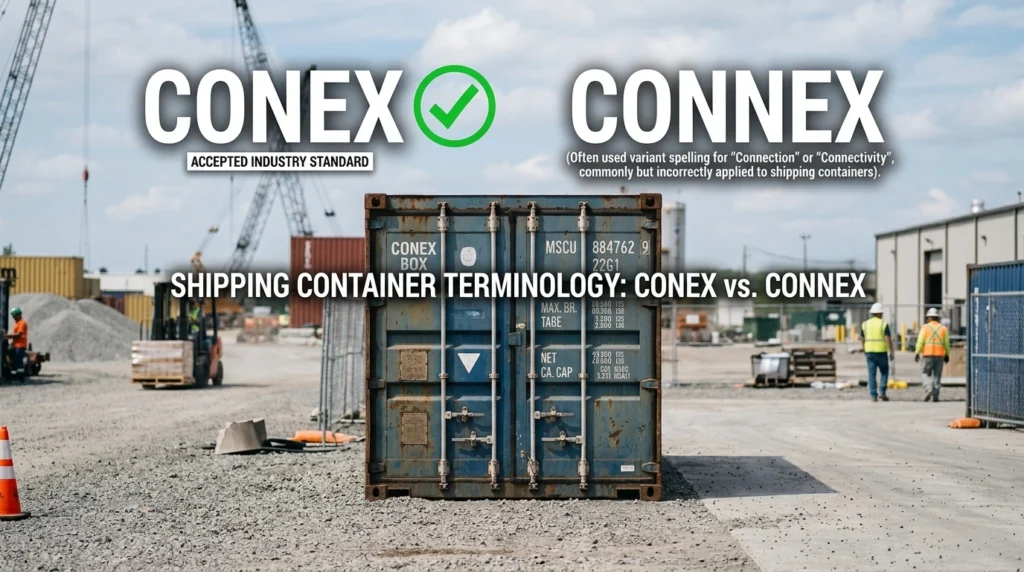

Use Conex when referring to a Conex box, shipping container, military container, or portable storage unit. It is the original and clearest spelling. Connex is often used as an alternative spelling in construction and storage conversations, but it is better avoided in formal writing unless it is part of an official brand or organization name.
What Is a Conex Box?
A Conex box is a strong metal container used to transport or store equipment, supplies, tools, and other goods. The name developed from the military expression container express, which was shortened to CONEX.
The original CONEX system was associated with military transportation and containerization. Modern speakers now use Conex box more broadly for steel shipping containers found at construction sites, warehouses, farms, military facilities, and storage yards. The U.S. Army continues to use CONEX as a shortened form of “container express.”
A modern Conex box may also be called:
- A shipping container
- A storage container
- An intermodal container
- An ISO container
- A cargo container
- A sea container
- A sea can
These terms frequently overlap, although their technical meanings can differ depending on whether the writer is discussing container history, international standards, transportation, or stationary storage.
Why the Difference Matters
Using conex or connex will rarely cause a serious misunderstanding in casual conversation. Most people in the storage, construction, or shipping industries will know what the speaker means.
The spelling still matters in professional writing. A contractor, logistics specialist, military writer, supplier, or student may appear less informed if the historical term is repeatedly written as connex. The double-N spelling can also create confusion because Connex is used as a proper name by various companies and organizations.
Correct spelling is particularly important in:
- Product descriptions
- Purchase orders
- Military documents
- Academic papers
- Construction proposals
- Shipping instructions
- Equipment inventories
- Search-optimized website content
Precise language helps the reader identify whether you mean a steel container or an organization named Connex.
The Core Rule
Use CONEX or Conex for the container. Use Connex only when it is the official spelling of a specific brand, company, product, service, or organization.
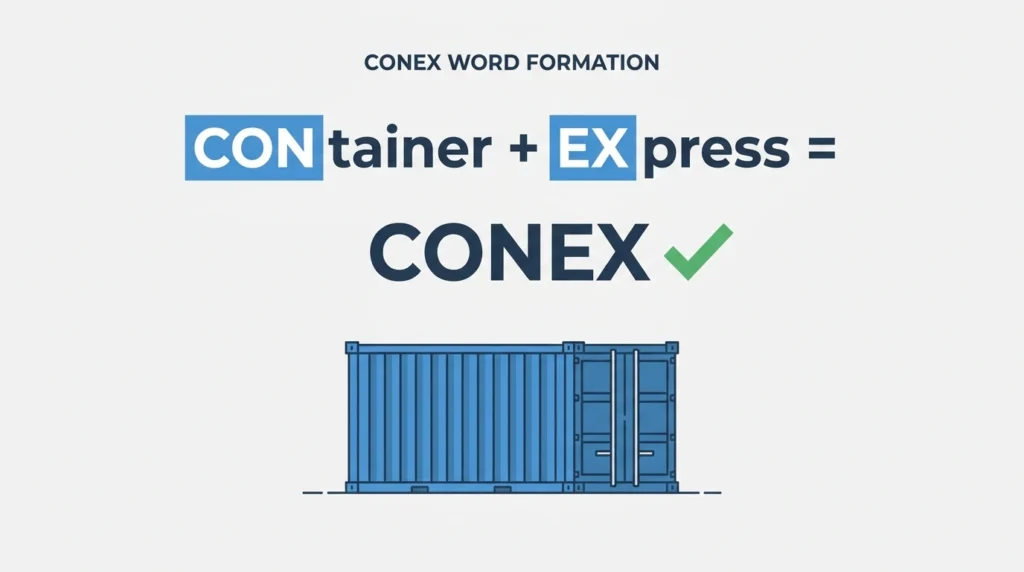
The word CONEX contains one n because it was formed from CONtainer and EXpress.
Although connex box is widely understood, it is a spelling variation rather than the historically grounded form.
How to Use Conex and Connex
Use CONEX for the Original Military Term
Write CONEX in capital letters when discussing the original military system, its historical development, or an official abbreviation.
Example:
The report explains how the CONEX system improved the movement of military supplies.
Capital letters make it clear that the word is being treated as a shortened historical name.
Use Conex for a General Container
Write Conex with an initial capital when you are using it as a familiar name for a steel storage or shipping container.
Example:
The crew placed the generators inside the Conex box.
Lowercase conex also appears in industry writing, especially when the term is treated as an ordinary common noun. Choose one style and use it consistently throughout the document.
Read More: Protestors or Protesters: Which Spelling Is Correct?
Use Shipping Container for the Broadest Clarity
Use shipping container when writing for readers who may not recognize the word Conex.
Example:
A 20-foot shipping container will be delivered to the construction site on Monday.
This wording is especially useful for international readers, public-facing documents, beginner guides, contracts, and general website content.
Use Connex for an Official Proper Name
Write Connex when that spelling forms part of an official name.
Example:
She contacted Connex to ask about her account.
In this sentence, Connex identifies a particular organization rather than a storage container. Proper names should keep their official spelling and capitalization.
Follow These Steps When Choosing the Word
- Decide whether you mean a steel storage or shipping container.
- Use Conex if the container term is needed.
- Use CONEX when discussing the historical abbreviation or military system.
- Use shipping container when maximum clarity is more important than industry vocabulary.
- Use Connex only when copying an official proper name or when quoting someone’s chosen spelling.
Correct Examples
The following examples show how Conex and CONEX can appear in different situations.
- Everyday conversation:
“The camping equipment is stored in the Conex behind the workshop.” - Work email:
“Please confirm whether the 20-foot Conex box will arrive before noon.” - Construction site:
“All power tools must be returned to the locked Conex at the end of the shift.” - Military writing:
“The unit inspected each CONEX before preparing the equipment for transport.” - School assignment:
“The CONEX system played an important role in the development of containerized transport.” - Supplier request:
“We need a wind- and water-resistant Conex container for temporary storage.” - Social media:
“We converted an old Conex box into a small pop-up coffee stand.” - Academic writing:
“The paper distinguishes early CONEX units from present-day standardized intermodal containers.” - Safety instructions:
“Do not enter the Conex until the ventilation system has been checked.” - Project meeting:
“The site manager recommended placing the Conex near the eastern access road.” - International communication:
“The equipment will be packed in a shipping container for overseas transport.” - Proper-name usage:
“The invoice was issued through the company’s Connex payment platform.”
The final example uses Connex because it represents an official product or service name, not a container.
Also Read: Kinesthesiology vs Kinesiology: What’s the Difference?
Incorrect vs. Correct Usage
| ❌ Incorrect | ✅ Correct | Why |
|---|---|---|
| The Army developed the CONNEX system. | The Army developed the CONEX system. | The historical military form is CONEX, with one n. |
| CONEX means Connected Export. | CONEX comes from “container express.” | The term is connected to the words container and express, not connected export. |
| Connex boxes are a separate type of container. | Connex box is usually an alternative spelling of Conex box. | The extra n does not normally identify a different container design. |
| We ordered three CONEX’s. | We ordered three CONEX boxes. | An apostrophe does not form a regular plural. |
| Every Conex is an original military container. | Modern speakers also call ordinary shipping containers Conex boxes. | Current usage is broader than the original military meaning. |
| A Conex can never be used for shipping. | A Conex may be used for shipping or storage. | The term is commonly associated with both transportation and stationary storage. |
| Please deliver the connex tomorrow. | Please deliver the Conex box tomorrow. | The revised sentence uses the preferred spelling and clearly names the object. |
| The conex System was introduced for military transport. | The CONEX system was introduced for military transport. | Historical abbreviations are normally presented in capitals. |
| Conex and shipping container always mean completely different things. | Conex and shipping container often refer to the same general object. | Modern industry usage frequently overlaps, even though the terms have different origins. |
| I opened an account with Conex Credit Union. | I opened an account with Connex Credit Union. | An official proper name must keep its registered or published spelling. |
| The conex boxs are locked. | The Conex boxes are locked. | The plural of box is boxes, not boxs. |
| We need a connex for international freight. | We need an ISO-compliant shipping container for international freight. | The revised term is more precise when technical compliance matters. |
Why People Confuse Conex and Connex
The Pronunciation Is Usually the Same
Most speakers pronounce Conex and Connex alike. Because the second n is not heard as a separate sound, pronunciation does not help the writer choose the spelling.
A person may hear the term at a job site for years before seeing it in an official document.
English Contains Many Double Consonants
Writers are familiar with words such as connect, connection, and connected. Since connex appears visually related to these words, adding a second n can feel natural.
That resemblance is misleading when the writer means a container. Conex was formed from parts of container and express, not from connect.
The Word Is Often Passed Through Speech
Industry vocabulary is frequently learned through conversation rather than formal instruction. A worker may hear “Conex box” from a supervisor and later guess how to spell it.
Both spellings then circulate through messages, listings, invoices, and social media posts.
Autocomplete Does Not Always Correct It
A spelling checker may accept both forms because Connex can be an official name, trademark, company name, or specialized term. Software cannot always determine whether the sentence refers to a container or a proper noun.
Writers must therefore check the meaning rather than relying entirely on autocorrect.
Online Listings Use Inconsistent Spelling
Container suppliers, sellers, contractors, and private owners may write Conex, CONEX, conex, or connex. Seeing all four forms can give the impression that each one has a separate technical meaning.
In most ordinary container listings, they do not.
Translation Can Affect the Spelling
A writer working between languages may associate the word with terms related to connection, connectivity, or linking. That association can encourage the double-N form.
The safest solution is to remember the source expression: CONtainer EXpress.
Read More: Unenroll vs Disenroll: Meaning and Key Difference
Common Mistakes Checklist
Treating Conex and Connex as Different Container Sizes
The spelling does not tell you whether a container is 10, 20, or 40 feet long. Size, height, condition, certification, doors, and intended use must be stated separately.
Avoid it: Write the actual specification, such as “20-foot standard shipping container.”
Assuming Every Modern Container Is Technically an Original CONEX
The historical CONEX units and today’s standardized intermodal containers are not identical in every technical or historical sense. However, modern speakers often use Conex as a general label for a shipping or storage container.
Avoid it: Use original CONEX unit when discussing history and modern shipping container when discussing present-day equipment.
Adding a Second N Because of “Connect”
Connex may look as though it belongs to the word family containing connect and connection. That is not the origin of the container term.
Avoid it: Break the word into CON + EX.
Using Connex for Every Proper Name
Not every business associated with containers uses Connex. Some use Conex, while others use completely different names.
Avoid it: Copy an organization’s official spelling exactly.
Writing an Apostrophe in the Plural
Forms such as Conex’s or CONEX’s are possessive or contraction-like forms, not normal plurals.
Avoid it: Write Conex boxes, CONEX units, or shipping containers.
Using Industry Slang in an International Contract
Some readers may not know what a Conex box is. Others may interpret it as a particular brand or military design.
Avoid it: Use ISO shipping container, intermodal freight container, or another technically defined term when the document requires precision.
Switching Capitalization Without a Reason
A page that alternates among CONEX, Conex, and conex can look poorly edited.
Avoid it: Choose a style based on context and apply it consistently.
Assuming Spellcheck Will Choose Correctly
Both forms may pass through editing software because both can exist in different contexts.
Avoid it: Ask what the word names in that specific sentence.
Conex and Connex in Real English
Grammatically Correct
A sentence such as “The equipment is inside the Conex box” is grammatically correct. Conex box functions as a noun phrase: Conex identifies the kind of box, while box is the main noun. Writing “the Connex box” can also form a grammatical sentence, but grammar alone does not decide whether the spelling is historically accurate or appropriate for the intended meaning.
Grammatically Possible but Unnatural
“The materials are secured within the container-express receptacle” is grammatically possible, but it sounds unnatural in normal workplace communication. Native and experienced industry speakers would usually choose Conex box, storage container, or shipping container. Expanding the shortened term inside an ordinary sentence makes the wording sound forced unless the writer is defining its history.
Natural Everyday English
On a North American construction site or military facility, a worker might naturally say, “Put it in the Conex” or “Lock the Conex before you leave.” In public-facing or international English, “Put it in the shipping container” is usually clearer. Connex may appear informally, but the reader cannot tell from pronunciation whether the speaker intends one or two n letters.
Also Read: Encode vs Incode: Which Is Correct and When Should You Use Each?
American vs. British English
There is no formal American-versus-British rule in which Americans must write Conex and British writers must write Connex.
The practical difference concerns familiarity. CONEX has strong roots in U.S. military usage and remains recognizable in American military, construction, and storage contexts. British and broader international readers may be more familiar with shipping container, freight container, or ISO container. This is a regional usage tendency, not a separate spelling rule.
For international content, introduce the term clearly:
A Conex box, also called a shipping or storage container, was delivered to the site.
After that first definition, the shorter form may be used throughout the text.
Formal vs. Informal Usage
Formal Writing
In formal documents, use the term that provides the greatest technical accuracy.
Suitable choices include:
- CONEX system
- Conex box
- Shipping container
- Intermodal freight container
- ISO container
- Portable storage container
Use CONEX when the historical or military origin matters. Use shipping container or intermodal container when describing modern transport equipment.
Avoid connex in formal container writing unless you are quoting a source, reproducing an official name, or following an organization’s established house style.
Informal Writing
In conversation, text messages, workplace notes, and informal listings, both Conex and connex may be understood.
For example:
The ladders are in the connex by the gate.
The meaning is clear, but the preferred edited version is:
The ladders are in the Conex by the gate.
Informal acceptance does not make the spellings equally useful in every professional context.
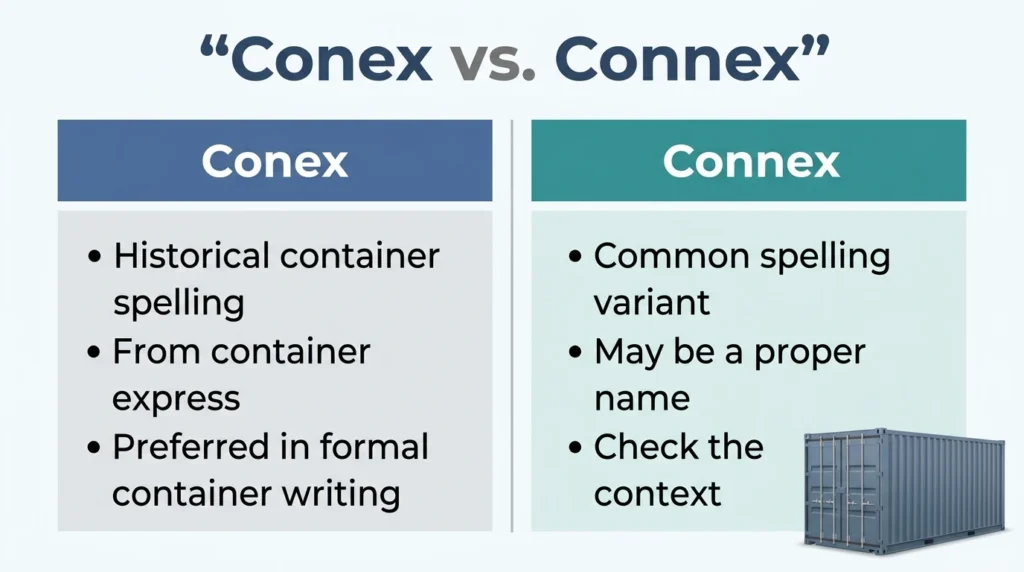
Conex vs. Connex Comparison Table
| Feature | Conex or CONEX | Connex |
| Main meaning | A military, shipping, or storage container | Often a spelling variant or an unrelated proper name |
| Historical basis | Formed from “container express” | Not the original container spelling |
| Number of n letters | One | Two |
| Best use | Container descriptions, military history, construction, storage | Official brand or organization names |
| Formal suitability | Preferred when the container term is intended | Usually avoided unless officially required |
| Informal recognition | Widely recognized in relevant industries | Often understood in the same context |
| Pronunciation | Usually sounds like “CON-ex” | Usually pronounced the same way |
| Capitalization | CONEX for the historical abbreviation; Conex as a familiar name | Connex when it is a proper name |
| International clarity | May require a definition | May be mistaken for a brand |
| Safer alternative | Shipping container | Use the exact official name |
Similar and Confusing Container Terms
| Term | Typical Meaning | Important Note |
| Conex box | A steel container used for transport or storage | Historically connected to the military term CONEX |
| Shipping container | A broad public term for a container used to move goods | Usually the clearest option for general readers |
| Intermodal container | A container designed for movement across transport modes | More technical than shipping container |
| ISO container | A container built according to relevant international standards | Appropriate when standardization matters |
| Storage container | A container being used mainly for stationary storage | It may or may not be suitable for active freight service |
| Cargo container | A container intended to carry goods | Common in transportation and logistics |
| Sea can | An informal North American term | Regional and less suitable for formal international writing |
| Connex | A spelling variant or proper name | Check the context before treating it as a container term |
Memory Trick
Remember this formula:
CONtainer + EXpress = CONEX
There is only one n because the first part is CON, not CONN.
A second memory line is:
One container, one N in Conex.
This is not the origin of the word, but it is an easy way to remember the preferred spelling.
Real-Life Situations
During a Job Interview
Interviewer: “Where did your team keep expensive equipment?”
Candidate: “We stored it in a locked Conex box and maintained a daily access log.”
Using Conex box shows familiarity with common job-site vocabulary while keeping the answer clear.
In a Project Meeting
Manager: “Where should the temporary storage unit go?”
Site supervisor: “The Conex should be placed beside the service road, provided it does not block emergency access.”
The shortened term is natural because everyone in the meeting already knows which container is being discussed.
In a Professional Email
Please confirm the delivery date for the 20-foot shipping container. The unit will be used as temporary tool storage.
Shipping container is preferable here because a supplier may need an exact, broadly understood description.
In a Text Message
Keys for the Conex are in the site office.
The short form is natural because the message is going to coworkers who know the location and object.
In an Exam
Question: What does CONEX refer to in military transportation history?
Answer: CONEX refers to the container-express system used for moving and storing military supplies.
The all-capital form is appropriate because the question concerns the historical term.
In an Academic Paper
Although the word Conex is now applied broadly to modern storage containers, the original CONEX system belongs to a specific stage in the history of military containerization.
This wording separates present-day vocabulary from historical equipment.
In a Product Listing
Used 20-Foot Conex Box for On-Site Storage
This title is understandable to buyers familiar with the term. The description should still provide dimensions, condition, door type, certification status, and delivery information.
In an International Contract
The supplier shall provide one 20-foot ISO-compliant intermodal freight container.
The technical phrase is better than Conex because contractual language should reduce ambiguity.
Expert Tips
Define Conex the First Time You Use It
For general readers, write:
A Conex box is a steel shipping or storage container.
You can then use Conex naturally in the rest of the article.
Match the Word to the Reader
Construction workers and military personnel may immediately recognize Conex. Homeowners, students, and international readers may respond better to shipping container.
Good editing is not limited to choosing the historically correct spelling. It also means choosing the term your reader will recognize.
Do Not Use Conex as a Technical Specification
The word does not provide enough information for a purchase, rental, shipment, or engineering decision.
Add details such as:
- External dimensions
- Internal dimensions
- Maximum payload
- Standard or high-cube height
- New or used condition
- Cargo-worthy status
- Wind- and water-resistant status
- Door configuration
- Certification requirements
Preserve Official Names
Never “correct” a company, product, road, service, or organization named Connex to Conex. Proper names follow the spelling chosen by their owners.
Likewise, do not change an official business name containing Conex to Connex merely because the double-N version looks more familiar.
Use Search Variations Without Sacrificing Accuracy
A page may naturally mention that some users search for connex box, connex container, or conex vs connex. However, the main explanatory wording should establish Conex as the preferred container spelling.
Do not repeat the incorrect or less precise variant in every paragraph simply to target a keyword.
Separate Spelling from Equipment Quality
A listing labeled connex box is not automatically fraudulent, low-quality, or technically incorrect. The seller may simply be using a common spelling variation. Judge the equipment through inspection, documentation, measurements, condition, and certification—not through spelling alone.
Read More: Protestors or Protesters: Which Spelling Is Correct?
Quick Summary
Conex and connex usually refer to the same steel shipping or storage container, but CONEX is the historically accurate form. The term developed from “container express,” so it contains one n. Use CONEX when discussing the original military abbreviation or historical system, and use Conex as the familiar container name in general writing. Connex is widely understood as a spelling variant, but it is less precise and may also be an official company, product, or organization name. For formal, international, contractual, or technical writing, shipping container, intermodal container, or ISO container may provide greater clarity. The easiest memory trick is CONtainer + EXpress = CONEX.
Frequently Asked Questions
Is Conex or Connex the correct spelling?
Conex is the historically grounded spelling for the container term. Connex is commonly used as a spelling variant, but it is not the original form.
Is Connex always a spelling mistake?
No. Connex may be incorrect when a writer intends the historical container term, but it can be completely correct as the official name of a company, product, platform, road, service, or organization.
What does CONEX stand for?
CONEX is associated with the expression container express. The shortened form combines CON from container and EX from express. Current U.S. Army materials continue to expand CONEX as “container express.”
Is a Conex box the same as a shipping container?
In modern everyday usage, Conex box and shipping container often identify the same general steel container. Historically, however, CONEX referred to a particular military container system that preceded modern standardized intermodal containers.
Should CONEX always be written in capital letters?
Not always. Use CONEX when treating it as the historical abbreviation or official military term. Conex is common when the word functions as a familiar name for a modern container.
Can conex be written in lowercase?
Yes. Some industries treat conex as a common noun and write it in lowercase. However, Conex often looks clearer in edited content, especially when introducing the term to general readers.
What is the plural of Conex?
The clearest plural is Conex boxes or CONEX units. Avoid Conex’s, because an apostrophe is not normally used to create a plural.
Is “Conex container” redundant?
It is slightly repetitive because Conex already identifies a type of container. However, Conex container is common and can help readers who do not know the shorter term. Conex box is also widely used.
Does the spelling indicate the container’s size?
No. Neither Conex nor connex tells the reader whether the container is 10, 20, 40, or 45 feet long. The size and other specifications must be given separately.
Is every Conex box suitable for international shipping?
No. A container used for stationary storage may not meet the inspection, structural, identification, or certification requirements needed for active international freight. Verify its condition and documentation before shipping.
Which term should I use for an international audience?
Use shipping container for broad public communication. Use intermodal freight container or ISO container when technical standardization matters. You may introduce Conex box as an alternative term if it is relevant to the subject.
Why do people add a second N to Connex?
The word resembles connect, connected, and connection, all of which use a double n. Since Conex and Connex are normally pronounced alike, people may guess the double-N spelling after hearing the word.
Mini Quiz
| Question | Answer | Explanation |
| 1. Multiple choice: Which spelling reflects the historical container term? A) Connex B) Conex C) Connecks | B) Conex | CONEX developed from container express. |
| 2. Fill in the blank: The tools are stored in the ______ box beside the office. | Conex | Conex box is the preferred spelling for the storage container. |
| 3. Correct the sentence: “The U.S. military introduced the CONNEX system.” | The U.S. military introduced the CONEX system. | Historical usage calls for CONEX with one n. |
| 4. Multiple choice: Which term is clearest for a general international audience? A) Shipping container B) Connex C) Conex’s | A) Shipping container | It is broadly recognized and does not depend on regional industry vocabulary. |
| 5. Fill in the blank: CONEX combines parts of the words ______ and ______. | Container and express | CON comes from container, and EX comes from express. |
| 6. Correct the sentence: “We rented two Conex’s for the project.” | We rented two Conex boxes for the project. | Regular plurals do not need an apostrophe. |
| 7. Multiple choice: When can Connex be unquestionably correct? A) When it is an official proper name B) Whenever a container is blue C) Only in British English | A) When it is an official proper name | Company and product names must keep their official spelling. |
| 8. Fill in the blank: In a technical shipping contract, “ISO-compliant ______ container” may be clearer than “Conex.” | Intermodal | The technical term communicates the container’s transport function more precisely. |
| 9. Correct the claim: “Conex and Connex identify two different container sizes.” | The spelling does not identify a container size. | Dimensions must be stated separately. |
| 10. Multiple choice: Which memory formula is correct? A) CONNection + EXport B) CONtainer + EXpress C) CONcrete + EXterior | B) CONtainer + EXpress | This formula reflects the established origin of CONEX. |