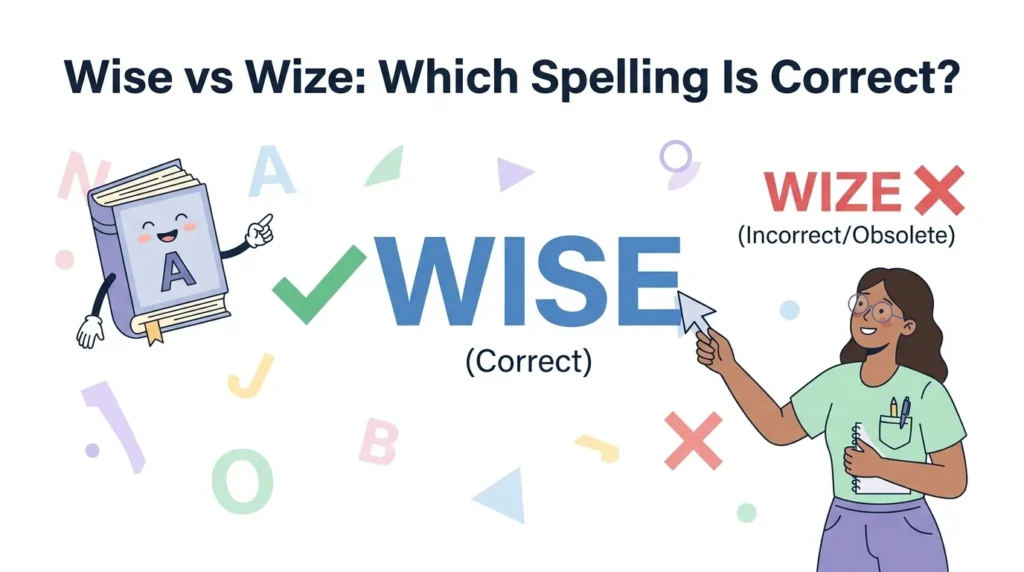

Wise is the correct spelling in modern standard English. It means having good judgment, knowledge, or experience. Wize is not the standard modern spelling of this word. Historical dictionaries record wize as an obsolete form of wise, but it is not the form you should use in normal modern writing. So, for an email, essay, report, social media post, or professional document, choose wise.
What Is the Difference Between Wise and Wize?
The difference between wise and wize is mainly a matter of standard spelling.
Wise is the normal modern English word. It is an adjective used to describe someone who has good judgment or experience, or something that shows sensible thinking.
For example:
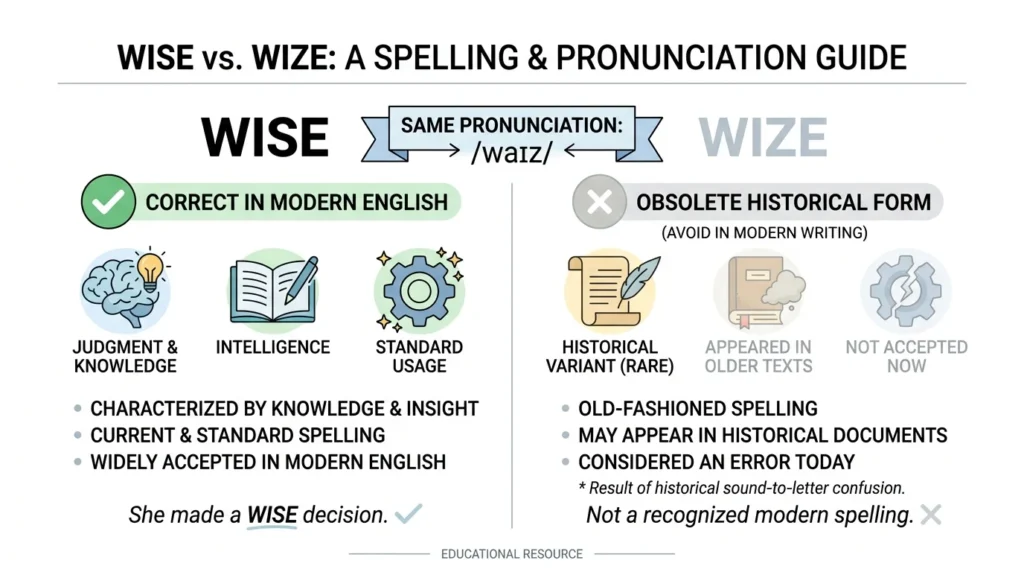
She made a wise decision.
Wize, with a z, is not the normal modern spelling of the word. It does appear in historical English records as an obsolete form of wise, meaning that it was used in earlier English but is no longer the standard spelling.
The important point is that the two spellings should not be treated as modern alternatives.
If you mean “showing good judgment,” write wise.
At a glance
- Wise = correct modern English spelling
- Wize = obsolete historical spelling, not the normal modern form
- Wise can be used in formal and informal modern English
- Wize should normally be avoided in standard writing
- The pronunciation does not give you a reliable clue because wise is pronounced /waɪz/
Why It Matters
A one-letter spelling mistake may seem minor, but spelling affects how readers judge written communication.
Imagine writing:
Your decision was very wize.
The meaning is understandable, but the spelling immediately looks unusual. In an academic assignment, business email, job application, report, or published article, that kind of error can make the writer appear less careful than intended.
Using wise avoids the problem:
Your decision was very wise.
This is especially important when the word appears in places where accuracy matters, such as:
- School assignments
- University papers
- Business emails
- Reports and proposals
- Job applications
- Website content
- Professional social media
- Customer communication
The good news is that this particular mistake has a very simple solution: when you mean the modern English adjective, use wise.
The Core Rule
Use wise in modern standard English. Do not use wize as an alternative spelling of wise.
The spelling wize may appear in historical texts, names, usernames, or deliberately creative writing, but those uses do not make it the standard modern spelling.
The normal form is:
W-I-S-E → wise
Not:
W-I-Z-E → wize
Read More: Trek vs Treck: Which Spelling Is Correct?
How to Use Wise Correctly
Wise to describe a person
Use wise when someone has good judgment, knowledge, or experience.
My grandfather is a wise man.
She is wise beyond her years.
A wise person does not simply know many facts. The word often suggests the ability to use knowledge and experience sensibly.
Wise to describe a decision
Wise can describe an action, choice, plan, investment, or decision that shows good judgment.
It was wise to leave early.
That was a wise investment.
We made a wise choice.
The structure wise + to + verb is also common:
It would be wise to check the figures again.
This pattern is recognized in standard English usage.
Wise with “of”
You can use wise of someone when describing a sensible action:
It was wise of Daniel to ask for help.
This construction focuses on the person’s good judgment.
Wise in the expression “wise to”
Wise can also mean informed or aware when used in the expression wise to something.
She is wise to his tricks.
Here, wise does not simply mean intelligent. It means that the person understands what is really happening.
Wise in “none the wiser”
The expression none the wiser means that someone still does not understand or know something after an explanation or event.
We explained the problem twice, but he was none the wiser.
This is a fixed expression, so it should be learned as a phrase rather than interpreted word by word.
Wise in words such as “otherwise”
The spelling wise also appears in established compounds and expressions.
For example:
- otherwise
- likewise
- clockwise
- lengthwise
- streetwise
- worldly-wise
The suffix -wise can have meanings related to manner, direction, or a particular subject. For example, clockwise refers to direction, while money-wise or business-wise can mean “in relation to money” or “in relation to business.”
Correct Examples of Wise
Here are original examples showing how wise works in different situations.
- Conversation:
“I think it would be wise to wait until tomorrow.” - Email:
“It would be wise to review the contract before signing it.” - School:
“Choosing a quiet place to study was a wise decision.” - University:
“The researcher made a wise choice by checking the data twice.” - Workplace:
“Our manager made a wise investment in employee training.” - Interview:
“She gave a wise answer instead of reacting emotionally.” - Social media:
“That is wise advice for anyone starting a new business.” - Family conversation:
“My father gave me some wise advice before I moved abroad.” - Academic writing:
“A wise policy should consider both short-term and long-term effects.” - Everyday English:
“It was wise to bring an umbrella.” - Business:
“The company took a wise approach to managing its limited resources.” - Personal decision:
“Saving some money each month was a wise move.”
Notice that wise naturally describes people, choices, actions, advice, strategies, and decisions.
Incorrect vs. Correct
| ❌ Incorrect | ✅ Correct | Why |
|---|---|---|
| He is very wize. | He is very wise. | Wise is the standard modern spelling. |
| That was a wize decision. | That was a wise decision. | The adjective is spelled wise. |
| She gave me wize advice. | She gave me wise advice. | Modern English uses wise for sensible or thoughtful advice. |
| It would be wize to wait. | It would be wise to wait. | The standard adjective is wise. |
| My teacher is very wize. | My teacher is very wise. | Wize is not the normal modern spelling. |
| He made a wize choice. | He made a wise choice. | Use wise for a sensible choice. |
| That was not a wize move. | That was not a wise move. | The established spelling is wise. |
| We need a wize strategy. | We need a wise strategy. | Wise is the standard English adjective. |
| She was wize enough to leave. | She was wise enough to leave. | The correct form is wise. |
| You made a wize investment. | You made a wise investment. | Wise describes a sensible investment. |
The mistake in every example is spelling, not pronunciation. The intended word is the same, but modern standard English uses wise.
Why People Make the Wise vs Wize Mistake
Phonetic spelling
The biggest reason is pronunciation.
Wise is pronounced approximately like “wize.”
That can create a natural temptation to spell the word according to its sound.
English, however, does not have a one-to-one relationship between pronunciation and spelling. Many English words contain letters that cannot be predicted simply by listening.
For wise, the final sound is /z/, but the spelling ends in -se.
The letter “s” can sound like “z”
This is an important spelling pattern.
The letter s does not always represent the /s/ sound. In wise, the final s represents a /z/ sound.
That means:
wise → pronounced /waɪz/
The pronunciation does not mean the word should be spelled wize.
This is one reason sound-based spelling can be unreliable for English learners.
Read More: Stared vs. Starred: Which Word Is Correct?
Visual familiarity
Because wize looks plausible, the eye may accept it for a moment.
Compare:
- wise
- wize
The difference is only one letter. Both look like they could belong to English, especially if you have seen creative spellings online.
But appearance is not enough to establish standard spelling.
Autocomplete and spellcheck
Technology can also create confusion.
A word processor may correct wize automatically, or it may leave it alone depending on the dictionary, language setting, proper-name database, or context.
Spellcheck is useful, but it should not replace knowledge of standard spelling.
Translation interference
Learners who write English as an additional language may also transfer spelling patterns from another language.
If a language commonly maps the /z/ sound to the letter z, a learner may naturally expect English to behave the same way.
That expectation can produce forms such as wize.
The safest approach is to learn the written form as a complete word:
wise = W-I-S-E
Common Mistakes Checklist
Mistake 1: Writing “wize” because it sounds right
Why it happens: The final sound in wise is /z/.
How to avoid it: Remember that English spelling is not always phonetic. Memorize the standard form as wise.
Mistake 2: Assuming “z” is required for the /z/ sound
Why it happens: Learners often expect sounds and letters to match directly.
How to avoid it: Remember that English can use s to represent the /z/ sound, as in wise.
Mistake 3: Treating “wize” as a modern spelling variant
Why it happens: You may encounter wize online or in historical material.
How to avoid it: In ordinary modern English, use wise.
Mistake 4: Trusting a username or brand name
Why it happens: Businesses and online accounts sometimes use unusual spellings for branding.
How to avoid it: Separate a proper name from ordinary English. If a company or product is officially called Wize, preserve its name. Do not assume that makes wize the standard spelling of the adjective.
Mistake 5: Assuming every dictionary occurrence means the word is current
Why it happens: Some dictionaries and historical word resources record obsolete forms.
How to avoid it: Check the usage label. Wize is recorded as an obsolete form of wise, which is very different from being a normal modern alternative.
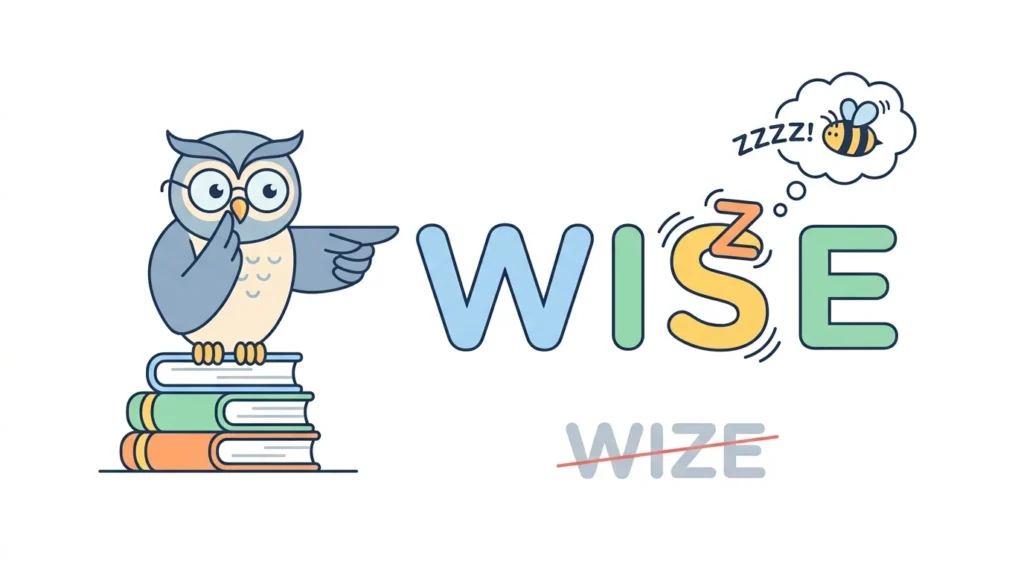
Wise vs Wize in Real English
Grammatically correct: “wise”
Wise is the natural modern choice when you mean sensible, experienced, or showing good judgment. It works comfortably in everyday speech, professional communication, academic writing, and formal prose. You can describe a person as wise, call a decision wise, or say that someone would be wise to do something. This is the form readers expect in normal modern English.
Grammatically possible in historical English: “wize”
Wize has a legitimate place in the history of English, but that does not make it a normal modern spelling. It is recorded as an obsolete form of wise. Therefore, you may encounter it while reading older texts or historical material. In modern writing, however, replacing wise with wize would look like a spelling error unless there is a special reason for the spelling.
Natural everyday English: “wise”
If you are writing a modern sentence and are unsure which form to choose, wise is the natural answer. A native or proficient English reader expects sentences such as “That was a wise decision” and “You would be wise to wait.” There is no modern everyday situation in which you need wize as an alternative spelling of this adjective. Use wize only when reproducing a specific name, historical spelling, or intentional creative form.
American vs. British English
There is no meaningful American-versus-British spelling difference between wise and wize.
Both American and British English use wise as the standard modern spelling.
For example:
- American English: “She made a wise decision.”
- British English: “She made a wise decision.”
The spelling does not change according to English variety.
This is different from genuine regional spelling pairs such as color/colour or favor/favour.
So if you are wondering whether wize might be the British version of wise, the answer is no.
Formal vs. Informal Usage
Wise works in both formal and informal English.
Formal
The committee made a wise decision after reviewing the evidence.
Professional
It would be wise to consider the long-term costs.
Academic
A wise interpretation should account for the limitations of the available evidence.
Informal
That was a wise move.
The spelling remains wise in all four settings.
Wize, on the other hand, should not be used simply to make ordinary writing sound informal. If you see it in a username, product name, brand, title, or other proper name, reproduce that specific spelling accurately. That is a naming choice, not evidence that wize is a standard alternative to wise.
Comparison Table
| Feature | Wise | Wize |
|---|---|---|
| Modern standard English | ✅ Yes | ❌ No |
| Standard spelling of the adjective | ✅ Yes | ❌ No |
| Meaning “showing good judgment” | ✅ Yes | ❌ Not as a modern standard form |
| Used in formal writing | ✅ Yes | ❌ Avoid |
| Used in everyday English | ✅ Yes | ❌ Avoid |
| Used in academic writing | ✅ Yes | ❌ Avoid |
| Used in professional writing | ✅ Yes | ❌ Avoid |
| Historical usage | Yes | Yes, as an obsolete form |
| May appear in names or branding | Yes | Yes, if officially styled that way |
| Recommended for modern writing | Yes | No |
The key distinction is between historical existence and modern standard usage. Saying that wize has appeared in English before is not the same as saying that it is an acceptable modern spelling.
Memory Trick
Use this simple mnemonic:
Wise people use S.
Think:
W-I-S-E = Wise
Even though the final sound is /z/, the word is spelled with S.
You can also remember:
Wise ends in “-ise,” not “-ize.”
This trick is useful because the mistake comes from hearing the /z/ sound and automatically choosing z.
Real-Life Situations
In an interview
Interviewer: “Why did you leave your previous position?”
Candidate: “I thought it would be wise to look for a role with more opportunities to grow.”
Here, wise describes a sensible decision.
In a business meeting
“It would be wise to review the budget before approving the project.”
The speaker is recommending a sensible action.
In an email
“I believe it would be wise to discuss the issue before making a final decision.”
This sounds natural and professional.
In a text message
“Taking an umbrella was a wise decision!”
The word remains wise even in casual communication.
In an exam
“The leader made a wise decision based on the available evidence.”
Again, wise is the correct spelling.
Read More: Waring vs Wearing: Which Word Is Correct?
Expert Tips
1. Do not spell English entirely by sound
English pronunciation can help, but it cannot always tell you the correct spelling.
Words such as wise demonstrate why.
2. Learn word families
Once you know wise, you can recognize related forms such as:
- wisely
- wisdom
- wiser
- wisest
- unwise
Learning related words can strengthen spelling memory.
3. Watch the final sound
When you hear /z/ at the end of a word, do not automatically write z.
English can represent that sound with different spellings.
4. Check whether a strange spelling is a name
If you see Wize online, first ask whether it is a brand, username, company, title, or other proper name.
A creative name does not change standard English spelling.
5. Pay attention to dictionary labels
A word marked obsolete should not automatically be treated as a modern alternative.
In this case, historical sources identify wize as an obsolete form of wise.
FAQ
Is “wize” a correct spelling of “wise”?
No, not in normal modern standard English. Wise is the standard spelling. Historical sources do record wize as an obsolete form of wise, but it is not the spelling you should normally use today.
Is “wize” a real English word?
It has a historical entry in English as an obsolete form of wise. So it is more accurate to say that it is an obsolete historical spelling than to claim that it has never existed. In modern everyday English, however, wise is the appropriate form.
Why is “wise” spelled with an S if it sounds like a Z?
Because English spelling does not always represent sounds with the letter you might expect. In wise, the final s represents a /z/ sound. The pronunciation therefore does not justify changing the spelling to wize.
Does “wise” mean intelligent?
Sometimes, but wise is more specific than simply “intelligent.” It usually suggests good judgment based on knowledge, experience, or careful thinking. Someone can be intelligent without always making wise decisions.
Can I use “wize” in a text message?
You can reproduce any intentional spelling in a name, username, joke, creative expression, or brand. But if you are simply trying to write the English adjective meaning sensible or experienced, use wise.
Is “wize” an American spelling?
No. Wize is not an American alternative to wise. American English uses wise.
Is “wize” a British spelling?
No. British English also uses wise. There is no standard British-versus-American distinction here.
Can “wise” be used as a verb?
Yes, although the verb is much less common than the adjective. Expressions such as wise up are more familiar in modern English. The adjective wise is by far the more common form.
What does “wise to” mean?
Wise to something means aware of or informed about it.
“She is wise to his plan.”
In this construction, wise means that she understands what is really happening.
What does “wise up” mean?
Wise up means to become aware of something, especially something that was previously misunderstood or hidden.
“You need to wise up before someone takes advantage of you.”
It is generally informal.
Should I write “wise decision” or “wize decision”?
Write wise decision.
✅ She made a wise decision.
❌ She made a wize decision.
Mini Quiz
| # | Question | Answer | Explanation |
|---|---|---|---|
| 1 | Which spelling is correct: wise or wize? | Wise | Wise is the standard modern spelling. |
| 2 | Fill in the blank: “It would be ___ to wait.” | wise | The adjective describes a sensible action. |
| 3 | Correct the sentence: “She gave me wize advice.” | She gave me wise advice. | The standard spelling is wise. |
| 4 | Which sentence is correct? A) He is wize. B) He is wise. | B | Wise is the modern standard form. |
| 5 | Fill in the blank: “That was a ___ investment.” | wise | A sensible investment can be described as wise. |
| 6 | Is wize an American spelling of wise? | No | American English uses wise. |
| 7 | Correct the sentence: “It was wize of her to leave early.” | It was wise of her to leave early. | Wise is the correct modern spelling. |
| 8 | What does “wise to something” mean? | Aware or informed about it | “Wise to” is an established expression meaning aware of something. |
| 9 | Which word is recorded as an obsolete historical form of wise? | Wize | Historical sources record wize as obsolete. |
| 10 | Fill in the blank: “My grandfather is very ___.” | wise | The word describes someone with good judgment and experience. |
Quick Summary
Wise is the correct modern English spelling when you mean sensible, experienced, knowledgeable, or capable of making good judgments. Wize is not a modern standard alternative. It is recorded historically as an obsolete form of wise, so it may appear in older material, but it should not normally be used in present-day writing. The pronunciation of wise can cause confusion because its final s sounds like /z/, but English spelling does not always match pronunciation letter for letter. There is no American-versus-British difference here: both varieties use wise. Use wise in conversations, emails, academic work, professional documents, and social media. If Wize appears as an official brand or name, preserve that specific spelling, but do not treat it as the standard spelling of the adjective.