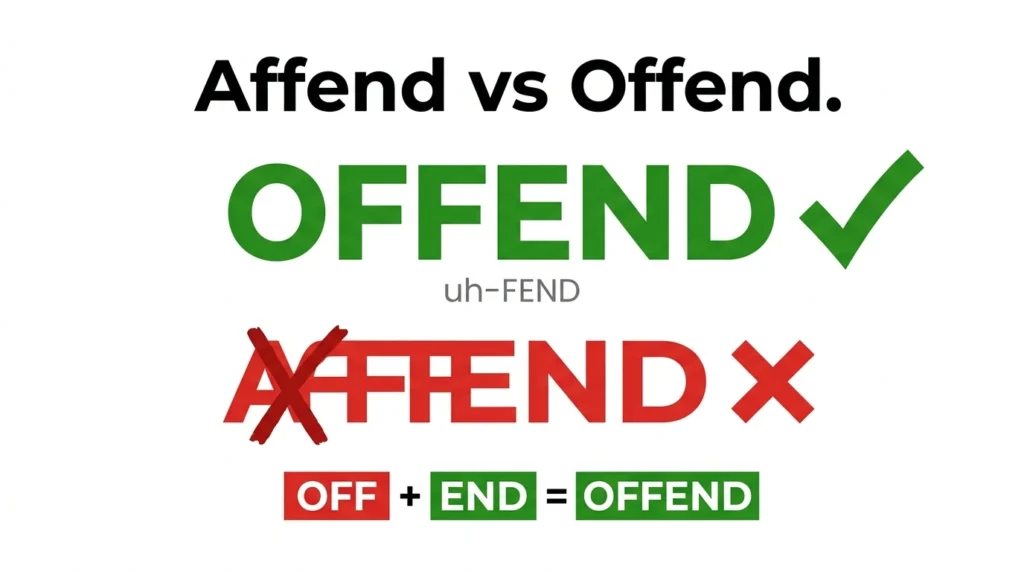

If you are choosing between affend and offend, use offend. Offend is the standard English verb. It means to make someone feel upset, angry, insulted, or hurt by something you say or do. Affend is not the standard spelling of this word. The confusion usually comes from the way offend is pronounced: its first syllable has a weak sound, so some learners hear it as “uh-fend” and spell it with a instead of o.
What Is the Difference Between Affend and Offend?
The difference is straightforward:
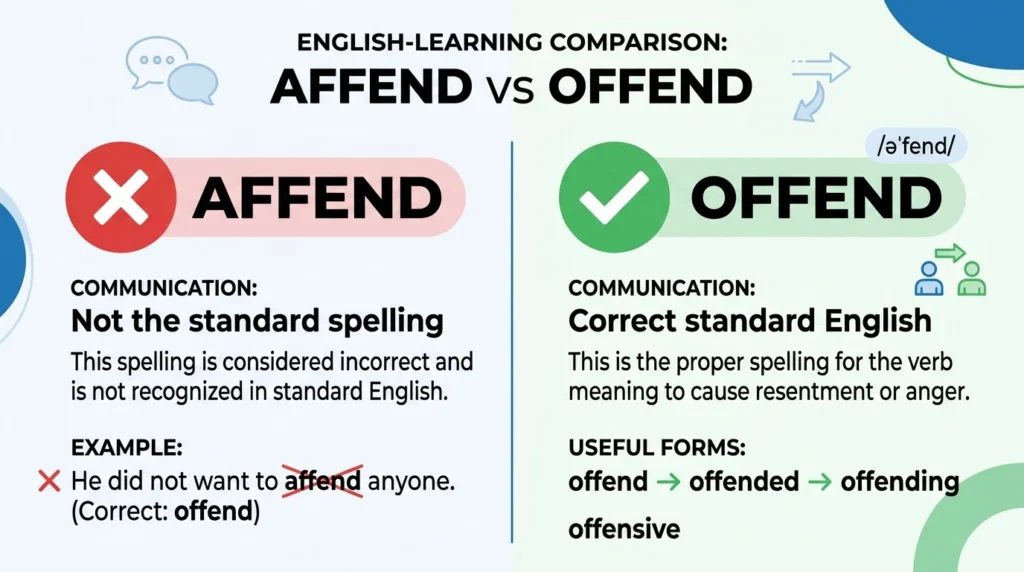
- Offend is the correct standard English word.
- Affend is not the standard spelling of the verb.
- Offend is used when someone causes another person to feel upset, insulted, angry, or disrespected.
- The common related forms are offended, offending, offensive, offender, offense in American English, and offence as the noun in British English.
For example:
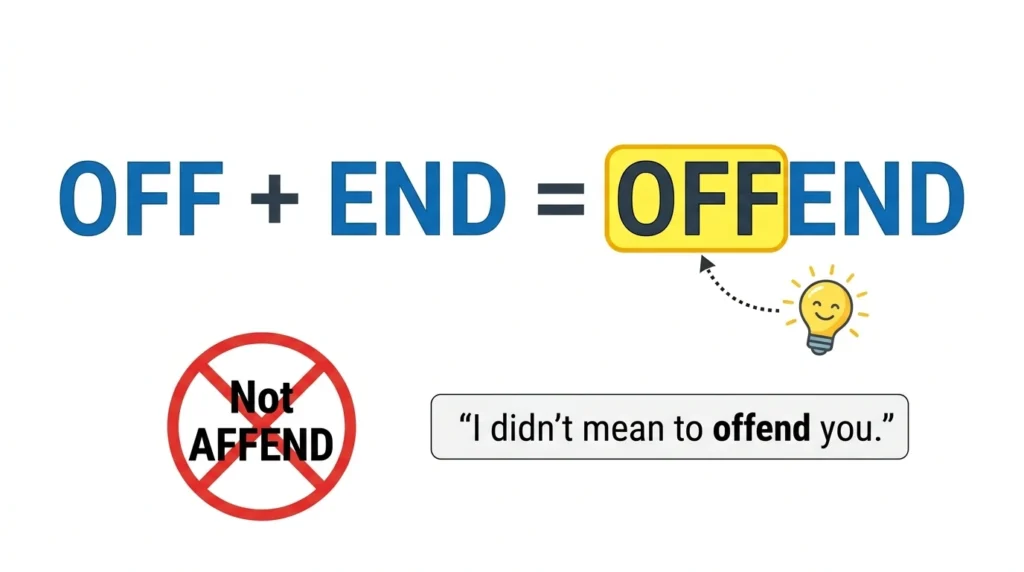
I didn’t mean to offend you.
Not:
I didn’t mean to affend you.
The spelling offend is used in both American and British English. There is a regional difference in the related noun: American English normally uses offense, while British English normally uses offence. The verb itself does not change.
Why Does “Affend” Look Right to Some People?
The mistake makes sense once you look at pronunciation.
Offend is pronounced approximately uh-FEND, with the stress on the second syllable. The first vowel is weak, so when people hear the word quickly, the beginning may not sound like a strong o. A learner may therefore write affend because that spelling seems to match what they hear.
This is a common problem in English because spelling and pronunciation do not always match perfectly.
Compare:
- offend → /əˈfend/
- offended → /əˈfendɪd/
- offending → /əˈfendɪŋ/
The correct spelling still begins with off-, even though the first vowel is pronounced weakly.
Read More: Whose vs Whos: Which Is Correct? Easy Grammar Guide.
Pronunciation Is Not Always a Reliable Spelling Guide
If you try to spell every English word exactly as it sounds, you will eventually make mistakes.
The important point here is that offend is not spelled the way its first unstressed syllable may sound.
So:
Sound: uh-FEND
Correct spelling: offend
Not:
Sound: uh-FEND
Guessed spelling: affend
The pronunciation explains the mistake, but it does not make affend an alternative spelling.
The Core Rule
Use offend when you mean “to upset, insult, or hurt someone’s feelings.” Do not replace the first “o” with “a.”
The spelling is:
O-F-F-E-N-D
There are two f letters.
Remember the Basic Pattern
OFF + END = OFFEND
This is not the historical breakdown of the word, but it is a useful spelling aid.
If you can remember off, you can remember the beginning of offend.
What Does “Offend” Mean?
Offend is a verb. In its most common use, it means to make someone feel upset, angry, insulted, or hurt because of something you say or do. It can happen intentionally or accidentally.
For example:
I didn’t mean to offend you.
The speaker is saying that they did not intend to hurt or insult the other person.
Offend Someone
The most common pattern is:
offend + person
Examples:
- She offended her colleague.
- His comment offended me.
- The joke offended several guests.
- I hope I didn’t offend anyone.
- They were worried that the advertisement might offend customers.
Be Offended
You can also use the passive form be offended when focusing on the person who feels hurt or insulted.
Examples:
- She was offended by his comment.
- He looked offended.
- Several customers were offended by the advertisement.
- I was not offended by the question.
Offend Against Something
In more formal English, especially British usage, offend against can mean to go against a moral principle, belief, or accepted standard.
For example:
The comments offended against their religious beliefs.
This construction is much less common in everyday conversation than offend someone. Oxford also records offend as a formal verb meaning to commit a crime.
How to Use “Offend” Correctly
The simplest everyday pattern is:
subject + offend + person
For example:
His comment offended his manager.
You can also use may, might, could, or would before the verb when talking about a possible reaction.
That joke might offend some people.
You can use didn’t mean to when explaining that you did not intend to cause offense.
I didn’t mean to offend you.
And you can use be offended by when describing the person affected.
She was offended by the remark.
Correct Verb Forms
| Form | Example |
|---|---|
| Base form | offend |
| Third-person singular | offends |
| Past tense | offended |
| Past participle | offended |
| -ing form | offending |
Examples:
- I try not to offend people.
- His behavior offends his coworkers.
- She offended her friend without realizing it.
- He has offended several customers.
- They are offending people with their comments.
The standard verb forms are documented consistently in major learner dictionaries.
Read More: To Bad vs Too Bad: Which Is Correct?
Correct Examples
Here are original examples showing how offend works in different situations.
- Conversation:
I hope that question didn’t offend you. - Email:
I apologize if my previous message offended anyone. - Workplace:
The manager reminded everyone to avoid jokes that could offend coworkers. - School:
The student apologized after realizing that his comment had offended another student. - Academic writing:
The author examines how certain forms of language may offend different audiences. - Social media:
The creator deleted the post after realizing that some viewers found it offensive. - Customer service:
We are sorry if our wording offended you. - Friendship:
I didn’t intend to offend her when I disagreed with her idea. - Public speaking:
Speakers should think carefully before making comments that could offend members of the audience. - Family:
He was worried that his honest answer might offend his parents. - Business:
The company reviewed the advertisement because some customers felt offended by it. - Everyday English:
Don’t worry. You didn’t offend me.
Incorrect vs. Correct
| ❌ Incorrect | ✅ Correct | Why |
|---|---|---|
| I didn’t mean to affend you. | I didn’t mean to offend you. | The standard verb is offend. |
| She was affended by the joke. | She was offended by the joke. | The past form is offended. |
| His comment may affend people. | His comment may offend people. | The base verb is offend. |
| Don’t affend your guests. | Don’t offend your guests. | Use offend for causing hurt or insult. |
| I hope I didn’t affend him. | I hope I didn’t offend him. | Affend is not the standard spelling. |
| That remark affends me. | That remark offends me. | The third-person form is offends. |
| They are affending customers. | They are offending customers. | The -ing form is offending. |
| She has affended several people. | She has offended several people. | The past participle is offended. |
| The joke was affensive. | The joke was offensive. | The related adjective is offensive. |
| No affense was intended. | No offense was intended. | American English uses offense; British English uses offence. |
Why People Make This Mistake
There is no complicated grammar rule behind affend. It is mainly a spelling problem.
1. The First Sound Is Weak
The pronunciation of offend begins with a weak vowel sound, represented in dictionaries as /ə/. This can make the beginning sound less clearly like the letter o.
2. People Spell What They Hear
English learners sometimes hear:
uh-FEND
and write:
affend
But pronunciation alone cannot tell you the spelling.
3. The Two Spellings Look Extremely Similar
Only the first vowel changes:
affend
offend
When a spelling mistake differs by only one letter, it can be easy to overlook during proofreading.
4. English Has Many Words Beginning With “A”
Learners see common words such as:
- affect
- attend
- arrange
- appear
- avoid
That may make affend look familiar even though it is not the standard spelling of this verb.
5. Autocomplete Is Not a Grammar Teacher
Typing tools can reduce errors, but they should not replace knowledge of spelling. A word appearing in a search suggestion, user-generated post, or informal message does not establish that it is standard English.
6. Translation Can Contribute to Spelling Errors
Learners who first encounter English through another language may map unfamiliar sounds onto the spelling patterns of their first language. This can encourage phonetic spelling guesses such as affend.
Common Mistakes Checklist
Mistake 1: Writing “Affend”
Problem: The first vowel is changed from o to a.
Avoid it: Remember OFF + END = OFFEND.
Mistake 2: Writing “Ofend”
Problem: One f is missing.
Correct: offend
The word contains two f letters.
Mistake 3: Writing “Affended”
Problem: The incorrect base spelling is carried into the past tense.
Correct: offended
Mistake 4: Writing “Affensive”
Problem: The spelling mistake spreads into a related word.
Correct: offensive
Mistake 5: Confusing “Offend” With “Hurt”
Problem: Offend usually concerns emotional upset, insult, displeasure, or violation of a moral or accepted standard. It is not normally used for ordinary physical injury.
❌ He offended his arm.
✅ He hurt his arm.
Affend vs Offend in Real English
This is where the distinction becomes especially useful.
Offend — Grammatically Correct and Natural
Offend is an ordinary English verb used naturally in conversation and writing.
I didn’t mean to offend you.
This sounds normal in everyday English.
The advertisement could offend some viewers.
This is also natural in professional or public communication.
The verb works in casual conversation, workplace writing, education, journalism, and formal contexts. Its register changes according to the surrounding sentence, but the word itself is not restricted to one level of formality.
Read More: Requester vs Requestor: Which Spelling Is Correct?
Affend — Not a Standard Alternative
Affend is not a second, less formal version of offend.
You should not think:
offend = formal
affend = informal
That is not how the two spellings work.
If you mean the verb describing emotional offense, use offend.
“Offended” Is Natural When Describing a Reaction
English frequently uses offended as an adjective to describe someone’s emotional response.
She looked offended.
He seemed offended by the question.
Here, offended describes how someone feels or appears to feel.
“Offensive” Describes the Cause
Offensive is an adjective meaning that something is likely to cause offense or is insulting or unpleasant.
That comment was offensive.
The distinction is useful:
offend → verb
offended → describes the person who feels hurt or insulted
offensive → describes something that causes or is likely to cause offense
This word family is documented in dictionary usage.
American vs. British English
There is no spelling difference between American and British English for the verb offend.
Both use:
offend
Both use:
offended
Both use:
offending
The regional difference appears in the related noun:
| Form | American English | British English |
|---|---|---|
| Verb | offend | offend |
| Past | offended | offended |
| -ing form | offending | offending |
| Noun | offense | offence |
| Adjective | offensive | offensive |
So if you are writing “I didn’t mean to offend you,” the spelling is the same in both varieties.
Formal vs. Informal Usage
Offend works in both informal and formal English.
Informal
Sorry, I didn’t mean to offend you.
I hope I didn’t offend anyone.
Professional
We apologize if the wording of the announcement offended any members of the community.
Academic
Certain forms of language may offend readers depending on their cultural or social context.
The difference is not the verb itself. Formal writing usually uses more carefully constructed sentences and more precise context around it.
A particularly formal use is offend against, meaning to go against a moral principle, belief, or accepted standard. This construction is much less common in ordinary conversation.
Comparison Table
| Feature | Affend | Offend |
|---|---|---|
| Standard English spelling | No | Yes |
| Part of speech | Not a standard form of this verb | Verb |
| Meaning | — | To upset, insult, or hurt someone’s feelings |
| Common in conversation | No | Yes |
| Common in professional writing | No | Yes |
| Past form | — | offended |
| -ing form | — | offending |
| Related adjective | — | offensive |
| American noun | — | offense |
| British noun | — | offence |
Offend vs. Insult
Offend and insult overlap, but they are not exactly the same.
To offend someone is to cause them to feel upset, angry, insulted, or hurt.
To insult someone generally means to say or do something disrespectful or offensive toward them.
Importantly, a person can be offended without someone deliberately trying to insult them.
For example:
I accidentally offended my colleague by forgetting her name.
The speaker may not have intended an insult.
This is why offend is broader than simply describing a deliberate insult.
Offend vs. Upset
Upset is a broader word.
A person can be upset because of:
- bad news
- disappointment
- fear
- stress
- an argument
- an insult
Offend is more specific. It usually involves something that causes a person to feel insulted, disrespected, or personally hurt.
For example:
The bad news upset him.
But:
The rude comment offended him.
The two words can overlap, but they are not interchangeable in every situation.
Read Most: Programming vs Programing: Which Spelling Is Correct?
Offend vs. Disrespect
Disrespect focuses more strongly on a lack of respect.
Offend focuses on the reaction or displeasure caused by something.
For example:
His behavior was disrespectful.
This describes the behavior.
His behavior offended the teacher.
This describes the effect on the teacher.
One action can therefore be both disrespectful and offensive.
Memory Trick
Use this:
OFF + END = OFFEND
Then connect it to:
An offensive comment can turn people OFF.
The purpose of this mnemonic is simply to keep the correct spelling in your memory. It is not an explanation of the word’s historical origin.
Real-Life Situations
In an Interview
Interviewer: Some people may disagree with your opinion. How would you respond?
Candidate: I would explain my position respectfully because I don’t want to unnecessarily offend anyone.
In a Meeting
The manager reminded the team that humor can sometimes offend colleagues, especially when people have different backgrounds.
In an Email
I apologize if my previous email offended you. That was not my intention.
In a Text Message
Sorry! I didn’t mean to offend you.
In an Exam
Question: Choose the correct spelling.
A. affend
B. offend
Answer: B. offend
In Social Media Writing
Before posting a joke, consider whether it could offend people who read it without knowing the context.
Expert Tips
Tip 1: Learn the Word Family
Instead of memorizing only offend, learn the connected forms:
offend → offended → offending → offensive → offense/offence
This creates several spelling anchors in your memory.
Tip 2: Remember the Double F
Many learners remember the first o but forget one f.
Correct:
offend
Not:
ofend
Tip 3: Don’t Let Pronunciation Change the Spelling
The beginning may sound like uh-, but the spelling begins with o.
Tip 4: Learn the Phrase “I Didn’t Mean to Offend You”
This is one of the most useful everyday patterns because it teaches both meaning and grammar at the same time.
Tip 5: Watch the Word After “Offend”
A person can offend:
- someone
- a group
- an audience
- customers
- readers
- viewers
You will often see offend + person/group or be offended by + thing/action.
Tip 6: Check the Related Noun Separately
If you are writing American English, use offense.
If you are writing British English, offence is standard.
Do not change the verb to affend just because the noun has a different spelling.
FAQ
Is “affend” a correct English word?
No. Affend is not the standard spelling of the English verb meaning to upset, insult, or hurt someone’s feelings. The correct spelling is offend.
Why do people spell offend as affend?
The most likely reason is pronunciation. Offend is pronounced /əˈfend/, so the first syllable can sound like a weak “uh” sound. A learner may hear that sound and guess affend.
Is offend a verb or an adjective?
Offend is a verb.
For example:
I didn’t mean to offend you.
Offended can function as an adjective when describing someone’s emotional state:
She looked offended.
Offensive is an adjective:
The comment was offensive.
What is the past tense of offend?
The past tense is offended.
His comment offended me.
The past participle is also offended:
She has offended several people.
Is it “offend someone” or “offend to someone”?
The normal construction is offend someone, without to.
Correct:
I didn’t mean to offend her.
Not:
I didn’t mean to offend to her.
Is “offended by” correct?
Yes. Be offended by is a common construction.
He was offended by the comment.
It identifies the thing that caused the person’s reaction.
Is “offensive” the same as “offended”?
No.
Offended normally describes the person experiencing the reaction:
She was offended.
Offensive describes something that causes or is likely to cause offense:
The remark was offensive.
Is “offense” or “offence” correct?
Both are correct regional spellings. Offense is standard in American English, while offence is standard in British English. The verb remains offend in both varieties.
Can I use offend in formal writing?
Yes. Offend is suitable for formal, professional, academic, and everyday writing. More formal constructions such as offend against also exist, but ordinary sentences such as “The remark offended several readers” are perfectly appropriate.
Can you offend someone accidentally?
Yes. Offending someone does not require deliberate intent.
I didn’t mean to offend him.
This sentence specifically communicates that the speaker caused offense unintentionally.
What is the easiest way to remember offend?
Remember:
OFF + END = OFFEND
The word begins with off, not aff.
Mini Quiz
| # | Question | Answer | Explanation |
|---|---|---|---|
| 1 | Choose the correct spelling: “I didn’t mean to ___ you.” A) affend B) offend | B) offend | Offend is the standard spelling. |
| 2 | Fill in the blank: “She was ___ by his comment.” | offended | The past form is offended. |
| 3 | Correct the sentence: “His joke may affend some people.” | His joke may offend some people. | The base verb is offend. |
| 4 | Choose the correct form: “The remark was ___.” A) offended B) offensive | B) offensive | Offensive describes something that causes or is likely to cause offense. |
| 5 | Fill in the blank: “I hope I didn’t ___ anyone.” | offend | After didn’t, use the base form offend. |
| 6 | Which is correct? A) ofend B) offend C) affend | B) offend | Offend has two f letters and begins with o. |
| 7 | Correct the sentence: “She has affended several customers.” | She has offended several customers. | The past participle is offended. |
| 8 | Which sentence is correct? A) He offended his arm. B) He hurt his arm. | B) He hurt his arm. | Offend normally concerns emotional offense, not ordinary physical injury. |
| 9 | Choose the correct sentence: A) I didn’t mean to offend her. B) I didn’t mean to offend to her. | A) I didn’t mean to offend her. | The normal construction is offend someone, without to. |
| 10 | Complete the sentence: “The comment was ___, so several readers complained.” A) offended B) offensive | B) offensive | Offensive describes the comment; offended would describe the people who reacted to it. |
Quick Summary
Offend is the correct standard English spelling. Affend is not the standard spelling of the verb. Use offend when you mean to make someone feel upset, angry, insulted, or hurt by something you say or do. The word is pronounced /əˈfend/, which helps explain why some learners hear the first syllable as “uh” and spell it incorrectly with a. The main forms are offend, offends, offended, and offending. Related words include offended, offensive, offender, offense, and offence. American English normally uses offense, while British English uses offence, but the verb offend is spelled the same in both varieties. When in doubt, remember: OFF + END = OFFEND.