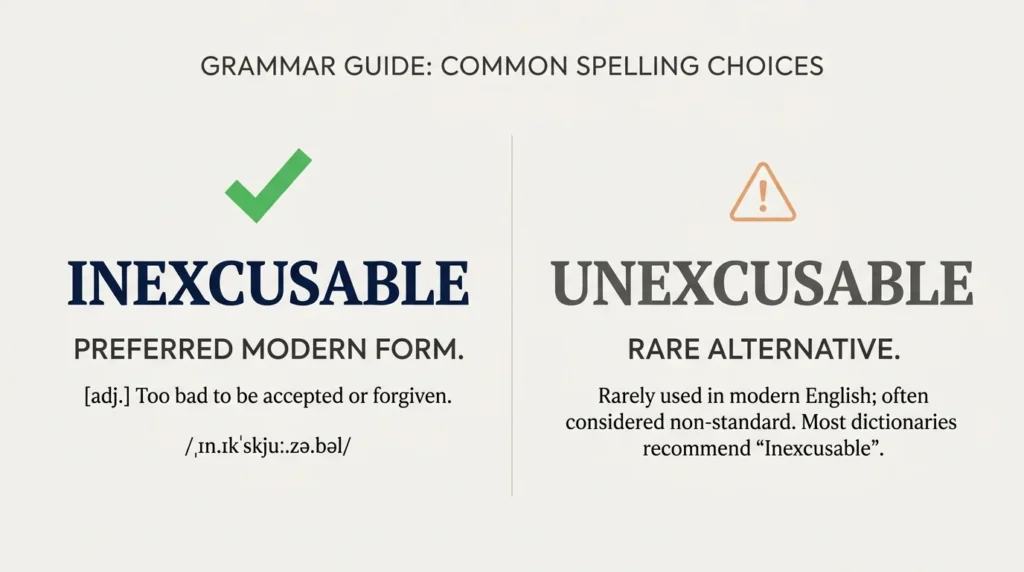

Inexcusable is the standard and natural word in modern English. It means impossible to excuse, justify, or accept. Unexcusable also exists and has essentially the same meaning, so calling it a nonexistent word is inaccurate. However, it is much less usual. For clear, polished English, use inexcusable in everyday, academic, professional, and formal writing.
Example:
✅ The manager described the safety violation as inexcusable.
What Is the Difference Between Inexcusable and Unexcusable?
The difference between inexcusable and unexcusable is mainly one of established usage rather than basic meaning.
Inexcusable is an adjective meaning that something cannot reasonably be excused or justified. It is the familiar form used when condemning serious behavior, negligence, mistakes, delays, or failures. Major dictionaries define it in terms such as being impossible to excuse, justify, or tolerate.
Unexcusable is also an adjective. It was formed from un- + excusable and is recorded as meaning inexcusable. It is therefore misleading to say that unexcusable is simply “not a word.” The practical problem is that it is far less established in present-day standard usage.
Compare:
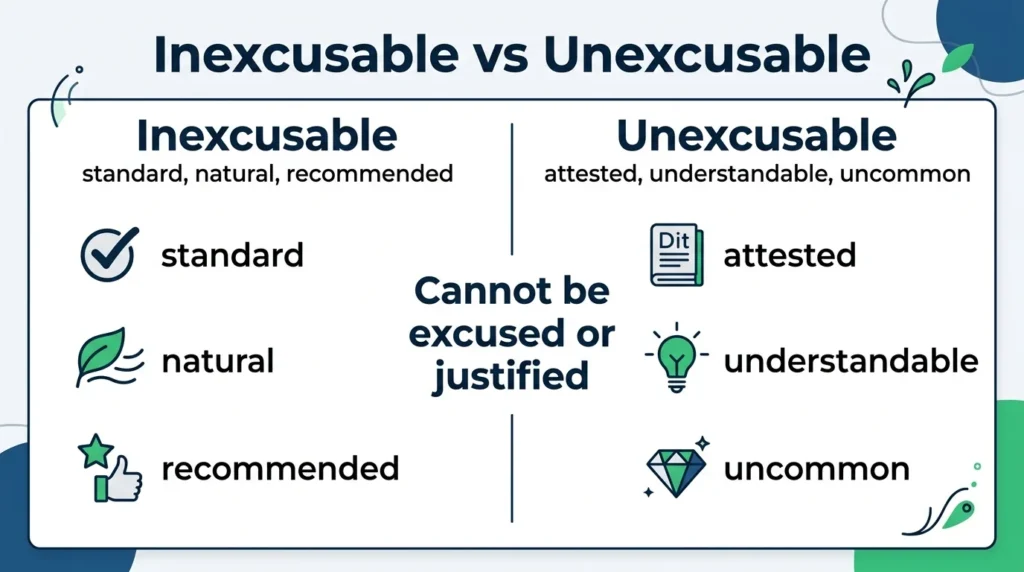
- inexcusable behavior — standard and natural
- an inexcusable delay — standard and natural
- unexcusable behavior — understandable but unusual
- an unexcusable delay — understandable but normally edited to inexcusable
So if your question is simply “Which should I write?”, choose inexcusable.
Why It Matters
Using unexcusable will not usually prevent someone from understanding you. The meaning is transparent.
The problem is perception.
In an exam, business email, report, academic paper, application, or published article, an unusual form can make a reader wonder whether you have made a spelling mistake. That distraction weakens otherwise clear writing.
There is also a second issue that writers sometimes miss: inexcusable is a strong word. It does more than say that something was inconvenient or incorrect. It communicates that the action or situation is so bad that the speaker believes it cannot reasonably be justified.
Compare:
The ten-minute delay was inconvenient.
with:
The ten-minute delay was inexcusable.
The second sentence makes a much stronger judgment.
Correct word choice therefore involves both spelling and tone.
The Core Rule
Rule: Use inexcusable when you mean “too wrong, bad, or unjustified to be excused.” Although unexcusable exists, it is an uncommon alternative and is normally best avoided in polished modern English.
Think of the practical contrast this way:
excusable → inexcusable
Something excusable can reasonably be forgiven or justified.
Something inexcusable cannot.
How to Use Inexcusable Correctly
Inexcusable is an adjective, which means it describes a person, action, behavior, mistake, situation, decision, or other noun.
Before a noun
Place inexcusable directly before the noun it describes.
- an inexcusable mistake
- inexcusable behavior
- an inexcusable failure
- inexcusable negligence
Example:
The audit revealed an inexcusable failure to follow basic safety procedures.
After a linking verb
It commonly follows linking verbs such as be, seem, or become.
His behavior was inexcusable.
Such carelessness seems inexcusable.
With a “that” clause
You can also use this pattern:
It is inexcusable that the complaints remained unanswered for three months.
Here, inexcusable evaluates the entire situation described by the clause.
Use the adverb “inexcusably” when describing an action or quality
The related adverb is inexcusably.
The company was inexcusably slow to respond.
He behaved inexcusably during the meeting.
The standard derived adverb is inexcusably.
A simple five-step test
When deciding whether to use the word:
- Ask whether you mean “cannot reasonably be excused or justified.”
- If yes, choose inexcusable.
- Check whether your judgment is genuinely strong enough for the word.
- Use inexcusable before a noun or after a linking verb.
- Use inexcusably when you need an adverb instead.
Correct Examples of Inexcusable
Here are original examples showing how the word works in different situations.
Everyday conversation
- Leaving a child alone in that situation would be inexcusable.
- I understand that mistakes happen, but deliberately hiding the truth was inexcusable.
- The repeated failure to respond to the client’s requests is inexcusable.
- We consider the disclosure of confidential information inexcusable and are reviewing what happened.
School
- Copying another student’s work and submitting it as your own is inexcusable.
- The teacher said the cruel comments were inexcusable, regardless of who started the argument.
Workplace
- Ignoring three separate safety warnings was an inexcusable management failure.
- The report identified an inexcusable lack of oversight during the project.
Social media
- Disagreeing with someone is fine; threatening them is inexcusable.
- That response to a genuine customer complaint was completely inexcusable.
Academic and analytical writing
- The researchers argued that knowingly removing contradictory evidence would constitute inexcusable misconduct.
- When reliable data are readily available, deliberately misrepresenting them is inexcusable.
Notice that inexcusable is normally connected with something the writer considers seriously unacceptable, not merely imperfect.
Read More: Nonresponsive vs Unresponsive: Both Are Correct; Context Decides
Incorrect vs. Correct Usage
Because unexcusable is an attested word, the ❌ symbol below does not always mean that the expression is impossible English. In several examples, it means poor choice for standard polished usage.
| Situation | ❌ Incorrect or weak | ✅ Correct | Why |
|---|---|---|---|
| Professional writing | The error was unexcusable. | The error was inexcusable. | Unexcusable exists, but inexcusable is the established standard choice. |
| Academic writing | This was an unexcusable omission. | This was an inexcusable omission. | Academic prose benefits from the conventional form readers expect. |
| Workplace email | Your conduct is unexcusable. | Your conduct is inexcusable. | The second form sounds natural and polished. |
| Spelling | The delay was inexcuseable. | The delay was inexcusable. | Do not add an extra e before -able. |
| Spelling | Such behavior is inexscusable. | Such behavior is inexcusable. | The correct spelling contains in + excusable. |
| Adverb | She acted inexcusablely. | She acted inexcusably. | The standard adverb is inexcusably. |
| Sentence structure | It was inexcusable of the delay. | The delay was inexcusable. | The adjective must describe the delay rather than use this faulty of construction. |
| Word form | He behaved inexcusable. | He behaved inexcusably. | An adverb is needed to modify behaved. |
| Meaning | The typo was mildly inexcusable. | The typo was careless. | Inexcusable expresses strong condemnation; mildly inexcusable is often an awkward mismatch. |
| Register | The coffee being lukewarm was absolutely inexcusable. | The coffee being lukewarm was disappointing. | Unless the context genuinely warrants outrage, inexcusable can sound exaggerated. |
Why People Confuse Inexcusable and Unexcusable
Both prefixes can mean “not”
English frequently uses both in- and un- to create negative meanings.
Examples include:
- accurate → inaccurate
- complete → incomplete
- acceptable → unacceptable
- fair → unfair
A learner may therefore reason:
excusable → unexcusable
That formation is logically understandable.
English vocabulary, however, is not built by one completely predictable prefix rule. Individual words become established through historical development and repeated usage. In this case, inexcusable became the conventional form, while unexcusable remained much less usual. The standard form ultimately reflects a word with a long history derived from Latin inexcusabilis.
The two forms look almost identical
Both words contain the entire base word excusable.
Only the opening prefix changes:
- in + excusable
- un + excusable
Because readers recognize the meaningful base word instantly, unexcusable can look plausible even when it is not the form they would normally use.
The prefixes can become less noticeable in speech
The opening syllables are not the most important part of the spoken word. In quick conversation, listeners are often focused on the recognizable excusable portion and the sentence’s meaning.
That can make it harder for learners to remember which negative prefix belongs to the conventional written form.
Writers overgeneralize the “un-” pattern
The prefix un- is extremely productive in English:
- unhappy
- unfair
- unnecessary
- unacceptable
- unavoidable
- unbelievable
A learner may assume that any adjective can simply take un- to create its opposite.
It does not always work that way.
English has conventional pairings that must often be learned as complete words rather than generated mechanically.
Spellcheck is not a perfect judge of natural English
A spellchecker may not flag every rare dictionary word.
That does not mean the word is the best choice for the sentence.
Spelling software mainly answers questions such as “Does this sequence exist in my dictionary?” It cannot always answer the more useful question:
“Is this the form an experienced writer would normally choose here?”
That distinction matters with unexcusable.
Translation can encourage literal prefix building
Some English learners first construct an idea such as “not excusable” and then search for an English negative prefix.
Because un- commonly means “not,” unexcusable may seem like the obvious result.
A more reliable learning method is to memorize the full contrast:
excusable ↔ inexcusable
rather than trying to rebuild the negative word each time.
Common Mistakes Checklist
Before publishing your sentence, check for these problems:
- Using “unexcusable” simply because it looks logical.
It is understandable and attested, but inexcusable is the conventional modern choice. - Writing “inexcuseable.”
The correct spelling is inexcusable, not inexcuseable. - Using an adjective where an adverb is required.
Write “He behaved inexcusably,” not “He behaved inexcusable.” - Treating “inexcusable” as a mild synonym for “bad.”
It normally communicates serious criticism. - Assuming every negative adjective takes “un-.”
English uses several negative prefixes, including un-, in-, im-, il-, and ir-. - Trusting spellcheck more than normal usage.
A word can appear in a dictionary and still be a poor stylistic choice for ordinary prose. - Calling “unexcusable” completely nonexistent.
That explanation goes too far. It is recorded as an adjective meaning inexcusable. - Using “inexcusable” for trivial inconveniences without considering tone.
Choose annoying, inconvenient, careless, or disappointing when the situation does not deserve strong condemnation.
Inexcusable vs Unexcusable in Real English
Grammatically correct and fully natural
Inexcusable is both structurally correct and natural in modern English. You can confidently use expressions such as inexcusable conduct, an inexcusable mistake, and the failure was inexcusable. It works in conversation, journalism, business, education, and formal prose. Because the adjective carries strong disapproval, its naturalness depends not only on grammar but also on whether the situation genuinely deserves such a forceful judgment.
Grammatically possible but unusual
Unexcusable is more complicated than a simple spelling error. It is recorded as an adjective with the meaning inexcusable. Nevertheless, it is unusual enough that many readers may interpret it as a mistaken formation. For that reason, using it intentionally rarely gives a modern writer any advantage. Unless you are quoting wording that already contains it or discussing the word itself, inexcusable is the safer choice.
Natural everyday English
In everyday speech, inexcusable sounds natural when someone wants to express strong disapproval: “What he did was inexcusable.” For less serious problems, speakers often choose milder expressions such as not okay, unacceptable, really bad, or hard to justify. Knowing the correct word is only half the skill; natural English also means choosing a level of criticism that matches the situation.
Formal vs. Informal Usage
Formal writing
Inexcusable is appropriate in professional, academic, legal-adjacent, journalistic, and official contexts when a strong judgment is justified.
Examples:
The committee described the failure to disclose the conflict as inexcusable.
Repeatedly ignoring the documented risk represented an inexcusable lapse in judgment.
For highly analytical writing, consider whether a more precise term would be better.
Depending on your meaning, alternatives include:
- unjustifiable — cannot be supported with good reasons
- indefensible — cannot reasonably be defended
- unacceptable — fails to meet an acceptable standard
- negligent — involving a failure to exercise proper care
- unforgivable — emphasizes forgiveness rather than justification
Informal writing and conversation
Inexcusable also works in ordinary conversation:
Cancelling after everyone arrived was inexcusable.
However, it sounds forceful.
If you only want to express annoyance, a milder sentence may sound more natural:
Cancelling that late was really inconsiderate.
The distinction is not about formal grammar. It is about strength and tone.
Inexcusable vs Unexcusable Comparison Table
| Feature | Inexcusable | Unexcusable |
|---|---|---|
| Part of speech | Adjective | Adjective |
| Basic meaning | Cannot be excused or justified | Essentially the same |
| Dictionary-attested | Yes | Yes |
| Standard modern choice | Yes | Rare/unusual alternative |
| Natural in professional writing | Yes | Usually avoided |
| Natural in academic writing | Yes | Usually avoided |
| Natural in conversation | Yes, especially for strong criticism | Unusual |
| Likely to be mistaken for an error | No | Yes |
| Recommended for exams | Yes | No |
| Recommended default | Use this form | Replace with inexcusable in most writing |
The distinction is therefore less about two competing meanings and more about which form modern English has conventionalized.
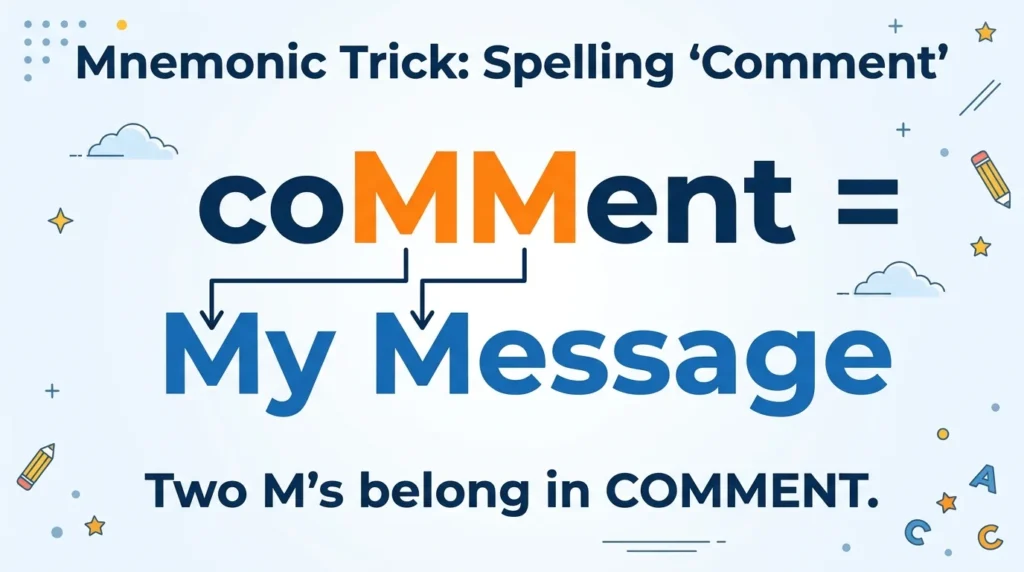
Memory Trick
Remember this sentence:
No excuse IN sight? Use INexcusable.
Both IN and inexcusable begin the same way.
You can also memorize the pair rather than the prefix rule:
excusable → inexcusable
Once that pair becomes familiar, there is no need to decide between in- and un- each time you write it.
Real-Life Situations
Interview
You are discussing workplace ethics:
“Falsifying safety records would be inexcusable, regardless of the pressure to meet a deadline.”
The word works because you are describing conduct that cannot reasonably be justified.
Meeting
A manager discusses a serious operational failure:
“One missed message is understandable. Ignoring repeated warnings for six weeks is inexcusable.”
The contrast makes the strength of the adjective clear.
You need to complain professionally:
“The continued disclosure of customer information after the issue was reported is inexcusable.”
For a minor inconvenience, however, unacceptable or disappointing may sound more measured.
Text message
A friend deliberately humiliates someone:
“Being angry doesn’t excuse what he posted. That was inexcusable.”
The sentence sounds natural because the speaker is making a strong moral judgment.
Exam
The question asks you to complete the sentence:
“The deliberate destruction of the evidence was ______.”
Choose:
inexcusable
Do not create unexcusable simply because un- commonly forms negative adjectives.
Read More: Scoup vs Scoop: Which Spelling Is Correct?
Expert Tips
Learn whole word pairs, not just prefix rules
Negative prefixes are useful, but English contains too many conventional forms to rely on a single formula.
Memorize:
excusable / inexcusable
in the same way you might memorize:
possible / impossible
legal / illegal
responsible / irresponsible
This is often faster than trying to calculate the correct prefix.
Separate “Is it a word?” from “Should I use it?”
These are different questions.
Is unexcusable a word?
Yes, it is recorded.
Should I normally use it?
No. Inexcusable is the better default.
This distinction is useful far beyond this particular word. Dictionaries record language that exists; good editing also considers frequency, audience expectations, register, clarity, and natural usage.
Watch the strength of your judgment
Consider three levels:
- The delay was inconvenient.
- The delay was unacceptable.
- The delay was inexcusable.
These sentences do not communicate exactly the same emotional force.
The third suggests that no reasonable excuse can justify what happened.
Use a more precise synonym when possible
Strong vocabulary is most effective when it is specific.
Instead of automatically writing inexcusable, ask what you really mean.
If the problem cannot be logically justified, use unjustifiable.
If it violates an acceptable standard, use unacceptable.
If it cannot reasonably be defended, use indefensible.
If you specifically mean that it cannot be forgiven, unforgivable may fit better.
Do not “correct” historical or quoted wording silently
If a source genuinely uses unexcusable, remember that the form exists.
When quoting, preserve the original wording unless your editing rules specifically allow alteration. When writing your own modern prose, use inexcusable.
Quick Summary
Inexcusable is the standard word to use when something is too wrong, serious, or unjustified to be excused. Unexcusable is also an attested English word, so it is inaccurate to dismiss it as completely nonexistent, but it is an unusual alternative and can easily look like a mistake. For emails, exams, academic papers, workplace communication, and normal conversation, choose inexcusable. Remember that the word carries strong criticism, so do not use it automatically for every minor problem. The adjective can appear before a noun (an inexcusable mistake) or after a linking verb (the mistake was inexcusable). When you need an adverb, use inexcusably. The easiest memory trick is: No excuse IN sight? Use INexcusable.
FAQ
Is unexcusable a real word?
Yes. Unexcusable is recorded as an adjective meaning essentially the same thing as inexcusable. It should therefore not be described as completely nonexistent. However, it is an uncommon choice compared with inexcusable, which is the form most writers should use.
Is unexcusable grammatically incorrect?
Not in the simple sense that it has no standing in English. It is an attested word with recognizable grammatical structure and meaning.
The more useful advice is that inexcusable is the conventional form for normal modern writing. Choosing it avoids making readers wonder whether unexcusable is an accidental spelling or prefix error.
Which is correct: inexcusable or unexcusable?
If you need one answer for ordinary writing, choose inexcusable.
Both forms have been recorded, but inexcusable is the established and natural choice for professional, academic, formal, and everyday English.
What does inexcusable mean in simple words?
It means so wrong or bad that it cannot reasonably be excused or justified.
For example:
Deliberately putting customers at risk was inexcusable.
The word expresses stronger criticism than simply saying something was unfortunate or inconvenient.
What is the opposite of inexcusable?
The direct opposite is excusable.
Something excusable can reasonably be forgiven, overlooked, or justified.
Something inexcusable cannot.
Depending on the sentence, words such as justifiable, defensible, or acceptable may also express an opposite idea.
Is “inexcuseable” a correct spelling?
No.
The standard spelling is:
inexcusable
not:
inexcuseable
A useful method is to remember the complete word excusable, then add in-:
in + excusable = inexcusable
What is the adverb form of inexcusable?
The adverb is inexcusably.
Example:
The organization was inexcusably careless with confidential information.
Use inexcusable to describe a noun and inexcusably when an adverb is required.
Does inexcusable mean the same thing as unforgivable?
They overlap, but the emphasis can differ.
Inexcusable focuses on the absence of an acceptable excuse or justification.
Unforgivable focuses more directly on forgiveness.
In casual conversation, however, people may use them in very similar situations.
Can I call a person inexcusable?
It is grammatically possible to say something such as “He is inexcusable,” but English more naturally uses the adjective for the person’s behavior, conduct, actions, mistake, decision, or failure.
For example:
His conduct was inexcusable.
This is clearer because it identifies exactly what you are condemning.
Is inexcusable too strong for a professional email?
Not necessarily, but use it carefully.
It is suitable when you genuinely intend to say that an action or failure cannot reasonably be justified. For routine service problems, words such as disappointing, unacceptable, or concerning may sound more proportionate and professional.
Mini Quiz
| # | Type | Question | Answer | Explanation |
|---|---|---|---|---|
| 1 | Multiple choice | Which is the normal modern form? A) unexcusable B) inexcusable | B) inexcusable | Inexcusable is the standard default. |
| 2 | Fill in the blank | Deliberately hiding the safety report was ______. | inexcusable | The sentence describes conduct that cannot reasonably be justified. |
| 3 | Correct the sentence | “His treatment of the staff was unexcusable.” | His treatment of the staff was inexcusable. | Unexcusable exists, but inexcusable is the natural standard choice. |
| 4 | Multiple choice | Which spelling is correct? A) inexcuseable B) inexcusable C) inexcusible | B) inexcusable | The standard spelling ends in -cusable. |
| 5 | Fill in the blank | The supervisor behaved ______ toward the new employee. | inexcusably | An adverb is needed to modify behaved. |
| 6 | Multiple choice | Which statement is most accurate? A) Unexcusable has never been an English word. B) Unexcusable exists but is unusual. C) Unexcusable is more standard than inexcusable. | B | The word is recorded, but inexcusable is the conventional choice. |
| 7 | Correct the sentence | “She acted inexcusable during the discussion.” | She acted inexcusably during the discussion. | Acted requires the adverb inexcusably. |
| 8 | Multiple choice | Which word is milder in most contexts? A) inconvenient B) inexcusable | A) inconvenient | Inexcusable expresses much stronger criticism. |
| 9 | Fill in the blank | An action that can reasonably be forgiven may be called ______. | excusable | Excusable is the direct contrast with inexcusable. |
| 10 | Correct the sentence | “Every small typo is an inexcusable failure.” | A small typo is usually a minor or careless error. | The grammar is possible, but inexcusable is normally too strong unless the context makes the error exceptionally serious. |