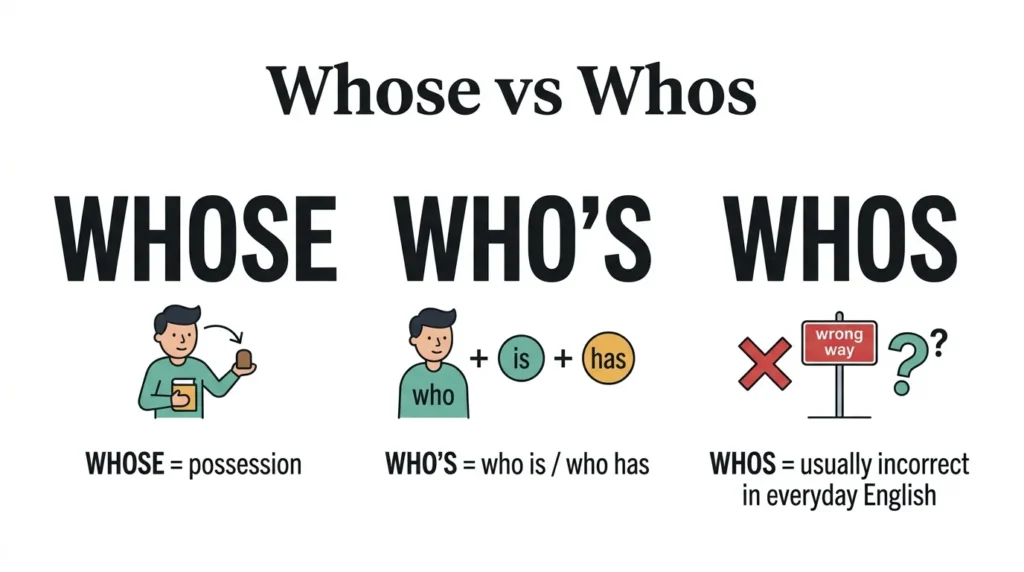

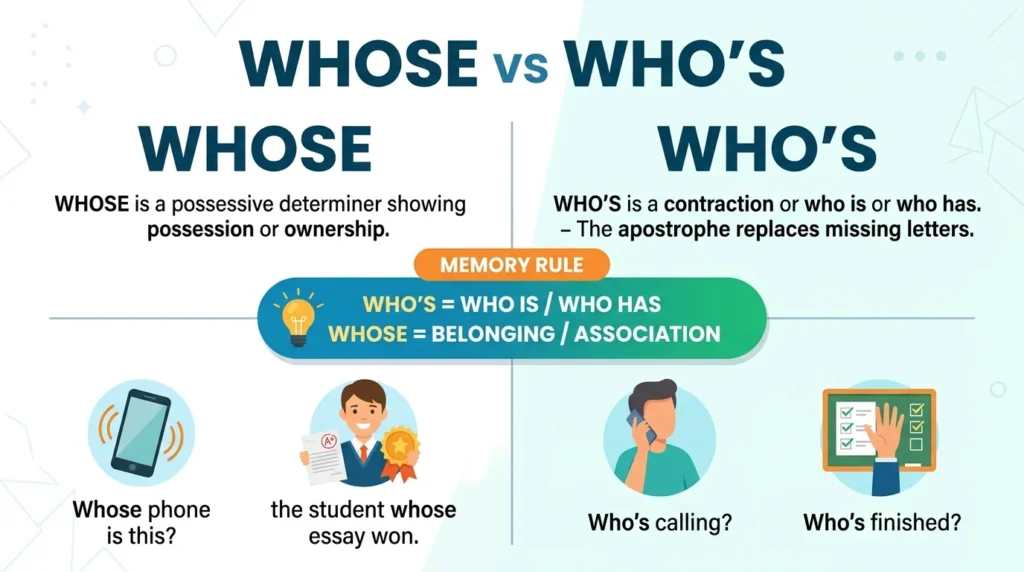
Whose is the standard word used to ask who something belongs to or to show a relationship or association: Whose phone is this? Who’s is a contraction of who is or who has: Who’s calling? or Who’s finished? Whos without an apostrophe is normally not the form you need in ordinary English writing. In rare linguistic or noun uses, whos can occur as a plural of who, but this is not the form used in everyday questions or sentences.
What Is the Difference Between Whose, Who’s, and Whos?
The confusion comes from three forms that look and sound very similar:
- whose — shows possession, belonging, or association
- who’s — means who is or who has
- whos — usually an incorrect spelling in ordinary English writing
The first two are common and important. The third is where many learners become unsure.
Compare:
Whose jacket is this?
The jacket belongs to whom?
Who’s wearing the jacket?
Who is wearing it?
Whos wearing the jacket?
This is normally incorrect because whos is missing the apostrophe required for who’s.
The key point is that whose and who’s are not interchangeable, even though they are pronounced the same in standard English. They perform different grammatical jobs.
Read More: Requester vs Requestor: Which Spelling Is Correct?
Why It Matters
This may look like a tiny spelling issue, but the apostrophe changes the grammatical meaning.
Consider a professional email:
Who’s responsible for the report?
This means:
Who is responsible for the report?
Now compare:
Whose report is this?
This asks who the report belongs to or is associated with.
Using whos instead of who’s can make a sentence look like a spelling error. In a school assignment, application, business email, report, or public post, that small mistake can make otherwise careful writing look less polished.
The distinction is especially important because apostrophes do not always indicate possession. In who’s, the apostrophe marks a contraction. In whose, there is no apostrophe because whose is already the possessive form of who.
The Core Rule
WHO’S = WHO IS or WHO HAS
WHOSE = possession, belonging, or association
WHOS = normally not the word you want in everyday English
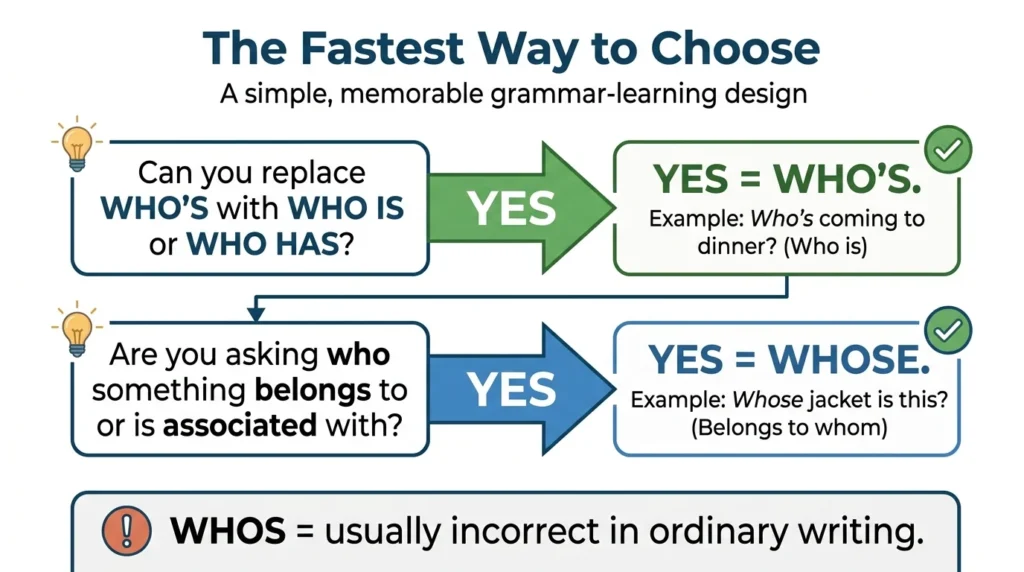
The fastest test is to replace who’s with who is or who has.
If the expanded sentence still makes sense, who’s is correct.
- Who’s coming? → Who is coming? ✓
- Who’s finished the work? → Who has finished the work? ✓
If you are asking or describing who something belongs to or is associated with, use whose.
- Whose bag is this?
- The student whose bag was missing reported it.
This replacement test works because who’s has two standard expansions: who is and who has.
How to Use Whose
Whose is the possessive form of who. It can be used in direct questions and in clauses that describe a person or thing.
Whose in questions
Use whose when you want to identify the owner or the person connected with something.
- Whose phone is ringing?
- Whose keys are these?
- Whose idea was this?
- Whose car is parked outside?
- Whose name is on the document?
In each sentence, the question concerns ownership or association.
For example:
Whose laptop is on the desk?
The question is not asking who is on the desk. It is asking which person the laptop belongs to.
Whose in relative clauses
Whose can also introduce a relative clause. A relative clause gives additional information about a noun.
I met a woman whose daughter is a doctor.
Here, whose daughter identifies the relationship between the woman and her daughter.
Another example:
We hired an employee whose experience matched the position.
The employee is associated with the experience described.
Importantly, whose does not have to refer only to a person’s physical possession. It can express a broader relationship or association. It can also refer to animals, organizations, places, and things.
For example:
The company whose sales increased opened another office.
We visited a museum whose collection includes rare manuscripts.
They found a tree whose branches had been damaged by the storm.
This use is established English, even when the antecedent is not a person.
How to Use Who’s
Who’s is a contraction. A contraction is a shortened form created by combining words and replacing omitted letters with an apostrophe.
Who’s has two standard meanings:
- who is
- who has
Who’s = who is
Who’s at the door?
= Who is at the door?
Who’s ready to leave?
= Who is ready to leave?
Do you know who’s responsible?
= Do you know who is responsible?
Who’s = who has
Who’s finished the assignment?
= Who has finished the assignment?
Who’s seen my glasses?
= Who has seen my glasses?
She is the person who’s helped me the most.
= She is the person who has helped me the most.
The meaning of who’s becomes clear when you expand it.
Correct Examples
Here are examples from different types of everyday and professional writing.
| Situation | Correct Example | Why |
|---|---|---|
| Conversation | Who’s coming with us? | Who’s = who is |
| Text message | Who’s at the door? | Who’s = who is |
| Who’s responsible for this file? | Who’s = who is | |
| Workplace | Whose approval do we need? | Asks whose approval |
| School | Whose notebook is on my desk? | Asks about ownership |
| Academic writing | The researcher whose work we studied used a different method. | Shows association |
| Social media | Who’s ready for the weekend? | Who’s = who is |
| Customer service | Whose order are we discussing? | Identifies the relevant customer/order |
| Interview | Who’s leading the project? | Who’s = who is |
| Business report | The company whose revenue increased expanded its team. | Shows association |
Notice that whose does not necessarily mean simple physical ownership. It can identify a relationship, connection, or association.
Incorrect vs. Correct
| ❌ Incorrect | ✅ Correct | Why |
|---|---|---|
| Whos calling you? | Who’s calling you? | Who’s means who is. |
| Whos your manager? | Who’s your manager? | The sentence means Who is your manager? |
| Whos phone is this? | Whose phone is this? | The question asks who owns the phone. |
| Whos car are we taking? | Whose car are we taking? | The question concerns ownership. |
| The woman whos office is upstairs called. | The woman whose office is upstairs called. | Whose shows the relationship between the woman and office. |
| I don’t know whos responsible. | I don’t know who’s responsible. | Who’s = who is. |
| Do you know whos bag this is? | Do you know whose bag this is? | The bag belongs to someone. |
| Whos finished the report? | Who’s finished the report? | Here who’s = who has. |
| The student whos essay won the prize smiled. | The student whose essay won the prize smiled. | Whose introduces a possessive relationship. |
| Whos idea was it? | Whose idea was it? | The question asks who the idea came from or belongs to. |
The most important correction is not simply “add an apostrophe.” First determine the meaning. If the sentence means who is/who has, use who’s. If it expresses possession or association, use whose.
Why People Make This Mistake
The words sound the same
Whose and who’s are homophones in standard English: they have the same pronunciation but different spellings and meanings. When you hear them in conversation, you cannot see the apostrophe or the spelling.
That means the problem often appears when someone moves from speaking to writing.
Apostrophes often suggest possession
English commonly uses apostrophe + s to show possession:
- Sarah’s book
- the teacher’s desk
- the company’s policy
That can create a misleading visual pattern. A writer may think who’s must also mean possession.
It does not.
In who’s, the apostrophe marks missing letters:
who + is → who’s
or
who + has → who’s
The possessive form is whose, without an apostrophe.
Spelling and pronunciation overlap
When someone hears /huːz/, they may not know whether the written form should be whose or who’s.
The same pronunciation therefore hides a grammatical difference.
Overgeneralization
A learner may remember a rule such as “apostrophe + s means possession” and apply it everywhere.
That rule is too broad.
An apostrophe can also indicate omitted letters in a contraction:
- it’s = it is / it has
- you’re = you are
- they’re = they are
- who’s = who is / who has
Autocomplete and spellcheck are not enough
A spelling checker may catch whos as an error, but it may not understand the intended meaning of a sentence.
For example, if you write:
Whos coming to the meeting?
a tool may identify the missing apostrophe.
But if you write:
Who’s report is this?
the sentence may look superficially correct because who’s is a real word. The problem is grammatical meaning: the intended word is whose.
That is why a meaning-based check is more reliable than relying only on spellcheck.
Translation interference
Learners whose first language handles possession and contractions differently may find this distinction especially difficult. A direct translation may not preserve the same grammatical structure.
The safest approach is to learn the function of each form rather than trying to translate the spelling mechanically.
Read More: Programming vs Programing: Which Spelling Is Correct?
Common Mistakes Checklist
Mistake 1: Writing “whos” for “who’s”
What happens: The apostrophe is omitted.
Why: The writer knows the pronunciation but forgets the contraction marker.
Fix: Expand it to who is or who has.
Mistake 2: Writing “who’s” for possession
What happens: The writer assumes apostrophe + s means ownership.
Why: This pattern is common with ordinary nouns.
Fix: Ask whether the sentence means “belongs to whom?” If yes, use whose.
Mistake 3: Assuming “whose” means only ownership
What happens: A learner avoids whose when the relationship is not literal ownership.
Why: “Possession” is sometimes taught too narrowly.
Fix: Remember that whose can show association or relationship too.
The organization whose headquarters are in London…
The headquarters do not literally “belong” to the organization in the same way a person’s phone belongs to them, but whose naturally expresses the connection.
Mistake 4: Using the word after hearing it
What happens: A writer chooses the spelling that sounds right.
Why: Whose and who’s sound alike.
Fix: Do not decide from pronunciation. Decide from meaning.
Mistake 5: Thinking “whos” is simply another form of “whose”
What happens: The writer treats the three spellings as interchangeable.
Why: The spelling differences seem minor.
Fix: In normal writing, distinguish the three forms carefully: whose, who’s, and the usually nonstandard whos.
Whose vs. Who’s vs. Whos in Real English
Grammatically correct: whose
Whose is natural when the sentence asks about or identifies possession, relationship, or association.
Whose coat is this?
The woman whose coat was missing called the office.
These are ordinary, natural constructions. The word works both in direct questions and in relative clauses.
Grammatically correct: who’s
Who’s is natural when it means who is or who has.
Who’s waiting outside?
Do you know who’s responsible?
Who’s already finished?
The contraction is especially common in conversation and ordinary informal writing. In more formal contexts, writers may choose the full forms who is or who has, but the contraction itself is not grammatically wrong.
Grammatically possible but unusual: whos
Whos without an apostrophe is not the normal spelling of either whose or who’s. In ordinary questions and sentences, writing whos will normally be understood as a spelling mistake.
There is, however, a narrow exception worth knowing. Whos can occur as a plural noun meaning multiple “who” items or people in certain linguistic or informal constructions, especially alongside words such as whats, wheres, and whys. This is a specialized use, not the ordinary grammar form needed by an English learner.
So, for everyday writing:
Whos coming? ❌
Who’s coming? ✅
Whos bag is this? ❌
Whose bag is this? ✅
Do not use the rare noun use of whos as a reason to write whos in normal questions.
American vs. British English
There is no meaningful American-versus-British spelling difference between whose and who’s.
Both varieties use:
- whose for possession or association
- who’s for who is or who has
For example:
Whose book is this?
Who’s coming to the meeting?
The basic distinction remains the same in both major varieties of English.
Formal vs. Informal Usage
The grammatical distinction does not change with formality, but contractions can be handled differently depending on the context.
In everyday conversation:
Who’s attending the meeting?
is completely natural.
In highly formal writing, you may choose:
Who is attending the meeting?
rather than the contraction.
However, whose remains whose in both formal and informal writing:
Whose report was selected?
There is no formal version such as who’s that should replace possessive whose.
The important thing is not to confuse “formal” with “correct.” Who’s is grammatically correct when it means who is or who has.
Comparison Table
| Feature | Whose | Who’s | Whos |
|---|---|---|---|
| Standard everyday form? | Yes | Yes | Usually no |
| Shows possession/association? | Yes | No | No |
| Means “who is”? | No | Yes | No |
| Means “who has”? | No | Yes | No |
| Uses an apostrophe? | No | Yes | No |
| Can introduce a relative clause? | Yes | Yes, when expanded as who is/has | Not normally |
| Example | Whose bag is this? | Who’s calling? | Usually incorrect |
| Main test | Ask “belonging to whom?” | Replace with “who is/has” | Check whether you actually mean whose or who’s |
Memory Trick
Use this simple two-part memory rule:
WHO’S has an apostrophe because something is missing.
who is → who’s
who has → who’s
WHOSE has no apostrophe because it is the possessive form.
Think:
whose = belonging
If you can say “who is” or “who has,” choose who’s.
If you are asking “belonging to whom?”, choose whose.
And if you have written whos, stop and check: in ordinary English, you almost certainly need whose or who’s.
Real-Life Situations
In an interview
Who’s leading the new project?
You can expand it:
Who is leading the new project?
Therefore, who’s is correct.
In a meeting
Whose approval do we need before launching the campaign?
The question concerns the person whose approval is required.
Therefore, whose is correct.
In an email
Do you know who’s responsible for updating the presentation?
Expand it:
Do you know who is responsible…?
Therefore, who’s is correct.
In a text message
Whose charger is this?
The writer wants to know who owns the charger.
Therefore, whose is correct.
In an exam
The student whose answer was correct received full marks.
The word whose connects student with answer.
Therefore, whose is correct.
In academic writing
The researcher whose findings influenced the study used a different method.
Again, whose expresses association between the researcher and the findings.
Mini Quiz
| # | Question | Answer | Explanation |
|---|---|---|---|
| 1 | ___ calling you? A) Whose B) Who’s C) Whos | B) Who’s | Who’s = who is. |
| 2 | ___ notebook is on the table? A) Who’s B) Whose C) Whos | B) Whose | The question asks who the notebook belongs to. |
| 3 | Choose the correct sentence: A) Whos ready? B) Who’s ready? C) Whose ready? | B) Who’s ready? | Who’s = who is. |
| 4 | The employee ___ laptop was stolen reported it. | whose | Whose shows the relationship between employee and laptop. |
| 5 | ___ finished the assignment? A) Whose B) Who’s C) Whos | B) Who’s | Here who’s = who has. |
| 6 | Choose the correct sentence: A) Whose car is parked outside? B) Who’s car is parked outside? | A) Whose car is parked outside? | The question asks who owns the car. |
| 7 | Correct the sentence: “Whos responsible for this?” | Who’s responsible for this? | It means “Who is responsible for this?” |
| 8 | Correct the sentence: “Who’s phone is ringing?” | Whose phone is ringing? | It asks who the phone belongs to. |
| 9 | The author ___ book we studied won an award. A) who’s B) whose C) whos | B) whose | Whose introduces the possessive relationship between author and book. |
| 10 | Complete the sentence: “I know ___ been working late.” A) whose B) who’s C) whos | B) who’s | Who’s = who has. |
Expert Tips
1. Never use pronunciation as your only test
Because whose and who’s sound the same, listening alone cannot tell you which spelling is correct.
Think about the grammatical meaning.
2. The “who is/who has” test is stronger than the apostrophe test
Do not simply think:
“I see an apostrophe, so it must be possession.”
Instead ask:
Can I expand this to who is or who has?
If yes, use who’s.
3. “Whose” can describe relationships, not just ownership
This is especially useful in academic and professional writing.
The company whose employees received training…
The company does not necessarily “own” the employees. Whose identifies the relationship between the company and its employees.
4. Watch for a noun after the word
A noun often follows whose:
- whose car
- whose idea
- whose report
- whose name
- whose office
But this is a clue, not an absolute rule. Whose can also stand alone:
Whose is this?
5. Do not assume every apostrophe means possession
This is one of the most useful apostrophe lessons in English.
Compare:
- John’s car → possession
- who’s coming → contraction
- it’s raining → contraction
- the company’s policy → possession
The apostrophe can serve different grammatical functions.
6. Treat “whos” as a warning sign
When you see whos in ordinary writing, pause.
Ask:
Do I mean who is?
Use who’s.
Do I mean who has?
Use who’s.
Do I mean belonging to whom / associated with whom?
Use whose.
That three-question check handles almost every everyday case.
FAQ
Is “whos” a correct English word?
In ordinary English writing, whos without an apostrophe is normally not the form you want. It is usually a misspelling of who’s or whose. A rare noun use of whos can occur when who is treated as a noun and made plural, particularly in linguistic or informal expressions.
Is “whose” always about ownership?
No. Whose can express ownership, but it can also show a relationship or association.
The company whose offices are downtown…
Here, whose connects the company with its offices.
Can “whose” refer to a thing?
Yes. Whose can refer to people, animals, organizations, places, and things.
We visited a building whose roof had collapsed.
This use is established in English.
Can “who’s” mean “who has”?
Yes. Who’s can be a contraction of who has.
Who’s finished the report?
means:
Who has finished the report?
Can “who’s” mean “who is”?
Yes. This is one of its two standard meanings.
Who’s at the door?
means:
Who is at the door?
Can “whose” start a sentence?
Yes. In fact, this is one of its most common uses.
Whose phone is this?
There is nothing grammatically unusual about beginning a sentence with whose.
Is “who’s” wrong in formal writing?
Not automatically. Who’s is grammatically correct when it means who is or who has. Some highly formal styles may prefer the full forms who is and who has, but that is a matter of register, not a rule that makes who’s grammatically incorrect.
Why does “who’s” look possessive?
Because English frequently uses apostrophe + s to show possession, as in Sarah’s book. But in who’s, the apostrophe marks omitted letters in a contraction. Whose is the possessive form.
Is “whose” the same as “who’s”?
No. They are pronounced the same but have different meanings and grammatical functions.
Whose bag is this? = Who does the bag belong to?
Who’s carrying the bag? = Who is carrying it?
What is the easiest way to remember whose and who’s?
Remember:
WHO’S = WHO IS / WHO HAS
WHOSE = BELONGING TO WHOM
If you can expand who’s, use the apostrophe. If the sentence concerns possession or association, use whose.
Quick Summary
Whose, who’s, and whos should not be treated as interchangeable. Whose is the possessive form of who and is used to ask about or describe ownership, belonging, or association: Whose jacket is this? Who’s is a contraction of who is or who has: Who’s calling? and Who’s finished? The easiest way to test who’s is to replace it with who is or who has. If the expanded sentence works, who’s is correct. If the meaning concerns belonging or association, use whose. In ordinary English writing, whos without an apostrophe is normally a mistake, although rare specialized noun uses do exist.