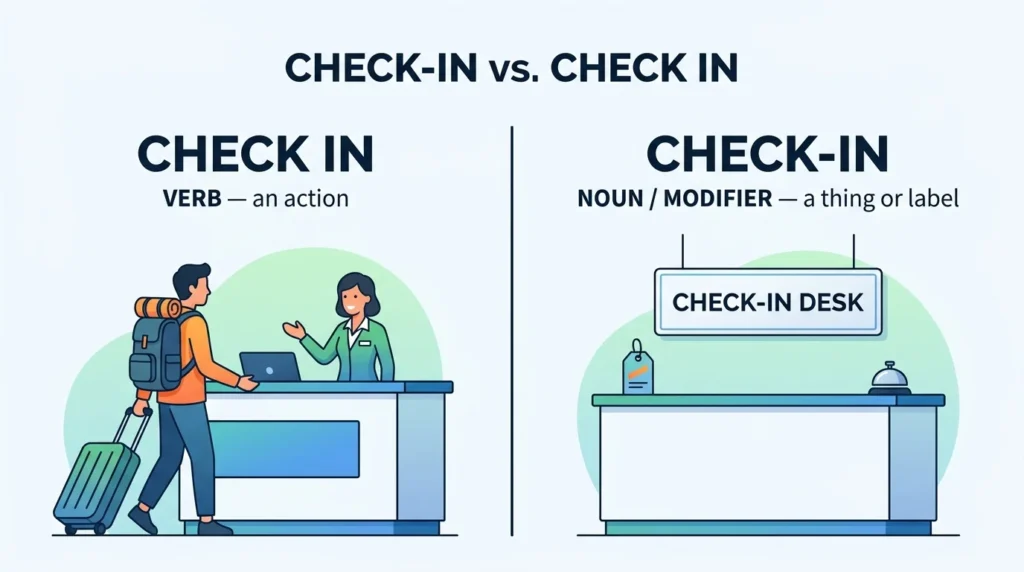

Use check in as two words when it functions as a verb and describes an action: “Please check in at reception.” Use check-in with a hyphen when it is a noun or modifies another noun: “Check-in begins at noon” or “Go to the check-in desk.” In standard prose, checkin as one word is normally avoided.
What Is Check-In vs. Check In?
Check in and check-in sound the same, but they perform different jobs in a sentence.
Check in is a phrasal verb. A phrasal verb combines a verb with another short word—in this case, check + in—to create a particular meaning.
You might check in at a hotel, check in for a flight, or check in with a coworker.
Check-in, with a hyphen, is normally a noun or a modifier placed before another noun.
For example:
- Our check-in took five minutes.
- The check-in desk is downstairs.
- We scheduled a weekly check-in.
- What is the hotel’s check-in time?
The difference is therefore grammatical rather than a difference in pronunciation.
Why It Matters
A missing or unnecessary hyphen rarely prevents someone from understanding your sentence, but it can make polished writing look careless.
The distinction appears constantly in:
- hotel and airline instructions
- workplace emails
- appointment systems
- school procedures
- event registrations
- software interfaces
- reports and professional documents
Consider these two sentences:
Please check in before noon.
Here, someone performs an action.
Check-in closes at noon.
Here, check-in names a process or period.
The pronunciation barely changes, but the grammatical function does.
The Core Rule
Rule: If it describes something you do, write check in. If it names or describes a thing, write check-in.
Use this four-step test:
- Ask whether the expression describes an action.
- If yes, use check in.
- If it names something or describes another noun, use check-in.
- If you have written checkin as one word, change it unless it is part of an official product name, brand, technical identifier, or other fixed spelling.
This action-versus-thing distinction is the simplest reliable way to choose the correct form.
Read More: Skiid vs Skied: Which Spelling Is Correct?
How to Use Check In and Check-In
Use Check In as a Verb
Write check in without a hyphen when someone performs the action.
Examples:
- We need to check in before boarding.
- Please check in when you reach the office.
- I will check in with Maria tomorrow.
- Guests can check in online.
- Students should check in at the main desk.
Because it is a verb phrase, it changes tense normally:
- check in
- checks in
- checked in
- checking in
- has checked in
The particle in remains separate from the verb in these forms.
Use Check-In as a Noun
Use check-in when the expression names the act, process, event, or occasion.
Examples:
- Check-in begins at 2 p.m.
- The check-in was surprisingly quick.
- We have a team check-in every Friday.
- Your next check-in is scheduled for June.
- The app recorded three check-ins.
Because check-in can be a countable noun, its plural is check-ins.
Use Check-In Before Another Noun
A hyphen is also standard when check-in works as a modifier describing another noun.
Examples include:
- check-in desk
- check-in counter
- check-in time
- check-in process
- check-in email
- check-in meeting
- check-in screen
- check-in policy
In check-in desk, for example, check-in tells us what kind of desk it is.
Is Checking In Hyphenated?
No. When you use the -ing form of the verb, write checking in, not checking-in.
Correct:
Checking in online saved us twenty minutes.
Although checking in is the subject of this sentence, it still comes from the phrasal verb check in. Turning the verb into an -ing form does not require a hyphen.
Similarly:
- We are checking in now.
- Checking in early may be helpful.
- She was checking in when I called.
Is Checked In Hyphenated?
Normally, no.
Write:
We checked in at noon.
Not:
We checked-in at noon.
The past-tense verb remains two words because checked in is still a verb phrase.
Correct Examples
Here are examples from different kinds of everyday writing.
- Conversation: We can check in as soon as the room is ready.
- Text message: I’ll check in when I get to the venue.
- Email: Please check in with me before sending the final proposal.
- Travel: Online check-in opens tomorrow morning.
- Hotel: The check-in desk is beside the main entrance.
- Workplace: Our weekly check-in has been moved to Thursday.
- School: Visitors must check in at the administration office.
- Social media: The app saved my location check-in automatically.
- Academic setting: Participants were asked to check in before entering the research room.
- Business: The manager scheduled individual check-ins with each new employee.
- Event: The check-in process should take less than five minutes.
- Customer service: I’ll check in with the support team and send you an update.
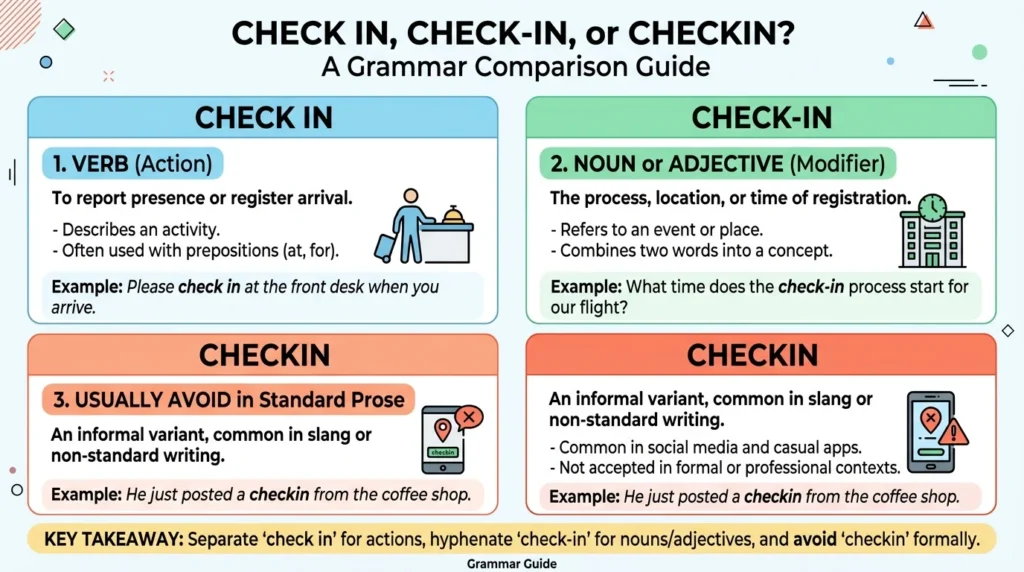
Incorrect vs. Correct
| ❌ Incorrect | ✅ Correct | Why |
|---|---|---|
| I need to check-in before 4 p.m. | I need to check in before 4 p.m. | It describes an action, so the verb remains two words. |
| Hotel check in begins at 3 p.m. | Hotel check-in begins at 3 p.m. | Here the expression names the registration process. |
| Please use the checkin desk. | Please use the check-in desk. | The expression modifies desk, so use the hyphenated form. |
| We checked-in online yesterday. | We checked in online yesterday. | The past-tense verb is still written as two words. |
| Our weekly check in starts at nine. | Our weekly check-in starts at nine. | It names a meeting or event. |
| I’ll check-in with you tomorrow. | I’ll check in with you tomorrow. | Check in is the verb in this sentence. |
| The system records each check in. | The system records each check-in. | The expression is a countable noun. |
| Checking-in early may save time. | Checking in early may save time. | The -ing form of the phrasal verb does not take a hyphen. |
| We have three client check ins today. | We have three client check-ins today. | The plural noun keeps the hyphen and adds -s. |
| They are checking-in at the airport. | They are checking in at the airport. | This is a progressive verb phrase, so the words remain separate. |
Why People Make This Mistake
You Cannot Hear the Hyphen
Check in and check-in are pronounced essentially the same way in normal speech.
A hyphen is a visual feature of writing, not something speakers clearly pronounce. That means learners cannot rely on sound to choose the spelling.
Both Forms Contain Exactly the Same Words
Unlike pairs such as accept and except, there is no obvious spelling difference between the individual words.
The only visible clue is the hyphen.
That makes the distinction easy to overlook when typing quickly.
English Often Turns Phrasal Verbs Into Nouns
English contains many verb-and-noun pairs with different spacing or punctuation.
For example:
- log in → login
- set up → setup
- follow up → follow-up
- check in → check-in
The problem is that these pairs do not all follow exactly the same spelling pattern. A learner who knows login may reasonably guess checkin, even though standard edited prose generally prefers check-in.
Writers Overgeneralize the Hyphen Rule
Once someone learns that check-in exists, they may start hyphenating every form:
❌ We will check-in tomorrow.
That does not work because the hyphenated form does not replace the verb.
Autocomplete Cannot Always Solve the Problem
Spellcheck software may recognize check in, check-in, and sometimes even checkin because the last form appears in product names, technical labels, usernames, code, and other specialized contexts.
A spelling tool therefore may not understand the grammatical job the expression performs in your particular sentence.
Translation Can Hide the Distinction
In another language, one word or expression may represent both the action and the resulting process.
An English learner translating directly may therefore use one spelling everywhere. In English, however, the sentence’s grammatical structure determines whether you need check in or check-in.
Common Mistakes Checklist
- Hyphenating the verb: Write “Please check in,” not “Please check-in.”
- Removing the noun’s hyphen: Write “early check-in,” not “early check in.”
- Writing checkin as one word: Avoid checkin in ordinary edited prose unless it is an official fixed spelling.
- Hyphenating checking in: Write “We are checking in,” not “checking-in.”
- Hyphenating checked in: Write “They checked in,” not “checked-in.”
- Forgetting the plural hyphen: Write “three check-ins,” not “three check ins.”
- Assuming pronunciation gives the answer: Both forms sound alike; identify the grammatical function instead.
- Treating every occurrence before another word as a verb: In “check-in time,” the expression modifies time, so the hyphen is needed.
- Copying software labels into formal prose: A button or database field may use Checkin, but that does not automatically make it standard sentence spelling.
Check-In vs. Check In in Real English
Grammatically Correct English
In standard edited English, use check in for the phrasal verb and check-in for the noun or noun modifier. “We need to check in” and “The check-in was quick” therefore follow different spelling patterns even though they refer to the same general activity. Past and progressive verb forms also stay open: checked in and checking in.
Grammatically Possible but Unnatural English
Some sentences can be technically understandable without sounding like the wording people usually choose. For example, “I will perform my check-in with my manager” is structurally possible, but in normal workplace conversation, “I’ll check in with my manager” is simpler and more natural. Likewise, overly formal phrases such as “conduct a check-in communication” are usually better replaced by clearer everyday wording unless a specialized document requires them.
Natural, Everyday English
In ordinary conversation, people frequently use check in beyond hotels and airports. Someone might say, “I’ll check in later,” “Let me check in with the team,” or “I wanted to check in and see how you’re doing.” In workplaces, a check-in also commonly refers to a short meeting or conversation used to exchange updates rather than a formal registration procedure.
Formal vs. Informal Usage
Both check in and check-in can appear in formal writing.
Travel instructions such as “Passengers must check in before departure” are neutral and professional. Terms such as check-in desk, check-in procedure, and check-in time are also appropriate in formal operational writing.
The expression check in with someone is more conversational:
I’ll check in with the client tomorrow.
That sentence is perfectly natural in workplace communication. In highly formal reports, however, a more specific verb may sometimes be clearer:
- contact
- consult
- confirm
- report back
- request an update
Choose the alternative according to what the person is actually doing rather than replacing check in simply because it sounds informal.
Check In vs. Check-In Comparison Table
| Feature | Check in | Check-in | Checkin |
|---|---|---|---|
| Main function | Verb phrase | Noun or modifier | Usually nonstandard in prose |
| Describes an action | Yes | No | Avoid |
| Names an event/process | No | Yes | Avoid |
| Can modify another noun | No | Yes | Avoid |
| Example | Please check in now. | Check-in begins now. | Usually rewrite |
| Past tense | checked in | Not applicable | Avoid |
| -ing form | checking in | Not applicable | Avoid |
| Plural | Not applicable | check-ins | Avoid |
| Workplace use | check in with a manager | weekly check-in | Usually avoid |
| Travel use | check in for a flight | check-in desk | Usually avoid |
Memory Trick
Remember:
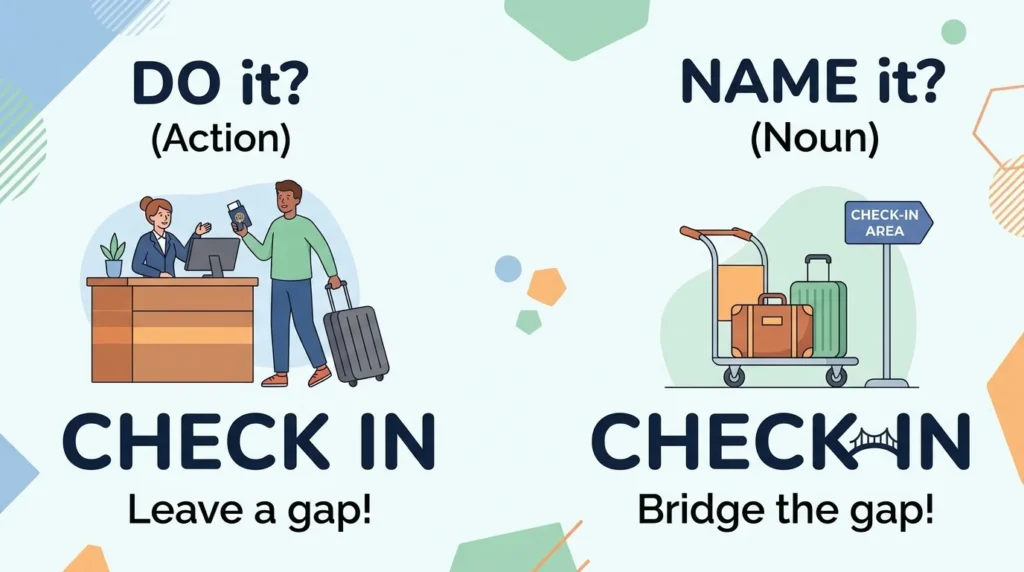
DO it? Leave a gap: check in.
NAME it? Bridge the gap: check-in.
If someone can perform the action, you usually need two words:
I need to check in.
If you are naming the process, meeting, desk, time, or event, connect the words with a hyphen:
The check-in took five minutes.
Real-Life Situations
Job Interview
You arrive at an office and receive this instruction:
Please check in with reception when you arrive.
Because you are performing an action, check in is correct.
Team Meeting
Your manager says:
Let’s have a quick check-in before the presentation.
Here, check-in names a short meeting.
Professional Email
You write:
I’ll check in with the design team tomorrow and send you their response.
The expression is a verb describing contact with colleagues.
Text Message
You send:
I’ll check in once I get to the hotel.
Again, an action requires two words.
Exam
You see this question:
Choose the correct form: “Online ___ closes at midnight.”
The answer is check-in because the phrase names a process rather than describing someone performing an action.
Check In To vs. Check Into
This is a separate issue from hyphenation.
You can say:
We checked into the hotel.
The expression check into is established when talking about registering at a hotel or similar place.
You can also structure the sentence with check in followed by another preposition:
We checked in at the hotel.
In many situations, check in at the hotel is especially clear because check in remains the phrasal verb and at the hotel tells the reader where the action happened.
Do not confuse either structure with the noun:
The hotel’s check-in was fast.
Check In With vs. Check In On
These expressions overlap, but they are not always interchangeable.
Check in with someone usually means contacting that person to exchange information, give an update, or find out what is happening.
I’ll check in with the project manager tomorrow.
Check in on someone or something places more emphasis on seeing whether the person or situation is okay or progressing properly.
I’ll check in on the new employee this afternoon.
If your main purpose is exchanging updates, with is often the clearer choice. If you are monitoring someone’s condition or progress, on may fit better.
Read More: Nonresponsive vs Unresponsive: Both Are Correct; Context Decides
Expert Tips
Look for an Auxiliary Verb
Words such as will, can, should, must, and to often make the answer obvious.
- will check in
- can check in
- should check in
- must check in
- to check in
After these structures, you need the verb, so do not add a hyphen.
Look for a Noun Immediately After It
If the expression directly labels another noun, check-in is usually what you need:
- check-in desk
- check-in time
- check-in system
- check-in meeting
- check-in instructions
Test It With “Registration”
In travel contexts, replace the phrase mentally with registration.
The check-in was easy.
→ The registration was easy.
Because a noun fits, check-in is correct.
Now test:
We need to check in.
You cannot naturally replace the verb with the noun registration:
❌ We need to registration.
That tells you check in must remain a verb.
Do Not Automatically Copy UI Labels
A website or app may use compressed spellings because of button width, branding, database conventions, or software naming.
If a button says CHECKIN, reproduce it when referring to that exact label. Otherwise, use standard prose conventions in your own writing.
Edit for Meaning, Not Appearance
Instead of asking, “Does the hyphen look right?” ask:
What job is this expression doing?
That question works far more reliably.
Quick Summary
Use check in when you mean the action of registering, arriving, reporting, or contacting someone: “We need to check in” or “I’ll check in with her tomorrow.” Use check-in when the expression is a noun or modifies another noun: “The check-in was quick,” “check-in time,” or “a weekly check-in.” Past and progressive verb forms remain open: checked in and checking in, not checked-in or checking-in. The plural noun is check-ins. In ordinary edited English, avoid checkin as one word unless it is part of an official name or technical label. The easiest test is simple: doing an action = check in; naming a thing = check-in.
FAQ
Is Checkin One Word?
In ordinary edited English, checkin is generally not the standard spelling for either the verb or noun. Use check in for the verb and check-in for the noun or modifier. A one-word spelling may appear in product names, software fields, code, or branded interfaces, where the creator’s official spelling should be preserved.
Is Checking In Hyphenated?
No. Write checking in as two words:
We are checking in now.
Checking in online is convenient.
It is the -ing form of the phrasal verb check in, so no hyphen is required.
Should Checked In Have a Hyphen?
No.
Correct:
They checked in yesterday.
Incorrect:
They checked-in yesterday.
Changing the tense of the verb does not turn it into the noun check-in.
What Is the Plural of Check-In?
The plural noun is check-ins.
For example:
The manager schedules three employee check-ins each week.
The hyphen remains, and the plural -s is added to in.
Is It Check-In Time or Check In Time?
Use check-in time.
Here, check-in modifies the noun time, so the hyphenated form is standard.
Is It Check-In Desk or Check In Desk?
Use check-in desk.
The expression identifies the type of desk, so check-in works as a compound modifier before the noun.
Is Check-In Meeting Correct?
Yes.
A check-in meeting is a meeting used for updates, discussion, or monitoring progress.
You can also use check-in alone as the noun:
We have a check-in at ten.
Should I Write Check In to a Hotel or Check Into a Hotel?
Check into a hotel is an established construction, while check in at a hotel is also standard and often especially clear.
Examples:
We checked into the hotel at five.
We checked in at the hotel at five.
What Is the Difference Between Check In With and Check In On?
Check in with usually focuses on contacting someone and exchanging information.
Check in on often focuses on seeing whether a person or situation is okay.
Compare:
I’ll check in with my manager about the deadline.
I’ll check in on the children before I leave.
Is the Rule Different in American and British English?
There is no important regional difference in the basic distinction covered here. Major American and British dictionary treatments recognize check in as the verb and check-in as the noun, so learners can safely apply the same core rule in both varieties.
Mini Quiz
| # | Question | Answer | Explanation |
|---|---|---|---|
| 1 | Fill in: “Please ___ before your flight.” | check in | It describes an action, so use the two-word verb. |
| 2 | Choose: “The hotel (check in / check-in) was quick.” | check-in | The expression names the registration process. |
| 3 | Correct the sentence: “I’ll check-in with Ben tomorrow.” | I’ll check in with Ben tomorrow. | Check in functions as the verb. |
| 4 | Fill in: “What is the ___ time?” | check-in | It modifies the noun time. |
| 5 | Choose: “We are (checking in / checking-in) now.” | checking in | The -ing verb form remains two words. |
| 6 | Correct: “They checked-in at noon.” | They checked in at noon. | Past-tense phrasal verbs do not take this hyphen. |
| 7 | Fill in: “I have two employee ___ this afternoon.” | check-ins | The expression is a plural countable noun. |
| 8 | Which is standard: “checkin desk,” “check in desk,” or “check-in desk”? | check-in desk | A hyphen joins the words when they modify desk. |
| 9 | Fill in: “___ online saved us time.” | Checking in | This is the -ing form of the verb phrase. |
| 10 | Choose: “I’ll ___ with the client after lunch.” | check in | The expression describes contacting someone for an update |