
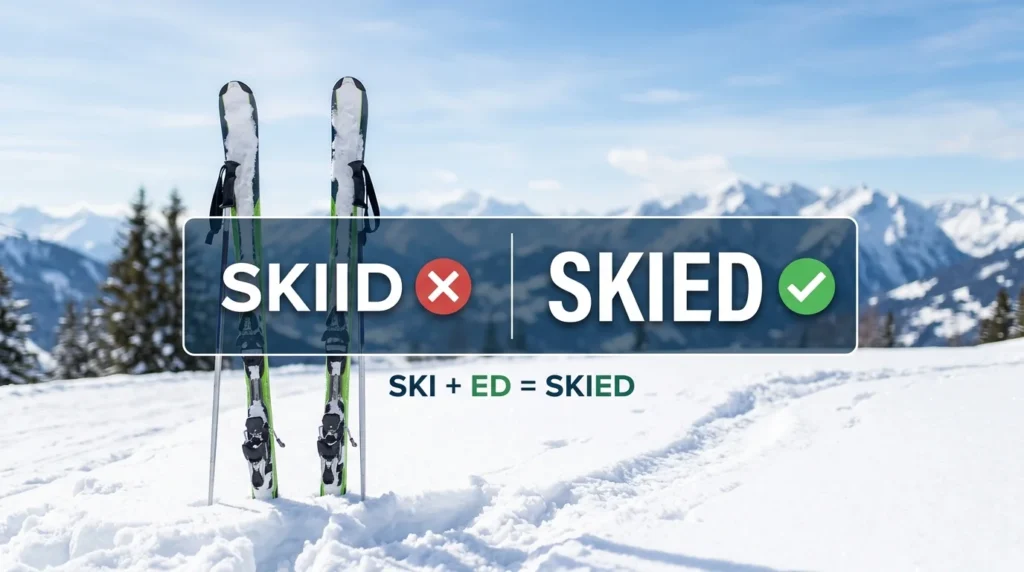

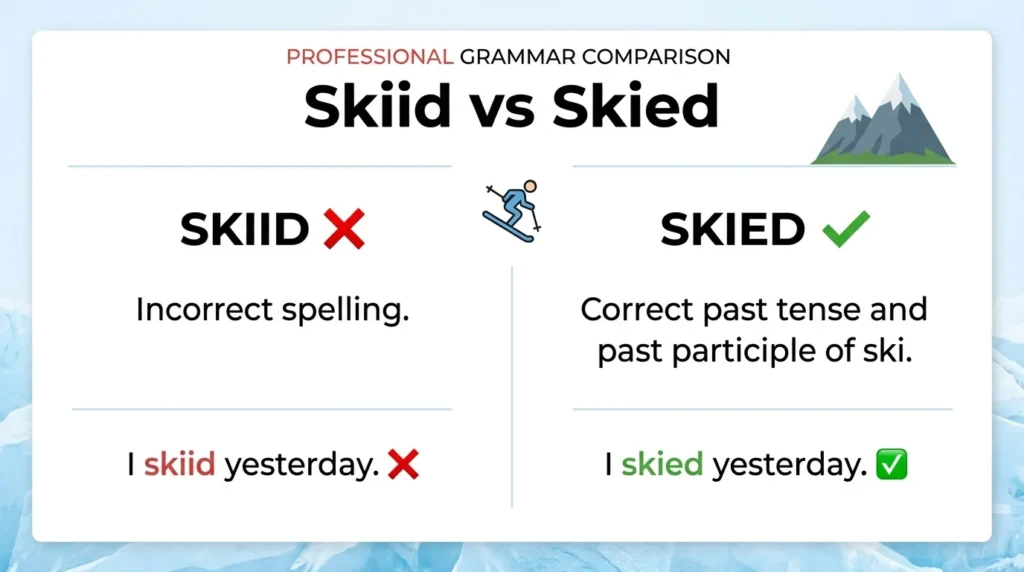
Skied is correct; skiid is incorrect. The word skied is the simple past tense and past participle of the verb ski. For example, “We skied yesterday” and “She has skied there before” are correct. Skiid is not the standard past-tense spelling. Simply add -ed to ski: ski + ed = skied.
At a glance:
- ski = base form
- skis = third-person singular present
- skied = simple past
- skied = past participle
- skiing = present participle
- skiid = incorrect spelling
- skiied = incorrect spelling
What Is the Difference Between Skiid and Skied?
Skied is a real verb form. Skiid is normally a spelling error made when someone tries to write the past tense of ski.
The verb ski means to travel or move on skis. When the action happened in the past, the normal form is skied.
Present: We ski every winter.
Past: We skied last winter.
Perfect: We have skied together several times.
The important point is that skied is not formed by replacing the final i. The base word stays ski, and the regular past-tense ending -ed is added:
ski + ed = skied
That produces one i followed by ed, not skiid or skiied. Standard conjugation references list skied as the past and past participle of ski.
Why It Matters
A spelling such as skiid may still be understandable, especially in a quick text or social-media post. However, understandable does not mean standard.
In school assignments, professional emails, articles, travel writing, reports, applications, and published content, a misspelled verb can distract readers from what you are trying to say. It can also make otherwise polished writing look insufficiently proofread.
The mistake is particularly easy to make because skiing contains two adjacent i’s. A writer may remember that visual pattern and incorrectly assume the past tense should also contain two i’s.
It does not.
Use skiing for an ongoing activity and skied for the past form.
The Core Rule
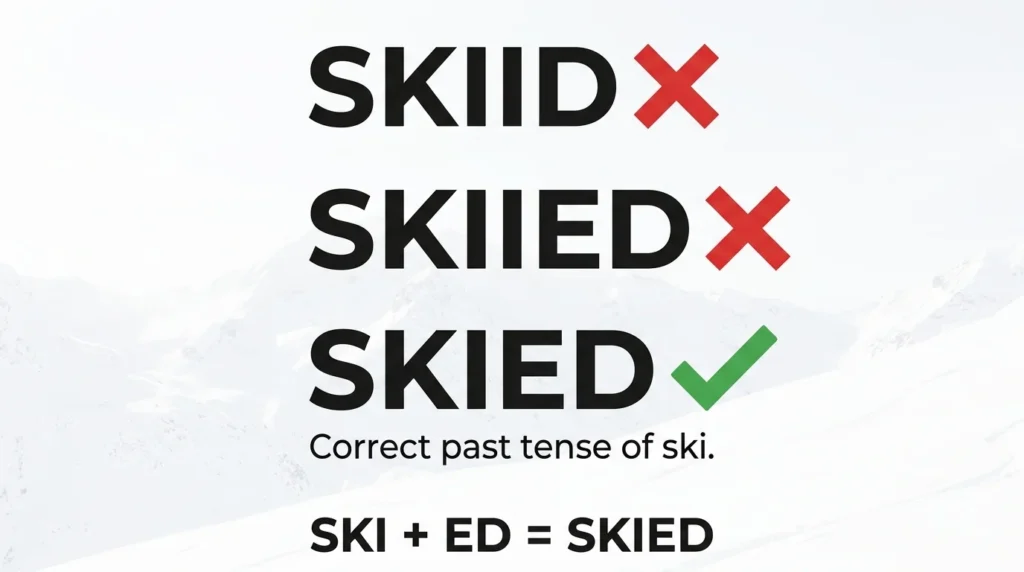
Rule: The standard past tense and past participle of ski are both skied.
ski + ed = skied
✅ skied
❌ skiid
❌ skiied
The verb behaves regularly when forming its past tense: the suffix -ed is attached to the base form ski.
How to Use Skied Correctly
Use Skied for the Simple Past
Use skied when the skiing happened and finished in the past.
We skied all morning.
Emma skied in the Alps last winter.
I skied for the first time when I was twelve.
Words and phrases such as yesterday, last year, on Saturday, and during our vacation often appear with the simple past because they identify a completed past period.
Use Skied as a Past Participle
A past participle is a verb form used with auxiliary verbs such as have, has, and had.
The past participle of ski is also skied.
I have skied that route before.
She had skied only twice before the competition.
They have never skied together.
The spelling does not change when skied follows have, has, or had.
Use Skiing for Continuous Actions
When describing an activity in progress, use skiing, not skied.
We are skiing today.
She was skiing when the weather changed.
They have been skiing since morning.
This is one source of the spelling confusion. Skiing naturally puts the final i in ski beside the initial i in -ing:
ski + ing = skiing
By contrast:
ski + ed = skied
That is why skiing has ii, while skied does not. Standard conjugation tables distinguish skied from skiing in exactly this way.
Use Ski for the Base Form
Use ski after modal verbs and infinitive marker to.
We want to ski tomorrow.
She can ski very well.
They might ski this weekend.
Do not use skied after can, could, will, might, or to when these constructions require the base form.
A Simple Four-Step Choice
- If the action happens regularly, use ski or skis.
- If the action finished in the past, use skied.
- If have, has, or had requires a past participle, use skied.
- If the action is continuous, use skiing.
Correct Examples of Skied
Here are examples across different kinds of everyday writing.
- Conversation: I skied with my cousins over the weekend.
- Travel: We skied several beginner runs before lunch.
- School: Daniel skied for the first time during winter break.
- Email: I skied yesterday, so I may join the meeting a little later this morning.
- Workplace: Our team skied together during the company retreat.
- Social media: Finally skied the whole trail without stopping!
- Academic writing: Participants who had skied previously reported greater confidence during the first session.
- Sports writing: The athlete had skied the course several times before race day.
- Personal writing: I had never skied until my family took a trip to the mountains.
- Travel review: We skied for three days and found the beginner slopes easy to navigate.
- Conversation: Have you ever skied at night?
- Formal writing: All participants had skied at least once before entering the advanced group.
These sentences demonstrate both major uses of skied: simple past and past participle.
Skiid vs Skied: Incorrect vs. Correct
| ❌ Incorrect | ✅ Correct | Why |
|---|---|---|
| I skiid yesterday. | I skied yesterday. | The simple past of ski is skied. |
| She skiied down the hill. | She skied down the hill. | Adding another i before -ed is unnecessary. |
| We have skiid here before. | We have skied here before. | The past participle is skied. |
| He had skiied that trail already. | He had skied that trail already. | Had requires the past participle skied. |
| They skiing there last winter. | They skied there last winter. | A completed past action requires the simple past. |
| I have ski yesterday. | I skied yesterday. | A finished time such as yesterday normally calls for the simple past here. |
| She can skied very well. | She can ski very well. | A modal verb such as can takes the base form. |
| We want to skied tomorrow. | We want to ski tomorrow. | To is followed by the base form ski in this infinitive. |
| He was skied when I called. | He was skiing when I called. | An action in progress uses was skiing. |
| I had ski before the lesson. | I had skied before the lesson. | Had needs the past participle. |
| She skiid every weekend last year. | She skied every weekend last year. | Skiid is not the standard past form. |
| Have you ever skiied before? | Have you ever skied before? | The correct past participle is skied. |
Why People Write Skiid or Skiied
The Pronunciation Does Not Reveal the Spelling
When skied means “went on skis,” it is normally pronounced like skeed, /skiːd/. The spoken form does not clearly tell a learner how the word should be spelled.
A learner who hears the long ee sound may therefore try spellings such as skiid, even though English spelling does not require a second i.
Skiing Really Does Have Two I’s
This is probably the most visually convincing source of the mistake.
ski + ing = skiing
The final i of ski touches the first letter of -ing, which is also i.
Writers may then incorrectly extend that pattern:
❌ skiid
❌ skiied
But -ed begins with e, not i:
ski + ed = skied
Writers May Overgeneralize Other Spelling Rules
English verbs have several spelling patterns when suffixes are added. Some consonants double, some words ending in y change spelling, and some base forms lose or keep letters depending on the suffix.
Because learners know these rules exist, they may assume ski also needs a special spelling change.
It does not need one for -ed. Simply attach the ending.
The Written Form Looks Unusual
Skied can look strange at first because the sequence -ied appears in words such as tried and cried, where the original word ends in y:
try → tried
cry → cried
But ski does not end in y.
The result looks similar, but the spelling process is different:
ski + ed → skied
Autocomplete and Spellcheck Are Not Perfect Teachers
A spelling checker can often identify skiid as unusual, but automated tools should not replace understanding the form.
Typing mistakes, usernames, brand names, informal posts, names, and specialized terms can appear in databases and online text. Seeing a spelling somewhere does not automatically make it standard English.
When you know the base form and suffix, you can solve the problem yourself:
ski + ed = skied
Translation Can Encourage Sound-Based Spelling
English learners sometimes write a new word according to how it sounds, particularly when their first language has a more predictable relationship between letters and pronunciation.
Because skied sounds approximately like “skeed,” a learner may try to represent the long vowel with ii.
The better approach is to remember the word’s grammatical structure rather than spelling it entirely by sound.
Common Mistakes Checklist
- Writing “skiid” for the past tense: Remember that the past ending is -ed, so write skied.
- Writing “skiied”: Do not copy the double-i pattern from skiing. The endings are different.
- Using “skiing” for a completed event: “We skiing yesterday” is incorrect. Use we skied yesterday.
- Using “skied” after a modal: Write can ski, will ski, or might ski, not can skied.
- Using the base form after “had”: Write had skied, not had ski.
- Assuming “skied” must sound like “skied” with two separate vowel sounds: In the skiing sense, it is pronounced like skeed.
- Confusing spelling with pronunciation: Learn the form as ski + ed, rather than trying to reconstruct it only from sound.
- Adding an apostrophe: In ordinary modern writing, use skied, not ski’d.
- Confusing “skis” with “ski’s”: Skis can be a plural noun or verb form. Ski’s normally indicates possession or a contraction in a suitable context.
- Changing the form after “have”: The correct phrase is have skied, not have skiid, have skiied, or have ski.
Skiid vs Skied in Real English
Grammatically Correct English
Skied is completely normal as both a simple past form and a past participle. Sentences such as “We skied yesterday,” “I have skied there before,” and “She had never skied at night” are standard English. You do not need to avoid the word simply because its spelling looks unusual. In ordinary writing, skied is the expected form whenever the grammar requires the past or past participle of ski.
Grammatically Possible but Less Natural English
English sometimes allows a longer construction where a simpler one would usually sound more natural. For example, “I did ski yesterday” is grammatical, but without contrast or emphasis, most speakers would simply say, “I skied yesterday.” The did + ski construction becomes natural when correcting someone or stressing the fact: “You said I stayed inside, but I did ski yesterday.” Grammar and naturalness are related, but they are not identical.
Natural Everyday English
In everyday conversation, both skied and went skiing are common ways to describe the activity, but they frame it slightly differently. “We skied all afternoon” focuses directly on the action. “We went skiing on Saturday” presents skiing as the activity or outing. Neither wording is inherently better. Choose whichever matches the sentence you naturally want to express; just do not replace skied with the misspellings skiid or skiied.
Skiid vs Skied Comparison Table
| Feature | Skiid | Skied |
|---|---|---|
| Standard English word? | No, when intended as the past of ski | Yes |
| Correct past tense of ski? | No | Yes |
| Correct past participle of ski? | No | Yes |
| Example | ❌ We skiid yesterday. | ✅ We skied yesterday. |
| Used after have/has/had? | No | Yes |
| Standard in formal writing? | No | Yes |
| Standard in informal writing? | No | Yes |
| Related base verb | Intended to represent ski | ski |
| Formation | Incorrect spelling | ski + ed |
| Pronunciation in the skiing sense | — | /skiːd/, “skeed” |
Skiied, Skiing, Skis, and Skied
Several related forms can create additional confusion.
| Form | Correct? | Use | Example |
|---|---|---|---|
| ski | ✅ | Base verb | I want to ski. |
| skis | ✅ | Third-person present | She skis every weekend. |
| skied | ✅ | Simple past | She skied yesterday. |
| skied | ✅ | Past participle | She has skied before. |
| skiing | ✅ | Present participle/gerund | Skiing is enjoyable. |
| skiid | ❌ | Misspelling of skied | — |
| skiied | ❌ | Misspelling of skied | — |
The key contrast is skiing vs. skied.
Skiing contains two consecutive i’s because ski ends in i and -ing begins in i.
Skied contains only the original i, followed by -ed.
Read More: Nonresponsive vs Unresponsive: Both Are Correct; Context Decides
Memory Trick
Use this simple mnemonic:
“You skI + ED yesterday.”
Keep the I already inside ski, then attach ED:
SKI + ED = SKIED
You do not need to invent another i.
For skiing, think:
SKI + ING = SKIING
The two i’s appear only because the base word ends with i and the suffix -ing begins with i.
Real-Life Situations
| Situation | Natural Example | Why It Works |
|---|---|---|
| Interview | “I skied competitively when I was younger.” | Describes a completed period in the past. |
| Meeting | “Our team skied together during the retreat.” | Uses the simple past for a finished event. |
| “I have skied at that resort before.” | Skied functions as a past participle after have. | |
| Text message | “We skied all day—it was amazing!” | Natural informal use of the simple past. |
| Exam | “Last winter, the family skied in the mountains.” | A finished time expression requires the past form. |
| Travel blog | “We skied until the lifts closed.” | Describes a completed travel activity. |
| Social post | “Finally skied my first advanced run!” | Concise and natural past-tense use. |
| Report | “Each participant had skied before joining the group.” | Correct past participle after had. |
Expert Tips
Look at the Suffix, Not the Sound
The safest way to spell skied is to break it into meaningful parts:
ski + ed
This method is more reliable than guessing from pronunciation.
Do Not Copy the Pattern From Skiing
The spelling skiing is visually memorable because of its ii, but the two i’s result from the suffix -ing.
That pattern tells you nothing about the past ending -ed.
Check the Auxiliary Verb
Words such as have, has, and had are useful clues.
After them, you need the past participle:
have skied
has skied
had skied
After modal verbs such as can, will, and might, use the base form:
can ski
will ski
might ski
Watch for Finished-Time Expressions
Expressions such as yesterday, last winter, two years ago, and on Saturday often signal the simple past.
We skied yesterday.
Not:
We have skied yesterday.
In standard usage, present perfect forms such as have skied generally do not combine with a specific finished past-time expression such as yesterday.
Remember That “Went Skiing” Is Also Natural
If skied still looks strange to you, do not assume it is wrong.
Compare:
We skied yesterday.
We went skiing yesterday.
Both are natural. The second construction uses skiing as the name of the activity, while the first directly uses ski as a verb.
Quick Summary
Skied is the correct simple past tense and past participle of ski. Skiid and skiied are incorrect spellings when you mean the past form of skiing. The easiest way to remember the spelling is to separate the word into its parts: ski + ed = skied. Use skied for completed past actions, as in “We skied yesterday,” and after have, has, or had, as in “She has skied there before.” Use skiing for continuous actions or when referring to the activity itself. The double i in skiing comes from combining ski + ing; it does not carry over to skied. When in doubt, remember: one i in skied, two adjacent i’s in skiing.
FAQ
Is skiid a word?
Not when you are trying to write the past tense of ski. In standard English, use skied.
Is skiied a correct spelling?
No. The standard past form is skied. Skiied probably develops by analogy with skiing, but the endings -ed and -ing produce different spellings.
What is the past tense of ski?
The simple past tense is skied.
Present: I ski.
Past: I skied.
What is the past participle of ski?
The past participle is also skied.
I have skied.
She had skied.
They have never skied together.
Why does skiing have two i’s but skied has only one?
Because the suffixes begin with different letters.
ski + ing = skiing
The final i of ski sits beside the first i of ing.
With the past ending:
ski + ed = skied
The suffix begins with e, so there is no second i.
How do you pronounce skied?
When skied is the past form of the snow-sport verb ski, it is pronounced /skiːd/, approximately “skeed.”
Is “I have skied before” correct?
Yes. Have skied is a present perfect construction. It is especially natural when discussing experience without naming a specific finished past time.
I have skied before.
Have you ever skied in deep snow?
Is “I have skied yesterday” correct?
Normally, no. Use:
I skied yesterday.
A specific finished past-time expression such as yesterday normally goes with the simple past in this context.
Are skied and went skiing the same?
They can describe the same general activity, but their structures are different.
We skied on Saturday.
We went skiing on Saturday.
The first uses ski directly as the main verb. The second uses go + skiing to describe taking part in the activity.
Is skied correct in both American and British English?
Yes. Skied is the standard past form of ski in both major varieties. Standard reference works record the form on both sides of the Atlantic.
Can “skied” have another meaning?
Yes. Sky can also function as a verb, particularly when something is sent or hit high into the air, and skied can occur as one of its past forms. That use is pronounced differently from skied meaning “traveled on skis.” Context normally makes the intended verb clear.
Mini Quiz
| # | Question | Answer | Explanation |
|---|---|---|---|
| 1 | Choose the correct sentence: A) We skiid yesterday. B) We skied yesterday. | B) We skied yesterday. | Skied is the correct simple past form. |
| 2 | Fill in the blank: She has ___ there before. | skied | Has requires the past participle skied. |
| 3 | Correct the sentence: “I skiied down the hill.” | I skied down the hill. | Skiied incorrectly adds another i. |
| 4 | Which is correct: skiing or skiying? | skiing | Ski + ing produces skiing. |
| 5 | Fill in the blank: We want to ___ tomorrow. | ski | The infinitive uses the base form: to ski. |
| 6 | Correct the sentence: “She can skied very fast.” | She can ski very fast. | Modal can takes the base form. |
| 7 | Choose the correct form: “They had ___ that route before.” A) ski B) skiid C) skied | C) skied | Had requires a past participle. |
| 8 | Correct the sentence: “We were skied when the storm began.” | We were skiing when the storm began. | An action in progress uses were skiing. |
| 9 | Which spelling is standard for the past of ski: skiid, skiied, or skied? | skied | Add -ed directly to ski. |
| 10 | Correct the sentence: “I have skied yesterday.” | I skied yesterday. | Yesterday identifies a finished past time, so the simple past is appropriate. |