
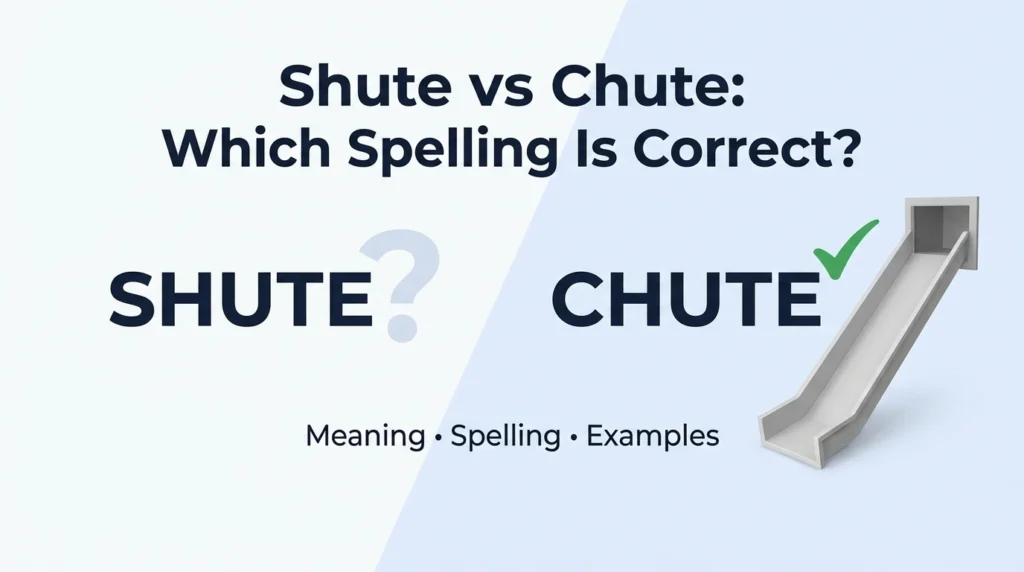

Chute is the standard spelling to use when you mean a sloping or vertical passage, tube, channel, slide, or a shortened form of parachute. Shute does exist as a less-common spelling in some dictionary records and as a proper name. However, in normal modern writing, chute is the clear and preferred choice.
If you’re writing about a laundry chute, garbage chute, cattle chute, emergency chute, grain chute, or water chute, spell the word chute.
What Is the Difference Between Shute and Chute?
The difference between shute vs chute is mainly a question of standard spelling and modern usage.
A chute is usually a narrow passage, channel, tube, or steep slope through which people, objects, water, or materials can move. The word can also informally mean a parachute. Major learner dictionaries use chute for expressions such as laundry chute, garbage chute, water chute, and emergency chute.
Shute requires more careful explanation. It isn’t simply a nonexistent word. At least one major dictionary records lowercase shute as a less common spelling of chute. Shute also occurs as a surname and other proper names.
For practical writing, however, that dictionary status doesn’t make the two spellings equally advisable. Chute is the established modern form readers expect.
Why Does the Difference Matter?
A spelling mistake rarely destroys the meaning of a sentence, but it can distract the reader.
Imagine a maintenance notice saying:
Please do not place cardboard inside the garbage shute.
Most readers will understand the intended meaning. Still, shute may look like an accidental phonetic spelling, especially in professional or educational writing.
The difference matters particularly in:
- school assignments and examinations
- workplace emails and reports
- engineering or construction documents
- building notices and instructions
- product descriptions
- academic writing
- professional website content
When readers already expect garbage chute or laundry chute, an unusual spelling can make otherwise polished writing appear less carefully edited.
The Core Rule for Shute vs Chute
Rule: When you mean a passage, channel, slide, tube, steep descent, or informal parachute, write chute. Treat shute as an uncommon variant or proper-name spelling rather than your default choice.
This rule covers almost every situation an everyday writer is likely to encounter.
A useful second rule is equally simple:
Don’t choose a spelling simply because it looks closer to the pronunciation.
English frequently preserves spellings that cannot be predicted reliably from sound alone.
Read More: Icycle vs Icicle Differences: Which Spelling Is Correct?
How to Use Chute Correctly
Chute as a Passage or Channel
This is the most familiar meaning.
A chute guides something through a particular path, often downward. It may be vertical, steeply sloped, open, or enclosed depending on its purpose.
Common combinations include:
- laundry chute
- garbage chute
- rubbish chute
- mail chute
- grain chute
- cattle chute
- debris chute
- water chute
- emergency chute
- ski chute
For example:
The workers sent the debris down the chute.
Here, chute names the channel through which the material travels.
Chute as a Short Form of Parachute
Chute can also be an informal shortened form of parachute. Modern learner dictionaries recognize this use.
For example:
His reserve chute opened safely.
The shorter word fits conversation, reporting, aviation discussions, and other contexts where the meaning is already obvious.
Chute as a Verb
Chute can function as a verb as well. Forms such as chuted and chuting are recorded for moving something through a chute or moving as though through one.
For example:
The grain was chuted into the storage area.
This usage is legitimate, but it sounds more specialized than the noun. In ordinary conversation, people are more likely to say that the grain went down the chute or was sent through the chute.
When Can Shute Be Correct?
There are two important cases.
First, Shute can be a proper name. You should preserve that spelling whenever it belongs to a person, place, organization, or another named entity.
Second, lowercase shute has dictionary support as a less-common variant of chute.
That does not mean writers should freely alternate between the spellings. In edited modern English, chute remains the safer and more recognizable form.
Correct Examples of Chute and Shute
These examples show how the distinction works across different situations.
- Conversation: Put the dirty towels down the laundry chute before you leave.
- Email: Please report any blockage in the waste chute to building management.
- School: Our science model uses a plastic chute to guide the marbles downward.
- Workplace: Packages leave the sorting machine through a narrow chute.
- Social media: That water chute was much faster than I expected.
- Academic writing: Researchers measured the velocity of material entering the chute.
- Construction: Workers attached the debris chute securely before clearing the upper floor.
- Agriculture: The veterinarian examined each animal after it entered the cattle chute.
- Aviation: The passenger reached the ground using the emergency chute.
- Skydiving: She checked her reserve chute before boarding the aircraft.
- Winter sports: The skiers carefully entered the narrow mountain chute.
- Proper name: The library displayed several novels written by Nevil Shute.
Notice the pattern. Chute handles the ordinary vocabulary meanings while Shute remains correct when the spelling belongs to a name.
Shute vs Chute: Incorrect vs Correct Examples
| ❌ Incorrect | ✅ Correct | Why |
|---|---|---|
| Put the clothes down the laundry shute. | Put the clothes down the laundry chute. | Laundry chute is the standard expression. |
| The garbage shute is blocked. | The garbage chute is blocked. | The waste-disposal passage is normally spelled chute. |
| Workers installed a debris shute. | Workers installed a debris chute. | Construction terminology normally uses chute. |
| The cattle entered the shute. | The cattle entered the chute. | A livestock passage is a cattle chute. |
| Grain fell through the loading shute. | Grain fell through the loading chute. | Chute is the expected modern spelling for the channel. |
| He opened his reserve shute. | He opened his reserve chute. | Informal chute can mean parachute. |
| The children raced down the water shute. | The children raced down the water chute. | A slide or steep water passage takes the spelling chute. |
| She will chute the photographs tomorrow. | She will shoot the photographs tomorrow. | Shoot means photograph or film something. |
| The plant produced a new chute. | The plant produced a new shoot. | New plant growth is a shoot, not a chute. |
| I read a novel by Nevil Chute. | I read a novel by Nevil Shute. | Proper names must retain their established spelling. |
Why Do People Confuse Shute and Chute?
The mistake makes sense once you hear the word aloud.
They Sound the Same
Chute is pronounced /ʃuːt/, essentially the same as shoot. Dictionaries list chute and shoot as homophones—words that share a pronunciation but differ in spelling or meaning.
Someone who hears the word before seeing it may therefore try to spell the initial /ʃ/ sound with sh.
That creates the very plausible-looking shute.
The Spelling Looks Counterintuitive
Beginning chute with ch may surprise learners who expect ch to sound as it does in chair, child, or change.
But English contains many borrowed words whose spelling reflects their linguistic history rather than a simple modern sound-to-letter rule.
Chute entered English from French, where the related word concerns a fall or descent. Its English history reaches back to the early nineteenth century.
Writers Overgeneralize the “Sh” Pattern
English learners quickly discover words such as:
- ship
- shop
- shape
- shut
- shine
All begin with the letters sh and the /ʃ/ sound.
It is therefore logical—but unreliable—to assume that a word pronounced like “shoot” and referring to a channel should be written shute.
Read More: Present vs Presant Differences: Meaning, Spelling, and Correct Usage
Spellcheck May Not Always Save You
A spellchecker can catch many errors, but shute presents a special problem.
Because the form can appear in dictionaries and Shute is also a proper name, some software may accept it rather than automatically replacing it. That means a lack of a red underline does not prove that shute is the best spelling for your sentence.
Context still matters.
Translation Can Encourage Phonetic Spelling
Learners whose first language has a more predictable relationship between sounds and letters may naturally attempt to spell unfamiliar English words according to pronunciation.
Since chute sounds like “shoot,” the spelling shute can appear logical.
The solution isn’t to memorize another complicated grammar rule. Instead, learn chute together with a familiar phrase such as laundry chute.
Common Mistakes Checklist
Use this checklist whenever you’re unsure about shute vs chute:
- Writing “shute” because it sounds right: Remember that standard spelling doesn’t always follow the most obvious phonetic pattern.
- Assuming every spellchecker suggestion is authoritative: Software may recognize proper names or uncommon variants.
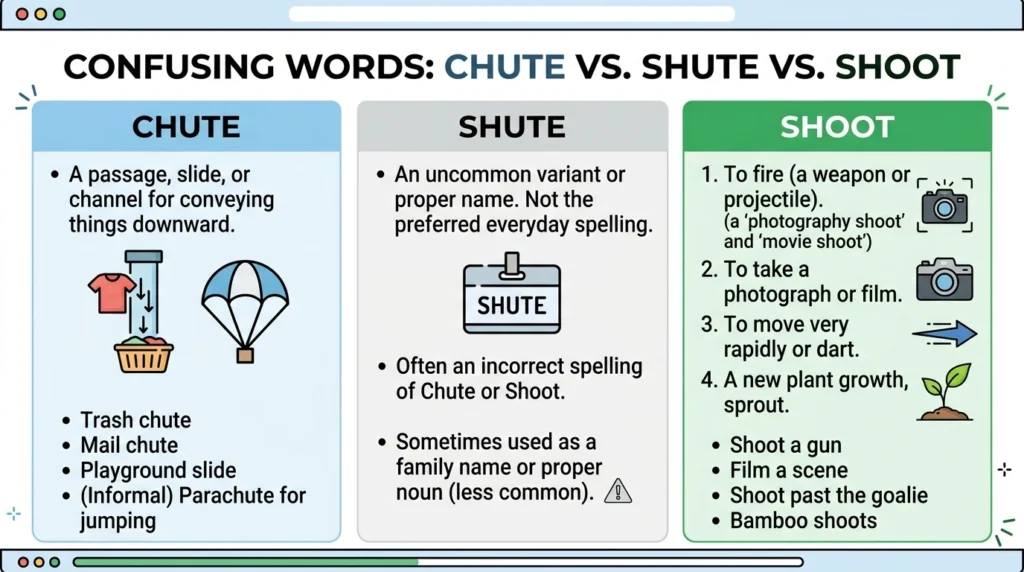
- Confusing chute with shoot: A chute is usually a passage; shoot commonly describes firing, photographing, moving rapidly, or new plant growth.
- Changing a proper name: If someone is actually named Shute, never “correct” the surname to Chute.
- Using the uncommon variant in formal documents: Even when a variant has dictionary support, recognizable standard usage usually creates clearer writing.
- Forgetting the informal parachute meaning: In the right context, chute can simply mean parachute.
- Assuming pronunciation reveals spelling: Chute and shoot sound alike, but their meanings and spellings differ.
Shute vs Chute in Real English
Grammatically Correct and Natural
In ordinary English, combinations such as laundry chute, garbage chute, emergency chute, cattle chute, debris chute, and water chute sound completely natural. Saying that something went down the chute is also normal. When a conversation clearly concerns parachuting, chute can naturally replace parachute. These are the forms readers are most likely to recognize immediately without stopping to question the spelling.
Technically Possible but Unusual
Lowercase shute has dictionary support as a less-common variant of chute, so describing every occurrence as impossible would be inaccurate. However, a sentence such as “Put the laundry down the shute” can easily look misspelled to modern readers. Similarly, verb forms such as chuted and chuting are legitimate but specialized. They make more sense in industrial or technical contexts than in ordinary conversation.
Natural Choice for Everyday Writing
If your goal is natural, immediately understandable English, use chute for the ordinary noun. Write garbage chute, laundry chute, grain chute, and emergency chute without hesitation. Reserve Shute for genuine proper names. This approach avoids unnecessary reader uncertainty while still recognizing that dictionaries sometimes preserve rare variants that aren’t equally common or equally useful in everyday writing.
Formal vs Informal Usage
Neutral and Formal English
The ordinary noun chute works comfortably in both formal and everyday writing.
For example:
The material enters the processing chamber through a steel chute.
Nothing informal appears in that sentence. Technical reports, operating manuals, academic papers, workplace documents, and professional emails can all use chute normally.
Informal English
Using chute as a shortened form of parachute is specifically informal. Dictionaries recognize that shortened meaning.
For example:
Make sure your chute is packed correctly.
In a formal safety document, writing parachute in full may provide greater clarity, especially on first mention.
Read More: Kinesthesiology vs Kinesiology: What’s the Difference?
What About Shute in Formal Writing?
If Shute is a surname or another proper name, use it exactly as written.
For the common noun, choose chute in formal writing. The existence of a rare variant doesn’t make it the strongest editorial choice when a far more familiar spelling is available.
Shute vs Chute Comparison Table
| Feature | Chute | Shute |
| Pronunciation | /ʃuːt/ | Usually /ʃuːt/ |
| Standard everyday spelling | Yes | Generally not preferred |
| Passage or channel meaning | Standard | Recorded as a less-common variant in some dictionaries |
| Laundry/garbage usage | Laundry chute, garbage chute | Avoid in ordinary edited writing |
| Parachute meaning | Yes, informal | Rare variant territory |
| Proper name | Possible | Yes |
| Professional writing | Preferred | Use mainly when required by a proper name or specific source |
| Reader familiarity | High | Much lower |
| Likely to look misspelled | No | Often |
| Best default choice | Yes | No |
The practical answer is therefore straightforward:
Use chute unless you have a specific reason to preserve the spelling Shute.
An Easy Memory Trick
Remember:
A CHute is a CHannel.
Both chute and channel begin with CH.
If something is traveling through a channel, passage, slide, or tube, start the word with CH:
CHannel → CHute
That one connection solves most everyday cases.

How to Choose the Right Word in Three Steps
- Ask whether you mean a passage, slide, tube, or parachute. If yes, choose chute.
- Ask whether you mean firing, photographing, moving quickly, or plant growth. If yes, you probably need shoot instead.
- Check whether Shute is an actual name. If it is, preserve the proper spelling.
This approach handles shute, chute, and shoot without relying on pronunciation alone.
Shute vs Chute in Real-Life Situations
Interview
You’re describing previous warehouse experience:
Natural: “Packages moved from the conveyor into a sorting chute.”
Using the standard industry spelling keeps the answer polished and clear.
Meeting
A maintenance team discusses a blockage:
Natural: “We need to inspect the waste chute on the fifth floor.”
Everyone immediately understands which building feature you mean.
You’re notifying residents about repairs:
Natural: “The garbage chute will remain closed until Monday morning.”
This spelling is appropriate for professional communication.
Text Message
You’re talking casually about a water park:
Natural: “You have to try that huge water chute!”
Casual writing doesn’t require changing the spelling.
Exam
The sentence asks you to choose between shute, chute, and shoot:
The package disappeared down the _____.
The answer is chute because the sentence refers to a passage through which something moves.
Expert Tips for Remembering Chute
Learn the Word as a Collocation
A collocation is a combination of words that commonly appear together.
Instead of memorizing chute alone, learn:
laundry chute
or
garbage chute
The familiar phrase makes the spelling easier to retrieve later.
Don’t Treat Dictionary Recognition as Frequency
A dictionary may record an uncommon form because that form genuinely exists. That doesn’t necessarily mean it is equally common, equally natural, or equally suitable for every context.
That principle explains why shute deserves acknowledgment without becoming the recommended default.
Check Meaning Before Spelling
If you’re choosing between chute and shoot, first decide what the sentence means.
Think:
passage → chute
fire/photo/plant growth → shoot
Meaning provides a stronger clue than pronunciation.
Respect Proper Names
Never automatically change Shute when it appears in a person’s name, business name, street name, title, quotation, or another fixed proper noun.
Spellcheckers can’t reliably decide whether a name was intentional.
Prefer the Form Readers Recognize
Good editing isn’t only about whether a form can technically be defended.
It is also about making communication effortless.
When chute conveys the intended meaning immediately and shute may cause hesitation, chute is usually the stronger editorial decision.
FAQ
Is Shute a Real Word?
Yes, but the answer needs qualification. At least one major dictionary records lowercase shute as a less-common spelling of chute. Shute also exists as a proper name. However, chute remains the spelling you should normally choose for a passage, channel, slide, or similar structure.
Is Shute a Misspelling of Chute?
Often, yes.
If someone writes laundry shute or garbage shute, they probably intended the standard spelling chute. However, calling every occurrence of shute an outright misspelling is too broad because the form has limited dictionary recognition and also occurs in proper names.
How Do You Spell Laundry Chute?
The standard spelling is laundry chute.
Example:
Put your towels down the laundry chute.
Is It Garbage Chute or Garbage Shute?
Write garbage chute.
The word chute refers to the vertical or sloping passage used to move waste toward a collection area.
Is Chute the Same as Shoot?
No.
They are homophones, meaning they can sound alike despite having different spellings and meanings. Chute usually names a passage or channel. Shoot has many meanings including firing something, photographing or filming something, and producing new plant growth.
How Do You Pronounce Chute?
Chute is pronounced /ʃuːt/, like shoot. Both British and American dictionary pronunciations use essentially this same sound.
Is Chute Short for Parachute?
It can be.
Chute is an established informal short form of parachute, particularly when the context already makes the meaning clear.
Can Chute Be a Verb?
Yes. Dictionary records include verb forms such as chuted and chuting for conveying something through a chute or moving through one. The usage is legitimate but less common in everyday conversation than the noun.
Is Chute Spelled Differently in American and British English?
No important spelling difference exists here. Both American and British English use chute. Dictionaries representing both varieties also give essentially the same pronunciation.
Why Does Chute Start With “Ch” If It Sounds Like “Sh”?
The spelling reflects the word’s history rather than a simple English sound-to-letter rule. Chute entered English from French and is connected historically with the idea of falling or descending.
Can I Use Shute in Academic Writing?
Use chute when you mean the ordinary common noun.
Use Shute when it is genuinely part of a person’s name, place name, quotation, historical text, or another proper expression that requires that spelling.
Mini Quiz: Shute vs Chute
| # | Question | Answer | Explanation |
| 1 | Fill in: Put the towels down the laundry _____. | chute | The passage used for laundry is a laundry chute. |
| 2 | Which is standard: garbage shute or garbage chute? | garbage chute | Chute is the preferred spelling for this passage. |
| 3 | Correct the sentence: “The cattle entered the shute.” | The cattle entered the chute. | Livestock can be guided through a cattle chute. |
| 4 | Multiple choice: A new green ___ appeared on the plant. A) chute B) shoot C) shute | B) shoot | New plant growth is called a shoot. |
| 5 | Fill in: The skydiver deployed her reserve _____. | chute | Informally, chute can mean parachute. |
| 6 | True or false: Shute never exists in English. | False | It has limited variant use and also occurs as a proper name. |
| 7 | Correct the sentence: “Please clear the blocked waste shute.” | Please clear the blocked waste chute. | Waste chute uses the standard spelling. |
| 8 | Multiple choice: Which word can mean “take photographs”? A) chute B) shoot C) shute | B) shoot | Shoot can refer to taking photographs or filming. |
| 9 | Fill in: Workers sent the construction debris down the _____. | chute | A debris passage is called a chute. |
| 10 | Correct or incorrect: “I’m reading a novel by Nevil Shute.” | Correct | Shute is the writer’s surname, so its spelling must remain unchanged. |
Quick Summary
The shute vs chute question has a simple practical answer with one useful nuance. Chute is the standard spelling for a passage, channel, tube, slide, steep descent, or the informal short form of parachute. Write laundry chute, garbage chute, cattle chute, and emergency chute. Shute isn’t completely imaginary: it has limited dictionary recognition as a less-common variant and also appears as a proper name. Even so, modern readers generally expect chute, making it the better choice in everyday, academic, and professional writing. Remember the mnemonic “A CHute is a CHannel.” Also keep chute separate from shoot, which sounds the same but carries different meanings.