

Across is the correct spelling. Accross is a misspelling and should not be used when you mean “from one side to the other,” “on the opposite side,” or “throughout an area or group.” Remember that across has one c and two s’s: a-c-r-o-s-s. Standard English dictionaries recognize across as the normal form.
What Is Across?
Across is a standard English word used when something moves, stretches, exists, or happens from one side to another. It can also describe something on the opposite side or something spread throughout a place, organization, or group.
For example:
- She walked across the parking lot.
- The café is across the street.
- The announcement spread across the company.
- I saw him sitting across from my desk.
In grammar, across most commonly works as a preposition or an adverb. A preposition connects the word to a noun or noun phrase, while an adverb can appear without a following object.
Compare:
Preposition: We drove across the bridge.
Adverb: The river was narrow enough to swim across.
Some dictionaries also recognize limited adjective uses, but learners will meet across mainly as a preposition or adverb in everyday English.
Why It Matters
The difference between accross vs across is small on the page but noticeable in polished writing.
Writing accross in a job application, academic assignment, business email, presentation, website heading, or client proposal can make the text look less carefully edited. The reader will usually understand what you mean, but the spelling error can distract from the message.
This matters especially in:
- school and university work
- resumes and cover letters
- professional emails
- business reports
- website copy
- product descriptions
- social media graphics
- presentations
- examinations
- client-facing documents
The important point is simple: this is a spelling issue, not a choice between two standard English words.
The Core Rule
Rule: Always write across with one c and two s’s when you mean movement, position, direction, extent, or distribution from one side to another.
Correct:
a + cross = across
Incorrect:
accross
The spelling does not change because of sentence position, tense, formality, or whether you write in American or British English.
Read More: Scoup vs Scoop: Which Spelling Is Correct?
The Fastest Way to Check
Use this three-step test:
- If you mean from one side to another, use across.
- If you mean on the opposite side, use across or an appropriate phrase such as across from.
- If you have written accross, remove the extra c.
How to Use Across
Across for Movement From One Side to Another
Use across when someone or something moves from one side of an area, surface, line, or boundary toward the other side.
Examples:
She ran across the playground before the bell rang.
We drove across the state during our vacation.
A deer moved across the road just ahead of us.
The child swam across the pool without stopping.
Here, across shows the path of movement.
Across for Position on the Other Side
Across can also describe the position of something on the other side of a road, room, table, river, or similar space.
Examples:
The pharmacy is across the street.
Daniel was sitting across the table.
Her apartment is across the courtyard.
In American English, across from is especially common when something directly faces or is opposite another person or place.
Example:
The bookstore is across from the train station.
Across Meaning Throughout
Across does not always describe a literal journey. It can mean throughout different parts of a place, organization, population, or group.
Examples:
The policy applies across the organization.
Temperatures dropped across the region.
The company introduced the software across all departments.
Support for the proposal increased across several age groups.
This use is common in news, business, research, and professional writing.
Across for Measurements
Across can describe the width or distance from one side of something to another.
Examples:
The table is four feet across.
The opening measures nearly two meters across.
Notice that no noun follows across in these examples, so it functions adverbially.
Across in Common Expressions
Across also appears in several established expressions.
Come across can mean to find or encounter something unexpectedly.
I came across an old notebook while cleaning the attic.
It can also describe the impression someone creates.
She came across as confident during the interview.
Get something across means to communicate an idea successfully.
The speaker used a diagram to get the main point across.
These expressions still use the normal spelling across, never accross.
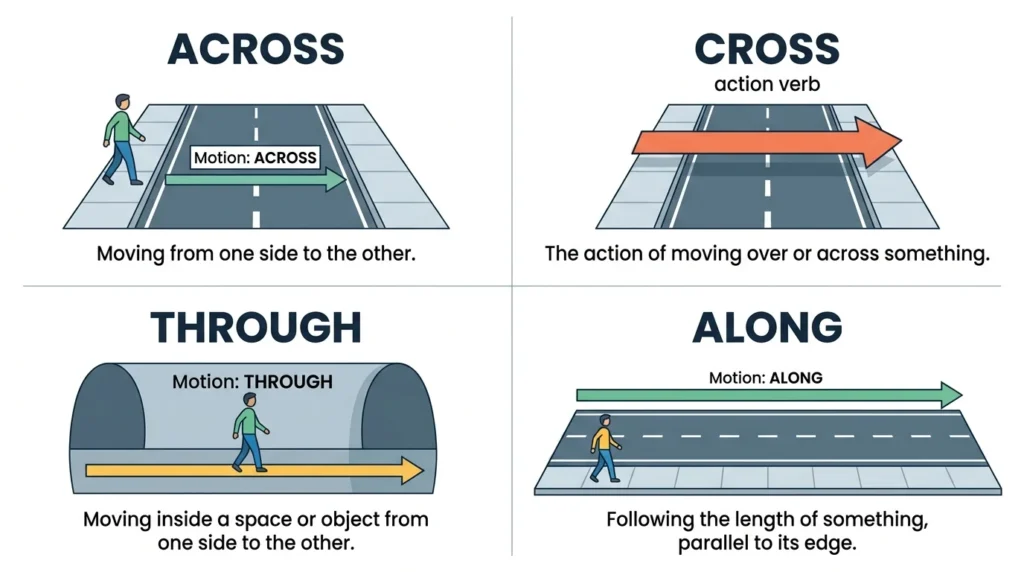
Across vs Through
Choosing the correct spelling is only the first step. You also need the correct word for the type of movement.
Across generally focuses on movement from one side of an area or surface to another. Through normally describes movement within and out of something that surrounds the person or object.
Compare:
We walked across the field.
We walked through the forest.
She ran across the road.
She walked through the tunnel.
A field or road is treated as an area you cross. A tunnel surrounds you as you move within it.
Across vs Along
Across means from one side toward the other side.
Along means following the length, direction, or course of something.
Compare:
We walked across the road.
We moved from one side to the other.
We walked along the road.
We followed the road.
That distinction can completely change the picture created by a sentence.
Read More: Naive vs Nieve: Which Spelling Is Correct?
Across vs Cross
Across and cross are related in meaning, but they do different grammatical jobs.
Cross commonly functions as a verb when it means to move from one side to another. Across commonly functions as a preposition or adverb describing that movement or position.
Correct:
We crossed the road.
We walked across the road.
Incorrect:
We acrossed the road.
You normally need the verb cross, not across, when the word itself expresses the action.
Correct Examples of Across
The following examples show across in different types of real-world writing:
- Conversation: “I saw Maya walking across the street this morning.”
- Email: “I have shared the updated schedule across all project teams.”
- School: “The students carried their science models across the classroom.”
- Workplace: “The new procedure will apply across the entire department.”
- Social media: “Storm clouds are moving across the city tonight.”
- Academic writing: “Similar patterns appeared across all three data sets.”
- Interview: “I have worked across several areas of digital marketing.”
- Travel: “We drove across the desert before reaching the next town.”
- Directions: “The bank is directly across from the post office.”
- Meeting: “We need consistent reporting across every regional office.”
- Personal message: “I came across your old photograph yesterday.”
- Measurement: “The dining table measures nearly five feet across.”
Each sentence uses the standard spelling across.
Incorrect vs Correct Examples
| ❌ Incorrect | ✅ Correct | Why |
|---|---|---|
| We walked accross the street. | We walked across the street. | Accross contains an unnecessary second c. |
| The store is accross the road. | The store is across the road. | The standard spelling for opposite-side position is across. |
| She ran accross the field. | She ran across the field. | Movement from one side of an area to another takes across. |
| I came accross an interesting article. | I came across an interesting article. | The expression is come across, meaning to encounter or find unexpectedly. |
| He sat accross from me. | He sat across from me. | The phrase is spelled across from. |
| The changes apply accross the company. | The changes apply across the company. | Here across means throughout the organization. |
| News spread accross the region. | News spread across the region. | The word describes distribution throughout an area. |
| We acrossed the highway. | We crossed the highway. | Cross is the verb. Standard English does not normally form the past tense as acrossed. |
| We walked across the tunnel. | We walked through the tunnel. | The spelling is correct, but through is more natural when movement occurs inside something surrounding you. |
| We walked across the road for two miles. | We walked along the road for two miles. | Along describes movement following the road’s length. Across suggests moving from one side to the other. |
| Her office is accross from mine. | Her office is across from mine. | Only one c appears in across. |
| The message was sent accross all teams. | The message was sent across all teams. | Across can mean throughout multiple groups. |
Why People Make This Mistake
Phonetic Similarity
If someone reads across and the incorrect spelling accross aloud, the extra written c does not naturally create a clearly separate syllable. Because the error may not sound different, pronunciation alone offers little help when choosing the spelling.
The approximate pronunciation is “uh-KROSS,” although the exact vowel varies by accent.
Spelling Overlap With Other Words
English contains familiar words beginning with acc-, such as access, account, and accept. Writers may unconsciously transfer that visual pattern to across.
However, across has its own fixed spelling. It does not follow the spelling pattern of access.
Overgeneralizing Double-Consonant Patterns
English uses doubled consonants in many words, so learners sometimes assume that across should begin with acc-.
That assumption produces:
accross
The standard word is:
across
The double consonant in across appears at the end: ss, not at the beginning.
Fast Typing
Typing the same key twice is easy, especially on a phone or when writing quickly.
A sentence can therefore contain accross even when the writer already knows the correct spelling.
Proofreading matters because knowledge and typing accuracy are not the same thing.
Autocorrect and Spellcheck Limits
Many spelling tools can flag accross, but writers should not depend entirely on software.
Spellcheck may be disabled, a custom dictionary may interfere, or the error may appear inside a graphic, file name, username, heading, or other place that receives less automatic checking.
Learning the spelling is more reliable than expecting a tool to repair it every time.
Read More: Transferred vs Transfered: Which Spelling Is Correct?
Translation Interference
Some English learners bring spelling expectations from another language into English. This can affect decisions about doubled consonants.
Translation interference is not the cause for every learner, but when it occurs, treating across as a fixed vocabulary item can help:
a-c-r-o-s-s
Common Mistakes Checklist
- Adding a second c: Writing accross is the main error. Remember that across begins a-c, not a-c-c.
- Removing one s: Acros is also wrong. The ending requires ss.
- Using across as a normal verb: Write “We crossed the road,” not “We acrossed the road.”
- Confusing across with through: Use through when the intended movement is within something that surrounds you, such as a tunnel.
- Confusing across with along: Use along when following the length or direction of a road, path, river, wall, or similar feature.
- Forgetting across from: When describing opposite positions, especially in American English, across from is often the natural phrase.
- Trusting pronunciation to reveal the spelling: The spoken word does not tell you that an extra c is wrong, so memorize the written form.
- Proofreading only the body text: Typos often survive in titles, headings, image text, captions, and filenames. Check those separately.
Accross vs Across Comparison Table
| Feature | Across | Accross |
|---|---|---|
| Standard English spelling | ✅ Yes | ❌ No, when intended as across |
| Number of c’s | One | Two |
| Ending | -ss | -ss |
| Can mean from one side to another | ✅ Yes | ❌ No |
| Can mean on the opposite side | ✅ Yes | ❌ No |
| Can mean throughout an area or group | ✅ Yes | ❌ No |
| Used as a preposition | ✅ Yes | ❌ No |
| Used as an adverb | ✅ Yes | ❌ No |
| Suitable for professional writing | ✅ Yes | ❌ No |
| Example | across the road | accross the road ❌ |
Across in Real English
Grammatically Correct English
Across is grammatically correct when it describes movement, position, width, distribution, or certain established expressions. Natural examples include “walk across the street,” “sit across from someone,” “five feet across,” “across the organization,” and “come across an old photo.” These patterns occur in everyday speech as well as professional and academic writing.
Grammatically Possible but Unnatural English
A sentence can contain the correctly spelled word across and still sound unnatural if the direction is wrong. For example, “We walked across the road for five miles” is structurally possible, but it suggests repeated side-to-side movement. If you mean that you followed the road for five miles, “We walked along the road” communicates the intended movement more naturally.
Natural Everyday English
Native and proficient speakers commonly use across in simple patterns such as “across the street,” “across the room,” “across from me,” and “come across something.” Business English also regularly uses phrases such as “across the company” or “across departments” to mean throughout several parts of an organization. The word is useful because it works for both physical and abstract relationships.
American vs British English
The spelling across is standard in both American and British English. There is no American spelling accross and British spelling across, or vice versa.
A genuine usage difference appears in the phrase across from. Guidance on regional usage notes that across from is especially associated with American English when describing something opposite another person or place. British speakers can understand and use it, but opposite is also common in British usage.
American-style example:
The hotel is across from the museum.
Possible British-style wording:
The hotel is opposite the museum.
The spelling of across itself remains unchanged.
Formal vs Informal Usage
Across is a standard, register-neutral word. That means it works naturally in informal conversation, professional communication, journalism, academic writing, and formal reports.
Informal:
“I’ll meet you across the street.”
Professional:
“The update will be implemented across all regional offices.”
Academic:
“The researchers observed the effect across multiple demographic groups.”
You usually do not need to replace across simply because your writing becomes more formal. Choose another word only when it expresses your meaning more precisely.
Memory Trick
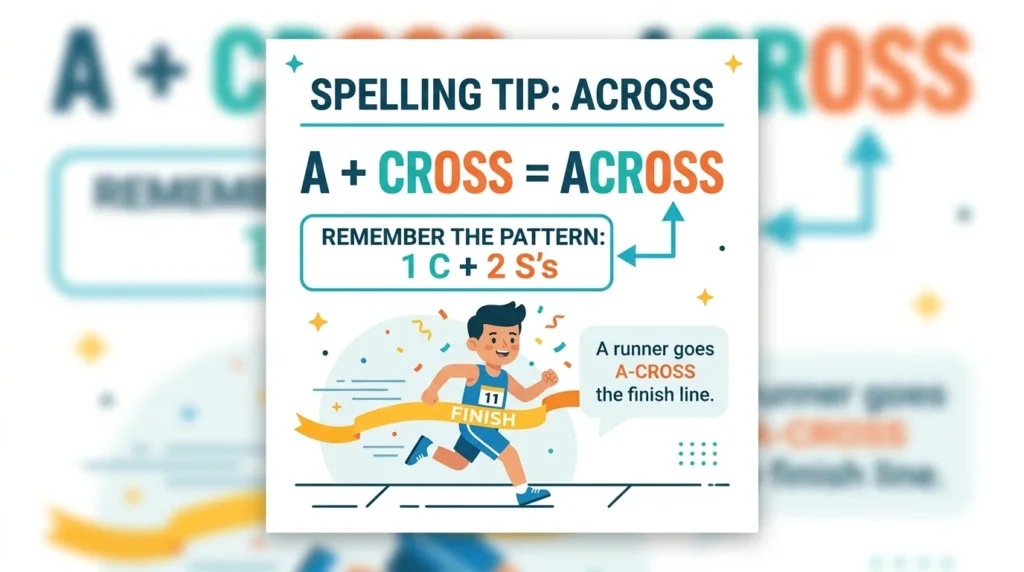
Remember:
A runner goes A-CROSS the finish line.
Write A + CROSS = ACROSS.
The word cross already begins with one c, so adding the initial a gives:
A + CROSS → ACROSS
Do not add another c.
Also remember the letter pattern:
1 C, 2 S’s
A C R O S S
Real-Life Situations
In a Job Interview
You want to explain your experience:
✅ “I have worked across several departments, including sales, operations, and customer support.”
Using across here communicates experience throughout different parts of an organization.
In a Meeting
A manager might say:
✅ “We need one reporting system across all teams.”
Here across means throughout the teams.
In an Email
You might write:
✅ “The revised guidelines have been shared across the organization.”
This is clear and professional.
In a Text Message
You might send:
✅ “I’m at the coffee shop across from the station.”
The phrase identifies an opposite location.
In an Exam
Suppose the sentence is:
“The children ran _____ the playground.”
If the meaning is from one side to the other, the answer is:
✅ across
Not:
❌ accross
Read More: Commit vs Comit: Which Spelling Is Correct?
Expert Tips
Search for the Specific Typo During Proofreading
When editing a long document, use Find and search for:
accross
This catches the error even when your eyes skim over it.
Check Titles Separately
Writers often proofread paragraphs carefully but overlook headings.
Search for the typo in:
- page titles
- headings
- image captions
- presentation slides
- filenames
- metadata
- social graphics
A spelling error is especially visible when displayed in large text.
Learn the Whole Phrase
Instead of memorizing across in isolation, practice useful combinations:
across the street
across the country
across from
across the room
across all departments
come across
get the point across
Phrase-level learning makes the spelling and meaning easier to retrieve together.
Decide Whether You Need Across, Cross, Through, or Along
Before correcting the spelling, check the intended movement:
cross = the action verb
across = from one side to another
through = within and out of something surrounding you
along = following the length or course of something
This prevents a sentence from being correctly spelled but incorrectly worded.
Do Not Treat Search Results as Proof That a Spelling Is Standard
A misspelled form can appear online simply because people search for it, discuss it, or type it incorrectly.
When deciding whether a spelling is standard, check established dictionary forms rather than counting how often each version appears in search results.
Quick Summary
The correct spelling is across, with one c and two s’s. Accross is a misspelling when you intend the standard English word. Use across for movement from one side to another, position on the opposite side, distribution throughout a place or group, and expressions such as come across and get a point across. Do not confuse across with the verb cross, through for movement inside something surrounding you, or along for movement following a length or path. The easiest spelling reminder is A + CROSS = ACROSS. In both American and British English, the standard spelling remains across.
FAQ
Is Accross a Real Word?
When you mean the standard English word describing movement, position, or distribution from one side to another, accross is not the correct spelling. Write across instead. Proper names can sometimes use unusual spellings, so do not automatically change a name without checking it.
Is It Across or Accross the Street?
The correct phrase is across the street.
Example:
“The grocery store is across the street from the library.”
How Many C’s Are in Across?
Across contains one c.
Spell it:
A-C-R-O-S-S
It contains one c and two s’s.
Why Does Across Have Two S’s but Only One C?
That is simply the established spelling of the English word. Modern spelling does not require you to double the c. Treat a-c-r-o-s-s as a fixed spelling rather than trying to build it from a general consonant-doubling rule.
Is Acrossed Correct English?
Normally, no. When you need a verb meaning “went from one side to another,” use crossed.
❌ We acrossed the road.
✅ We crossed the road.
Across itself normally functions as a preposition or adverb in this kind of sentence.
Is Acrost the Same as Across?
No. Acrost may occur in some dialectal pronunciations or representations of speech, but across is the standard form to use in ordinary edited English. One dictionary records a dialectal pronunciation ending with a /t/-like sound, but the standard spelling remains across.
Can Across Mean Throughout?
Yes. Across can mean throughout different parts of a place, population, organization, or group.
Example:
“The program is available across the country.”
This use is standard.
Can I Start a Sentence With Across?
Yes.
Example:
“Across the room, a large clock hung above the doorway.”
There is no rule preventing across from appearing at the beginning of a sentence.
What Is the Difference Between Across and Opposite?
Across can describe a position on the other side of a space. Opposite emphasizes that two things face or lie directly against each other in position.
In American English, across from is a common way to express this relationship:
“The café is across from the bank.”
Is Across a Preposition or an Adverb?
It can be both.
Preposition:
“She walked across the room.”
Adverb:
“She walked across.”
The first example has an object, the room. The second does not. Standard references recognize both functions.
Mini Quiz
| Question | Answer | Explanation |
|---|---|---|
| 1. Choose the correct spelling: across / accross | across | Standard English uses one c and two s’s. |
| 2. Fill in the blank: We walked _____ the bridge. | across | The movement goes from one side of the bridge toward the other. |
| 3. Correct the sentence: “The café is accross from my office.” | The café is across from my office. | Remove the unnecessary second c. |
| 4. Choose: “We walked across/along the road for three miles.” | along | Following the road’s length takes along. |
| 5. Choose: “We walked across/through the tunnel.” | through | A tunnel surrounds you while you move inside it. |
| 6. Correct the sentence: “We acrossed the street after lunch.” | We crossed the street after lunch. | Cross is the verb; its past tense is crossed. |
| 7. Fill in the blank: The policy applies _____ every department. | across | Here across means throughout multiple departments. |
| 8. Which is correct: “I came across an old letter” or “I came accross an old letter”? | I came across an old letter. | The established expression is come across. |
| 9. Fill in the blank: The lake is almost two miles _____. | across | Across can describe width from one side to another. |
| 10. Correct the sentence: “News spread accross the country.” | News spread across the country. | Across is the correct spelling and means throughout the country. |