
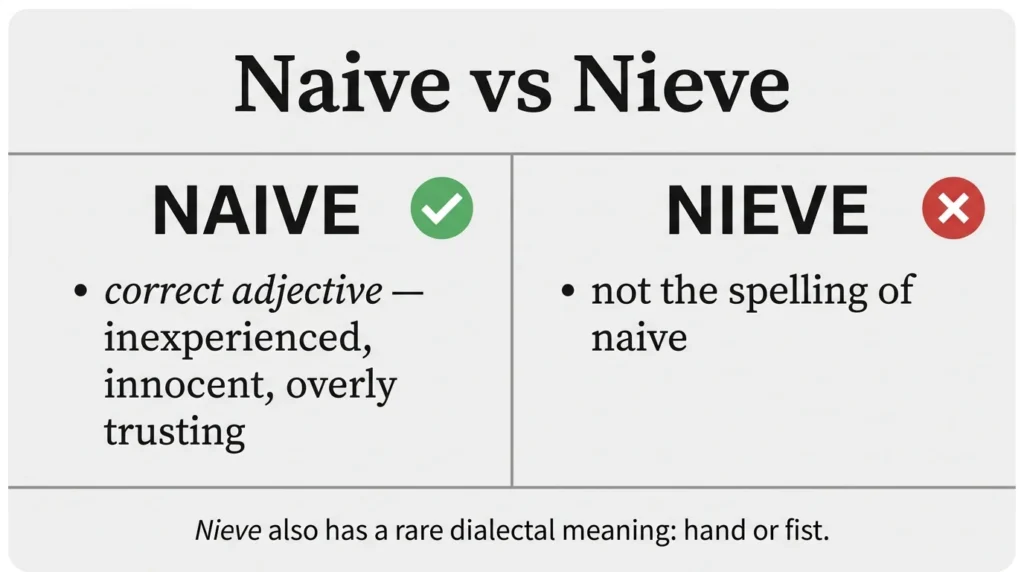

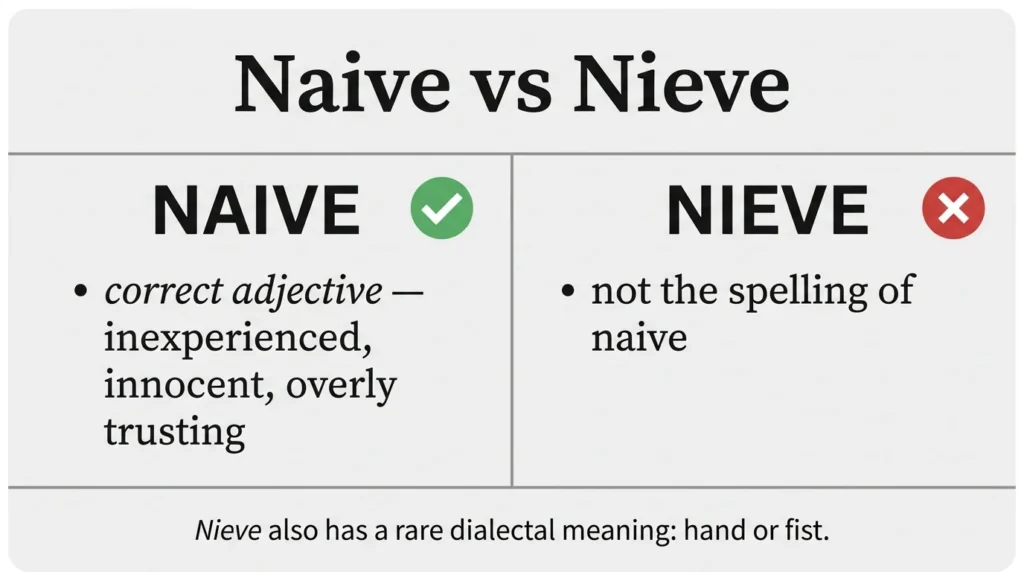
Naive is the correct spelling when you mean innocent, inexperienced, unsophisticated, or too willing to trust. Nieve is not an alternative spelling of naive in standard English. However, nieve does exist as a rare, old, dialectal English noun meaning a hand or fist. You may also see naïve, with two dots over the i; both naive and naïve are accepted English spellings.
What Does Naive Mean?
Naive is an adjective, which means it describes a person, belief, idea, action, or approach.
A naive person lacks experience or knowledge and may therefore trust people or situations too easily. The word can also describe an idea or argument that seems overly simple because it does not take enough real-world complications into account.
For example:
- A naive employee might believe every promise made during a sales pitch.
- A naive assumption might ignore obvious risks.
- A naive plan might work in theory but overlook practical problems.
- A naive child may trust someone without recognizing possible dishonesty.
The word does not always mean “stupid.” Often, it points specifically to inexperience, innocence, excessive trust, or lack of sophistication.
Is Nieve a Word?
Yes, but this needs an important distinction.
If you write:
She was nieve enough to believe the scam.
then nieve is a spelling error. The adjective you need is naive.
However, nieve has also been recorded as an old or dialectal English noun meaning a hand or fist, particularly in Scottish and Northern British usage. That meaning is unrelated to the adjective naive.
Nieve is also a Spanish noun meaning snow, another completely separate use of the spelling.
So the accurate rule is not “nieve can never be a word.” It is:
Nieve is not the correct spelling of naive when you are describing innocence, inexperience, or excessive trust.
Why Naive vs Nieve Matters
A single misplaced vowel can change how readers judge your writing.
Writing nieve instead of naive in an essay, résumé, business email, report, article, or application can look like a basic spelling mistake. That is especially noticeable because naive is a familiar English word even though its spelling does not closely match the way many speakers expect it to sound.
The mistake can matter in:
- job applications and professional emails;
- school assignments and examinations;
- academic papers;
- website and marketing copy;
- social media posts for a professional account;
- business reports and presentations;
- published articles.
Correct spelling does not make an argument stronger by itself, but obvious spelling errors can distract readers from what you are trying to say.
The Core Rule
RULE: Use naive or naïve when you mean inexperienced, innocent, unsophisticated, or overly trusting. Do not use nieve as an alternative spelling of that adjective.
A simple comparison:
Naive = correct adjective
Naïve = also correct
Nieve = not an alternative spelling of naive
That one distinction solves almost every everyday case.
Read More: Transferred vs Transfered: Which Spelling Is Correct?
Naive or Naïve: Are Both Correct?
Yes. Naive and naïve are accepted spellings of the same English adjective. They have the same basic meaning and grammatical function.
The two dots in naïve are called a diaeresis. They indicate that the a and i belong to separate syllables rather than forming one combined vowel sound.
Therefore:
- naive — correct;
- naïve — correct;
- nieve — incorrect if you mean naive.
In ordinary modern English writing, using naive without the diaeresis is completely acceptable. There is no need to add the dots unless you or the style you follow prefers naïve.
How Do You Pronounce Naive?
Naive is normally pronounced as two syllables, with the stronger stress on the second syllable: roughly ny-EEV. Dictionary pronunciations confirm that the second syllable carries the main stress.
That pronunciation partly explains the spelling problem. A learner who hears the word before seeing it written may try to represent the sounds with nieve.
How to Use Naive Correctly
Use naive when a lack of experience, realistic judgment, sophistication, or caution is central to what you mean.
A practical method is:
- Identify what you are describing. It may be a person, belief, assumption, question, plan, argument, or approach.
- Ask whether inexperience or excessive simplicity is involved. If yes, naive may fit.
- Check the tone. Calling a person naive can sound critical, even when you only mean inexperienced.
- Spell it N-A-I-V-E. Do not reverse the a and i into nieve.
- Use naïve if your preferred style keeps the diaeresis. The meaning remains the same.
Naive for a Person
Use it when someone’s lack of experience affects what they believe or how they behave.
Example:
Daniel was naive enough to assume the stranger would return the money.
Naive for an Idea or Belief
The word can describe a belief that ignores complexity or practical difficulties.
Example:
It would be naive to assume that one policy could solve the entire problem overnight.
Naive for an Approach
In academic, technical, or analytical contexts, naive may describe an approach that is deliberately simple or that does not account for more sophisticated factors.
Example:
The first model used a naive approach that ignored seasonal changes.
Here, naive describes the method, not the intelligence of the person who created it.
Correct Examples of Naive
The following examples show how naive works in different kinds of English.
- Conversation: I was naive enough to believe the deal had no hidden conditions.
- Text message: Maybe I’m being naive, but I think he genuinely wants to apologize.
- Social media: It is naive to assume every viral claim has been fact-checked.
- School: The character begins the novel as a naive teenager who knows little about the outside world.
- Exam: The writer criticizes the naive belief that economic growth has no environmental cost.
- Email: Our original estimate was naive because it did not account for shipping delays.
- Workplace: The new employee was inexperienced, but nobody considered her naive or incapable.
- Meeting: It would be naive to launch the project without discussing the security risks first.
- Academic writing: A naive interpretation of the data may overlook the influence of several confounding variables.
- Business: Management rejected the naive assumption that demand would continue rising indefinitely.
- Interview: Looking back, I was naive about how much preparation the role required.
- Everyday life: He had a naive belief that online reviews were always genuine.
Incorrect vs. Correct
| ❌ Incorrect | ✅ Correct | Why |
|---|---|---|
| She was nieve about office politics. | She was naive about office politics. | Naive is the adjective meaning inexperienced or insufficiently worldly. |
| It was nieve to trust the message. | It was naive to trust the message. | The vowel order in the English adjective is a-i, not i-e. |
| His nieve assumption caused problems. | His naive assumption caused problems. | An unrealistic or oversimplified assumption can be described as naive. |
| I may sound nieve, but I believe her. | I may sound naive, but I believe her. | Nieve is not an alternative spelling of the adjective. |
| The plan seems nieve and unrealistic. | The plan seems naive and unrealistic. | Naive can describe a plan that overlooks important complications. |
| She gave a nieve answer. | She gave a naive answer. | The adjective before answer must be spelled naive. |
| We were nieve about the costs. | We were naive about the costs. | Naive about something is a normal construction for lacking realistic knowledge of it. |
| His argument is too nieve. | His argument is too naive. | Naive can describe an argument that treats a complicated subject too simply. |
| Don’t be so nieve about online scams. | Don’t be so naive about online scams. | The intended meaning is “too trusting,” so naive is required. |
| Their forecast now looks nieve. | Their forecast now looks naive. | The criticism concerns an oversimplified forecast, so the correct adjective is naive. |
Why People Write Nieve Instead of Naive
The mistake is understandable because English spelling does not always map neatly onto pronunciation.
Phonetic Similarity
People often learn a word by hearing it before they see it written.
Because naive is pronounced in two syllables and does not sound like a simple letter-by-letter reading of n-a-i-v-e, a writer may guess the spelling and arrive at nieve.
Read More: Commit vs Comit: Which Spelling Is Correct?
Unusual Vowel Order
The sequence ai can feel unexpected. Writers may unconsciously rearrange the vowels into the more familiar-looking ie pattern.
This is similar to many spelling errors in which the writer remembers all the correct letters but puts two vowels in the wrong order.
Influence of Naïve
Seeing both naive and naïve can make learners think English has several competing spellings.
It does—but only regarding the diaeresis.
The underlying letter order remains:
n-a-i-v-e
not:
n-i-e-v-e
Naive or Naïve: Are Both Correct?
Autocomplete and Spellcheck Limits
Do not assume that an unflagged word must be correct for your intended meaning.
Because nieve can occur as a dialectal word, a proper name, or a word in another language, some digital systems may not treat every occurrence as an obvious typo. Context still matters. Dictionaries record nieve separately from naive.
Translation Interference
Spanish speakers may already recognize nieve as a correctly spelled word because it means snow in Spanish. That can make the spelling look especially natural even though it is wrong when the intended English adjective is naive.
Overgeneralizing “I Before E”
The traditional classroom rhyme about i and e is not a reliable way to spell every English word.
More importantly, naive is not a case where you should choose between an ie and ei sequence. Its actual sequence is a-i-v-e.
Learning the complete word is safer than trying to force it into a general spelling rhyme.
Common Mistakes Checklist
Before submitting your writing, check for these problems:
- Writing nieve for naive: Remember that the adjective contains nai-, not nie-.
- Assuming naïve is a different word: Naive and naïve are spelling variants of the same adjective.
- Calling nieve universally nonexistent: It has separate dialectal English meanings, so say it is incorrect for the meaning “naive.”
- Confusing naive with innocent: The words overlap, but naive usually emphasizes lack of experience or realistic judgment.
- Using naive as an automatic synonym for stupid: Someone can be intelligent yet naive about a particular subject because they lack experience with it.
- Overusing naive in professional feedback: The word can sound dismissive when applied directly to a person. Sometimes inexperienced, optimistic, or oversimplified is more precise.
- Trusting spellcheck without reading the sentence: A spelling tool cannot always determine what meaning you intended.
- Changing the spelling by register: Formal and informal English both use naive; nieve does not become correct just because the context is casual.
Naive vs Nieve in Real English
Grammatically Correct and Natural
Sentences such as “I was naive to trust him” and “That assumption seems naive” are both grammatical and natural. The first describes a person’s judgment, while the second evaluates an idea. In everyday English, naive is commonly followed by structures such as naive about, naive enough to, and it is naive to. The word works naturally in conversation as well as serious writing.
Grammatically Possible but Potentially Unnatural
A sentence can be structurally grammatical while still sounding poorly chosen. For example, “My manager is extremely naive” is grammatically fine, but in a professional review it may sound unnecessarily personal or insulting. If you mean the manager lacks experience with one specific process, “My manager is inexperienced with this system” is clearer and more neutral.
Natural Everyday English
In conversation, speakers often use naive when looking back at something they once believed: “I was naive back then” or “Maybe I’m being naive.” These expressions usually acknowledge limited experience or excessive optimism. When discussing someone else, context and tone matter more because “You’re naive” may sound like criticism rather than a neutral description.
Formal vs. Informal Usage
Naive is not restricted to either formal or informal English. It appears naturally in conversation, journalism, business writing, academic discussion, and analytical writing.
The spelling does not change by register:
- formal: naive
- informal: naive
- alternative accepted spelling: naïve
- misspelling for this meaning: nieve
What does change is tone.
In casual conversation, “I was naive” can be a harmless way to describe your younger or less experienced self.
In a workplace report, calling a colleague “naive” may sound judgmental. Describing the specific problem is usually better:
Less precise: His view was naive.
More precise: His forecast did not account for changes in demand.
Use the word when it communicates your exact meaning, not merely as a substitute for “wrong.”
Read More: Pentoxide vs Pentaoxide: Which Spelling Is Correct in Chemistry?
Naive vs Nieve Comparison Table
| Feature | Naive | Nieve |
|---|---|---|
| Correct for “inexperienced/too trusting”? | Yes | No |
| Part of speech in normal use here | Adjective | Not the intended adjective |
| Example | She was naive to trust the offer. | She was nieve to trust the offer. ❌ |
| Standard modern English usage | Common | Not as an alternative spelling of naive |
| Separate dictionary meaning | Innocent, inexperienced, unsophisticated | Dialectal noun meaning hand/fist |
| Spanish meaning | Not relevant | “Snow” |
| Variant spelling | Naïve | N/A |
| Suitable in formal writing | Yes | Not for the meaning “naive” |
| Suitable in informal writing | Yes | Still incorrect for this meaning |
| Easy spelling cue | N-A-I-V-E | Avoid when you mean naive |
The distinction between the standard adjective and the separate dialectal noun is supported by major dictionary entries.
Naive vs Innocent: Are They the Same?
Not exactly.
Innocent can mean free from guilt, harmless, morally blameless, or unaware of something.
Naive usually emphasizes insufficient experience, sophistication, or realistic judgment.
Compare:
The defendant was innocent.
This means the defendant was not guilty.
The defendant was naive.
This suggests the defendant lacked experience or judgment.
Another comparison:
Her question was innocent.
She meant no harm.
Her question was naive.
It showed limited understanding or experience.
The words can overlap when innocence comes from inexperience, but they are not interchangeable in every sentence.
Naive vs Gullible
Gullible is generally stronger than naive when the main idea is being easily deceived.
A naive person may lack experience without actually being fooled.
A gullible person is especially willing to believe claims that should perhaps be questioned.
For example:
He was naive about how online scams worked.
This describes limited experience.
He was gullible enough to send money to three obvious scammers.
This emphasizes how easily he was deceived.
Choose the word that identifies the real problem instead of treating them as perfect synonyms.
Naive vs Ignorant
These words should not be treated as exact synonyms either.
Naive often suggests lack of experience or worldly understanding.
Ignorant means lacking knowledge or awareness about something.
A person could have extensive factual knowledge but still be naive about how people behave in a particular situation.
Likewise, someone can be ignorant of a technical fact without being naive.
Naive: She trusted the salesperson without questioning any claims.
Ignorant: She did not know that the product required an annual license.
Precision makes your description fairer and clearer.
Read More: Preform vs Perform: Difference, Meaning, and Examples
Memory Trick
Remember this sentence:
A NAIVE person says, “I trusted it.”
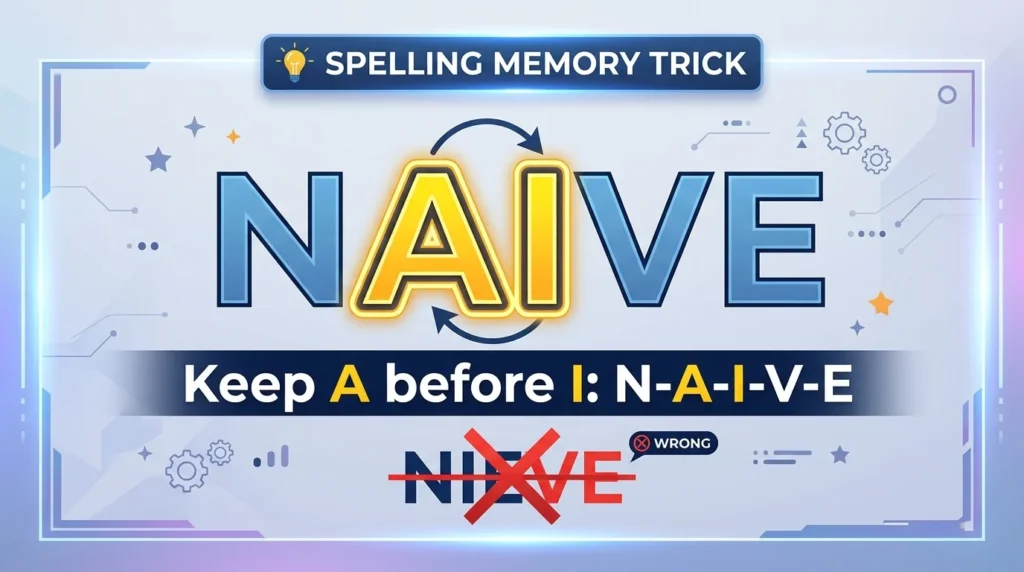
The word NAIVE contains AI immediately after the N:
N + AI + VE = NAIVE
Picture the letters AI standing together and refusing to switch places.
If you start writing nie-, stop and rebuild the word:
N-A-I-V-E
The memory trick is about the letter order, not the meaning of artificial intelligence.
Real-Life Situations
Interview
Question: What did you learn from your first management role?
Natural answer:
“I was naive about how much time good delegation requires, so I learned to set clearer expectations.”
The speaker admits inexperience without claiming to lack intelligence.
Meeting
Natural:
“It would be naive to assume the launch will have no technical problems.”
Here, naive describes an unrealistic assumption rather than attacking a person.
Professional Email
Better:
“Our original forecast was too optimistic and did not account for supplier delays.”
Possible but stronger:
“Our original forecast was naive.”
The second version is grammatical, but the first gives the reader more useful information.
Text Message
Natural:
“Maybe I’m naive, but I still think they’ll refund us.”
This is a common self-reflective use.
Exam
Correct:
“The narrator’s naive understanding of the conflict changes as she gains experience.”
The adjective describes the narrator’s limited early understanding.
Expert Tips
1. Learn Naive as a Complete Visual Unit
Do not try to construct the spelling from pronunciation each time.
Memorize:
NAIVE
Seeing the whole word repeatedly is more reliable than guessing which vowels should appear.
2. Remember That Naïve Is Not a Correction of Naive
If software suggests naïve, that does not mean naive was wrong. Both forms are recognized English spellings.
3. Correct the Meaning, Not Just the Letters
When proofreading, ask whether naive is actually the word you need.
Sometimes a more precise choice is:
- inexperienced;
- trusting;
- innocent;
- gullible;
- unrealistic;
- simplistic;
- optimistic;
- unsophisticated.
These alternatives are not exact synonyms in every context.
4. Be Careful When Applying the Word to People
“Your proposal is naive” criticizes an idea.
“You are naive” criticizes a person more directly.
When clarity matters, explain what the person or proposal has overlooked.
5. Do Not Create an American/British Spelling Rule
There is no useful rule saying Americans should write naive while British writers should write nieve, or vice versa. Standard references recognize naive/naïve, while nieve has a separate dialectal history rather than functioning as the British equivalent of naive.
Quick Summary
Naive is the correct adjective when describing someone or something as inexperienced, innocent, unsophisticated, overly trusting, or unrealistically simple. Naïve, with a diaeresis over the i, is also correct and has the same meaning. Nieve is not an alternative spelling of naive in standard English, although it does exist separately as an old or dialectal noun meaning a hand or fist and as the Spanish word for snow. To avoid the common spelling error, remember the letter order N-A-I-V-E. Use naive for people, assumptions, plans, beliefs, arguments, and approaches, but consider tone when describing another person because the word can sound critical.
FAQ
Is it naive or nieve?
Use naive when you mean inexperienced, innocent, unsophisticated, or too trusting. Nieve is not the correct spelling of that adjective.
Is nieve a real English word?
Yes, but not with the meaning most people intend in the naive vs nieve question. Dictionaries record nieve as an old or dialectal noun meaning a hand or fist.
Is naïve spelled with two dots?
It can be. Naïve is correct, but naive without the diaeresis is also an accepted English spelling.
What are the two dots in naïve called?
They are called a diaeresis. In this word, the mark helps show that the adjacent vowels are pronounced separately.
Does nieve mean snow?
Yes, nieve is the Spanish word for snow. That Spanish noun is unrelated to the English adjective naive.
Is naive a negative word?
It can be negative, but not always severely so. It often suggests that someone lacks experience, realistic judgment, or appropriate caution. The tone depends on context.
Can an idea be naive?
Yes. You can describe an assumption, theory, argument, plan, interpretation, or approach as naive if it treats a complicated issue too simply or overlooks important realities.
Can an intelligent person be naive?
Yes. Naive does not necessarily mean unintelligent. Someone can be highly knowledgeable in one area but inexperienced and overly trusting in another.
What is the noun form of naive?
Common noun forms include naivety, naïvety, and naïveté, depending on spelling and style preferences. The noun refers to the quality or state of being naive.
What is the opposite of naive?
The best opposite depends on context. Possible choices include experienced, worldly, sophisticated, skeptical, cautious, or savvy.
Should I use naive in a professional email?
You can, but use it carefully when referring to another person. Critiquing a specific assumption or explaining what was overlooked is often more professional than calling a colleague naive.
Mini Quiz: Naive vs Nieve
| # | Question | Answer | Explanation |
|---|---|---|---|
| 1 | Multiple choice: Which spelling describes someone who lacks experience? A) nieve B) naive | B) naive | Naive is the standard adjective for this meaning. |
| 2 | Fill in the blank: I was _____ to believe the advertisement. | naive | The sentence describes excessive trust caused by limited judgment or experience. |
| 3 | Correct the sentence: “Her nieve assumption created problems.” | Her naive assumption created problems. | The correct adjective is spelled N-A-I-V-E. |
| 4 | True or false: Naïve is an acceptable spelling. | True | Naïve and naive are both accepted forms. |
| 5 | Multiple choice: Which sentence is correct? A) The plan seems nieve. B) The plan seems naive. | B | Naive can describe an oversimplified or unrealistic plan. |
| 6 | Fill in the blank: It would be _____ to assume that every online review is genuine. | naive | The assumption shows excessive trust and insufficient caution. |
| 7 | True or false: Nieve can never occur as an English word. | False | It has rare dialectal meanings such as “hand” or “fist,” but it is not the adjective naive. |
| 8 | Correct the sentence: “Maybe I’m nieve, but I trust her explanation.” | Maybe I’m naive, but I trust her explanation. | The speaker is describing possible excessive trust. |
| 9 | Multiple choice: Which word more directly means easily deceived? A) gullible B) naive | A) gullible | Naive can involve inexperience without necessarily implying that someone is repeatedly deceived. |
| 10 | Spelling challenge: Complete the word: N _ I V E | A → NAIVE | Remember the full sequence N-A-I-V-E rather than guessing from pronunciation. |