
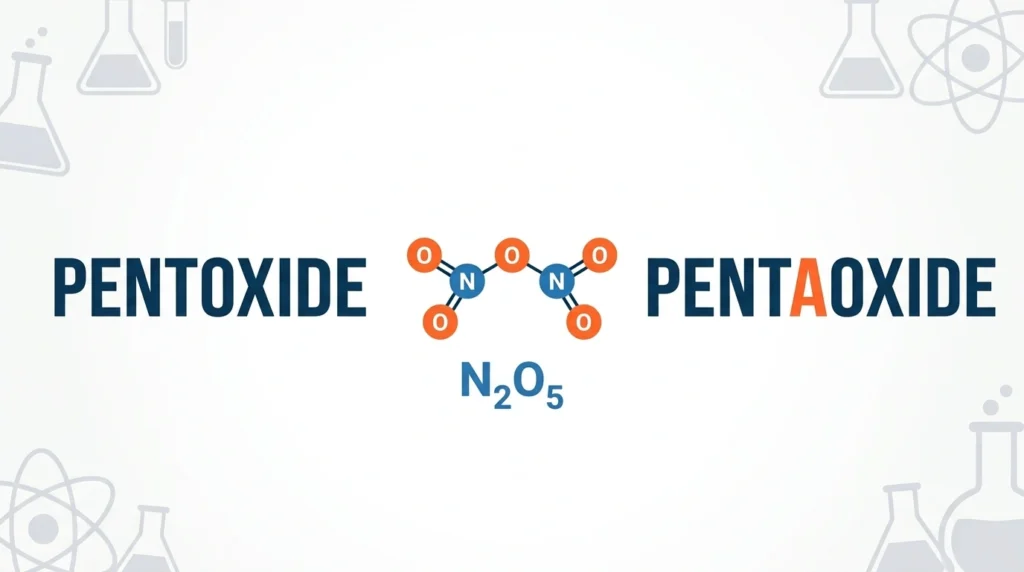

Pentoxide and pentaoxide can both appear in legitimate chemistry writing, but they come from different naming practices. In strict compositional nomenclature, the final vowel of a multiplicative prefix is normally retained, making penta + oxide = pentaoxide. The published guidance specifically gives pentaoxide as an example. However, pentoxide is an established form used in many familiar compound names and scientific databases.
What Is the Difference Between Pentoxide and Pentaoxide?
The difference between pentoxide and pentaoxide is mainly about chemical naming convention rather than ordinary English spelling.
The prefix penta- means five. When it is attached to oxide, it indicates a composition involving five oxygen atoms in the relevant formula unit or molecular formula. Under modern compositional nomenclature rules, the prefix remains intact: pentaoxide. The official brief guide explicitly states that vowels are not elided, or removed, and gives pentaoxide as an example.
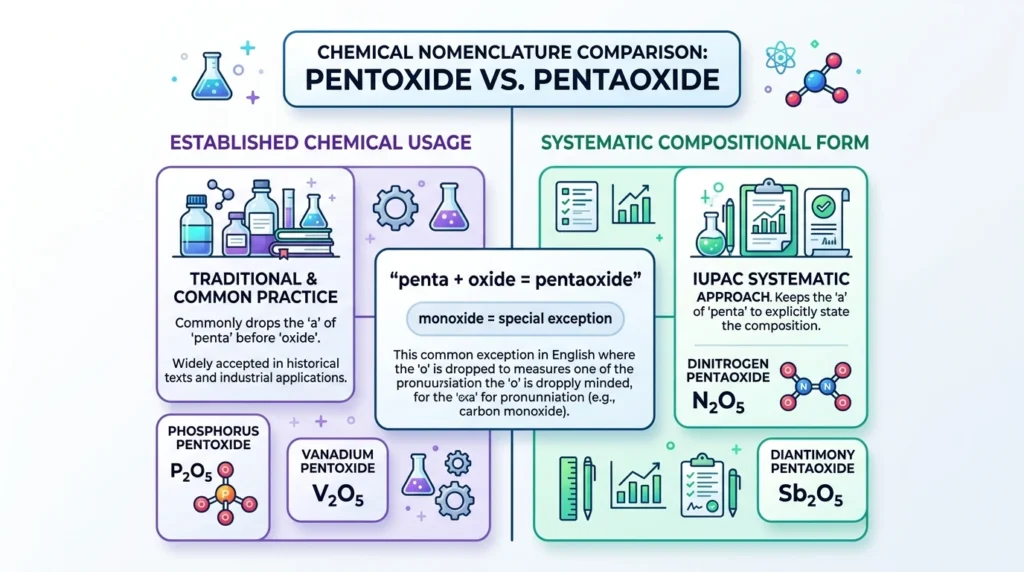
Pentoxide, however, is not simply a careless misspelling. It is an established contracted form found in familiar chemical names such as phosphorus pentoxide, vanadium pentoxide, and dinitrogen pentoxide. Major scientific databases continue to use it.
This is why a simple statement such as “pentoxide is correct and pentaoxide is wrong” does not accurately describe modern chemical usage.
Why It Matters
For everyday conversation, the extra a may seem unimportant. In chemistry, however, naming systems are designed to communicate composition precisely.
The distinction matters when you are:
- answering a chemistry exam question;
- writing a laboratory report;
- preparing an academic paper;
- searching a chemical database;
- copying a compound name from an SDS or product label;
- creating educational material;
- standardizing names in a scientific database.
A student following one naming convention may write dinitrogen pentaoxide, while a database or older source may display dinitrogen pentoxide for the same N₂O₅ compound. One major scientific database, for example, uses Dinitrogen pentoxide as its main heading while also listing dinitrogen pentaoxide as another name.
Understanding the convention prevents you from “correcting” a term that may already be valid in its context.
The Core Rule
Rule: In IUPAC compositional nomenclature, the final vowel of a multiplicative prefix is generally not removed. Therefore, penta + oxide = pentaoxide. The familiar form monoxide is specifically treated as an exception to this general rule.
The same guidance gives forms such as dinitrogen tetraoxide, rather than automatically contracting every prefix that ends in a vowel.
This does not mean that every occurrence of pentoxide must be changed. Established chemical names can preserve older or conventional forms.
Read More: Preform vs Perform: Difference, Meaning, and Examples
How to Use Pentoxide and Pentaoxide Correctly
The safest approach is to identify the type of naming being used before choosing a spelling.
- If the task specifically requires modern compositional nomenclature, keep the final vowel and use pentaoxide.
- If you are using an established compound name, database entry, product name, or source terminology, preserve pentoxide when that is the recognized form.
- If you are unsure, check the naming convention required by your instructor, journal, laboratory, database, or regulatory source rather than relying on spellcheck.
The official inorganic nomenclature table gives N₂O₅ as dinitrogen pentaoxide.
Yet real scientific usage provides an excellent demonstration of why the issue is more complicated. A major reference database calls N₂O₅ dinitrogen pentoxide while also listing dinitrogen pentaoxide as another name.
Phosphorus compounds show the same importance of context. Phosphorus pentoxide is a firmly established name. Its molecular formula is P₄O₁₀, although the substance is commonly associated with the empirical formula P₂O₅.
When Pentaoxide Is the Better Choice
Use pentaoxide when you are deliberately constructing a compositional name according to the no-elision rule.
For example:
N₂O₅ → dinitrogen pentaoxide
Here, di- indicates two nitrogen atoms and penta- indicates five oxygen atoms. The final a is retained before oxide. This exact form appears in the published inorganic nomenclature table.
When Pentoxide Is Appropriate
Use pentoxide when it forms part of an established chemical name that is already standard in your source, field, database, product documentation, or literature.
Examples include:
phosphorus pentoxide
vanadium pentoxide
dinitrogen pentoxide
These forms are present in modern scientific and regulatory records rather than being merely informal internet spellings.
The important point is context: do not automatically replace every pentoxide with pentaoxide, and do not automatically label every pentaoxide as incorrect.
Correct Examples
The following examples show how the two forms can be used clearly in different situations.
- Conversation: “Our instructor wants the strict compositional form, so I wrote dinitrogen pentaoxide.”
- Conversation: “The reagent bottle is labeled phosphorus pentoxide, so I used that name in the inventory.”
- Email: “Could you confirm whether the manuscript should use pentaoxide for systematic compositional names?”
- School: “Under the stated compositional rule, N₂O₅ is named dinitrogen pentaoxide.”
- School: “Do not assume that pentaoxide is a spelling error simply because pentoxide looks more familiar.”
- Workplace: “The safety record is filed under vanadium pentoxide.”
- Workplace: “We should preserve pentoxide as a searchable synonym in the database.”
- Social media: “Pentoxide and pentaoxide both occur in chemistry, but the naming convention determines which form makes sense.”
- Academic writing: “The systematic compositional form retains the final vowel in pentaoxide.”
- Academic writing: “The cited paper uses pentoxide, so its published title should not be silently altered.”
- Laboratory note: “The phosphorus pentoxide container was returned to dry storage.”
- Exam preparation: “Remember that the no-elision rule produces pentaoxide when the question explicitly follows modern compositional nomenclature.”
Read More: Really vs Realy: Which Spelling Is Correct?
Incorrect vs. Correct Usage
The table below applies the published no-elision rule while also respecting established chemical names.
| ❌ Incorrect | ✅ Correct | Why |
|---|---|---|
| Pentaoxide is always a spelling mistake. | Pentaoxide is a legitimate compositional form. | Modern inorganic nomenclature guidance explicitly uses pentaoxide as an example of keeping the final vowel. |
| Pentoxide is the only scientifically correct spelling. | Pentoxide is an established form, but pentaoxide is also valid in systematic contexts. | Chemical usage cannot be reduced to one universal spelling. |
| penta oxide | pentaoxide | The multiplicative prefix is joined directly to the name it modifies. |
| penta-oxide | pentaoxide | A hyphen is not inserted between the simple multiplicative prefix and oxide. |
| pent oxide | pentoxide | When the established contracted form is used, it is written as one word. |
| N₂O₅ = nitrogen pentaoxide in a strict stoichiometric exercise | N₂O₅ = dinitrogen pentaoxide | The di- accounts for the two nitrogen atoms. |
| N₂O₅ must always be called dinitrogen pentoxide. | Dinitrogen pentaoxide is the compositional form given in the nomenclature table. | The strict no-elision rule retains the a. |
| Phosphorus pentaoxide is the only acceptable wording everywhere. | Phosphorus pentoxide is an established chemical name. | Conventional names may remain widely used even when a systematic construction would follow another pattern. |
| Every occurrence of pentoxide should be automatically changed to pentaoxide. | Check whether the term is an established compound name before editing it. | Editing scientific terminology requires chemical context, not only spelling rules. |
| Monoxide proves that all prefix vowels disappear before oxide. | Monoxide is a specific allowed exception. | The published rule explicitly identifies monoxide as an exception rather than the model for all prefixes. |
Why People Make This Mistake
Phonetic Similarity
Pentoxide and pentaoxide sound close in normal speech. When people say the words quickly, the boundary between penta- and oxide is easy to compress.
That makes the shorter spelling feel natural even when a systematic rule preserves the vowel.
Spelling Overlap
Both words clearly come from the same pieces:
penta- + oxide
Because the only visible difference is one letter, writers often assume one version must simply be a typo.
Chemistry nomenclature is more complicated. A systematic form and an established conventional form can coexist.
Overgeneralizing Vowel-Dropping Rules
Many learners know familiar names such as monoxide and may conclude that a final vowel should always disappear when the next element begins with another vowel.
That shortcut does not match the modern compositional rule. The published guidance specifically says that vowel elision does not normally occur and identifies monoxide as the special case.
Autocomplete and Spellcheck
General spellcheck software measures ordinary spelling patterns and dictionary frequency. It does not know whether you are following a particular inorganic nomenclature system.
As a result, software may accept one form, flag another, or suggest the more familiar spelling without understanding the chemistry.
Translation Interference
Students who learned chemistry through another language or through translated textbooks may have been taught a naming convention that handles adjacent vowels differently.
The safest solution is not to guess from pronunciation. Check which nomenclature system your current course, publication, or organization expects.
Common Mistakes Checklist
- Calling pentaoxide a typo: Avoid this because it is explicitly used in modern compositional nomenclature.
- Calling pentoxide universally wrong: Established names containing pentoxide remain widespread in scientific usage.
- Applying the monoxide pattern everywhere: Monoxide is a stated exception, not proof of a universal vowel-dropping rule.
- Forgetting the first prefix: N₂O₅ requires di- before nitrogen when a fully stoichiometric compositional name is being constructed.
- Adding a space: Write pentaoxide, not penta oxide.
- Adding a hyphen: Write pentaoxide, not penta-oxide.
- Trusting autocomplete: A spelling suggestion cannot determine the required chemical naming system.
- Changing names copied from official records: If an SDS, database, product, or cited publication uses an established name, do not silently rewrite it without a reason.
- Confusing common and systematic names: One substance can have several legitimate names.
- Ignoring assignment instructions: In an exam, the naming convention specified by the instructor determines the expected answer.
Pentoxide vs Pentaoxide in Real English
Grammatically and Systematically Correct
Pentaoxide is fully legitimate when a systematic compositional name is being constructed. The important point is that this is a chemical nomenclature rule, not ordinary English grammar. Modern guidance says the vowels of simple multiplicative prefixes are not normally removed, and it specifically gives pentaoxide as an example. In a context explicitly testing that system, retaining the a is the precise choice.
Grammatically Possible but Contextually Misleading
A sentence can be perfectly grammatical while still using an unsuitable chemical name. For example, changing every occurrence of phosphorus pentoxide to phosphorus pentaoxide because you know the no-elision rule may create unnecessary inconsistency with established literature or product terminology. Chemical naming depends on the nomenclature framework and the identity conventions being used, not simply on whether a word can be formed logically.
Natural Everyday Scientific English
In laboratories, textbooks, articles, catalogs, and databases, pentoxide remains familiar because it occurs in established names. Pentaoxide is most useful when systematic compositional nomenclature is specifically relevant. A careful writer therefore does not force one form into every context. Instead, use the established name for an identified substance and the systematic construction when the purpose is to express composition according to that naming system.
Pentoxide vs Pentaoxide Comparison Table
| Feature | Pentoxide | Pentaoxide |
|---|---|---|
| Basic idea | Contracted form involving penta- + oxide | Unelided form of penta- + oxide |
| Final a | Removed | Retained |
| Strict compositional no-elision rule | Not the regular construction | Follows the regular construction |
| Status | Established in many chemical names | Legitimate systematic nomenclature form |
| N₂O₅ | Dinitrogen pentoxide occurs widely | Dinitrogen pentaoxide appears in the published nomenclature table |
| Phosphorus oxide terminology | Phosphorus pentoxide is strongly established | May arise when constructing a fully systematic compositional name |
| Scientific databases | Commonly encountered | Also appears as an accepted name or synonym |
| Ordinary spellcheck | More likely to look familiar | May appear unusual to general-language software |
| Best choice in an IUPAC compositional exercise | Usually avoid contraction | Prefer pentaoxide |
| Best choice for an established product/source name | Preserve when that is the recognized name | Do not substitute automatically |
The coexistence of the two forms is visible in scientific data sources: N₂O₅ may be headed as dinitrogen pentoxide while dinitrogen pentaoxide is also recorded, and the systematic nomenclature table itself uses dinitrogen pentaoxide.
Memory Trick
Remember:
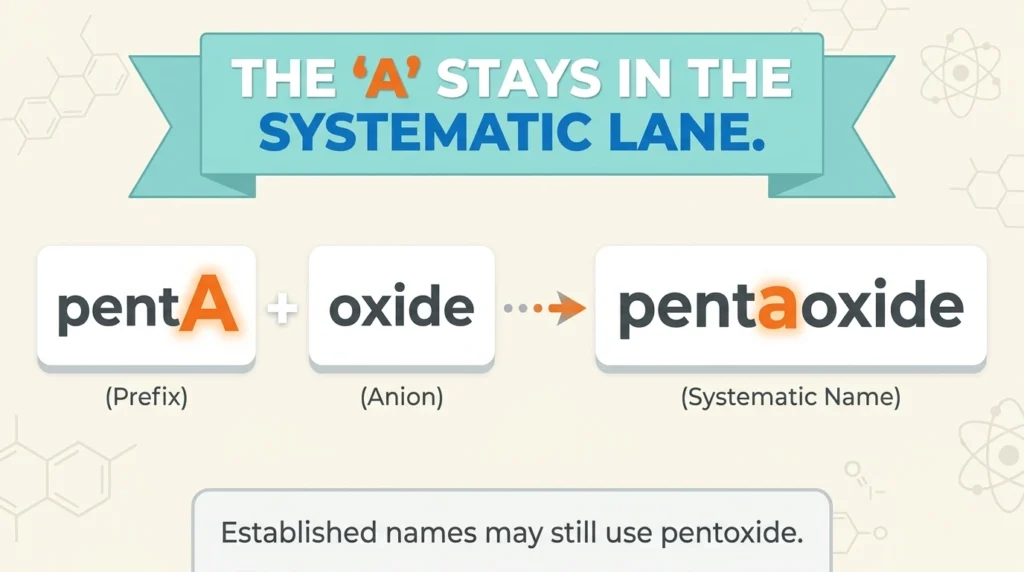
“The A stays in the systematic lane.”
Start with:
pentA + oxide → pentaoxide
If you are deliberately applying the modern compositional no-elision rule, keep the A.
Then remember the second half:
“Established labels may travel without the A.”
That reminds you why familiar names containing pentoxide should not automatically be treated as errors.
Real-Life Situations
Interview
An interviewer asks how N₂O₅ would be constructed under modern compositional nomenclature.
You answer: dinitrogen pentaoxide, explaining that the final vowel of penta- is retained.
Meeting
Your team is cleaning duplicate chemical names in a database.
Instead of deleting dinitrogen pentoxide, you keep it as an established searchable name while linking it to the same substance record as dinitrogen pentaoxide.
You are submitting a chemistry manuscript and are unsure which naming convention the journal follows.
You write: “Please confirm whether systematic compositional names should retain the final vowel in forms such as pentaoxide.”
Text Message
A classmate asks, “Is pentaoxide a typo?”
You reply: “No. It is the unelided systematic form. Pentoxide also appears in established chemical names.”
Exam
The question says, “Name N₂O₅ according to the stated IUPAC compositional rules.”
The expected construction is dinitrogen pentaoxide, because the prefix vowel is retained.
Expert Tips
Check the naming system before checking the spelling. This single habit prevents most confusion around pentoxide vs pentaoxide.
Search both forms when researching a substance. A database, paper, or older reference may index the compound under one spelling but not the other.
Do not rewrite product or safety names casually. Chemical identification is more important than making every word conform to one visual pattern.
Separate nomenclature from ordinary grammar. Neither form should be judged solely by what “sounds smoother.”
Remember that systematic names describe composition. The current brief guide explains that a stoichiometric or compositional name conveys composition rather than molecular structure.
Do not build a general rule from monoxide. The published guidance makes monoxide the special exception to the no-elision rule.
When teaching the distinction, show both real usage and the formal rule. Telling students simply that one spelling is “wrong” hides the reason they will encounter both forms later.
The currently published nomenclature material continues to identify the 2005 inorganic recommendations as the standard source while a revision project is in progress.
Read More: Unaffected vs Uneffected: Which Is Correct?
Quick Summary
Pentoxide vs pentaoxide is not a simple correct-versus-incorrect spelling problem. Under modern IUPAC compositional nomenclature, vowels in multiplicative prefixes are normally retained, so penta + oxide becomes pentaoxide. The guidance specifically gives pentaoxide as an example and treats monoxide as a special exception. At the same time, pentoxide remains firmly established in chemical names such as phosphorus pentoxide, vanadium pentoxide, and dinitrogen pentoxide. For exams that explicitly require compositional nomenclature, use pentaoxide. For established compound names, product records, literature, and databases, preserve pentoxide when that is the recognized terminology. The safest rule is simple: identify the naming system before changing the spelling.
FAQ
Is pentaoxide a real word?
Yes. Pentaoxide is a legitimate chemical nomenclature form. Modern inorganic naming guidance specifically gives it as an example of a multiplicative prefix whose final vowel is retained.
Is pentoxide a misspelling?
No. Pentoxide is an established chemical term and appears in recognized compound names and scientific databases. It should not be treated as a general spelling error.
What is the correct name for N₂O₅?
Under the published compositional nomenclature table, N₂O₅ is dinitrogen pentaoxide. However, dinitrogen pentoxide is also widely established; a major scientific database uses that form as its heading and lists dinitrogen pentaoxide as another name.
Why do I often see dinitrogen pentoxide in textbooks?
Dinitrogen pentoxide is a long-established name and remains common in chemistry. Its continued use does not make dinitrogen pentaoxide incorrect. The two forms reflect the difference between established usage and the modern no-elision convention.
Is phosphorus pentoxide correct?
Yes. Phosphorus pentoxide is a well-established name. The molecular formula of the substance is P₄O₁₀, although it is often represented through the empirical formula P₂O₅.
Should I write diphosphorus pentoxide or diphosphorus pentaoxide?
If you are explicitly constructing a compositional name according to the no-elision rule, diphosphorus pentaoxide follows that rule. You may still encounter diphosphorus pentoxide in databases and established usage, so follow the naming convention required by your context.
Should I use pentaoxide on a chemistry exam?
If the exam explicitly follows modern compositional nomenclature and tests vowel elision, pentaoxide is the safer systematic answer. If your course has supplied a different classroom convention, follow the convention specified by your instructor.
Does spellcheck know whether pentoxide or pentaoxide is correct?
Not reliably. General spellcheck tools deal mainly with language patterns and dictionary entries. They cannot determine which chemical nomenclature system your sentence requires.
Should pentaoxide contain a hyphen or a space?
No. Write pentaoxide as one word. Simple multiplicative prefixes are attached directly to the names they modify rather than being separated with a space or hyphen.
Does the same rule affect tetraoxide and tetroxide?
Yes, the same naming issue can occur. The compositional recommendations give dinitrogen tetraoxide for N₂O₄, keeping the final a of tetra-. Established names containing tetroxide, such as osmium tetroxide, also remain familiar in scientific usage.
Is pentoxide vs pentaoxide an American vs British English difference?
No. The main distinction is chemical nomenclature convention, not American versus British spelling.
Can pentoxide and pentaoxide appear in the same scientific document?
Yes, when there is a reason for the difference. For example, a writer might use a systematic compositional name in one passage while preserving an established product name, database name, or cited title elsewhere. Consistency should be maintained within each naming context.
Mini Quiz
| # | Question | Answer | Explanation |
|---|---|---|---|
| 1 | Fill in the blank: Under the no-elision compositional rule, penta + oxide becomes ______. | pentaoxide | The final a of penta- is retained. |
| 2 | Multiple choice: Which form is given for N₂O₅ in the published compositional nomenclature table? A) nitrogen pentoxide B) dinitrogen pentaoxide C) pentanitrogen dioxide | B) dinitrogen pentaoxide | Di- represents two nitrogen atoms and penta- represents five oxygen atoms. |
| 3 | True or false: Pentoxide is always a misspelling. | False | It is an established term in many chemical names and scientific records. |
| 4 | Correct the sentence: “The systematic name contains the form penta oxide.” | “…contains the form pentaoxide.” | The multiplicative prefix is joined directly to oxide. |
| 5 | Multiple choice: Which familiar form is specifically treated as an allowed vowel-elision exception? A) dioxide B) monoxide C) pentaoxide | B) monoxide | The inorganic nomenclature recommendations identify monoxide as the exception. |
| 6 | True or false: A laboratory should automatically replace every occurrence of phosphorus pentoxide with phosphorus pentaoxide. | False | Phosphorus pentoxide is an established substance name and should not be changed automatically. |
| 7 | Fill in the blank: In simple compositional names, multiplicative prefixes are normally attached without spaces or ______. | hyphens | The prefix joins directly to the name it modifies. |
| 8 | Multiple choice: Which statement is most accurate? A) Only pentoxide exists B) Only pentaoxide exists C) Both occur, but context determines their appropriate use | C | Systematic construction and established terminology do not always produce the same visible form. |
| 9 | Correct the rule: “All final vowels disappear before oxide.” | Final vowels are normally retained in compositional nomenclature; monoxide is a special exception. | The blanket vowel-dropping rule is too broad. |
| 10 | Practical question: You are researching N₂O₅ in several databases. Should you search only pentoxide or only pentaoxide? | Search both. | Both names occur in scientific records, so searching both can improve retrieval. |