
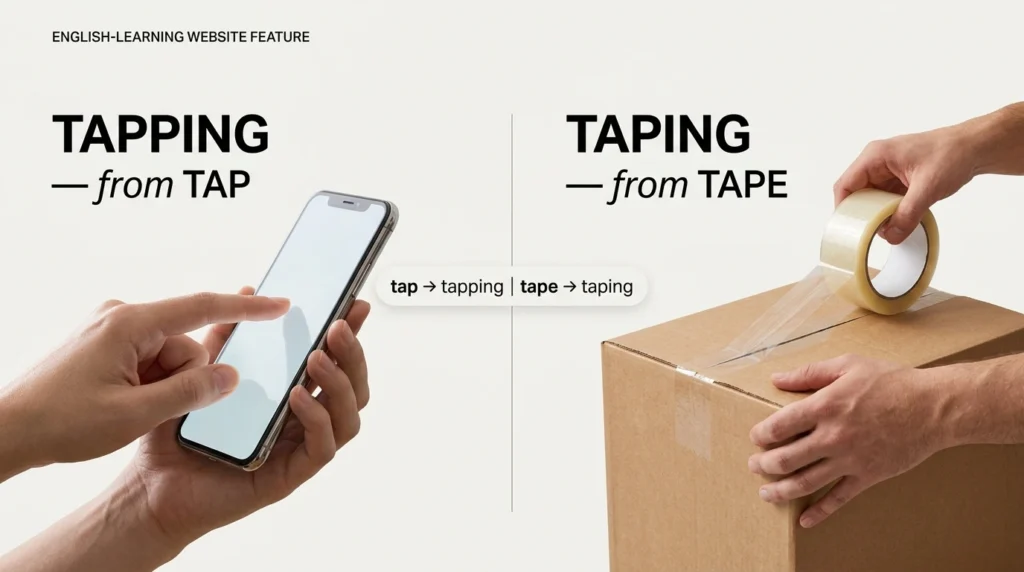

Tapping and taping are both correct words, but they come from different verbs. Tapping comes from tap and usually means touching or striking something lightly, often repeatedly. Taping comes from tape and means attaching something with tape or recording something. Remember: tap → tapping, while tape → taping.
What Are Tapping and Taping?
Tapping and taping look remarkably similar, but they describe different actions.
Tapping is the -ing form of the verb “tap.” It commonly describes touching, pressing, or striking something lightly.
You might tap your fingers on a desk, tap an icon on your phone, or tap your foot while listening to music.
Taping is the -ing form of the verb “tape.” It usually means attaching, covering, securing, or repairing something with tape. It can also mean recording audio or video.
You might be taping a cardboard box before shipping it or taping an interview for later use.
The difference becomes easier when you look at the base words:
| Base Verb | -ing Form | Basic Meaning |
|---|---|---|
| tap | tapping | touch or strike lightly |
| tape | taping | use tape or record |
The extra p in tapping is not optional. Likewise, writing tapping when you mean using adhesive tape changes the word completely.
Why the Difference Matters
Confusing tapping and taping can change the meaning of an entire sentence.
Imagine someone writes:
“I was tapping the package before shipping it.”
That sentence suggests the person was lightly hitting or touching the package.
If the intended meaning is that they were sealing the package with adhesive tape, the correct sentence is:
“I was taping the package before shipping it.”
The distinction becomes even more important in workplace instructions, technical documentation, school assignments, emails, medical contexts, and professional writing.
A small spelling difference can describe a completely different action.
The Core Rule for Tapping vs Taping
RULE: Use tapping when the base verb is tap. Use taping when the base verb is tape.
The spelling changes because the two words follow different rules for adding -ing.
Read More: Developed vs Developped: Which Spelling Is Correct?
Why Tap Becomes Tapping
Tap is a short, one-syllable word ending in this pattern:
consonant + vowel + consonant
t + a + p
When -ing is added, the final consonant is doubled:
tap + p + ing = tapping
The same pattern appears in words such as:
- run → running
- sit → sitting
- stop → stopping
- hop → hopping
- plan → planning
So:
tap → tapping
Not:
tap → taping
Why Tape Becomes Taping
Tape ends in a silent e.
When -ing is added to many verbs ending in silent e, that final e is dropped:
tape + ing = taping
The same pattern appears in:
- make → making
- write → writing
- hope → hoping
- use → using
- save → saving
Therefore:
tape → taping
Not:
tape → tapeing
This spelling rule is especially useful because it shows that tapping and taping are not simply alternative spellings of one word. They come from two different base verbs.
Tapping vs Taping Pronunciation
The words also sound different.
| Word | Approximate Pronunciation | Vowel Sound |
|---|---|---|
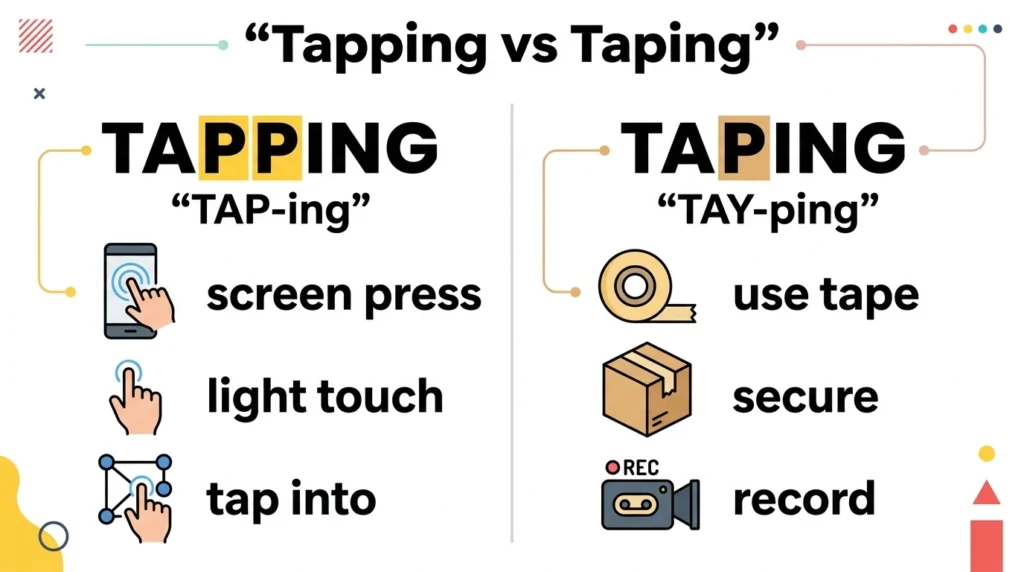
| tapping | TAP-ing | short a, as in cat |
| taping | TAY-ping | long a, as in day |
The doubled p in tapping helps preserve the short vowel sound found in tap.
The word taping keeps the long vowel sound from tape.
Compare:
tap → tapping
tape → taping
This pronunciation difference is one of the easiest ways to distinguish the words while speaking.
How to Use Tapping Correctly
Use tapping when you mean touching, pressing, hitting, or striking something lightly.
Tapping a Surface
You can tap something gently with your fingers or another object.
Mia kept tapping her pen against the notebook.
The action involves small, light movements rather than using tape.
Tapping a Phone or Screen
Modern technology has made this use extremely common.
Open the app by tapping the icon.
Here, tapping means briefly touching a touchscreen.
Tapping Your Foot or Fingers
Tapping often describes repetitive movements.
He was tapping his foot to the rhythm.
Someone may also tap their fingers when waiting, thinking, or feeling impatient.
Tapping Into Something
Tapping into is also a common phrasal expression. It means accessing or making use of a resource, ability, market, source, or opportunity.
The company is tapping into growing demand for online education.
No physical tapping occurs in this example. The expression is figurative.
Tapping a Tree
Tapping can also describe making an opening in a tree so that sap or another liquid can be collected.
Farmers begin tapping the maple trees when conditions are suitable.
The exact meaning of tapping therefore depends on context, but it always comes from the verb tap.
How to Use Taping Correctly
Use taping when the action comes from the verb tape.
Taping Something Together
This is one of the most common meanings.
She is taping the torn pages together.
Adhesive tape is being used to attach or repair something.
Taping a Package
Taping often appears in packaging and shipping contexts.
Marcus was taping the box before taking it to the post office.
The box is being secured with adhesive tape.
Taping an Area Before Painting
Painters commonly use tape to protect edges and create clean lines.
They are taping around the windows before painting the walls.
Again, actual tape is involved.
Taping an Interview or Performance
Taping can also mean recording audio or video.
The production team is taping the interview this afternoon.
Although modern recordings are usually digital rather than stored on magnetic tape, tape and taping are still established verbs meaning to record.
Read More: Comprable vs Comparable: Which Spelling Is Correct?
Correct Examples of Tapping and Taping
These examples show how both words work across everyday and professional situations.
| Context | Correct Example |
|---|---|
| Conversation | Stop tapping your fingers on the table. |
| Smartphone | Try tapping the settings icon twice. |
| Music | She was tapping her foot to the beat. |
| Workplace | We are tapping into feedback from existing customers. |
| School | The teacher noticed him tapping his pencil during the test. |
| We are tapping into our existing network to find suitable applicants. | |
| Shipping | I’m taping the package securely before sending it. |
| Office | She is taping the label to the storage container. |
| Media | They are taping tomorrow’s episode this evening. |
| DIY | He spent the morning taping the edges before painting. |
| Social Media | I accidentally opened the video by tapping the screen. |
| Academic Writing | The study examines how organizations are tapping into previously unused data sources. |
Notice that you can usually determine the correct word by asking one simple question:
Does the action come from “tap” or “tape”?
Incorrect vs Correct: Tapping and Taping
| ❌ Incorrect | ✅ Correct | Why |
|---|---|---|
| She is taping her fingers on the desk. | She is tapping her fingers on the desk. | She is lightly striking the desk, not using tape. |
| I kept taping the screen but nothing happened. | I kept tapping the screen but nothing happened. | Touching a screen uses the verb tap. |
| He was tapping the parcel closed. | He was taping the parcel closed. | Adhesive tape is being used to close the parcel. |
| They are tapping the interview today. | They are taping the interview today. | Here taping means recording. |
| Stop taping your foot during the meeting. | Stop tapping your foot during the meeting. | Moving the foot repeatedly is tapping. |
| She is tapping the poster to the wall. | She is taping the poster to the wall. | The poster is being attached with tape. |
| The company is taping into a new market. | The company is tapping into a new market. | The established expression is tap into. |
| He was taping on the window. | He was tapping on the window. | Lightly knocking against a surface is tapping. |
| We are tapping the damaged cable temporarily. | We are taping the damaged cable temporarily. | Tape is being applied to the cable. |
| The audience watched the tapping of the TV episode. | The audience watched the taping of the TV episode. | A recorded production session can be called a taping. |
| She was tapeing the box. | She was taping the box. | The final silent e in tape is dropped before -ing. |
| He was taping his fingers nervously. | He was tapping his fingers nervously. | Nervous repetitive finger movement uses tap. |
Why People Confuse Tapping and Taping
The mistake is understandable because the words differ by only one letter.
Their Spellings Strongly Overlap
Both words contain:
tap + ing
At a quick glance, tapping and taping can therefore look almost identical.
However, that extra p changes both the base word and the pronunciation.
Their Pronunciations Have Similar Shapes
Both begin with t, contain a p sound, and end in -ing.
However, their vowels are different:
tapping = TAP-ing
taping = TAY-ping
Listening for that vowel difference helps when deciding which word you heard.
Writers Overgeneralize the -ing Rule
Some learners assume that creating an -ing form simply means placing -ing after the root.
English spelling is not always that simple.
Tap requires consonant doubling:
tap → tapping
Tape requires dropping the silent e:
tape → taping
Understanding the root word is more reliable than guessing from the final spelling.
Autocorrect May Not Catch the Error
Spellcheck software can detect nonexistent spellings such as tappping.
It may not flag:
“I was taping my finger on the desk.”
Both taping and tapping are valid English words. Software therefore needs enough context to determine whether you selected the wrong one.
A final human check is still useful.
Translation Can Hide the Difference
Some English learners first think of the action in another language and then translate it into English.
If their first language uses different spelling patterns or broader verbs for these actions, distinguishing tap from tape may require extra practice.
A reliable solution is to learn each base verb and its -ing form together:
tap → tapping
tape → taping
Common Mistakes Checklist
Before using either word, check these common problem areas:
- Using one p for the verb “tap.”
If the root word is tap, write tapping, not taping. - Using two p’s for the verb “tape.”
If the root word is tape, write taping, not tapping. - Writing “tapeing.”
The silent e normally disappears before -ing, producing taping. - Choosing the word only by appearance.
Think about the intended action before checking the spelling. - Ignoring pronunciation.
Tapping has the vowel in tap. Taping has the vowel in tape. - Forgetting figurative “tapping into.”
When you mean accessing a resource or opportunity, the correct expression is tapping into. - Assuming taping always involves adhesive tape.
Taping can also mean recording something. - Trusting spellcheck without checking meaning.
Both spellings are real words, so software may accept the wrong one.
Tapping vs Taping in Real English
Grammatically Correct Usage
Both tapping and taping are standard English words. Tapping is correct whenever the intended verb is tap, whether someone is touching a screen, lightly striking a surface, collecting a resource, or “tapping into” an opportunity. Taping is correct when something is being attached or secured with tape or when audio or video is being recorded. Context determines which word belongs.
Grammatically Possible but Unnatural Usage
A sentence can occasionally be grammatically well formed while still sounding unusual because a speaker would normally choose another verb. For example, “I am taping a video on my phone” is understandable and grammatically possible, but many speakers today would simply say “I am recording a video.” That does not make taping incorrect. It means word choice can depend on context and normal modern usage.
Natural Everyday Usage
In everyday English, tap is extremely common with phones, tablets, fingers, feet, doors, and light physical contact. Phrases such as “tap the screen” and “tapping my foot” sound completely natural. Tape is common when attaching or securing objects: “tape the box shut” or “tape it to the wall.” For digital media, recording is often more natural than taping, although taping remains established English.
Tapping vs Taping Comparison Table
| Feature | Tapping | Taping |
|---|---|---|
| Base word | tap | tape |
| Correct spelling | tapping | taping |
| Pronunciation | TAP-ing | TAY-ping |
| Number of p’s | two | one |
| Basic action | light touch or strike | use tape |
| Technology example | tapping a screen | taping cables together |
| Physical example | tapping your fingers | taping a box |
| Figurative use | tapping into resources | uncommon |
| Recording meaning | usually no | yes |
| Common phrase | tapping into a market | taping an interview |
| Main spelling rule | double final consonant | drop silent e |
| Example | She is tapping the glass. | She is taping the package. |
The Easiest Memory Trick
Remember this:
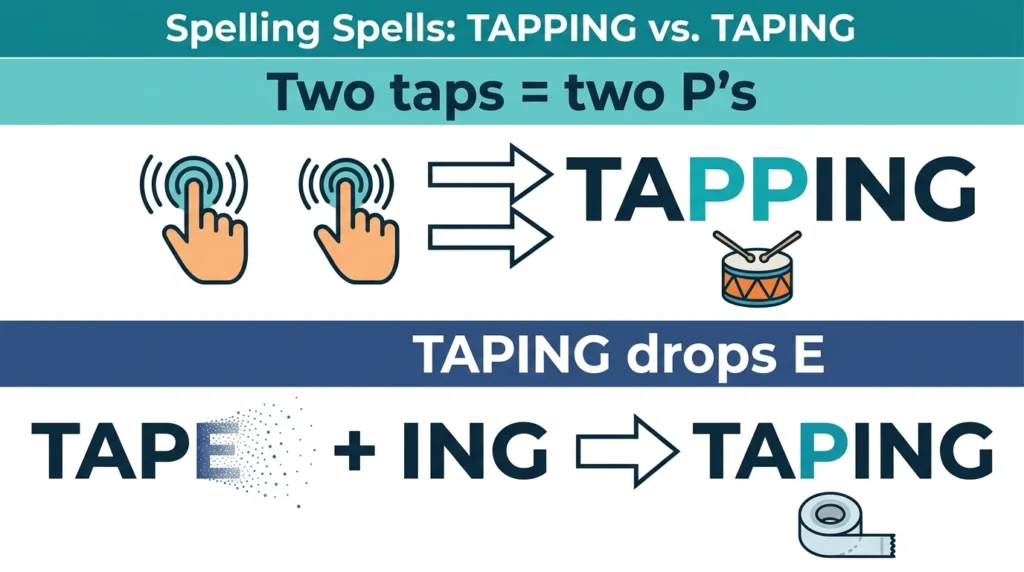
Two quick taps need two p’s. Tape loses its e before -ing.
So imagine hitting a table twice:
tap-tap = tapping = pp
Then picture a roll of tape. When you add -ing, the final e disappears:
tape − e + ing = taping
That gives you two separate visual clues instead of relying on memorization alone.
Real-Life Situations
In an Interview
You notice your foot moving repeatedly while waiting for the interviewer.
Correct:
“I realized I was tapping my foot because I was nervous.”
Taping would suggest adhesive tape was involved.
In a Meeting
Your company wants to reach customers in a different industry.
Correct:
“We could grow faster by tapping into a new customer segment.”
The phrase tap into means gaining access to or making use of something.
In an Email
You need to tell a colleague how a package was secured.
Correct:
“I’m taping the box carefully before sending it.”
The action involves tape, so taping is required.
In a Text Message
Someone cannot find a button in an app.
Correct:
“Try tapping the three dots in the top-right corner.”
Touchscreen actions normally use tap or tapping.
In an Exam
The sentence reads:
“The crew is ___ the documentary tomorrow.”
If the options are tapping and taping, choose taping because the documentary is being recorded.
Expert Tips for Remembering Tapping vs Taping
Find the Base Verb First
Instead of asking, “Does this look like tapping or taping?” remove -ing mentally.
Are you describing tap?
Use tapping.
Are you describing tape?
Use taping.
This method works much more reliably than memorizing the completed forms independently.
Use Pronunciation as a Second Check
Say the intended word aloud.
If you hear TAP, you need:
tapping
If you hear TAYP, you need:
taping
The vowel sound can reveal which root word you actually mean.
Look for Physical Clues
Ask what is happening in the sentence.
Light touch, repeated movement, screen press, or accessing a resource?
Choose tapping.
Adhesive tape, securing something, wrapping something, or recording?
Choose taping.
Read More: Shinny vs Shiny: What Is the Difference?
Learn Related Word Families
Learning forms together makes spelling easier:
| Base | Past Form | -ing Form |
|---|---|---|
| tap | tapped | tapping |
| tape | taped | taping |
Notice the same pattern continues in the past tense.
Tap doubles the p in tapped.
Tape simply becomes taped.
Frequently Asked Questions About Tapping vs Taping
Is taping a misspelling of tapping?
No. Taping and tapping are both correct English words. They come from different verbs. Taping comes from tape, while tapping comes from tap.
Is tapping spelled with one p or two?
Tapping is spelled with two p’s. The base word tap ends in a short vowel followed by a consonant, so the final p doubles when -ing is added.
Why doesn’t taping have two p’s?
Because taping comes from tape, not tap. The final silent e in tape is dropped before adding -ing.
Is “tapeing” ever correct?
For the ordinary verb tape, the standard -ing form is taping, not tapeing. Drop the final silent e before adding -ing.
Does tapping always mean hitting something?
No. It can describe lightly touching something, pressing a touchscreen, extracting something from a source, or figuratively accessing a resource, as in tapping into a new market.
Can taping mean recording a video?
Yes. Taping is an established verb meaning recording audio or video. In modern everyday conversation, people also commonly use recording, especially when discussing phones and digital devices.
Which is correct: tapping into or taping into?
Tapping into is correct when you mean accessing or making use of something.
For example:
“The organization is tapping into local expertise.”
Taping into does not carry this meaning.
Is it tapping or taping your foot?
The correct phrase is tapping your foot.
You are moving or lightly striking your foot repeatedly, so the verb is tap.
Is it tapping or taping a box?
If you are sealing the box with adhesive tape, use taping a box.
If you are lightly striking the box with your fingers, you could literally be tapping the box.
Context changes the answer.
Is it tapping or taping a phone screen?
Use tapping:
“She was tapping the phone screen.”
Touching a screen briefly uses the verb tap.
Tapping vs Taping Mini Quiz
| # | Question | Answer | Explanation |
|---|---|---|---|
| 1 | She kept ___ her foot during the presentation. A) tapping B) taping | A) tapping | Her foot is moving or striking the floor lightly. |
| 2 | I’m ___ the parcel before taking it to the post office. | taping | Adhesive tape is being used on the parcel. |
| 3 | Correct this: “Try taping the icon once.” | Try tapping the icon once. | A touchscreen is touched or tapped, not taped. |
| 4 | They are ___ the television episode tonight. A) tapping B) taping | B) taping | Taping can mean recording a programme or performance. |
| 5 | Our team is ___ into a new source of customer data. | tapping | The established expression is tap into. |
| 6 | Correct this: “She is tapping the package closed.” | She is taping the package closed. | Tape is being used to close the package. |
| 7 | Which spelling comes from tap: tapping or taping? | tapping | Tap doubles its final p before -ing. |
| 8 | He heard someone ___ gently on the window. | tapping | A light repeated knock is called tapping. |
| 9 | Correct this: “I am tapeing the poster to the wall.” | I am taping the poster to the wall. | Drop the silent e in tape before adding -ing. |
| 10 | The crew began ___ the cables to the floor before the event. A) tapping B) taping | B) taping | They are securing the cables using tape. |