
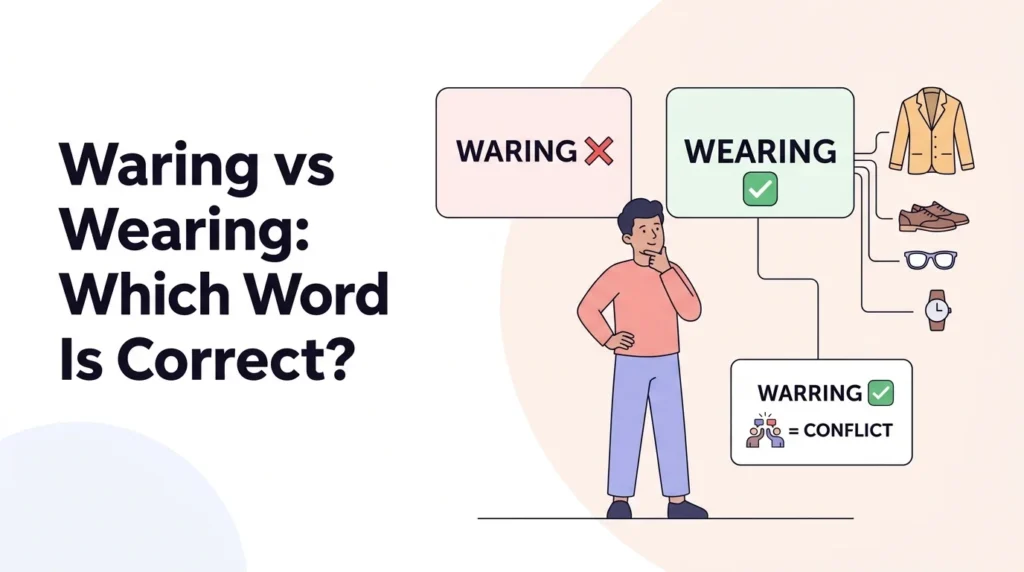

Wearing is the correct word when you mean having clothes, shoes, glasses, jewelry, or another item on your body. Waring is a real but very rare form of the verb ware, not the normal spelling of wearing. In everyday English, write wearing when talking about clothing or appearance: “She is wearing a red dress.”
What Is the Difference Between Waring and Wearing?
Wearing and waring look almost identical, but they come from different words and have different uses.
Wearing is the present participle of wear. It is extremely common in modern English and is used when someone has clothes, shoes, accessories, glasses, makeup, or similar things on their body. It can also describe something gradually becoming damaged through use or a situation becoming tiring or difficult.
Waring, although a legitimate dictionary form, is much rarer. Merriam-Webster lists waring as a form of the verb ware, which has archaic or regional meanings such as “to beware of” and, in Scottish usage, “to spend” or “expend.” It is not the normal present participle of war.
That distinction matters because some online explanations incorrectly describe waring as the normal present participle of war. For modern standard English, the usual form is warring, with two r’s, when you mean engaging in conflict.
The simplest distinction
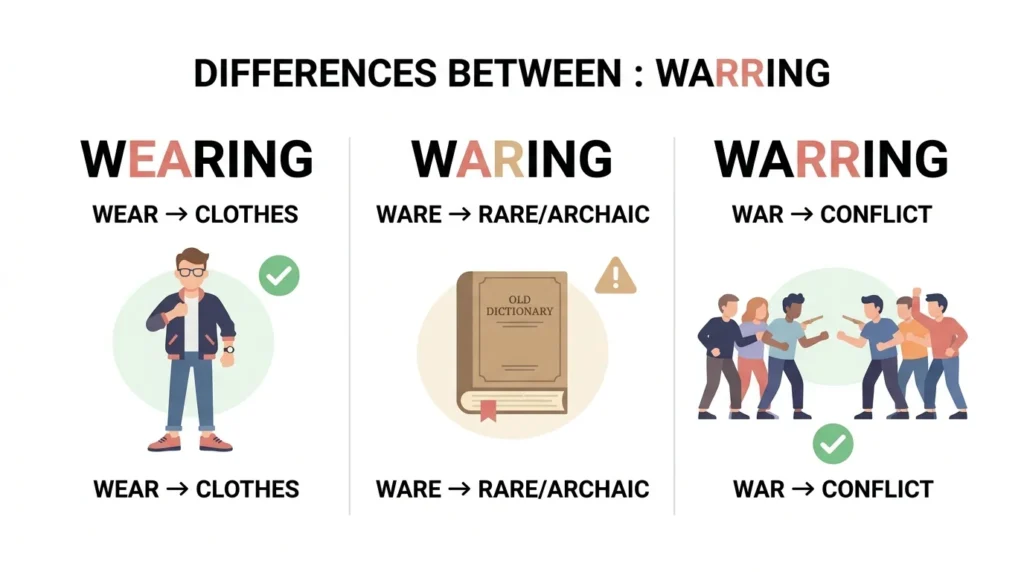
- wear → wearing = having something on your body
- wear → wearing = gradually damaging or using something
- war → warring = engaging in conflict
- ware → waring = a rare, archaic or regional form
So if you want to say that someone has a jacket, hat, uniform, or pair of shoes on, the answer is wearing.
Why It Matters
A one-letter spelling difference can completely change the word you are using.
Consider these two sentences:
She is wearing a black suit.
She is waring a black suit.
The first sentence is normal English. The second does not mean “wearing a black suit.” It uses waring, a rare form associated with the verb ware, and therefore does not communicate the intended meaning.
This matters especially in professional emails, school assignments, applications, websites, social media posts, product descriptions, and other writing where a small spelling error can make the writer appear careless.
There is another important reason to understand the distinction: waring is not simply “a misspelling” in every possible context. It exists as a legitimate but highly uncommon word form. That is why a spellchecker may not always identify it as an error. Merriam-Webster records waring as the present participle of ware.
The Core Rule
Use “wearing” when you mean having clothes, accessories, or something similar on your body.
Examples:
- She is wearing a blue dress.
- He is wearing glasses.
- They were wearing matching uniforms.
- I am wearing my new shoes.
- Are you wearing a jacket?
If you mean participating in or continuing a conflict, use warring, not waring:
- The two warring groups eventually agreed to a ceasefire.
- The novel describes two warring kingdoms.
If you encounter waring, it may be the rare present participle of ware, not a shortened spelling of wearing.
How to Use Wearing
Wearing as the Present Participle of “Wear”
The most common use of wearing is as the -ing form of the verb wear.
A present participle is an -ing form that can be used in continuous verb forms and other grammatical constructions.
For example:
She is wearing a green coat.
Here, is wearing is the present continuous form of wear. It describes what she has on at the time being discussed.
The same form appears in sentences such as:
I was wearing my school uniform yesterday.
They are wearing protective helmets.
Wearing Clothes and Accessories
You can use wearing for many things that are put on or carried on the body as part of someone’s appearance.
Common examples include:
- shirts
- dresses
- trousers
- shoes
- boots
- hats
- watches
- glasses
- jewelry
- uniforms
- gloves
- makeup
- protective equipment
For example:
Maria is wearing a silver necklace.
The workers are wearing safety helmets.
He was wearing sunglasses at the beach.
This matches standard English usage. Cambridge’s vocabulary material, for example, explicitly distinguishes wear from carry: you wear clothes and glasses, while you carry things such as bags and suitcases.
Wearing Can Mean More Than Clothing
Wearing is not limited to clothes.
It can describe something that gradually becomes damaged or reduced through continued use.
For example:
The constant friction is wearing the surface away.
The related phrasal verb wear away means to gradually remove or weaken something.
Wearing can also describe something that causes tiredness or tests someone’s patience:
The long journey was wearing.
The constant delays were wearing on everyone’s patience.
So the word has a wider range than simply “having clothes on.”
Correct Examples
Here are examples from different areas of everyday English.
| Situation | Correct sentence |
|---|---|
| Conversation | “What are you wearing tonight?” |
| Workplace | “All employees must be wearing their ID badges.” |
| “I will be wearing a navy suit for the interview.” | |
| School | “Students should be wearing the required uniform.” |
| Social media | “I’m wearing my favorite sneakers today.” |
| Academic writing | “The participants were wearing protective equipment.” |
| Shopping | “She is wearing the new collection from the brand.” |
| Travel | “He was wearing a warm coat at the airport.” |
| Sports | “The players were wearing matching jerseys.” |
| Safety | “Everyone entering the site must be wearing a helmet.” |
| Fashion | “The model is wearing a tailored black jacket.” |
| Everyday conversation | “Are you wearing your glasses?” |
Notice that wearing remains the same even though the contexts change.
Incorrect vs. Correct
| ❌ Incorrect | ✅ Correct | Why |
|---|---|---|
| She is waring a red dress. | She is wearing a red dress. | The verb meaning “have clothes on” is wear. Its -ing form is wearing. |
| He is waring a blue shirt. | He is wearing a blue shirt. | The extra e belongs to the spelling of wearing. |
| I was waring my new shoes. | I was wearing my new shoes. | Waring does not mean having shoes on. |
| Are you waring a jacket? | Are you wearing a jacket? | Clothing requires the verb wear. |
| She is waring glasses. | She is wearing glasses. | The normal modern expression is wearing glasses. |
| He was waring his school uniform. | He was wearing his school uniform. | Wearing is the present participle of wear. |
| They are waring helmets. | They are wearing helmets. | Safety equipment is something you wear. |
| I am waring a watch. | I am wearing a watch. | A watch worn on the wrist takes wearing. |
| The actors were waring costumes. | The actors were wearing costumes. | Costumes are clothing, so use wearing. |
| She is waring makeup. | She is wearing makeup. | The intended verb is wear, not ware. |
One important correction
You may see examples online such as:
“The countries were waring against each other.”
This is not the standard modern spelling you should use for that meaning.
The normal form is:
“The countries were warring against each other.”
Warring comes from war and means involved in or engaged in conflict.
Why People Make This Mistake
Phonetic Similarity
One major reason is sound.
In many varieties of English, wearing and waring can sound very similar or even effectively identical in ordinary speech. That makes it difficult for a learner to reconstruct the spelling from pronunciation alone.
English spelling often cannot be reliably predicted from sound.
That is why learning the relationship between the base word and its -ing form is more useful than trying to spell the word entirely by ear.
Spelling Overlap
The visual similarity is also strong:
waring
wearing
Both begin with war and end with ing.
The only visible difference is the letters e in wearing. When someone types quickly, that small spelling detail is easy to lose.
Autocomplete and Spellcheck
Spellcheck is helpful, but it is not a perfect grammar teacher.
A spellchecker may fail to flag waring because waring actually exists as a dictionary form. Merriam-Webster lists it as the present participle of ware.
This creates an important lesson:
A word can be spelled correctly but still be the wrong word for your sentence.
For example, a system that recognizes waring as a valid word cannot necessarily know that you intended wearing.
Translation Interference
English learners may also confuse the words when translating directly from another language.
If a learner has learned one spoken form for the concept of “having clothes on,” they may try to reproduce the English spelling from pronunciation.
The solution is to connect the English word to its base form:
wear → wearing
rather than memorizing wearing as an isolated spelling.
Overgeneralization
English has many verbs that form their -ing forms by adding -ing:
- work → working
- talk → talking
- play → playing
- wash → washing
A learner may therefore see:
war + ing = waring
and assume the spelling must work the same way.
But wear already contains the letters ea, and the -ing form is:
wear + ing → wearing
The base word remains visible.
Common Mistakes Checklist
1. Writing “waring” for clothing
Mistake:
“She is waring a dress.”
Why it happens: The writer hears the word and omits the e.
Avoid it: Remember the base verb:
wear → wearing
2. Treating “waring” as the normal form of “war”
Mistake:
“The two nations were waring.”
Why it happens: The writer applies the simple -ing pattern to war.
Avoid it: Use warring for ongoing conflict.
war → warring
3. Assuming every valid dictionary word fits the sentence
Mistake: Choosing waring because a spellchecker accepts it.
Why it happens: Spellcheck checks spelling more reliably than intended meaning.
Avoid it: Ask what the sentence actually means before accepting the suggested word.
4. Relying entirely on pronunciation
Mistake: Spelling the word exactly as it sounds.
Why it happens: English has many words whose spelling is not obvious from pronunciation.
Avoid it: Learn the base form with the derived form.
wear → wearing
5. Confusing “wearing” with “carrying”
Some learners also use wearing for objects they hold or transport.
For example:
❌ She is wearing a suitcase.
✅ She is carrying a suitcase.
You wear clothes and things placed on the body. You generally carry bags, suitcases, umbrellas, and similar objects.
Waring vs. Wearing in Real English
Wearing: Grammatically Correct and Completely Natural
She is wearing a black coat.
This is ordinary, natural English. The sentence describes what someone has on their body. There is no special register or unusual context involved. Wearing is the normal word choice for clothing, accessories, uniforms, glasses, and many similar items. If your sentence describes someone’s appearance or what they have on, wearing is almost certainly the form you need.
Waring: Grammatically Possible but Extremely Unusual
Waring is a legitimate form, but it does not normally mean “wearing clothes.”
Modern dictionaries record it as the present participle of ware. In one sense, ware is an archaic verb meaning “to beware of” or “avoid,” while another sense is regional, especially Scottish, meaning “to spend” or “expend.” These meanings are unusual in contemporary everyday English.
Warring: Natural When You Mean Conflict
The two factions were warring for control of the region.
If the intended meaning is fighting or being engaged in conflict, warring is the natural modern form. This is an important distinction because some online pages incorrectly present waring as the ordinary -ing form of war. For standard modern writing, use warring when you mean conflict.
The Practical Test
If you can replace the word with:
“has clothes on”
then you need wearing.
If you mean:
“engaged in conflict”
then you need warring.
If you encounter waring, check whether the sentence genuinely uses the rare verb ware. In ordinary writing, that situation is uncommon.
American vs. British English
There is no meaningful American-versus-British spelling difference between wearing and waring.
Both major varieties use:
wear → wearing
The distinction is not one of American versus British spelling.
Regional pronunciation can make wearing sound different from one speaker to another, but that does not change its spelling.
There is also no standard American or British rule that changes wearing to waring.
Formal vs. Informal Usage
Wearing works naturally in both formal and informal English.
Informal
“What are you wearing tonight?”
Professional
“Employees must be wearing their identification badges.”
Academic
“Participants were wearing protective equipment during the experiment.”
The word itself does not belong to one special register.
Waring, however, is so uncommon that you should not substitute it for wearing in ordinary writing merely to sound formal or sophisticated. If you genuinely need one of the rare meanings of ware, the context should make that meaning clear.
Comparison Table
| Feature | Waring | Wearing | Warring |
|---|---|---|---|
| Base word | ware | wear | war |
| Common today? | Very rare | Very common | Common enough |
| Main meaning | Rare/archaic or regional uses of ware | Having something on; gradual deterioration | Engaged in conflict |
| Clothing? | ❌ No | ✅ Yes | ❌ No |
| Accessories? | ❌ No | ✅ Yes | ❌ No |
| Conflict? | ❌ Not the normal modern form | ❌ No | ✅ Yes |
| Standard everyday choice? | Usually no | Yes | Yes when conflict is intended |
| Example | “Ware the danger” → “waring” in a rare grammatical context | “She is wearing a coat.” | “The warring groups reached a settlement.” |
Memory Trick
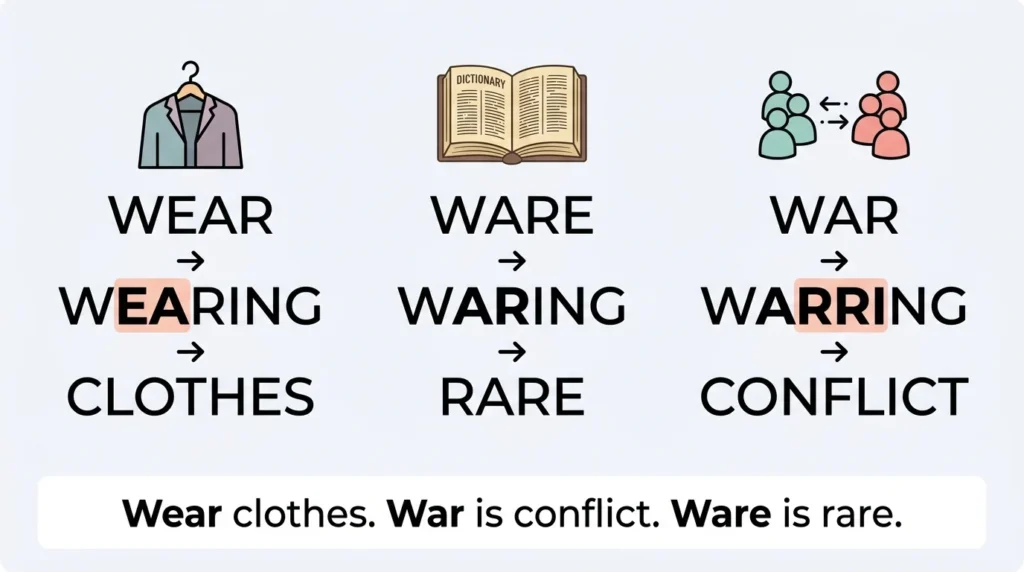
Use this simple three-word chain:
WEAR → WEARING → CLOTHES
The word wearing keeps the ea from wear.
For conflict, use:
WAR → WARRING → CONFLICT
Notice the doubled r.
And remember:
Wear clothes. War is conflict. Ware is rare.
That three-part distinction prevents most mistakes.
Real-Life Situations
Job Interview
You are telling a friend what you plan to wear:
“I’ll be wearing a navy suit for the interview.”
Not:
“I’ll be waring a navy suit.”
Workplace
A manager sends a safety reminder:
“Everyone must be wearing a helmet inside the production area.”
The word describes protective equipment worn on the body.
Text Message
A friend asks what you have on:
“I’m wearing the black shirt you gave me.”
This is completely natural everyday English.
School
A teacher explains the uniform policy:
“Students should be wearing the correct school uniform.”
Again, wearing comes from wear.
History Class
A student describes opposing armies:
“The two warring kingdoms fought for control of the territory.”
Here the meaning is conflict, so warring is appropriate.
A conference organizer writes:
“Please note that attendees will be wearing identification badges during the event.”
The context is formal, but the word remains wearing.
Expert Tips
Learn the base word first
Instead of memorizing:
wearing = clothes
learn:
wear → wearing
This makes the spelling easier to reproduce.
Don’t trust spellcheck blindly
A word can be a legitimate English word and still be wrong for your intended meaning.
Waring is a good example. It exists in dictionaries, so software may not automatically treat it as an error.
Watch the double “r”
If the sentence involves conflict, ask whether you need:
war → warring
not:
war → waring
Use context to choose the word
Ask yourself:
Are we talking about clothes?
→ wearing
Are we talking about conflict?
→ warring
Is “waring” being used in an unusual historical, archaic, or regional context?
→ Check whether ware is actually intended.
Remember that “wearing” has other meanings
Don’t restrict wearing to fashion.
You can also talk about:
wearing away
wearing out
wearing on someone’s patience
These expressions come from the same verb wear but describe deterioration or emotional/tiring effects.
Read More: Symptomatology vs Symptomology: Which Word Is Correct?
FAQ
Is “waring” a correct English word?
Yes, but it is a very rare word form. Merriam-Webster lists waring as the present participle of ware, a verb with archaic and regional meanings. It is not the ordinary spelling of wearing.
Is “waring” the correct spelling of “wearing”?
No. If you mean having clothes, shoes, glasses, jewelry, or another item on your body, the correct spelling is wearing.
Is “waring” the present participle of “war”?
Not in standard modern English. If you mean engaging in conflict, the normal form is warring, with two r’s. The dictionary evidence for waring instead connects it to ware, not the ordinary verb war.
Why does “wearing” have an extra “e”?
Because it is formed from wear + -ing:
wear + ing = wearing
The spelling of the base verb remains visible in the derived form.
Why does “warring” have two r’s?
The word is formed from war with the -ing ending, producing warring. The doubled consonant helps preserve the pronunciation and spelling pattern of the base word before the suffix.
Can “wearing” describe something other than clothes?
Yes. Wearing can describe gradual deterioration, as in “wearing away,” and it can describe something that causes tiredness or tests patience, as in “a wearing experience.”
Can I use “wearing” for a bag?
Usually not if you mean carrying the bag. English normally distinguishes wearing from carrying: you wear clothes and glasses, but you carry a suitcase or handbag.
Is “waring” ever used in real English?
Yes. It occurs as a rare form of ware, including an archaic sense meaning “beware of” and a regional Scottish sense meaning “spend” or “expend.” It may also appear as a proper name.
Why might spellcheck accept “waring”?
Because waring is not simply a nonexistent string of letters. It has legitimate dictionary uses. A spellchecker can recognize that a word exists without knowing that you intended a different word in your particular sentence.
Which one should English learners use most of the time?
If you are talking about clothes, appearance, accessories, uniforms, glasses, or similar things, use wearing. If you are describing conflict, use warring. You will rarely need waring in ordinary modern English.
Is “wearing” the same in American and British English?
Yes. There is no standard spelling difference between American and British English for wearing. Both use wear → wearing.
What is the easiest way to remember “waring vs. wearing”?
Remember:
WEAR has EA, so WEARING has EA.
If someone has clothes on, use wearing.
Mini Quiz
| # | Question | Answer | Explanation |
|---|---|---|---|
| 1 | Choose the correct word: “She is ___ a blue jacket.” A) waring B) wearing C) warring | B) wearing | The sentence describes clothing, so use the -ing form of wear. |
| 2 | Fill in the blank: “The two ___ factions continued fighting.” | warring | Warring means engaged in conflict and comes from war. |
| 3 | Correct the sentence: “He is waring glasses.” | He is wearing glasses. | Glasses are something you wear. |
| 4 | Choose the correct word: “I am ___ my new shoes today.” A) waring B) wearing C) warring | B) wearing | Shoes are worn on the feet. |
| 5 | Correct the sentence: “The countries were waring for control of the region.” | The countries were warring for control of the region. | The intended meaning is conflict, so warring is required. |
| 6 | Fill in the blank: “Are you ___ your school uniform?” | wearing | The sentence asks about clothing. |
| 7 | Which word comes from wear? A) waring B) wearing C) warring | B) wearing | Wearing is the present participle of wear. |
| 8 | Which word is associated with conflict? A) wearing B) warring C) ware | B) warring | Warring describes people, groups, or nations engaged in conflict. |
| 9 | Is this sentence correct? “The workers are wearing protective helmets.” | Yes. | Helmets are safety equipment worn on the body. |
| 10 | Choose the best sentence. A) She is waring a dress. B) She is wearing a dress. C) She is warring a dress. | B) She is wearing a dress. | Wearing is the correct form of wear for clothing. |
Quick Summary
Wearing is the correct and overwhelmingly common word when you mean having clothes, shoes, glasses, jewelry, uniforms, or other items on your body. It is the present participle of wear. Waring is a real but extremely uncommon form of ware, a verb with archaic and regional meanings; it is not the normal spelling of wearing. If you mean conflict, use warring, the standard modern form related to war. The easiest memory trick is wear → wearing → clothes and war → warring → conflict. When writing about everyday clothing or appearance, choose wearing. It works naturally in both American and British English and in both formal and informal contexts.
FAQ
Is “waring” ever the right word?
Yes, but only in unusual contexts involving the rare verb ware, or as a proper name. It should not be used as a replacement for wearing.
Should I write “waring” when talking about war?
No. In modern standard English, use warring when describing people, groups, or nations engaged in conflict.
Does “wearing” only refer to clothes?
No. It can also refer to deterioration, such as something wearing away, or to something becoming tiring or difficult, such as a wearing experience.
Why doesn’t spellcheck always catch “waring”?
Because waring exists as a legitimate dictionary form. Spellcheck can recognize a valid word without understanding that it is the wrong word for your intended meaning.
Is there an American spelling and a British spelling?
No. Wearing is spelled the same in both varieties of English.
What is the base verb of “wearing”?
The base verb is wear.
wear → wearing
What is the base verb of “warring”?
The base verb is war.
war → warring
What is the base verb of “waring”?
The rare word waring comes from ware.
ware → waring
Quiz
1. Which sentence is correct?
A. She is waring a red coat.
B. She is wearing a red coat.
C. She is warring a red coat.
Answer: B. Wearing is the present participle of wear.
2. Complete the sentence:
“The soldiers belonged to two ___ factions.”
Answer: warring.
Warring means engaged in conflict.
3. Correct this sentence:
“I am waring my favorite shoes.”
Answer: “I am wearing my favorite shoes.”
The intended verb is wear.
4. Which word means having clothes on?
A. waring
B. wearing
C. warring
Answer: B. wearing.
5. Complete the sentence:
“Everyone should be ___ a helmet.”
Answer: wearing.
A helmet is safety equipment worn on the head.
6. Correct this sentence:
“The two nations were waring.”
Answer: “The two nations were warring.”
The sentence describes conflict.
7. Which base verb produces “wearing”?
A. ware
B. war
C. wear
Answer: C. wear.
8. Which word is extremely rare and connected to the verb “ware”?
A. wearing
B. warring
C. waring
Answer: C. waring.
9. Is this sentence correct?
“She was wearing glasses.”
Answer: Yes.
Wearing glasses is standard English.
10. Complete the rule:
“Wear → ___ → clothes.”
Answer: wearing.
That is the easiest rule to remember.