


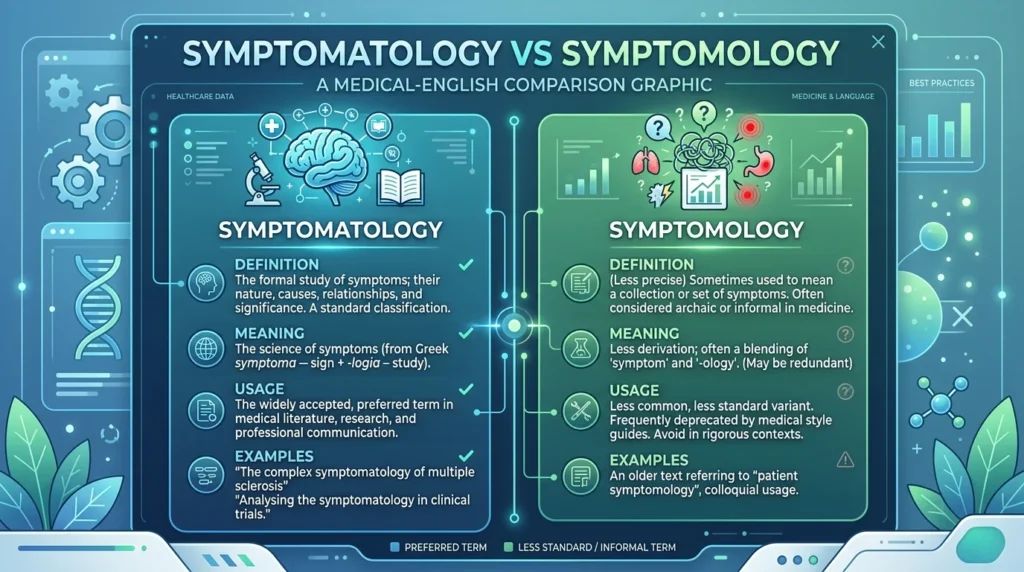
Symptomatology is the better choice for formal medical, academic, and professional writing. It refers to the study or description of symptoms, and it can also mean the collection or pattern of symptoms associated with a disease or condition. Symptomology is not simply meaningless or misspelled: it is an attested word, generally used as a shortened or informal form of symptomatology.
What Is Symptomatology?
Symptomatology is a noun used in medical and related fields to talk about symptoms as a group, including their pattern, characteristics, and study.
In plain English, think of it as the symptoms considered together rather than one symptom considered alone.
For example:
The patient’s symptomatology changed over several weeks.
This means the patient’s overall pattern or collection of symptoms changed.
The word can also refer to the study of symptoms as part of medical science. Dictionary definitions support both uses: symptomatology can describe the branch or study concerned with symptoms, as well as the collective symptoms of a disease or patient. (Wiktionary)
That distinction is important because symptomatology does not have to mean only “the study of symptoms.” In an actual sentence, its precise meaning depends on context.
What Does Symptomology Mean?
Symptomology is an established English word, but it has a different status from symptomatology.
Some dictionary sources explicitly define symptomology as an informal form of symptomatology. Its historical development also supports this relationship: the word is recorded as a shortening of symptomatology.
So it would be misleading to say:
“Symptomology is not a word.”
It is a word that appears in English usage.
The more useful question is:
Which word should I choose when I want the safest, most established term?
The answer is symptomatology.
Why It Matters
This distinction matters most when your writing needs to sound precise.
If you are writing a medical report, research paper, dissertation, university assignment, clinical article, or professional document, unusual terminology can distract readers from your actual point.
Compare:
- The study examined the symptomology of the condition.
- The study examined the symptomatology of the condition.
Both are understandable. The second is the safer choice when you want established medical terminology.
There is another reason to be careful: symptomatology itself can have more than one sense. It may describe the study of symptoms or the overall symptoms associated with a condition. Good writing therefore depends not only on choosing the longer word, but also on understanding what the sentence actually means.
The Core Rule
Use symptomatology as your default in formal, academic, scientific, and professional writing. Treat symptomology as a less formal or shortened variant, not as a completely different medical concept.
A simple decision rule is:
- Formal or academic writing? Use symptomatology.
- Clinical or scientific writing? Use symptomatology.
- Casual conversation? Symptomology may be understood, but symptomatology remains the established choice.
- Discussing the word itself? You can use symptomology when explaining or quoting that form.
Read More: Distress vs Duress: Meaning, Differences, and Correct Usage
How to Use It
Use Symptomatology for the Overall Pattern of Symptoms
When you mean the symptoms associated with a condition as a whole, symptomatology works naturally in medical and academic contexts.
Examples:
The researchers compared the symptomatology of the two disorders.
Here, symptomatology means the overall symptom patterns being compared.
The patient’s symptomatology was consistent with the condition under investigation.
Here, the word refers to the patient’s overall pattern of symptoms.
Use Symptomatology for the Study or Analysis of Symptoms
The word can also refer to the study of symptoms.
The course introduces students to the symptomatology of neurological disorders.
Here, the focus is on understanding and studying symptoms.
Do Not Assume Every Sentence Needs the Technical Word
A common mistake is replacing simple language with symptomatology when symptoms would be clearer.
For example:
The patient reported several symptoms.
This is usually better than:
The patient reported a complex symptomatology.
The second sentence is more technical and may be appropriate in a specialist context, but the first is clearer for a general audience.
Good medical writing is not about using the longest available word. It is about using the most accurate word for the intended reader.
When Symptomology May Appear
You may encounter symptomology in:
- informal medical discussion;
- general-interest writing;
- online discussions;
- quotations;
- older or less formal usage;
- writing that deliberately reflects a speaker’s wording.
Its existence in real English usage is why simply labeling it “wrong” is too strong. Some dictionary sources recognize it as an informal equivalent of symptomatology.
Correct Examples
Here are examples across different situations.
Conversation
“The doctor asked about the symptomatology before discussing the test results.”
Please review the section describing the symptomatology of the condition before we submit the report.
School
The assignment asks students to explain the symptomatology associated with the disorder.
University
The researchers examined differences in symptomatology between the two groups.
Workplace
Our report summarizes the symptomatology observed during the study period.
Academic Writing
The paper focuses on the relationship between symptomatology and treatment response.
Medical Writing
A detailed history was obtained to document the patient’s symptomatology.
Research
The researchers recorded changes in symptomatology throughout the trial.
Social Media
The article explains how the symptomatology of the condition can vary from person to person.
General Health Writing
Understanding the symptomatology of a disease can help readers recognize why symptoms may occur in different combinations.
Notice that symptomatology is not limited to one grammatical pattern. It can follow phrases such as the symptomatology of, patient symptomatology, clinical symptomatology, and changes in symptomatology.
Incorrect vs. Correct
| ❌ Incorrect or less suitable | ✅ Correct / preferred | Why |
|---|---|---|
| The paper studies the symptomology of the disorder. | The paper studies the symptomatology of the disorder. | Symptomatology is the established formal choice. |
| We compared the symptomology of both groups. | We compared the symptomatology of both groups. | Formal research writing favors the established term. |
| Her symptomology changed after treatment. | Her symptomatology changed after treatment. | Symptomology is understandable but less formal. |
| The assignment discusses symptomology in children. | The assignment discusses symptomatology in children. | Academic writing benefits from the standard term. |
| The report focuses on the symptomology associated with the disease. | The report focuses on the symptomatology associated with the disease. | The longer form is the safer professional choice. |
| Researchers analyzed the patient’s symptomology. | Researchers analyzed the patient’s symptomatology. | Symptomatology is more established in scientific prose. |
| The doctor documented the symptomology. | The doctor documented the symptomatology. | Formal clinical documentation calls for precise terminology. |
| The article describes the symptomology of the condition. | The article describes the symptomatology of the condition. | The preferred formal term is symptomatology. |
| The study examines symptomology over time. | The study examines symptomatology over time. | The standard form fits academic research better. |
| The lecture covered the symptomology of the disorder. | The lecture covered the symptomatology of the disorder. | The formal medical term is the better choice. |
A useful qualification: calling every occurrence of symptomology “incorrect” would oversimplify the evidence. Dictionary sources do record the word, with one source specifically labeling it informal.
Read More: Attornies vs Attorneys: Which Spelling Is Correct?
Why People Make This Mistake
Phonetic Similarity
When you hear the two words spoken, the difference can be easy to miss.
Symptomatology is longer, while symptomology removes the -at- portion. In fast speech, that difference may not be obvious to a learner.
If you learned the word by listening rather than reading, it is easy to reproduce the shorter version.
Spelling Overlap
Both words begin with:
symptom-
and end with:
-ology
That leaves only a small middle section to distinguish them visually.
The brain naturally recognizes the familiar beginning and ending and may overlook the missing letters.
Overgeneralisation
English contains many scientific words ending in -ology:
- biology
- psychology
- sociology
- cardiology
- neurology
A learner may therefore reason:
symptom + ology = symptomology
That construction looks logical. The problem is that English vocabulary is not built by applying a perfectly predictable formula to every word.
Symptomatology has a longer established form, while symptomology developed later as a shortening.
Autocomplete and Spellcheck
A spellchecker is not a complete usage guide.
If a software program accepts symptomology, that does not necessarily mean it is the best word for a formal medical document. A word can be spelled correctly and still be a less appropriate choice for a particular register.
This is an important writing lesson:
Spellcheck can identify many spelling errors, but it cannot reliably decide which valid word is most appropriate for your audience and context.
Translation Interference
Learners who work across languages may encounter medical terminology that maps differently from English.
A direct translation may produce a form that looks natural because the equivalent term in another language follows a similar pattern. That does not guarantee that the same construction is the preferred English form.
When translating medical terminology, it is better to check established English usage rather than build a word literally from the source language.
Common Mistakes Checklist
1. Assuming Symptomology Is Completely Wrong
What happens: A writer sees symptomology and immediately marks it as a spelling error.
Why it happens: The writer has learned that symptomatology is the standard term.
How to avoid it: Remember that symptomology is an attested word. The practical distinction is preferred formal usage versus a less formal/shortened form, not simply “real word versus fake word.”

2. Using Symptomology in a Research Paper
What happens: A writer uses the shorter form because it feels more natural.
Why it happens: Shorter words often feel easier and more conversational.
How to avoid it: In academic or scientific writing, default to symptomatology.
3. Thinking Symptomatology Always Means “Study”
What happens: A writer assumes symptomatology can only describe a medical discipline.
Why it happens: The suffix -logy often suggests a field of study.
How to avoid it: Remember that symptomatology can also mean the aggregate or pattern of symptoms associated with a condition.
4. Using Symptomatology When Symptoms Is Clearer
What happens: A writer replaces ordinary language with technical terminology.
Why it happens: Medical writing can encourage unnecessarily formal vocabulary.
How to avoid it: Use symptoms when you simply mean symptoms. Use symptomatology when the broader clinical or analytical concept matters.
5. Treating Popularity as Proof of Formality
What happens: A writer sees symptomology frequently online and assumes it must be the preferred form.
Why it happens: Frequent exposure creates familiarity.
How to avoid it: Check the register and dictionary treatment of a word, not just how often you see it online.
Symptomatology in Real English
Grammatically Correct and Professionally Natural
Symptomatology is both grammatically correct and a natural technical choice when the context is medical, clinical, psychological, or academic. For example, “The researchers compared the symptomatology of the two groups” clearly treats symptoms as a broader pattern or subject of analysis. In specialist writing, the term can efficiently express an idea that would otherwise require a longer phrase such as “the overall pattern of symptoms.”
Grammatically Possible but Less Formal
Symptomology is understandable and occurs in English, so calling it grammatically impossible would be inaccurate. However, its status is less formal: one dictionary source explicitly labels it an informal form of symptomatology. It may therefore be acceptable when discussing actual usage, quoting someone, or writing casually, but it is not the strongest default for a research paper or clinical document.
Read More: Attornies vs Attorneys: Which Spelling Is Correct?
Natural Everyday English
For everyday readers, symptoms is often more natural than either technical term. A doctor speaking to a patient might say, “Tell me about your symptoms,” rather than “Tell me about your symptomatology.” That does not make symptomatology incorrect; it simply reflects audience and register. Technical vocabulary is useful when precision or professional context requires it, not merely because it sounds more sophisticated.
The Most Natural Choice Depends on Meaning
If you mean individual complaints or experiences, use symptoms. If you mean the overall pattern or clinical study of symptoms, symptomatology can be precise. If you encounter symptomology, understand it as a real but less formal variant rather than assuming it represents a separate medical concept. This three-way distinction is more useful than memorizing a simple “right/wrong” label.
American vs. British English
There is not a simple American-versus-British spelling rule in which one variety requires symptomology and the other requires symptomatology.
However, dictionary treatment does show a difference worth noting. One major dictionary source gives symptomatology as the main American English form, while its British English entry lists symptomatology or symptomology for the medical field.
That does not mean British writers should automatically use symptomology. If you want the safest international choice, particularly in formal medical or academic writing, symptomatology remains the better default.
Formal vs. Informal Usage
| Context | Best choice | Reason |
|---|---|---|
| Medical research paper | Symptomatology | Established technical terminology |
| Academic essay | Symptomatology | More formal and precise |
| Clinical report | Symptomatology | Safer professional choice |
| University assignment | Symptomatology | Avoids unnecessary register questions |
| Medical textbook | Symptomatology | Standard technical vocabulary |
| General health article | Symptomatology or symptoms | Depends on audience and meaning |
| Casual conversation | Either may be understood | Informal usage is more flexible |
| Quoting a speaker | Symptomology may be retained | Preserve the original wording |
| Discussing the word itself | Symptomology | The word is the subject of discussion |
Comparison Table
| Feature | Symptomatology | Symptomology |
|---|---|---|
| Part of speech | Noun | Noun |
| Core meaning | Study, description, or overall pattern of symptoms | Usually a shortened form of symptomatology |
| Established in medical English | Yes | Less established |
| Formal writing | Preferred | Usually avoid as the default |
| Academic writing | Preferred | Less suitable |
| Clinical writing | Preferred | Less formal |
| Informal usage | Possible | Possible |
| Dictionary evidence | Established entry | Attested as an informal form in some sources |
| Best default | Yes | No |
| Completely “wrong”? | No | No |
| Easiest recommendation | Use it when precision matters | Recognize it, but normally choose symptomatology |
Dictionary evidence is important here because it prevents an overly rigid conclusion: symptomology is recorded, while symptomatology is the more established term and has broader formal medical use.
Memory Trick
Think:
Symptom + MAT + ology = the established medical term.
The MAT in symptomatology is the part people most often drop.
A second memory aid is:
Formal medicine → keep the MAT.
When you are writing a report, research paper, assignment, or clinical document, remember to keep -mat-:
sympto-MAT-ology → symptomatology
Real-Life Situations
Job Interview
You are discussing medical research:
“My previous project examined the symptomatology of patients with different neurological conditions.”
The formal term fits the professional setting.
Team Meeting
A research team is reviewing results:
“We need to compare the symptomatology recorded at baseline and at the end of the study.”
Again, symptomatology is appropriate.
You are sending an academic draft:
“I’ve revised the section on symptomatology and clarified the terminology.”
Text Message
A friend asks what a difficult medical term means:
“Symptomatology basically refers to the overall pattern or study of symptoms.”
The technical term can still be explained in simple language.
Exam
A question asks for the term describing the study or overall pattern of symptoms:
Symptomatology
Research Paper
“The study investigated changes in symptomatology over a six-month period.”
The term is concise and appropriate for formal research writing.
When Should You Avoid Both Words?
Sometimes the best answer to a vocabulary question is neither word.
If your audience is not familiar with medical terminology, symptoms may communicate the idea more clearly.
Compare:
The article discusses the symptomatology of the illness.
with:
The article discusses the symptoms of the illness.
For a general audience, the second sentence is simpler.
Likewise:
The patient experienced several symptoms.
is usually clearer than:
The patient experienced a complex symptomatology.
The technical term should earn its place. If it adds precision, use it. If it merely makes a simple sentence sound more complicated, choose the simpler word.
Expert Tips
Tip 1: Do Not Confuse “Correct” With “Preferred”
English contains many words that are understandable and attested but differ in register, frequency, or conventionality.
That is exactly what makes symptomology tricky.
The useful question is not only:
Is this word real?
Ask:
Is this the word I should use in this context?
For formal medical writing, symptomatology is the safer answer.
Tip 2: Use “Symptoms” for Patients and General Readers
Technical vocabulary should match the audience.
A specialist may write:
The patient’s symptomatology was unusual.
A patient-facing explanation might say:
The patient’s symptoms were unusual.
Both can communicate essentially the same underlying idea, but the second is more accessible.
Tip 3: Do Not Let Spellcheck Make the Decision
A spellchecker may accept both forms because both exist in English usage.
That is not a contradiction. Spelling correctness and register are different questions.
Tip 4: Remember That -ology Does Not Always Tell You the Whole Story
It is tempting to construct words mechanically:
symptom + ology = symptomology
English does not always work that way. Established vocabulary often reflects historical development rather than a simple modern formula.
In this case, symptomology developed as a shortening of symptomatology, which helps explain why both forms exist. (Etymology Online)
Tip 5: Do Not Invent a Meaning Difference
You may see claims that symptomology means one very specific thing while symptomatology means something completely different.
That distinction is not reliably supported.
The safer interpretation is that symptomology is generally used as a shortened or informal form of symptomatology, while symptomatology has the established technical sense.
Tip 6: Choose the Term Before You Start Repeating It
In a long article or research paper, inconsistent terminology looks careless.
If you decide that symptomatology is your preferred term, use it consistently unless there is a specific reason to reproduce symptomology.
Frequently Asked Questions
Is symptomology a real word?
Yes. Symptomology is an attested English noun. Some dictionary sources define it as an informal form of symptomatology, and historical sources describe it as a shortening of the older term.
Is symptomology a misspelling of symptomatology?
Not exactly. It can function as a shortened form of symptomatology, so calling it simply a misspelling is too absolute. The practical issue is that symptomatology is the safer established choice for formal writing.
Which word should I use in a medical report?
Use symptomatology. It is the more established and professional choice and avoids unnecessary questions about informal terminology.
Can I use symptomology in an academic paper?
You can encounter the word in published or informal material, but symptomatology is the safer choice for academic writing. Unless you have a specific reason to retain symptomology, use the established form.
Does symptomatology mean the same thing as symptoms?
Not exactly. Symptoms are individual experiences or manifestations associated with a condition. Symptomatology can refer to the overall collection or pattern of symptoms, or to their study.
Is symptomatology only used in medicine?
It is strongly associated with medicine and health-related fields, but it can be used more broadly when discussing patterns or manifestations of symptoms. Its strongest and clearest use is in medical, psychological, clinical, and academic contexts.
Why does symptomology sound correct?
The spelling looks logical because English has many familiar scientific words ending in -ology. The form symptomology also exists in actual usage, which reinforces that impression. Its existence does not, however, make it the best choice for formal writing.
Which is more professional: symptomology or symptomatology?
Symptomatology is generally the more professional choice. It is the established technical form and is safer in medical, academic, and scientific contexts.
Can symptomatology be used for one patient’s symptoms?
Yes. You can refer to a patient’s overall symptom pattern as their symptomatology. The word can describe the aggregate of symptoms associated with a patient or condition, not only the academic study of symptoms.
What is a simpler word than symptomatology?
Usually, symptoms is the simplest alternative. Depending on the sentence, you might also use symptom pattern, clinical presentation, or symptom profile. The best replacement depends on the exact meaning.
Is symptomology more common in British English?
There is some dictionary evidence for a British English variant. One major dictionary lists symptomology alongside symptomatology in its British English entry, while its American English entry presents symptomatology. This is a dictionary distinction, not a rule requiring British speakers to choose symptomology.
Mini Quiz
| # | Question | Answer | Explanation |
|---|---|---|---|
| 1 | Multiple choice: Which is the safest choice for a research paper? A) symptomology B) symptomatology | B) symptomatology | Symptomatology is the established formal choice. |
| 2 | Fill in the blank: The researchers compared the ______ of the two groups. | symptomatology | The sentence refers to the overall patterns of symptoms. |
| 3 | Correct the sentence: “The thesis examines the symptomology of the disorder.” | The thesis examines the symptomatology of the disorder. | Symptomatology is more appropriate for formal academic writing. |
| 4 | Multiple choice: Is symptomology a real English word? A) No B) Yes, but it is less formal | B | It is attested and is treated as an informal form in some sources. |
| 5 | Fill in the blank: For a patient-friendly article, ______ may be clearer than symptomatology. | symptoms | Plain language is often better for general readers. |
| 6 | Correct the sentence: “The doctor documented the patient’s symptomology in the report.” | The doctor documented the patient’s symptomatology in the report. | The formal clinical context favors symptomatology. |
| 7 | Multiple choice: What can symptomatology mean? A) Only one symptom B) The study or overall pattern of symptoms C) A diagnosis | B | It can refer to the study of symptoms or their aggregate/pattern. |
| 8 | Fill in the blank: When writing formally, remember to keep the ______ in sympto-MAT-ology. | MAT | The mnemonic helps distinguish symptomatology from the shortened form. |
| 9 | Correct the sentence: “The article uses symptomology as its formal medical term.” | The article uses symptomatology as its formal medical term. | Symptomatology is the stronger formal choice. |
| 10 | Multiple choice: Which sentence is clearest for a general audience? A) The symptomatology was complex. B) The patient’s symptoms were complex. | B | Symptoms is simpler and more accessible for general readers. |

Quick Summary
Symptomatology is the established medical term for the study, description, or overall pattern of symptoms associated with a disease or patient. Symptomology is also an attested word, but it is generally treated as a shortened or informal form of symptomatology. Therefore, if you are writing a research paper, medical report, academic assignment, clinical document, or other formal text, choose symptomatology. Do not call symptomology a completely nonexistent word; that is too absolute. In everyday or patient-facing writing, symptoms may be clearer than either technical term. The easiest memory trick is “formal medicine → keep the MAT”: sympto-MAT-ology.