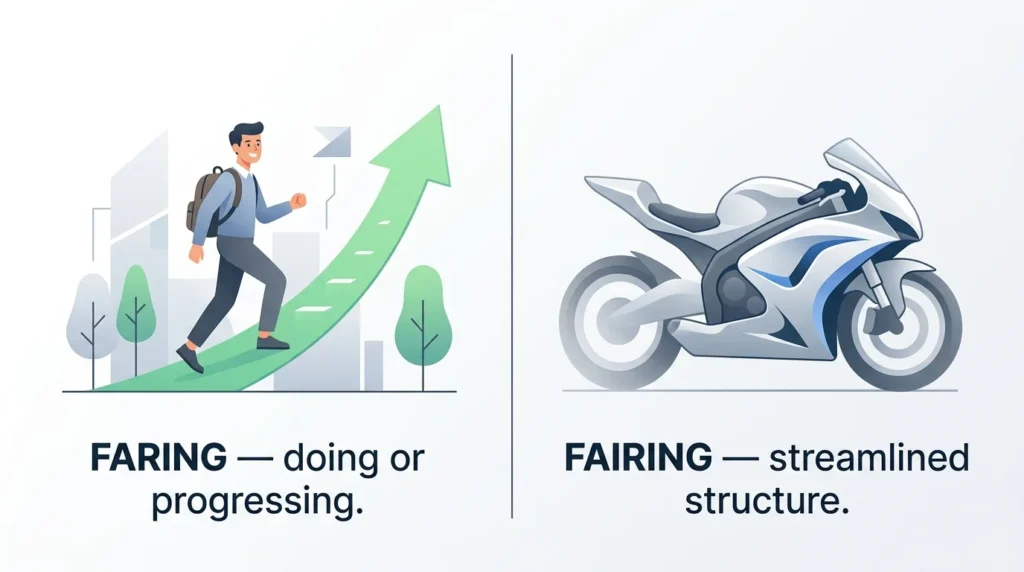

Faring and fairing are both correct English words, but they are not interchangeable. Faring is the present participle of fare and usually means doing, managing, progressing, or performing in a particular way. Fairing most commonly names a smooth structure that reduces drag, such as a motorcycle or aircraft fairing. Therefore, write “How are you faring?”, not “How are you fairing?”
What Are Faring and Fairing?
The easiest way to understand faring vs fairing is to look at the words they come from.
Faring comes from the verb fare. When fare is used as a verb, it can mean to get along, manage, succeed, or perform in a particular way. That is why we can say that a student is faring well, a company is faring badly, or a family is faring better than expected.
Fairing has a different origin and function. As a noun, it commonly refers to a structure designed to give something a smoother outline and reduce aerodynamic drag. You may encounter fairings on motorcycles, aircraft, rockets, bicycles, cars, or other engineered objects.
There is also an important technical use that simple explanations sometimes miss: fairing can be the -ing form of the verb fair when fair means to smooth, shape, or blend a surface. Specialist writers may therefore discuss fairing a hull, fairing a surface, or fairing a curve.
Why It Matters
Mixing up faring and fairing usually will not make a sentence impossible to understand, but it can make otherwise polished writing look careless.
Imagine sending this sentence to a manager:
“How is the new employee fairing?”
The reader can probably guess that you mean “How is the new employee doing?” However, fairing suggests a completely different word. In professional communication, academic work, applications, reports, and published content, such errors can weaken the reader’s confidence in the writing.
The distinction matters even more in technical environments. An engineer discussing an aircraft fairing is naming a physical structure. A business analyst saying an airline is faring poorly is describing performance. One extra i changes the underlying word and therefore the meaning.
The Core Rule
Use faring when you mean doing, coping, progressing, succeeding, or performing. Use fairing when you mean a streamlined structure—or, in specialist technical language, the process of making something smooth or properly shaped.
A fast substitution test works in most everyday sentences:
- If doing, managing, or progressing makes sense, choose faring.
- If the sentence is about airflow, a vehicle covering, smoothing, or shaping, fairing may be correct.
- If you are asking how somebody is doing, write “How are you faring?”
Read More: Check-In vs. Check In: Which One Is Correct?
How to Use Faring and Fairing
When to Use Faring
Use faring when you are describing how a person, group, business, project, animal, product, economy, or other subject is performing or managing under particular circumstances.
The grammatical term for faring is a present participle. In plain English, that means it is the -ing form of the verb fare.
Examples:
The interns are faring well in their first month.
How is the project faring after the schedule change?
Local shops are faring better this summer.
In each case, you could replace faring with a phrase such as doing, performing, or getting along without destroying the basic meaning.
When to Use Fairing
Use fairing as a noun when referring to a component or structure that creates a smoother external shape, often to manage airflow and reduce drag. This meaning is particularly common in aviation, motorcycling, automotive engineering, rocketry, cycling, and related technical fields.
Examples:
The mechanic removed the damaged front fairing.
The payload remained protected inside the rocket fairing.
Engineers redesigned the fairing around the joint.
Here, replacing fairing with doing would make no sense. The sentences refer to physical structures.
Fairing Can Also Be an -ing Verb
There is a less familiar but legitimate use of fairing.
The verb fair can mean to make something smooth. As a result, specialists may use fairing for the process of smoothing or shaping a surface or form. Current published usage includes technical references to painting and fairing as manufacturing or finishing processes.
For example:
The restoration team is fairing the hull before applying the final coating.
That sentence does not mean the team is “doing the hull.” It means they are smoothing or shaping it.
This technical verb use is one reason the rule “faring is a verb and fairing is always a noun” is too simplistic.
Why Faring Is Not Spelled Fareing
The base verb is fare, but its present participle is faring, not fareing.
English normally drops a final silent e before adding -ing:
fare → faring
Compare:
make → making
write → writing
move → moving
So when you mean “doing” or “progressing,” neither fairing nor fareing is correct. The spelling you need is faring. Current conjugation references list fare, fared, faring as the standard forms.
Correct Examples of Faring and Fairing
The following examples show both words across everyday, professional, academic, and technical situations.
- Conversation: I heard the first week was difficult. How are you faring now?
- Email: I wanted to check how the new team members are faring with the revised process.
- School: Most students are faring better after the extra revision sessions.
- Workplace: The smaller branch is faring surprisingly well despite increased competition.
- Social media: My balcony tomatoes are faring much better than last year’s plants.
- Academic writing: Participants in the supported group appeared to be faring better during the later assessment period.
- Motorcycling: A crack appeared along the edge of the motorcycle’s front fairing.
- Aviation: The technicians inspected the aircraft fairing before departure.
- Engineering: The new fairing creates a smoother transition between the two sections.
- Rocketry: The payload fairing protects the spacecraft during the early part of launch.
- Technical workshop: The crew spent the afternoon fairing the repaired surface.
- Business report: Companies with lower operating costs are faring better in the current market.
The examples reveal a useful pattern: faring usually answers a question about performance or condition; fairing usually names or describes technical smoothing and streamlining.
Incorrect vs. Correct
| ❌ Incorrect | ✅ Correct | Why |
|---|---|---|
| How are you fairing in your new job? | How are you faring in your new job? | The question asks how someone is doing or progressing, so the verb comes from fare. |
| Our sales team is fairing well this month. | Our sales team is faring well this month. | The sentence describes performance, not an aerodynamic component. |
| The motorcycle’s front faring was scratched. | The motorcycle’s front fairing was scratched. | A vehicle covering or streamlined structure is a fairing. |
| Students are fairing better after tutoring. | Students are faring better after tutoring. | The students are performing better, so faring is required. |
| The aircraft faring needs to be replaced. | The aircraft fairing needs to be replaced. | The sentence names a physical aircraft structure. |
| I hope your parents are fairing well. | I hope your parents are faring well. | Faring well means doing or managing well. |
| How is the company fairing against larger competitors? | How is the company faring against larger competitors? | The question concerns business performance. |
| The engineers installed a lightweight faring. | The engineers installed a lightweight fairing. | Something installed as a streamlined component is a fairing. |
| She seems to be fareing better this week. | She seems to be faring better this week. | The final silent e in fare is dropped before -ing. |
| The crew is faring the repaired hull before painting it. | The crew is fairing the repaired hull before painting it. | In specialist usage, fairing can mean smoothing or shaping a surface. |
Why People Make This Mistake
Several things make faring vs fairing unusually easy to confuse.
They Sound the Same
The two words are normally pronounced alike. They are therefore homophones—words that share a pronunciation but differ in spelling or meaning. The pronunciation gives the writer little help in choosing the correct spelling.
Read More: Skiid vs Skied: Which Spelling Is Correct?
Their Spellings Overlap
Only one letter separates the visible patterns:
faring
fairing
Because both are genuine English words, the wrong choice may still look perfectly plausible.
Writers Think of Fair Before Fare
The word fair is extremely familiar because it appears in expressions such as fair price, fair decision, and fair game. Some writers therefore automatically connect the sound “fair-ing” with fair, even when the intended verb is fare.
The Spelling Rule Hides the Base Word
When fare becomes faring, its final e disappears.
That makes the connection between the two forms less obvious:
fare → faring
A learner may expect fareing or may add an i and arrive at fairing instead.
Spellcheck May Not Catch It
A basic spellchecker looks for misspelled words. Because faring and fairing are both legitimate spellings, software must understand the sentence’s context to identify the mistake.
Even advanced tools can occasionally miss context-dependent homophone errors. The writer still needs to check meaning.
Translation Can Encourage Literal Choices
Learners translating from another language may have one word for ideas such as doing, managing, progressing, or getting on. When they encounter the English sound /fair-ing/, they may choose the visually familiar spelling fairing without realizing that the required base verb is fare.
The safest solution is not to memorize the sound. Memorize the meaning and base word.
Common Mistakes Checklist
- Using “fairing” in “How are you ___?”
Ask what the sentence means. If it means “How are you doing?” the answer is faring. - Writing “fareing.”
Remember that fare drops its final silent e before -ing: fare → faring. - Assuming fairing is a misspelling.
It is a real word. A motorcycle, aircraft, bicycle, or rocket can have a fairing. - Assuming fairing can only be a noun.
In specialist language, it may also be the present participle of fair when discussing smoothing or shaping. - Using faring for a physical component.
A cracked motorcycle body panel designed as a streamlined cover is a fairing, not a faring. - Thinking only people can fare.
Businesses, teams, policies, products, economies, plants, animals, and projects can all be described as faring well or badly when their performance or condition is being discussed. - Using “faring” merely because the sentence contains a person.
Meaning still controls the choice. A mechanic can be fairing a surface even though a person performs the action.
Faring vs Fairing in Real English
Grammatically Correct English
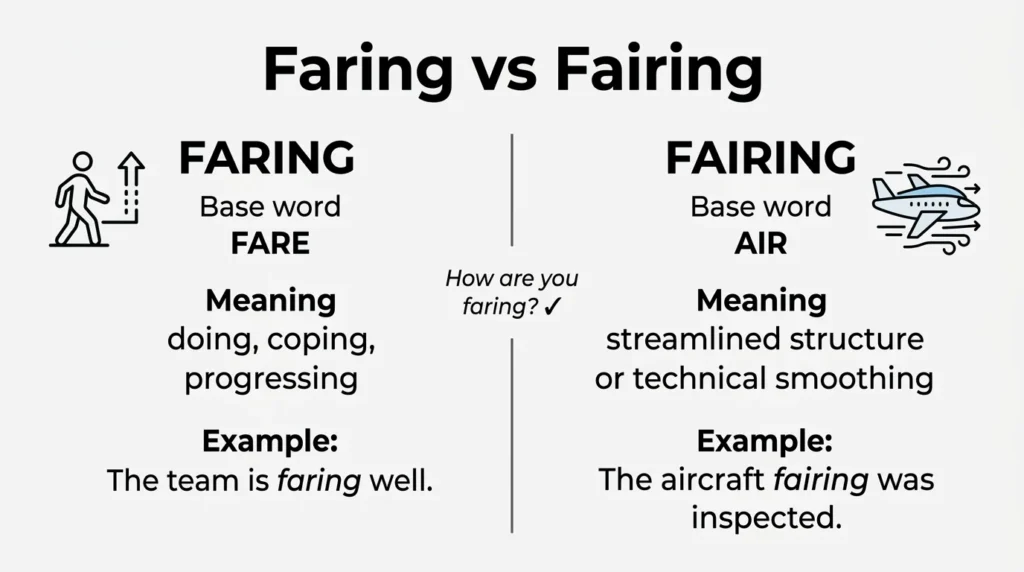
“How are you faring with the new workload?” is grammatically correct because faring is the present participle of fare, meaning to manage or perform in a particular way. Similarly, “The company is faring well” is standard English. Fairing is correct when naming an aerodynamic structure or, in specialist contexts, describing the action of smoothing or shaping something.
Grammatically Possible but Unnatural English
A sentence can follow grammar rules without being the wording people normally choose in a particular situation. For instance, “I am faring well, thank you” is perfectly grammatical, but it may sound unusually formal in an ordinary text conversation where “I’m doing well” would be simpler. The problem is not correctness; it is register, context, and what sounds proportionate to the situation.
Natural Everyday English
In casual conversation, people commonly ask “How are you doing?” or “How’s it going?” When a speaker specifically wants to ask how someone is coping with a situation, however, “How are you faring with the workload?” can be useful and precise. Current usage guides likewise distinguish the more formal or serious faring construction from everyday alternatives such as How are you doing?
American vs. British English
The central rule does not change between mainstream American and British English. In both, fare can describe how somebody or something performs, producing the present participle faring. The technical aerodynamic meaning of fairing is also established internationally.
There is, however, a genuine regional detail worth knowing. Fairing also has an older or chiefly British noun sense referring to a present or gift, especially something bought or given at a fair. That meaning is separate from both faring and the aerodynamic sense of fairing.
For most modern writers, this older sense will rarely affect the choice between “How are you faring?” and “How are you fairing?”
Formal vs. Informal Usage
Faring is not excessively formal, but it often feels more deliberate than everyday alternatives.
In professional or serious contexts, sentences such as these work naturally:
How are the new hires faring during training?
The sector is faring better than analysts expected.
How are residents faring after the disruption?
In a casual conversation between friends, these alternatives are usually simpler:
How are you doing?
How’s it going?
How are you getting on?
Fairing, by contrast, is primarily a matter of technical register, not social formality. A motorcycle mechanic may use the word casually at work because it names an ordinary component in that field.
Faring vs Fairing Comparison Table
| Feature | Faring | Fairing |
|---|---|---|
| Base word | fare | fair, or independent noun fairing |
| Common part of speech | Verb form | Noun; also specialist verb form |
| Main meaning | Doing, managing, progressing, succeeding | Streamlined structure; smoothing or shaping |
| Common subjects | People, teams, businesses, projects, animals, economies | Motorcycles, aircraft, rockets, surfaces, hulls, engineered forms |
| Common phrase | faring well | aircraft fairing |
| Correct question | How are you faring? | Not normally used for someone’s well-being |
| Spelling pattern | fare + ing → faring | fair + ing → fairing |
| Technical use | Performance or condition | Aerodynamics, manufacturing, shaping |
| Pronunciation | Usually the same as fairing | Usually the same as faring |
| Example | The team is faring better. | The fairing was damaged. |
Faring vs Fairing vs Fare vs Fair
The confusion becomes easier to solve when you compare the four related forms.
| Word | Common Function | Meaning | Example |
|---|---|---|---|
| fare | Verb | Do or perform in a specified way | How did you fare in the interview? |
| fare | Noun | Cost of transportation; food | The train fare increased. |
| faring | Verb form | Doing or progressing | She is faring well. |
| fair | Adjective | Just, reasonable, impartial | That seems like a fair decision. |
| fair | Noun | Public event or exhibition | We went to the county fair. |
| fairing | Noun | Smooth, streamlined structure | The motorcycle fairing is cracked. |
| fairing | Verb form | Smoothing or shaping | They are fairing the repaired surface. |
The most useful contrast for everyday writing is:
fare → faring = doing
fair → fairing = smoothing
The independent noun fairing then covers the familiar aerodynamic structure.
Memory Trick
Use the letters inside the words.
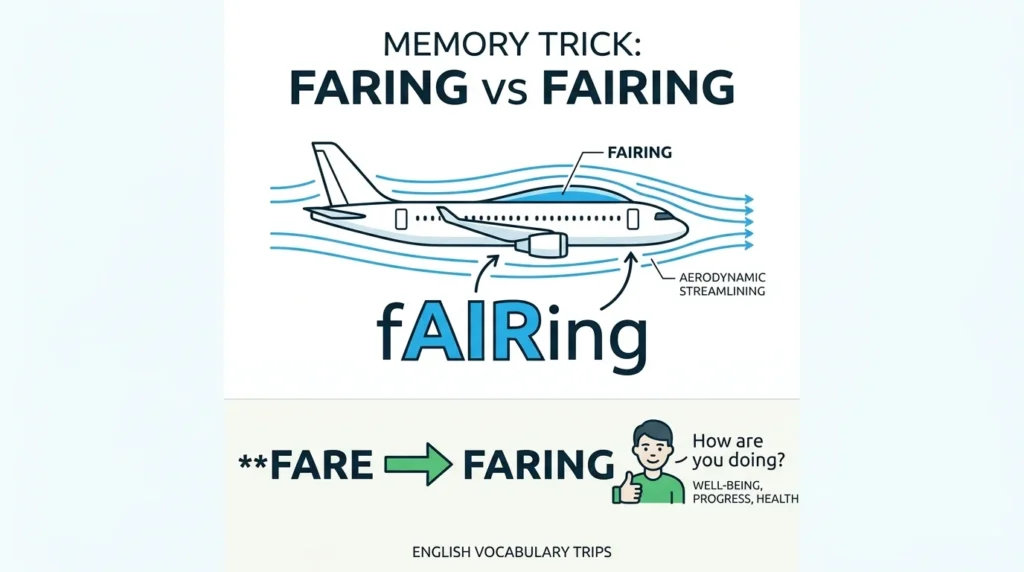
FAIRING Contains AIR
Look at the middle of the word:
fAIRing
A technical fairing often deals with airflow, streamlining, or a smooth external shape.
Think:
AIR inside FAIRING → airflow → vehicle or technical fairing
FARING Comes From FARE
When someone is doing or progressing, begin with the verb:
FARE → FARING
So:
How did she fare?
becomes
How is she faring?
One memory route starts with AIR. The other starts with FARE.
Real-Life Situations
Interview
After a difficult interview, a friend might ask:
“How do you think you fared?”
Later, while you are adjusting to the new job, someone could ask:
“How are you faring in the new role?”
Both use the verb fare because the question concerns performance or progress.
Meeting
A project manager might say:
“The rollout is faring better in smaller markets than in larger ones.”
The project is not physically moving through air. The speaker is evaluating results, so faring is correct.
A professional check-in could read:
“I wanted to see how your team is faring with the new reporting system.”
The wording is slightly more deliberate than “How is your team doing?”, which can suit a professional message.
Text Message
A friend might text:
“How are you faring with all that studying?”
The sentence is correct, although a more casual version would be:
“How’s the studying going?”
Exam
Suppose the sentence is:
The motorcycle’s damaged ___ was replaced before the race.
The answer is fairing because the blank names a physical component.
If the sentence were:
The motorcycle team is ___ better this season.
the answer would be faring because it describes performance.
Expert Tips
- Find the base word first.
If the meaning comes from fare, spell the -ing form faring. - Use the “doing” test.
If you can replace the word with doing and preserve the basic meaning, faring is probably right. - Do not rely on pronunciation.
The words sound alike, so saying the sentence aloud usually does not solve the spelling problem. - Check the noun after possessives.
Phrases such as the motorcycle’s ___, the aircraft’s ___, or the rocket’s ___ often point toward the noun fairing when a physical streamlined component is meant. - Watch for “well,” “badly,” “better,” and “worse.”
These words frequently follow or relate to the performance sense of fare: faring well, faring badly, faring better, faring worse. - Do not memorize “faring = people.”
That shortcut eventually fails. A company, crop, product, animal, project, or economy can fare well or badly. - Do not memorize “fairing = noun only.”
It is usually a noun in general writing, but specialist technical writers can use fairing as an -ing verb for smoothing or shaping. - Proofread for meaning, not spelling alone.
Because both forms are real words, a clean spellcheck result does not guarantee that you chose the correct one.
Quick Summary
Faring and fairing sound alike but perform different jobs. Faring comes from the verb fare and describes how a person, business, team, project, animal, or other subject is doing, coping, progressing, or performing. That makes “How are you faring?” and “She is faring well” correct. Fairing most commonly refers to a streamlined structure used on vehicles or aircraft to create a smoother shape and reduce drag. In specialist technical writing, fairing can also describe smoothing or shaping a surface. Remember fAIRing contains AIR, while faring comes directly from FARE. Also avoid the spelling fareing: standard English drops the final silent e, giving fare → faring.
FAQ
Is it faring or fairing?
Both words are correct, but the right choice depends on meaning.
Use faring when talking about how somebody or something is doing, performing, or coping.
Use fairing when referring to a streamlined component or, in specialist language, the process of smoothing or shaping something.
Is it “How are you faring?” or “How are you fairing?”
Write “How are you faring?”
The question asks how a person is doing or managing. The required verb is fare, whose present participle is faring.
Is it “faring well” or “fairing well”?
When you mean doing well, write faring well.
For example:
The children are faring well at their new school.
The company is faring well despite higher costs.
The phrase comes from the verb fare, meaning to perform or get along in a specified way.
Is “faring” an old-fashioned word?
No. Faring remains standard modern English, particularly when discussing how someone or something is performing under particular circumstances.
However, in a very casual greeting, “How are you doing?” or “How’s it going?” may sound more conversational than the broader question “How are you faring?”
Can an object or organization be “faring well”?
Yes.
The subject does not have to be a person. A company, industry, project, policy, crop, animal population, product, or team can fare well or fare badly if you are evaluating its results, condition, or performance. Dictionary examples likewise apply fare to both people and things.
Is “fareing” ever correct?
Not as the ordinary present participle of fare.
Write:
fare → faring
not:
fare → fareing
The final silent e is dropped before -ing.
Can fairing be used as a verb?
Yes, although this use is much more specialized than the everyday verb faring.
The verb fair can mean to make something smooth. Therefore, engineers, builders, designers, boat restorers, and other specialists may use expressions such as fairing a hull or fairing a surface.
Is a motorcycle body panel called a faring or fairing?
The correct spelling is fairing.
A motorcycle fairing is part of the motorcycle’s bodywork and may contribute to a smooth external shape and aerodynamic performance.
Are faring and fairing homophones?
In ordinary standard pronunciation, they are pronounced alike, making them homophones for practical purposes. Their similar sound is one of the main reasons they are confused in writing.
Does fairing have a meaning outside engineering?
Yes.
Besides its technical meanings, fairing has an older or chiefly British noun sense meaning a gift or present, particularly one associated with a fair. This use is much less likely to appear in ordinary international English than the engineering meaning.
Mini Quiz
| # | Question | Answer | Explanation |
|---|---|---|---|
| 1 | Fill in the blank: “How are you ___ after your first week at university?” A) faring B) fairing | A) faring | The question asks how someone is doing or adjusting. |
| 2 | Fill in the blank: “The motorcycle’s front ___ was damaged.” A) faring B) fairing | B) fairing | The sentence names a physical motorcycle component. |
| 3 | Which is correct? A) The team is fairing well. B) The team is faring well. | B | Faring well means performing successfully. |
| 4 | Correct the sentence: “How is your business fairing this year?” | How is your business faring this year? | Business performance requires the verb fare. |
| 5 | Fill in the blank: “Engineers inspected the aircraft ___.” | fairing | An aircraft fairing is a streamlined structure. |
| 6 | Which spelling is correct for the -ing form of fare? A) fareing B) faring C) fairing | B) faring | The final silent e is dropped before adding -ing. |
| 7 | Correct the sentence: “My seedlings are fairing much better indoors.” | My seedlings are faring much better indoors. | The sentence describes how the seedlings are doing. |
| 8 | Fill in the blank: “The technicians are ___ the repaired hull before painting.” A) faring B) fairing | B) fairing | In specialist usage, fairing can mean smoothing or shaping a surface. |
| 9 | Which sentence is correct? A) I hope you’re faring well. B) I hope you’re fareing well. | A | Faring is the standard present participle of fare. |
| 10 | Fill in the blank: “The new product is ___ better than expected.” | faring | The sentence evaluates the product’s performance. |