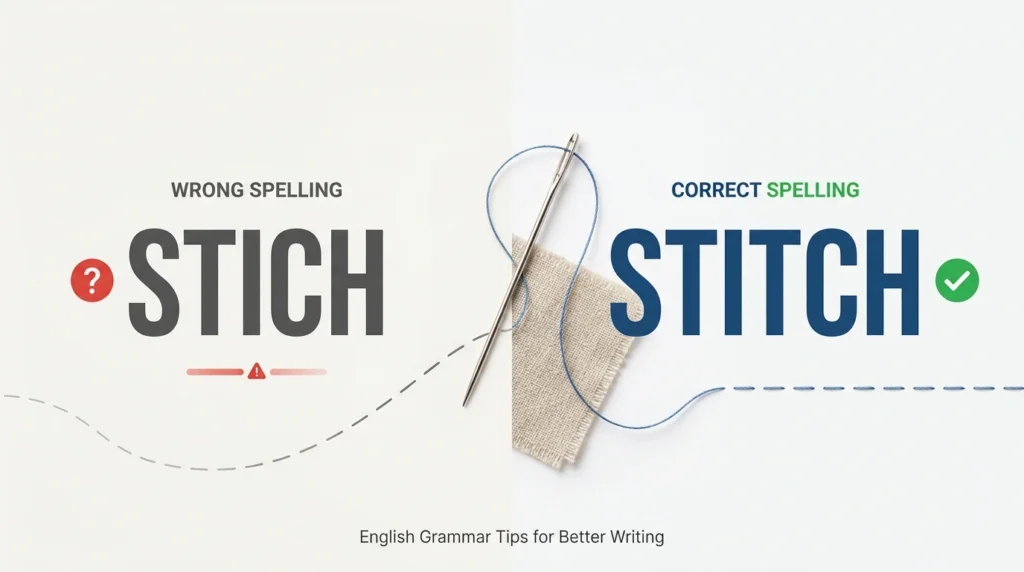

Stitch is the correct spelling in almost every everyday situation. Write stitch when talking about sewing, knitting, crochet, medical sutures, repairing fabric, or a sudden pain in your side. Stich is a real but rare specialist word meaning a line or verse, so it should not replace stitch in normal writing.
Simple rule: If you mean something connected with sewing, thread, knitting, a wound, or side pain, spell it stitch.
What Is the Difference Between Stich and Stitch?
The main difference between stich and stitch is meaning and usage, not merely spelling.
Stitch is a common English noun and verb. As a noun, it can describe a movement of a threaded needle, the thread left in material, a knitting or crochet loop, a medical suture, or a sudden sharp pain. As a verb, it means to join, repair, close, or decorate something using stitches.
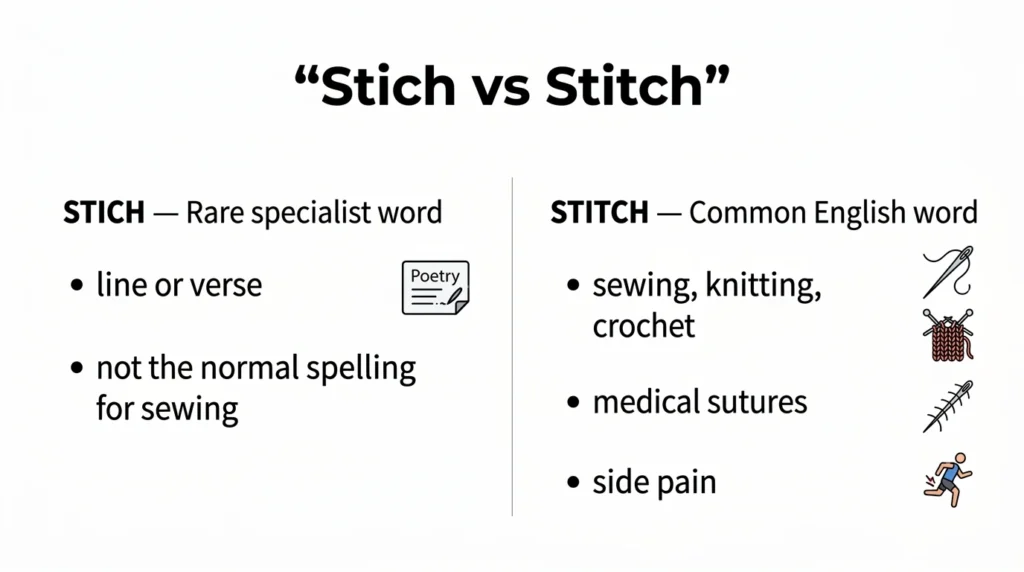
Stich is much rarer. One established meaning is a measured section of written verse, particularly a line or verse. It also appears in highly specialised terminology.
That means these words are not genuine alternatives in normal English.
You would write:
She put another stitch in the hem.
Not:
She put another stich in the hem.
The second sentence accidentally uses a rare word where the common word stitch is required.
Why Does the Difference Matter?
A missing t seems tiny, but spelling mistakes are especially noticeable in short, familiar words.
Imagine these situations:
- A clothing business advertises “hand-stiched jackets.”
- A student writes about “medical stiches.”
- A designer labels an embroidery tutorial “basic stich techniques.”
- An employee writes, “The tear needs one more stich.”
- A craft seller describes a “cross-stich pattern.”
Readers will probably understand the intended meaning, but the repeated spelling error can make otherwise professional writing appear poorly edited.
The issue becomes even more important in product listings, educational material, medical communication, craft instructions, CVs, academic assignments, and professional emails.
Correct spelling removes unnecessary doubt.
The Core Rule for Stich vs Stitch
RULE: Use STITCH for sewing, knitting, crochet, wounds, side pain, and ordinary English expressions. Use STICH only when you deliberately mean its rare specialist sense, such as a line or verse.
For most learners, writers, students, and professionals, this solves the problem immediately.
Consider this three-step check:
- Ask whether you mean sewing, thread, knitting, crochet, a wound, or pain.
- If yes, write stitch.
- Use stich only if you specifically know that its rare technical meaning fits your sentence.
Read More: Tapping vs Taping: What’s the Difference?
How to Use Stitch Correctly
Stitch as a Noun in Sewing
In sewing, a stitch can refer to one movement of the needle and thread or the resulting piece of thread in the material.
For example:
The final stitch came loose near the pocket.
You can also describe different techniques:
Use a small running stitch along the edge.
Common combinations include:
- hand stitch
- running stitch
- chain stitch
- cross-stitch
- decorative stitch
- straight stitch
Stitch as a Verb
Stitch can also be a verb meaning to sew, join, repair, or close something using stitches.
For example:
She stitched the torn pocket by hand.
The normal verb forms are:
| Form | Correct Word |
|---|---|
| Base form | stitch |
| Third-person singular | stitches |
| Past tense | stitched |
| Past participle | stitched |
| -ing form | stitching |
Notice that the tch remains in every form.
Stitch in Knitting and Crochet
In knitting and crochet, a stitch refers to an individual loop or a particular method of forming loops.
For example:
Cast on forty stitches before beginning the next row.
Or:
I accidentally dropped a stitch halfway through the scarf.
The plural is stitches, not stiches.
Stitch in Medical Contexts
A stitch can also refer to material used to close the edges of a wound or incision.
For example:
The cut required four stitches.
The verb works here too:
The doctor stitched the wound.
In technical medical writing, suture may be preferred in some contexts, but stitch remains completely normal in everyday English.
Stitch as a Sudden Pain
English also uses stitch for a sudden sharp pain, especially one felt in the side during physical activity.
For example:
I had to stop running because I got a stitch in my side.
This meaning may seem unrelated to sewing, but the spelling remains exactly the same: stitch.
Stitch in Common Expressions
You will also see stitch in established expressions.
In stitches means laughing very hard:
His story had everyone in stitches.
A stitch in time saves nine expresses the idea that fixing a small problem early can prevent a larger problem later.
These expressions also require stitch, never stich.
Is Stich Actually a Word?
Yes, but this is where many explanations of stich vs stitch become too simplistic.
Stich is an English word in specialised usage. One dictionary meaning is a measured part of written material, especially a line or verse.
That does not make stich an alternative spelling of stitch.
Compare:
Rare specialist use:
The scholar analysed each stich of the verse.
Normal everyday use:
The tailor repaired the sleeve with one stitch.
For ordinary writing, you may go years without needing the specialist noun stich. You are far more likely to encounter it as an accidental misspelling of stitch.
That distinction matters because saying “stich is never a word” would be inaccurate. A better rule is:
Stich exists, but it normally does not mean what someone intends when they accidentally leave the second “t” out of stitch.
Why Is Stitch Spelled With “tch”?
The ending of stitch follows a useful English spelling pattern.
In many one-syllable words, the /ch/ sound that follows a short vowel is written tch rather than simply ch.
Examples include:
- catch
- fetch
- pitch
- notch
- hutch
- stitch
That makes stitch easier to remember once you recognise the pattern. The guideline is useful but should not be treated as an absolute law because English contains exceptions such as much, rich, such, and which.
Correct Examples of Stitch
The following examples show how stitch works naturally across different situations.
- Conversation: “Can you put a quick stitch in my jacket before we leave?”
- Email: “I noticed that one stitch near the sleeve has started to come loose.”
- School: “Our teacher showed us how to make a basic cross-stitch pattern.”
- Workplace: “The sample failed inspection because several stitches were uneven.”
- Social media: “I finally learned this embroidery stitch and I love the result.”
- Academic writing: “The researchers compared the strength of several stitch configurations.”
- Medical conversation: “The doctor said the cut would probably need three stitches.”
- Knitting: “Be careful not to drop a stitch when you change colours.”
- Crochet: “Repeat the same stitch until you reach the end of the row.”
- Exercise: “I developed a stitch in my side during the final kilometre.”
- Everyday repair: “I stitched the loose button back onto my coat.”
- Figurative language: “The comedian had the entire audience in stitches.”
Read More: Developed vs Developped: Which Spelling Is Correct?
Stich vs Stitch: Incorrect and Correct Examples
| ❌ Incorrect | ✅ Correct | Why |
| She repaired the shirt with one stich. | She repaired the shirt with one stitch. | Sewing requires the common noun stitch. |
| The doctor gave me five stiches. | The doctor gave me five stitches. | The correct plural of stitch is stitches. |
| Can you stich this button back on? | Can you stitch this button back on? | The verb meaning “sew or attach with thread” is stitch. |
| I dropped a stich while knitting. | I dropped a stitch while knitting. | Knitting loops are called stitches. |
| Use a small cross stich here. | Use a small cross stitch here. | The recognised craft term is cross-stitch. |
| My grandmother stiched the blanket. | My grandmother stitched the blanket. | The past tense keeps the tch: stitched. |
| She is stiching a patch onto her bag. | She is stitching a patch onto her bag. | The -ing form is stitching. |
| I got a stich while running. | I got a stitch while running. | A sudden pain in the side is called a stitch. |
| His jokes had us in stiches. | His jokes had us in stitches. | The fixed expression is in stitches. |
| The final stich on the seam broke. | The final stitch on the seam broke. | A piece of sewing is a stitch, not the rare literary noun stich. |
Why Do People Confuse Stich and Stitch?
The /ch/ Sound Makes “stich” Look Plausible
English frequently represents the /ch/ sound with the letters ch, as in chair, much, and child.
Someone spelling purely from sound may therefore think:
sti + ch = stich
However, the established spelling of the everyday word is stitch.
The extra t is part of the spelling even though speakers do not pronounce a separate /t/ and then a separate /ch/ in normal speech.
The Words Look Almost Identical
The difference is only one letter:
stich
stitch
When people scan text quickly, the brain often recognises the general shape of a familiar word rather than consciously checking every letter.
That makes the missing t easy to overlook.
Fast Typing Encourages Letter Omission
Typing quickly creates omissions.
A writer may know perfectly well that the word is stitch but type:
stich
The problem is therefore not always a vocabulary mistake. Sometimes it is simply a keyboard error.
Spellcheck Is Helpful but Not Perfect
Spellcheckers can catch many instances of stich, but no automated system understands every context perfectly.
This problem is particularly relevant because stich itself can exist as a specialised word. A system that recognises it as a valid dictionary entry may not always know that you intended stitch.
Context still matters.
Translation Can Interfere With Spelling
English learners sometimes transfer spelling expectations from another language.
A learner may correctly hear the final /ch/ sound but assume the shorter spelling ch is enough.
The best solution is not to memorise the word as a random exception. Connect stitch with the broader -tch spelling pattern found in words such as catch, match, and pitch.
Writers Overgeneralise Simpler Spellings
Once learners know words such as rich, much, and which, writing stich can feel logical.
The difficulty is that English spelling has developed through several historical patterns and is not perfectly phonetic.
Learning common spelling families is usually more reliable than trying to spell every word exactly as it sounds.
Common Mistakes Checklist
Writing “Stich” for Sewing
Mistake: “Put another stich in the fabric.”
Why it happens: The writer spells the final /ch/ sound simply as ch.
How to avoid it: Associate sewing with stitch, including the full tch ending.
Writing “Stiches” as the Plural
Mistake: “The wound needed six stiches.”
Correct form: stitches
The plural does not remove the t.
Think:
stitch → stitches
Writing “Stiched”
Mistake: “The tailor stiched the pocket.”
Correct form: stitched
Adding -ed does not change the base spelling.
Writing “Stiching”
Mistake: “She is stiching the dress.”
Correct form: stitching
Again, the tch remains.
Assuming Stich Can Be Used as an Alternative Spelling
This is perhaps the biggest conceptual mistake.
Because stich exists in rare specialist contexts, someone may conclude that both spellings are acceptable.
They are not interchangeable.
For sewing, knitting, wounds, side pain, and everyday idioms, use stitch.
Using Stitch When You Mean Seam
A stitch and a seam are related, but they are not always identical.
A stitch is an individual sewing action, loop, or type of sewing. A seam is generally the line where pieces of material are joined.
For example:
The seam split near the shoulder.
Several stitches in the seam came loose.
Confusing Stitch With Sew
Sew describes the broader action of joining or making things with a needle and thread.
Stitch can describe an individual unit or technique and can also function as a verb.
Natural:
She sewed the dress herself.
Natural:
She stitched the patch onto the sleeve.
Less natural in many contexts:
She stitched a whole dress yesterday.
The last sentence is grammatically possible, but sewed a dress will often communicate the intended meaning more naturally when you mean making the entire garment.
Read More: Comprable vs Comparable: Which Spelling Is Correct?
Stich vs Stitch in Real English
Grammatically Correct English
Using stitch for sewing, knitting, crochet, sutures, side pain, and expressions such as in stitches is grammatically and lexically standard. You can use it as either a noun or verb: one stitch, several stitches, stitch the fabric, stitched by hand, and stitching the edge. These forms sound completely normal because they match the established meanings of the word.
Grammatically Possible but Unnatural English
Some sentences containing stitch may be technically understandable but sound less natural because another word expresses the idea better. For example, “She stitched a new dress yesterday” can be understood, but “She sewed a new dress yesterday” may sound more natural when you mean she made the entire garment. Stitch often focuses attention on the joining, repairing, or individual sewing work.
Natural Everyday English
In everyday conversation, people commonly say things such as “I need a few stitches,” “I dropped a stitch,” “Can you stitch this up?” or “I got a stitch while running.” They also use the idiom “in stitches” for intense laughter. By contrast, most speakers will rarely encounter stich outside specialist, literary, linguistic, historical, or name-related contexts.
Stich vs Stitch Comparison Table
| Feature | Stich | Stitch |
| Is it a real word? | Yes, but rare and specialised | Yes |
| Common in everyday English? | No | Yes |
| Sewing meaning | No | Yes |
| Knitting meaning | No | Yes |
| Crochet meaning | No | Yes |
| Medical-suture meaning | No | Yes |
| Side-pain meaning | No | Yes |
| Can function as a verb meaning “sew”? | Not in normal modern English | Yes |
| Literary meaning | Can refer to a line or verse | Not normally |
| Common plural for sewing | Not applicable | stitches |
| Past tense | Not stiched for sewing | stitched |
| -ing form | Not stiching for sewing | stitching |
| Usually intended in “stich vs stitch” searches | Usually a misspelling | Usually the desired word |
Stich, Stitch, Sew, Seam, and Suture
These related terms should not be treated as perfect synonyms.
| Word | Basic Meaning | Example |
| stich | Rare specialist term for a line or verse | The scholar examined the stich. |
| stitch | A sewing movement, loop, suture, or related action | One stitch came loose. |
| sew | To join, make, or repair using needle and thread | She sewed the dress herself. |
| seam | A line where pieces of material are joined | The seam split at the shoulder. |
| suture | Technical term connected with closing a wound | The surgeon placed the suture carefully. |
Understanding these differences makes your writing more precise than simply memorising that one spelling is “right.”
Memory Trick for Stitch
Remember:
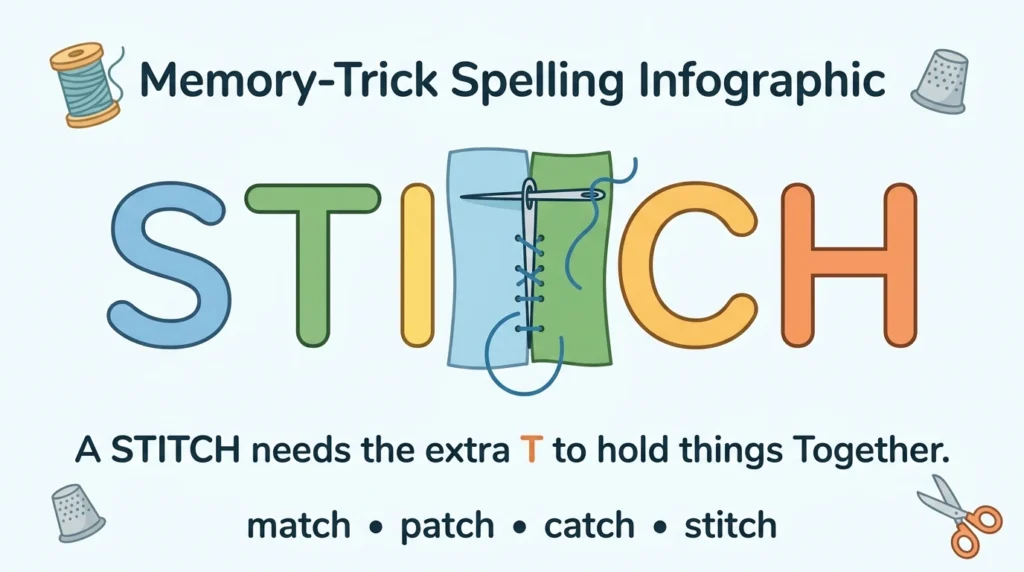
A STITCH needs the extra T to hold things Together.
Think of the second T as an extra thread helping hold the word together:
S T I T C H
You can also connect it with other -tch words:
match – patch – catch – stitch
If you remember a patch needs a stitch, you remember the spelling of both words at once.
Real-Life Situations
In an Interview
Suppose you are describing previous work in clothing production.
Say:
“I inspected each stitch to make sure the finished garments met the quality standard.”
Writing stich on a portfolio or CV could make a small spelling error unnecessarily noticeable.
In a Workplace Meeting
A product designer might say:
“We should strengthen the stitch around this section before production.”
Here, stitch clearly refers to sewing construction.
In an Email
You might write:
“One stitch near the pocket has come loose. Could the item be repaired?”
This sounds clear and professional.
In a Text Message
Casual English does not change the spelling.
“I ripped my sleeve. Can you stitch it for me?”
The tone is informal, but stitch remains correct.
In an Exam
If the question describes sewing, knitting, crochet, medical stitches, or side pain, use stitch.
Do not switch to stich simply because both forms may pass a quick visual check.
In Academic Writing
If your paper genuinely discusses lines of verse and your discipline uses stich in that specialised sense, the word may be appropriate.
That is one of the unusual contexts where stich is intentional rather than an error.
Expert Tips for Remembering Stich vs Stitch
Learn the Whole Word Family
Do not memorise only stitch.
Learn:
stitch → stitches → stitched → stitching
Seeing the whole family reinforces the tch spelling.
Check Meaning Before Checking Spelling
Ask yourself what the word means in the sentence.
If it concerns sewing, knitting, crochet, wounds, pain, or common idioms, you almost certainly need stitch.
Meaning is often a stronger proofreading tool than simply staring at the letters.
Use the “Patch–Stitch” Pair
Both patch and stitch belong naturally in the same context.
Think:
You stitch a patch.
That phrase gives you two visual reminders of the tch spelling.
Proofread Search Titles and Product Listings Carefully
Spelling errors are particularly visible in headings because headings contain fewer words.
A title such as:
Beginner Cross Stich Patterns
looks far less polished than:
Beginner Cross-Stitch Patterns
This matters for teachers, bloggers, craft businesses, marketplaces, course creators, and anyone publishing searchable content.
Do Not Trust “It Looks Like a Word”
Because stich can exist as a rare word, simply asking whether a spellchecker accepts it is not enough.
Ask whether its meaning fits the sentence.
That is a stronger habit for all commonly confused words.
Read More: Crier vs Cryer: The Correct Usage Explained
Frequently Asked Questions About Stich vs Stitch
Is it stich or stitch?
Use stitch when you mean sewing, knitting, crochet, medical stitches, a side pain, or a related everyday expression. Stich exists in rare specialist contexts but is not an alternative spelling for these meanings.
Is stich a real English word?
Yes. Stich has a rare specialist meaning connected with a line or verse. However, when someone writes stich while discussing sewing or wounds, it is normally a misspelling of stitch.
What does stitch mean?
Stitch can mean a movement or piece of thread in sewing, a loop in knitting or crochet, a medical suture, or a sharp pain in the side. As a verb, it means to join, repair, decorate, or close something using stitches.
Is “stich” the British spelling of “stitch”?
No. Stich is not a British alternative spelling of stitch. The standard spelling for the ordinary word is stitch.
Is “stich” the American spelling?
No. The normal American English spelling is also stitch.
Is it stitches or stiches?
The correct plural is stitches.
One stitch → two stitches
The t remains in the plural.
Is it stitched or stiched?
The correct past tense and past participle are stitched.
Correct:
She stitched the hole closed.
Incorrect:
She stiched the hole closed.
Is it stitching or stiching?
The correct -ing form is stitching.
Correct:
He is stitching the pieces together.
What does “in stitches” mean?
To be in stitches means to be laughing very hard.
For example:
Her impression had everyone in stitches.
The expression has nothing to do with an actual sewing project in this context.
What does “a stitch in my side” mean?
A stitch can describe a sudden sharp pain in the side, often associated with exercise such as running.
For example:
I slowed down because I developed a stitch in my side.
Is cross-stich correct?
No, if you mean the embroidery technique, write cross-stitch.
Correct:
I bought a beginner cross-stitch kit.
Why does stitch contain “tch”?
The word fits a common English spelling pattern in which the /ch/ sound after a short vowel in a one-syllable word is often represented by tch, as in match, catch, and pitch. The pattern has exceptions, so use it as a helpful guideline rather than an absolute rule.
Mini Quiz: Stich vs Stitch
| # | Question | Answer | Explanation |
| 1 | Choose the correct word: “The doctor gave him four ___.” A) stiches B) stitches | B) stitches | The plural of stitch is stitches. |
| 2 | Fill in the blank: “I dropped a ___ while knitting.” | stitch | A knitting loop is called a stitch. |
| 3 | Correct the sentence: “She stiched the patch onto her backpack.” | She stitched the patch onto her backpack. | The past tense is stitched. |
| 4 | True or false: “Stich” can exist as a rare specialist English word. | True | It can refer to a line or verse, although it is uncommon. |
| 5 | Choose the correct spelling: A) stitching B) stiching | A) stitching | The base spelling stitch keeps the tch before -ing. |
| 6 | Fill in the blank: “The comedian had the audience in ___.” | stitches | In stitches is the established expression for laughing very hard. |
| 7 | Correct the sentence: “I got a stich while running uphill.” | I got a stitch while running uphill. | A sudden pain in the side is a stitch. |
| 8 | Which sentence uses stitch correctly? A) “One stitch came loose.” B) “One stich came loose.” | A | Sewing requires stitch. |
| 9 | Fill in the blank: “Can you ___ this button back onto my shirt?” | stitch | As a verb, stitch can mean attach something using stitches. |
| 10 | True or false: Because stich is a real specialist word, it can freely replace stitch. | False | The two words have different meanings and are not interchangeable. |
Quick Summary
The difference between stich vs stitch is simple once context is considered. Stitch is the standard word for sewing, knitting, crochet, medical sutures, a sudden pain in the side, and expressions such as “in stitches.” It also works as a verb: stitch, stitches, stitched, and stitching. Stich, however, is not merely invented; it exists as a rare specialist noun that can refer to a line or verse. That does not make it an alternative spelling of stitch. For normal everyday writing, remember the tch ending. A useful memory trick is: a stitch needs the extra T to hold things together. When proofreading, check both spelling and meaning.