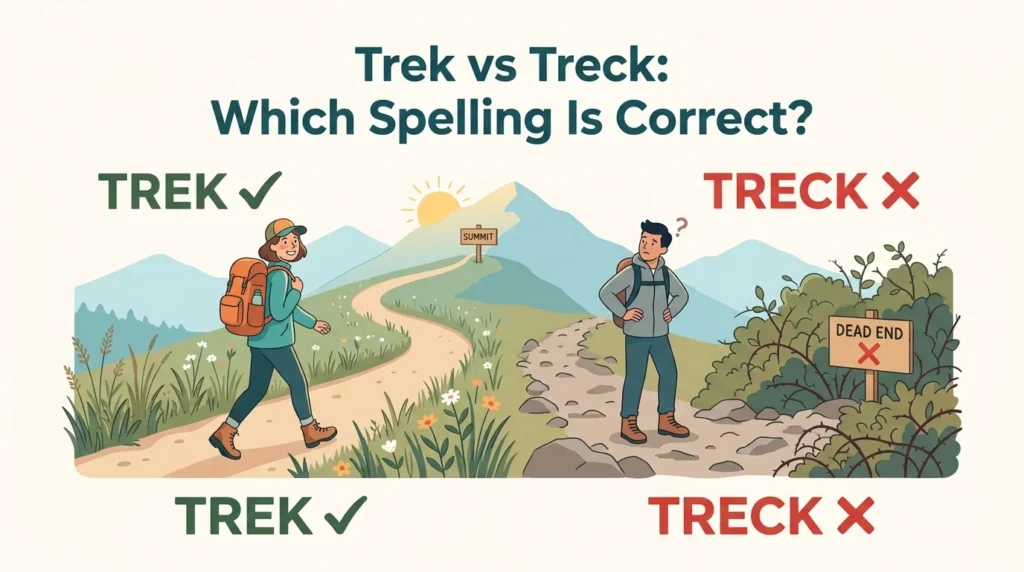

Trek is the correct spelling when you mean a long, difficult, or tiring journey, especially one made on foot. Treck is not the standard spelling of this word. Use trek in essays, emails, workplace writing, travel content, and everyday English. When the verb takes -ed or -ing, the spelling changes to trekked and trekking, not trecked or trecking.
What Is the Difference Between Trek and Treck?
The difference is simple: trek is the standard English word; treck is normally a misspelling of trek.
Trek can be a noun or a verb.
As a noun, it means a long or difficult journey, particularly one involving walking:
We went on a three-day trek through the mountains.
As a verb, it means to travel or walk a long distance, often with some difficulty:
They trekked across the valley before sunset.
The spelling treck is not the standard form for either use.
There is therefore no special grammar rule that tells you when to choose treck instead of trek. If you are talking about a journey, difficult walk, or demanding trip, the standard spelling is trek.
Cambridge lists trek as both a noun and a verb and gives the pronunciation /trek/ in both British and American English.
Why It Matters
A one-letter spelling mistake can make an otherwise strong piece of writing look less polished.
Consider these situations:
- A student writes about a mountain treck in an assignment.
- A travel company advertises a guided treck.
- A professional writes about a long treck to a remote project site.
- A blogger publishes a hiking guide containing trecking throughout the article.
- A social media user captions a photograph, “Our first Himalayan treck.”
In each case, the intended word is understandable. But trek is the standard spelling, so treck can distract readers and reduce confidence in the writing.
This is particularly important in formal writing. A spelling error does not necessarily make the meaning impossible to understand, but it can suggest that the writer did not proofread carefully.
The Core Rule
Rule: When you mean a long, difficult, or tiring journey or walk, spell the word TREK — never TRECK.
The basic forms are:
- trek — base form
- treks — third-person singular or plural noun
- trekked — past tense and past participle
- trekking — present participle or gerund
- trekker — a person who treks
The important point is that treck is not the alternative spelling of trek.
The extra c does not belong in the base word.
Read More: Stared vs. Starred: Which Word Is Correct?
How to Use Trek
Trek as a Noun
Use trek when the word refers to the journey itself.
Examples:
Our trek through the forest lasted six hours.
The final trek to the summit was exhausting.
She planned a trek across the northern region.
The village is a two-hour trek from the main road.
The noun can be used for literal journeys and, in informal English, for difficult trips that are not necessarily adventures in the wilderness.
For example:
Getting from the airport to the hotel was quite a trek.
Cambridge specifically records this informal use for a journey that is long, difficult, or tiring.
Trek as a Verb
Use trek as a verb when someone is making the journey.
Examples:
We will trek through the valley tomorrow.
They trekked across the desert.
She enjoys trekking in the mountains.
The researchers trekked into the remote area.
The verb is normally used with a direction, destination, or location when the context calls for one:
- trek through the forest
- trek across the valley
- trek to the village
- trek up the mountain
- trek into the wilderness
Major dictionaries define the verb in terms of making one’s way, traveling, or walking a long distance, often with difficulty.
Correct Examples
Here are original examples covering everyday, academic, professional, and digital contexts.
- Conversation:
“That trek up the hill was harder than I expected.” - Travel writing:
“The guided trek takes visitors through a remote mountain valley.” - Email:
“Our team will trek to the field station early tomorrow morning.” - School writing:
“The explorers began their trek across the desert at dawn.” - Academic writing:
“The researchers completed a month-long trek through the region.” - Workplace conversation:
“It is quite a trek from our office to the new warehouse.” - Social media:
“What an incredible trek! The views were worth every step.” - Travel brochure:
“This challenging trek offers spectacular views of the surrounding peaks.” - Everyday English:
“I had to trek all the way back home because I forgot my keys.” - Formal report:
“The expedition team completed the final stage of the trek without incident.”
Notice that trek does not have to describe a mountain expedition. It can also describe an unusually long or tiring journey in ordinary life.
Incorrect vs. Correct
| ❌ Incorrect | ✅ Correct | Why |
|---|---|---|
| We went on a long treck. | We went on a long trek. | Trek is the standard spelling of the noun. |
| They will treck across the valley. | They will trek across the valley. | The base verb is trek, not treck. |
| She trecked through the forest. | She trekked through the forest. | The past-tense form doubles the final k. |
| We are trecking tomorrow. | We are trekking tomorrow. | The -ing form is trekking. |
| The mountain treck was exhausting. | The mountain trek was exhausting. | The noun requires trek. |
| He enjoys trecking in the hills. | He enjoys trekking in the hills. | The present participle is trekking. |
| It was a difficult treck home. | It was a difficult trek home. | Trek can describe a long or tiring journey. |
| The hikers trecked for seven hours. | The hikers trekked for seven hours. | Trekked is the standard past tense. |
| Our guide organized the treck. | Our guide organized the trek. | Trek is the standard noun. |
| They plan to treck into the forest. | They plan to trek into the forest. | The infinitive uses the base form trek. |
Why People Make This Mistake
The confusion between trek and treck is understandable because English spelling does not always behave predictably.
Phonetic similarity
The word is pronounced /trek/. When people hear the final /k/ sound, they may instinctively represent it with ck.
That instinct works in words such as back, check, neck, and wreck. But English spelling patterns are not perfectly consistent.
In trek, the final sound is represented by a single k.
Spelling-pattern interference
English contains many short words ending in -ck after a short vowel:
- back
- deck
- neck
- pick
- rock
- check
- truck
Because of these familiar patterns, treck can look visually convincing.
But familiarity does not make it the correct spelling.
Overgeneralization
Learners sometimes discover a spelling pattern and apply it too widely.
For example:
“Short vowel + /k/ = -ck.”
That is too broad a rule.
English has many exceptions and borrowed words whose spellings do not fit a simple pattern.
Autocomplete and spellcheck
Digital tools can also contribute to confusion.
A spellchecker may catch treck, but users should not assume that every unfamiliar spelling will be automatically corrected. Names, technical terms, usernames, product names, and unusual words can make automated checking unreliable.
Spellcheck is useful, but it should support your knowledge rather than replace it.
Translation interference
Learners may also transfer spelling patterns from another language. A word that sounds like /trek/ may be represented differently in another writing system or language.
That can make treck feel logical even though standard English uses trek.
Common Mistakes Checklist
1. Writing treck as the noun
Mistake:
“We completed a difficult treck.”
Why it happens: The final /k/ sound makes -ck feel natural.
Avoid it: Remember that the noun is trek.
2. Writing treck as the verb
Mistake:
“We will treck through the forest.”
Why it happens: The writer carries the same mistaken spelling into the verb.
Avoid it: Use trek as the base verb.
3. Writing trecked
Mistake:
“They trecked across the valley.”
Why it happens: The writer thinks the final consonant remains represented by ck.
Avoid it: The correct form is trekked.
4. Writing trecking
Mistake:
“We are trecking this weekend.”
Why it happens: The writer combines treck with -ing.
Avoid it: Start with trek, then apply the spelling change: trekking.
5. Assuming pronunciation determines spelling
Mistake: “It sounds like it should end in -ck, so treck must be correct.”
Why it happens: English spelling is not completely phonetic.
Avoid it: Learn the established spelling: trek.
Trek in Real English
Grammatically correct and natural
“We went on a trek through the mountains.”
This is completely natural English. Trek is commonly used for a long walk or journey, particularly through hills, mountains, forests, or other challenging terrain. Cambridge gives this type of use as a standard noun meaning.
Grammatically correct but more informal
“It’s quite a trek from here.”
This is also natural, but the meaning is broader. The speaker may simply mean that the destination is far away or inconvenient to reach. Cambridge specifically labels this broader sense as informal.
Correct but more context-dependent
“We trekked to the office.”
The sentence is grammatically possible, but it gives the journey a sense of distance, effort, or difficulty. If the office is five minutes away, ordinary speakers would usually say walked to the office rather than trekked to the office. The word choice adds emphasis.
Not standard English
“We went on a treck.”
This is not an alternative everyday spelling. If the intended meaning is the journey or difficult walk, the standard form is trek.
American vs. British English
There is no meaningful spelling difference between American and British English for this word.
Both use:
- trek
- treks
- trekked
- trekking
- trekker
Cambridge provides both UK and US pronunciation entries for trek, and its definitions use the same spelling in both varieties.
So you do not need to choose between trek and treck based on whether your audience is American or British.
Use trek in both.
Read More: Waring vs Wearing: Which Word Is Correct?
Formal vs. Informal Usage
Trek works across different levels of formality.
In formal writing:
“The expedition involved a demanding trek through the mountain region.”
In everyday conversation:
“It’s a bit of a trek from my house.”
The word itself is not restricted to casual speech. The difference is usually in how it is being used, not in whether trek is acceptable.
The informal sense can simply mean a long or tiring trip:
“Getting to the other side of town is quite a trek.”
Cambridge explicitly identifies this use as informal.
Trek vs. Treck: Comparison Table
| Feature | Trek | Treck |
|---|---|---|
| Standard English spelling | ✅ Yes | ❌ No |
| Can be a noun | ✅ Yes | ❌ Not in this meaning |
| Can be a verb | ✅ Yes | ❌ Not in this meaning |
| Meaning | A long, difficult, or tiring journey | Usually a misspelling of trek |
| Present form | trek | — |
| Third-person form | treks | — |
| Past tense | trekked | ❌ trecked |
| -ing form | trekking | ❌ trecking |
| British English | trek | treck is not the standard spelling |
| American English | trek | treck is not the standard spelling |
| Academic writing | Use trek | Avoid treck |
| Professional writing | Use trek | Avoid treck |
| Everyday English | Use trek | Avoid treck |
What About Trekked and Trekking?
This is where many learners encounter a second spelling question.
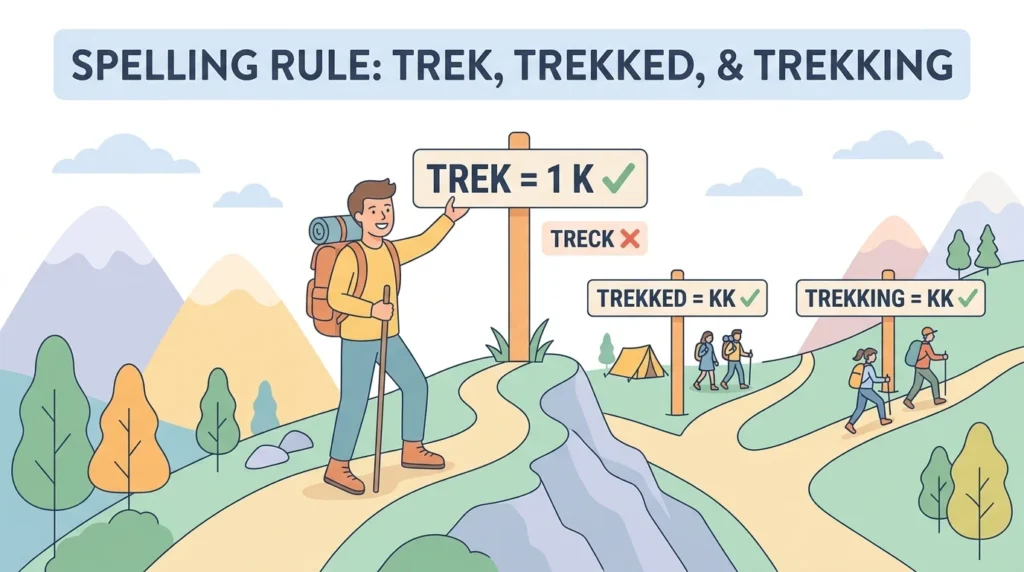
The correct forms are:
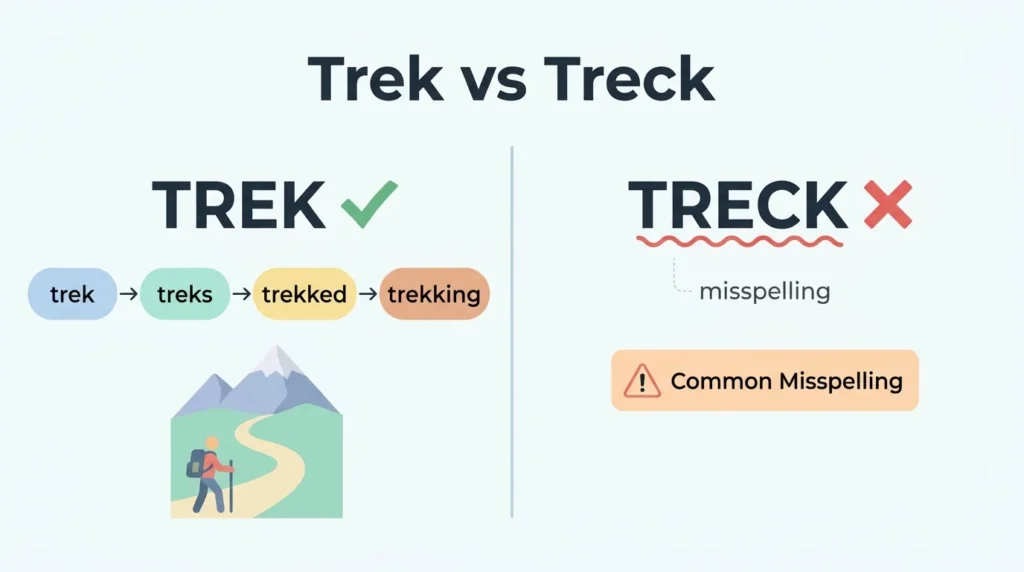
trek → trekked → trekking
Not:
treck → trecked → trecking
Merriam-Webster lists trekked as the past-tense/past-participle form and trekking as the present participle.
Why does the k double?
English commonly doubles a final consonant in certain short verbs before endings such as -ed and -ing. The spelling keeps the short vowel sound in the base word.
Compare:
- stop → stopped → stopping
- plan → planned → planning
- run → running
- trek → trekked → trekking
So the double k is correct in trekked and trekking.
It does not mean the base word should be treck.
What Does Trek Actually Mean?
A trek is generally a long, difficult, or tiring journey. It is especially associated with walking over land such as mountains, forests, or other challenging terrain.
For example:
“The eight-hour trek took us through dense forest.”
But the word has a wider modern use.
You can also say:
“It was a long trek to the station.”
Here, trek does not necessarily describe an outdoor adventure. It emphasizes that the journey was long or difficult.
As a verb:
“They trekked across the region.”
The word also has a historical South African sense connected with traveling or migrating by ox wagon. Its English history comes through Afrikaans from Dutch, and the modern general sense developed from that history.
Can “Treck” Ever Be Correct?
There is one important qualification.
Treck can appear as a name, brand, surname, username, fictional name, or other deliberately chosen proper noun. If an organization or person officially spells its name Treck, that spelling can be correct for that specific name.
For example:
“Treck Industries announced a new product.”
If Treck Industries were the organization’s official name, you would not change its name to Trek Industries.
But that is different from using treck as the ordinary English word for a journey.
So:
“We went on a long trek.” ✅
But a specific organization could legitimately be called:
“Treck Industries.” ✅
The proper-name exception does not create a spelling variant of the ordinary word trek.
Memory Trick
TREK = TRavel + Effort + K
Think:
TREK = TRavel + Effort + K
A trek is a journey that usually takes effort.
And remember:
One K in trek. Two Ks when the ending needs them: trekked, trekking.
If you like visual associations, think of the famous title Star Trek. The word Trek has one k, not Treсk.
The simplest memory rule is:
Go on a TREK — never a TRECK.
Real-Life Situations
Interview
Interviewer: “Tell us about a challenging experience.”
Candidate: “During university, I completed a three-day trek through the northern mountains.”
Here, trek works naturally because it describes a demanding journey.
Workplace Meeting
“The new warehouse is quite a trek from our main office.”
This is informal but natural workplace English when the speaker emphasizes the distance.
“Our research team will trek to the field site on Monday morning.”
The spelling remains trek, even though the context is professional.
Text Message
“That was some trek home!”
This is casual English. The word can emphasize that getting home was tiring or inconvenient.
School Exam
Question: Choose the correct spelling.
The explorers began their ___ across the mountains.
Answer: trek
Social Media Caption
“Five days, hundreds of photographs, and one unforgettable trek.”
Again, trek is the standard spelling.
Expert Tips
Tip 1: Learn the whole word family
Do not memorize only trek.
Learn:
trek → treks → trekked → trekking → trekker
This makes it easier to recognize the correct forms when you write quickly.
Tip 2: Do not add “c” because the sound is /k/
English has several ways to represent the /k/ sound.
It can appear as:
- k — trek, skin, king
- c — cat, cold, music
- ck — back, neck, check
- ch — school, chemistry in certain words
So pronunciation alone cannot tell you the spelling.
Tip 3: Watch for the double-k trap
The correct spelling changes in:
- trekked
- trekking
A learner who knows trek but writes treked has not learned the complete word pattern.
Tip 4: Remember that spelling and meaning are separate questions
If someone writes treck, you can usually understand what they mean from context.
That does not make the spelling correct.
Understandable and standard are not always the same thing.
Tip 5: Use context to choose between trek and similar words
Trek, hike, journey, trip, and walk overlap, but they are not identical.
A trek often suggests distance, effort, or difficulty.
A walk can be very short and easy.
A trip can involve any type of transportation.
A journey emphasizes traveling from one place to another.
A hike commonly refers to walking for pleasure or exercise, especially outdoors.
Choosing the right word is therefore about more than spelling.
FAQ
Is “trek” or “treck” correct?
Trek is the correct standard spelling for the word meaning a long, difficult, or tiring journey. Treck is normally a misspelling.
Is “treck” a real English word?
Not as the standard spelling of the ordinary word meaning a long journey. It may appear as a proper name, brand, surname, username, or other name, but that is different from standard vocabulary.
Is “trek” a noun or a verb?
It is both. As a noun, it means a long or difficult journey. As a verb, it means to travel or walk a long distance, often with difficulty.
What is the past tense of trek?
The past tense is trekked.
“They trekked across the valley.”
Merriam-Webster lists trekked as the past tense and past participle.
Is it “treking” or “trekking”?
The correct form is trekking, with two ks.
“We are trekking through the mountains.”
Is it “trecked” or “trekked”?
It is trekked.
The spelling trecked is incorrect when you mean the past tense of trek.
Is “trek” the same in American and British English?
Yes. Both American and British English use trek. There is no AmE/BrE spelling difference that changes it to treck.
Can I use “trek” for a city journey?
Yes. In informal English, trek can describe a long or tiring journey even when it is not a mountain walk.
“It’s quite a trek from the station to the hotel.”
Cambridge records this broader informal use.
What is the easiest way to remember trek?
Remember:
Trek has one K. Trekking and trekked have two Ks.
You can also associate the spelling with Star Trek.
Does “trek” always mean walking?
Not necessarily. Its central modern sense involves a long or difficult journey, especially on foot, but dictionaries also record broader uses of the verb meaning to make one’s way or journey.
Why do people spell trek as treck?
The likely reasons include the influence of familiar -ck spellings such as check, neck, and wreck, the pronunciation of the final /k/ sound, fast typing, and spelling-pattern overgeneralization. These factors make treck look plausible even though trek is the standard form.
Mini Quiz
| # | Question | Answer | Explanation |
|---|---|---|---|
| 1 | Choose the correct spelling: “We went on a mountain ___.” A) treck B) trek | B) trek | Trek is the standard noun. |
| 2 | Fill in the blank: “They ___ across the valley yesterday.” | trekked | The past tense of trek is trekked. |
| 3 | Which is correct? A) trecking B) trekking | B) trekking | The -ing form doubles the final k. |
| 4 | Correct the sentence: “The treck took five hours.” | The trek took five hours. | Trek is the correct noun spelling. |
| 5 | Is trek a noun, a verb, or both? | Both | You can go on a trek or trek through a region. |
| 6 | Choose the correct sentence: A) We will treck through the forest. B) We will trek through the forest. | B | The base verb is trek. |
| 7 | Fill in the blank: “It was quite a ___ from the station to the hotel.” | trek | Trek can informally describe a long or tiring journey. |
| 8 | Which is correct? A) They trecked for six hours. B) They trekked for six hours. | B | The past tense is trekked. |
| 9 | Correct the sentence: “She enjoys trecking in the mountains.” | She enjoys trekking in the mountains. | The correct -ing form is trekking. |
| 10 | Which spelling should you use in an academic essay? A) trek B) treck | A) trek | Trek is the standard spelling in formal writing. |
Quick Summary
Trek is the correct standard spelling. Treck is normally a misspelling when you mean a long, difficult, or tiring journey. Trek works as both a noun and a verb: you can go on a trek or trek across a mountain region. Its common forms are trek, treks, trekked, trekking, and trekker. Notice the double k in trekked and trekking; that does not make treck correct. American and British English use the same spelling. The easiest memory trick is simple: TREK has one K; TREKKED and TREKKING have two. If you are writing about a journey, hike, expedition, or difficult trip, choose trek.