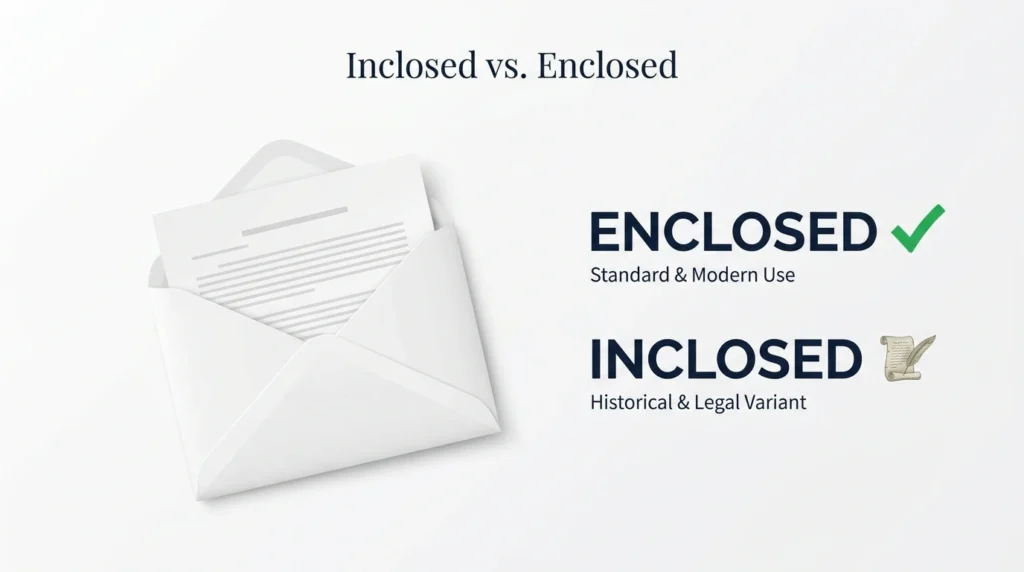

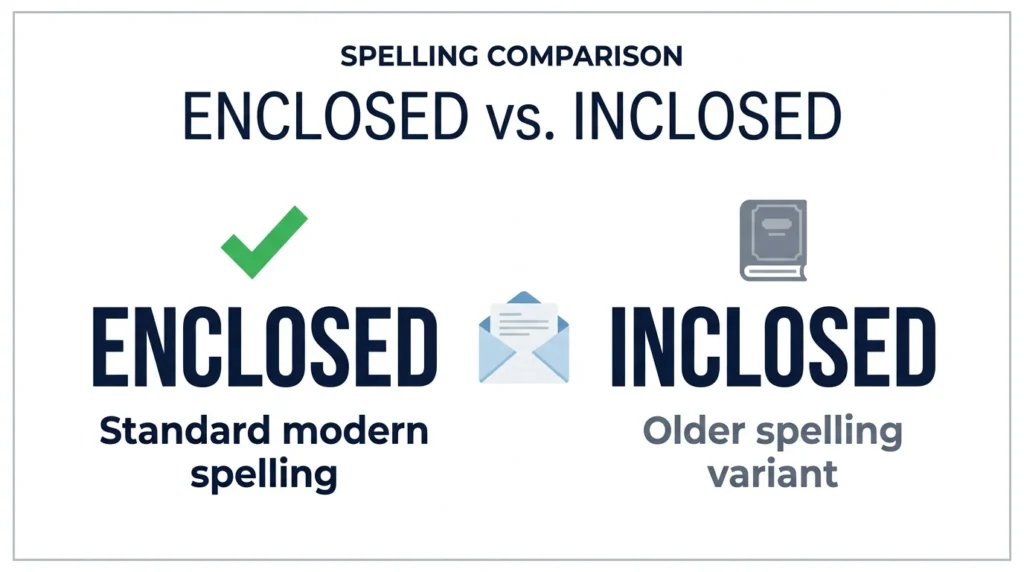
Enclosed is the standard spelling in modern English. It means surrounded by something, kept within a boundary, or placed inside an envelope or package. Inclosed is an older spelling variant with essentially the same meaning, but it is now rare and may look incorrect in everyday writing. Use enclosed in emails, business letters, school assignments, academic papers, and professional documents. Reserve inclosed for historical quotations or situations where you need to preserve an original text’s spelling.
What Is the Difference Between Inclosed and Enclosed?
The difference between inclosed and enclosed is primarily a matter of spelling and modern usage, not meaning. Both forms have historically expressed the idea of surrounding something, shutting it in, or placing something inside another object.
However, English spelling conventions have changed over time. Enclosed became the established modern form, while inclosed fell out of ordinary use.
Consider these examples:
- Modern English: The signed agreement is enclosed with this letter.
- Historical spelling: The signed agreement is inclosed with this letter.
Both sentences communicate essentially the same message. The first, however, follows contemporary spelling conventions and is the appropriate choice for modern communication.
The practical rule is simple: if you are writing for today’s readers, choose enclosed.
What Does Enclosed Mean?
Enclosed is the past tense and past participle of the verb enclose. It is also commonly used as an adjective to describe something that is surrounded, contained, or included with another item.
The word has several related uses.
1. Surrounded by a Boundary
Use enclosed when something is surrounded by walls, fences, barriers, or other boundaries.
Examples:
- The children played in an enclosed garden.
- The property is enclosed by a high brick wall.
- We held the meeting in an enclosed courtyard.
In these sentences, something is surrounded or separated from the surrounding area.
2. Placed Inside an Envelope or Package
Use enclosed when a physical item is included inside a letter, parcel, or package.
Examples:
- Please find the completed form enclosed.
- I have enclosed a copy of your receipt.
- The package contains the enclosed instruction booklet.
This usage is especially common in formal correspondence and business communication.
3. Confined Within a Space
Enclosed can also describe a space that is closed off or surrounded.
Examples:
- The equipment must remain in an enclosed storage area.
- The building has an enclosed loading bay.
- An enclosed room can help reduce outside noise.
The exact meaning depends on the context, but the central idea remains the same: something is contained within a boundary or included inside something else.
Why Does the Difference Matter?
Choosing the standard spelling helps readers understand your message without being distracted by an unfamiliar word form.
Although inclosed has a genuine history in English, most contemporary readers expect enclosed. Using the older spelling in a modern document can make an otherwise correct sentence appear outdated or incorrectly spelled.
This matters in situations such as:
- Business emails: Standard spelling helps your correspondence look professional.
- Academic assignments: Conventional spelling supports clear, polished writing.
- Job applications: Avoidable spelling errors can distract from your qualifications.
- Legal documents: Consistent wording and spelling help maintain clarity.
- Website content: Familiar language makes information easier for readers to process.
- Historical research: Recognizing older spellings helps you interpret original documents accurately.
The goal is not to erase historical language. It is to understand when a historical form belongs in a text and when modern conventions are more appropriate.
The Core Rule: When Should You Use Enclosed?
Use enclosed in modern English. Treat inclosed as an obsolete or archaic spelling variant unless you have a specific historical reason to reproduce it.
Follow these three steps when deciding which form to use:
- Identify whether you are writing a modern text or reproducing a historical one.
- If you are writing a modern text, choose enclosed.
- If you are quoting an older document, preserve inclosed when it appears in the original and exact wording matters.
For example:
- Modern email: I have enclosed the requested documents.
- Historical quotation: The original letter states, “I have inclosed the requested documents.”
Both forms can be understood, but they serve different purposes. The first follows current conventions; the second preserves historical wording.
How to Use Enclosed Correctly
The word enclosed works in several grammatical patterns. Understanding these patterns will help you use it naturally rather than simply memorizing the spelling.
Enclosed as a Verb Form
The past tense and past participle of enclose is enclosed.
Use it to describe the act of surrounding something or putting something inside an envelope or package.
Examples:
- The company enclosed a warranty card with the product.
- We enclosed the signed contract in the parcel.
- The council enclosed the playground with a metal fence.
In these sentences, enclosed describes an action that has been completed.
Enclosed as an Adjective
An adjective describes a person, place, thing, or condition. Enclosed can describe something that is surrounded or contained.
Examples:
- The enclosed courtyard provides a quiet place to relax.
- Please read the enclosed notice before entering.
- The building includes an enclosed parking area.
Here, enclosed describes a noun rather than functioning as the main action of the sentence.
Enclosed in Formal Letters and Emails
In formal correspondence, enclosed traditionally refers to a document or item placed inside the same physical envelope or package as a letter.
Examples:
- Please find the enclosed certificate.
- The enclosed invoice lists the outstanding balance.
- I have enclosed the signed application for your review.
However, email communication requires a small distinction. If you are sending a digital file, attached is generally more natural than enclosed.
For example:
- Natural for email: Please find the report attached.
- Natural for a physical letter: Please find the report enclosed.
This difference is about choosing the word that accurately describes how the recipient receives the document.
Correct Examples of Enclosed in Everyday English
The following examples show how enclosed works in different situations.
| Context | Correct example |
|---|---|
| Everyday conversation | The dog needs a safe, enclosed area to play. |
| Business email | I have enclosed the signed agreement for your review. |
| Physical letter | Please find the enclosed payment receipt. |
| School assignment | The experiment was conducted in an enclosed container. |
| Academic writing | The samples were stored in an enclosed chamber. |
| Workplace instructions | Keep the machine inside the enclosed operating area. |
| Social media | We finally found a house with an enclosed garden for our pets. |
| Customer service | Your warranty information is enclosed with the product. |
| Property description | The apartment has an enclosed balcony. |
| Shipping notice | The enclosed packing list identifies every item in the shipment. |
| Legal correspondence | The enclosed document contains the requested information. |
| Personal message | I have enclosed a few photographs from our trip. |
Notice that enclosed does not always refer to a physical document. It can describe a place, structure, container, or area that is surrounded or closed off.
Inclosed vs Enclosed: Incorrect vs Correct Examples
The following table shows common modern-writing situations in which inclosed should normally be replaced with enclosed.
| ❌ Incorrect or unsuitable in modern writing | ✅ Correct modern form | Why |
|---|---|---|
| Please find the inclosed invoice. | Please find the enclosed invoice. | Enclosed is the standard modern spelling. |
| I have inclosed the signed contract. | I have enclosed the signed contract. | The modern past participle is enclosed. |
| The garden is inclosed by a fence. | The garden is enclosed by a fence. | The standard spelling applies to physical boundaries. |
| Please read the inclosed instructions. | Please read the enclosed instructions. | Modern documents use enclosed. |
| The inclosed room was very quiet. | The enclosed room was very quiet. | Enclosed is the conventional adjective. |
| We inclosed the payment with the letter. | We enclosed the payment with the letter. | The standard verb form is enclosed. |
| An inclosed courtyard stood behind the house. | An enclosed courtyard stood behind the house. | The modern spelling is preferred in descriptions. |
| The parcel contains an inclosed certificate. | The parcel contains an enclosed certificate. | Use the conventional form for included physical items. |
| The animals stayed in an inclosed space. | The animals stayed in an enclosed space. | Enclosed is the normal contemporary form. |
| I have inclosed a copy for your records. | I have enclosed a copy for your records. | The modern spelling is expected in professional correspondence. |
Important: These examples concern contemporary writing. If inclosed appears in a historical document, it is not automatically a typographical error. It may be the original spelling used by the writer or publisher.
Why Do People Confuse Inclosed and Enclosed?
Several factors explain why writers hesitate between these forms.
1. Both Spellings Have a Historical Basis
The confusion is understandable because inclose and enclose have both appeared in English. A reader who encounters inclosed in an old book may reasonably assume that it remains equally common today.
The important distinction is that historical existence does not guarantee equal acceptance in modern writing.
2. The Pronunciation Does Not Help Much
The two forms have traditionally been associated with the same basic word and meaning. Because the difference is mainly visual, hearing the word in conversation does not reliably tell a writer which spelling to choose.
The solution is to learn the standard written form: enclosed.
Read More: Honor vs Honour: The Spelling Difference Explained.
3. Writers Overgeneralize Spelling Patterns
English contains many words beginning with in- and en-. Writers sometimes assume that these beginnings can be exchanged without changing the acceptability of a word.
That assumption is unreliable. English spelling must be learned word by word, especially when historical variants are involved.
4. Spellcheck Does Not Explain History
A spellchecker may flag inclosed, accept it in some dictionaries, or fail to explain why it is unsuitable for ordinary modern prose. A tool’s response does not always tell you which form is best for your audience.
When in doubt, use enclosed for contemporary communication.
5. Older Books and Scanned Documents Preserve Original Spellings
Historical letters, digitized books, archived newspapers, and scanned records may contain inclosed. Seeing the spelling repeatedly in these sources can make it seem more current than it is.
When transcribing such documents, preserve the original spelling if faithful reproduction is important. When summarizing or rewriting the text for a modern audience, use contemporary spelling unless you have a reason not to.
6. Translation Can Introduce Uncertainty
English learners may translate a word meaning “inside,” “surrounded,” or “contained” into English and then choose a spelling based on a familiar pattern in their first language.
Instead, learn the complete English expression. For modern use, the correct forms are enclose, encloses, enclosed, enclosing, and enclosure.
Common Mistakes Checklist
Before publishing or sending your writing, check these frequent errors.
- Writing inclosed in a modern email. This older form may distract readers. Replace it with enclosed.
- Assuming the two spellings have different meanings. Their historical meanings substantially overlap. The main distinction is modern usage.
- Changing an original historical quotation. If exact wording matters, preserve the spelling in the source.
- Using enclosed for every digital file. In email, attached is often more precise for a file sent electronically.
- Confusing enclosed with included. Enclosed often suggests physical containment or surrounding boundaries, while included means that something forms part of a group, collection, or package.
- Assuming every old spelling is a typo. Historical texts may reflect genuine spelling conventions of their period.
- Relying entirely on spellcheck. Consider the audience, context, and modern standard usage.
- Using inconsistent forms in the same document. Prefer the modern word family unless reproducing historical material.
Inclosed vs Enclosed in Real English
Grammatically Correct
Enclosed is grammatically correct and standard in contemporary English. You can use it as the past tense or past participle of enclose, or as an adjective describing something surrounded or contained. Examples include “We enclosed the documents,” “The garden is enclosed by a wall,” and “Please read the enclosed notice.” These constructions are natural in everyday, professional, and academic writing.
Read More: Eying vs Eyeing: Which Spelling Is Correct?
Grammatically Possible but Unnatural in Modern Writing
Inclosed is a historically attested spelling, not simply a random combination of letters. Readers can understand it in sentences such as “The papers were inclosed in the envelope.” Nevertheless, this spelling is archaic and unusual in contemporary prose. Even when the grammar and intended meaning are clear, using inclosed in a current business email or school assignment can look like a spelling mistake.
Natural, Everyday English
For modern communication, enclosed is the natural choice when describing a fenced area, a contained space, or a document placed inside a physical envelope. For a digital document sent by email, attached will often sound more natural. For example, say “The signed form is enclosed with the letter” but “The signed form is attached to the email.” The best word depends on what actually happens to the item.
American vs British English
There is no meaningful modern American-versus-British spelling distinction that requires you to choose inclosed in one variety and enclosed in the other.
Both American and British English use enclosed as the standard contemporary form. The older spelling inclosed may appear in historical material, but it is not the normal choice for modern writing in either variety.
One difference you may notice in formal correspondence is vocabulary surrounding the enclosed item. American English commonly uses check, while British English generally uses cheque. The spelling of enclosed itself remains the same.
Examples:
- American English: The check is enclosed with the application.
- British English: The cheque is enclosed with the application.
Both sentences use the standard spelling enclosed.
Formal vs Informal Usage
The word enclosed is suitable for both formal and informal English. The main difference is how it is used in a particular situation.
Formal Usage
In formal letters, contracts, business correspondence, and official notices, enclosed can refer to a document physically included with the letter.
Examples:
- Please find the enclosed documents for your review.
- The enclosed certificate confirms your registration.
- We have enclosed a copy of the agreement for your records.
In modern professional email, attached is often preferable when referring to electronic files.
Informal Usage
In everyday conversation, people may use simpler phrases such as inside, in the package, or surrounded by a fence.
Examples:
- The keys are inside the box.
- The yard is surrounded by a fence.
- I put the receipt in the envelope.
These expressions may sound more conversational, but enclosed is not too formal for ordinary speech. It is simply more precise in certain contexts.
Read More: Labelling vs Labeling: Which Spelling Is Correct?
Enclosed vs Included vs Attached vs Surrounded
These words overlap in some situations, but they are not interchangeable in every sentence.
| Feature | Enclosed | Included | Attached | Surrounded |
|---|---|---|---|---|
| Main idea | Contained or shut within a boundary | Made part of a group or set | Connected to or supplied with something | Having something around it |
| Physical letter | A document inside the envelope | An item supplied as part of a set | An item fastened to another item | Usually describes the surrounding area |
| Possible, but often less natural for digital files | Suitable for content forming part of a message or package | Standard for digital files sent with an email | Usually not suitable for describing a file | |
| Physical space | An enclosed room or garden | Not usually used to describe boundaries | A structure connected to another structure | A garden surrounded by a wall |
| Example | The receipt is enclosed in the envelope. | Tax is included in the price. | The report is attached to the email. | The house is surrounded by trees. |
Enclosed vs Included
Use enclosed when something is placed within an envelope, package, or bounded space. Use included when something is part of a collection, offer, or total.
- Enclosed: The warranty card is enclosed in the box.
- Included: A one-year warranty is included in the purchase.
Enclosed vs Attached
Use enclosed for an item placed inside a physical envelope or package. Use attached when something is connected to another object or supplied as an attachment to an electronic message.
- Enclosed: The signed form is enclosed with the letter.
- Attached: The signed form is attached to the email.
Enclosed vs Surrounded
Use enclosed when a space is closed off or contained within boundaries. Use surrounded when you want to emphasize that something has other objects or features around it.
- Enclosed: The courtyard is enclosed by a high wall.
- Surrounded: The house is surrounded by tall trees.
Memory Trick: Remember the E in Enclosed
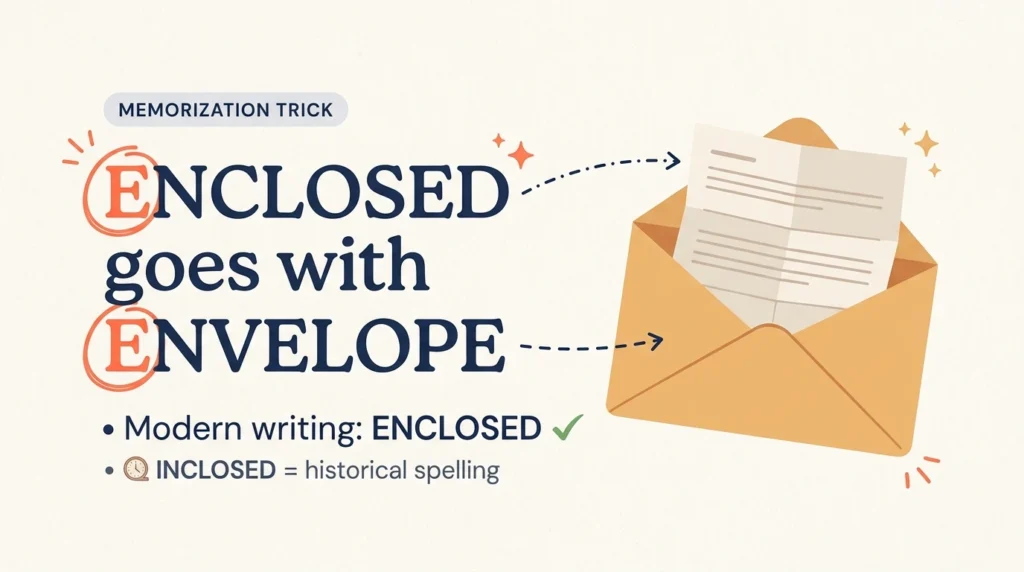
Use this simple reminder: Enclosed goes with envelope.
Both enclosed and envelope begin with the letter E. When you are writing about a document placed inside a physical envelope, this connection can help you remember the modern spelling.
You can also remember this short rule:
Modern writing = enclosed. Historical spelling = inclosed.
The trick is not a rule about all English words beginning with en- or in-. It is simply a memory aid for this particular spelling choice.
Enclosed in Real-Life Situations
Situation 1: A Job Application
You are mailing a signed application and supporting documents to a potential employer.
Use: “I have enclosed my signed application and supporting documents.”
Why it works: The documents are physically included in the envelope.
Situation 2: A Business Email
You are emailing a client a copy of a proposal.
Use: “I have attached the proposal for your review.”
Why it works: The document is a digital attachment rather than a paper item placed inside an envelope.
Situation 3: A School Assignment
You are describing an experiment performed inside a closed container.
Use: “The materials were kept in an enclosed container throughout the experiment.”
Why it works: Enclosed describes the container’s contained or closed-off space.
Situation 4: A Historical Letter
You are transcribing a letter written many generations ago, and the original says, “I have inclosed the receipt.”
Use: Preserve “I have inclosed the receipt” if you are producing an exact transcription.
Why it works: Historical transcription aims to reproduce the original wording, including its spelling.
Situation 5: A Property Description
You are advertising a home with a private garden separated from the street by a wall.
Use: “The property features an enclosed garden.”
Why it works: The garden is surrounded by a boundary.
Expert Tips for Choosing the Right Word
- Check the context before correcting the spelling. In a modern email, change inclosed to enclosed. In an exact historical transcription, do not automatically change the original.
- Choose words based on the actual situation. A physical document may be enclosed in a letter, while a digital file is usually attached to an email.
- Learn the word family together. Use enclose, encloses, enclosed, enclosing, and enclosure in modern writing.
- Do not confuse age with meaning. An older spelling can carry the same meaning as its modern equivalent without being equally appropriate today.
- Read the sentence aloud after editing. This can help reveal whether a word fits the context, although it will not reliably identify every spelling error.
- Follow the required style when one exists. If a historical edition, archive, or scholarly project specifies a transcription method, follow that method consistently.
Quick Summary
Enclosed is the standard modern English spelling. It is the past tense and past participle of enclose and can also function as an adjective describing something contained, surrounded, or placed inside an envelope or package. Inclosed is an older spelling variant that has largely disappeared from ordinary modern writing. Although readers may understand it, it can look like a spelling error in contemporary emails, school assignments, and professional documents. Use enclosed for modern communication, and preserve inclosed when accurately reproducing historical wording. Remember the simple trick: enclosed goes with envelope. When referring to a digital file in an email, attached is usually the more natural choice.
Frequently Asked Questions
Is inclosed a real word?
Yes. Inclosed is a historically attested spelling variant of enclosed. It appeared in older English writing, but it is now rare and generally unsuitable for ordinary modern prose. Use enclosed unless you are preserving historical wording or have a specific reason to reproduce the older form.
Is inclosed or enclosed correct in modern English?
Enclosed is the standard modern spelling. Although inclosed has historical validity, it is not the normal choice for contemporary writing. Use enclosed in emails, letters, reports, essays, and professional documents.
What does enclosed mean in a letter?
In a physical letter, enclosed means that an item, such as a photograph, cheque, receipt, or form, has been placed inside the same envelope. For example, “The requested certificate is enclosed with this letter.”
Can I use inclosed in a formal letter?
You generally should not use inclosed in a newly written formal letter because enclosed is the established modern spelling. However, you may preserve inclosed when quoting or transcribing a historical letter exactly as it was written.
Is enclosed the same as attached?
Not always. Enclosed typically refers to something placed inside a physical envelope or package, or to a space surrounded by boundaries. Attached describes something connected to another item or supplied with an electronic message. In modern email, “The report is attached” is usually more natural than “The report is enclosed.”
Why did people write inclosed instead of enclosed?
English spelling has varied across periods, and inclose was one of the historical forms of the word. Over time, enclose became the established modern spelling. The older form survives mainly in historical texts and occasional reproductions of older writing.
Do American and British English spell enclosed differently?
No. Enclosed is the standard modern spelling in both American and British English. Differences such as American check and British cheque do not change the spelling of enclosed.
What is the difference between enclose and enclosed?
Enclose is the base form of the verb, while enclosed is its past tense and past participle. For example, “Please enclose a copy of your receipt” gives an instruction, while “I enclosed a copy of my receipt” describes a completed action.
Is enclosed an adjective or a verb?
It can function as either, depending on the sentence. In “We enclosed the documents,” it is the past-tense verb. In “Please read the enclosed document,” it is an adjective describing the document.
Should I write enclosed or included in a business email?
Choose the word that matches your meaning. Enclosed traditionally describes a physical item placed inside a letter or package. Included means that something forms part of a larger set or offering. For a digital file sent with an email, attached is generally the clearest choice.
Mini Quiz: Test Your Understanding
Choose the appropriate spelling or word for each situation. Answers and explanations are included so you can check your understanding.
| No. | Question | Answer | Explanation |
|---|---|---|---|
| 1 | Choose the standard modern spelling: “The documents are ___ with this letter.” (A) inclosed (B) enclosed | B — enclosed | Enclosed is the conventional spelling in modern English. |
| 2 | Fill in the blank: “The garden is ___ by a tall fence.” | enclosed | The word describes a garden surrounded by a boundary. |
| 3 | Correct this sentence for modern writing: “I have inclosed the signed form.” | I have enclosed the signed form. | Replace the archaic spelling with the standard modern form. |
| 4 | Which word is usually more natural for a PDF sent with an email? (A) enclosed (B) attached | B — attached | Digital files are normally described as attachments. |
| 5 | True or false: Inclosed has never been used in English. | False | It is a historically attested spelling variant of enclosed. |
| 6 | Fill in the blank: “Please read the ___ notice before entering.” | enclosed | The adjective describes a notice supplied with or placed inside something. |
| 7 | Correct this modern sentence: “The enclosed documents was signed yesterday.” | The enclosed documents were signed yesterday. | The plural subject documents requires the plural verb were. |
| 8 | Which spelling should you normally use in a modern British English report? (A) inclosed (B) enclosed | B — enclosed | Enclosed is standard in both British and American English. |
| 9 | You are transcribing an old letter exactly as written. The original uses inclosed. Should you automatically change it? | No | Exact historical transcription preserves the original wording and spelling unless the transcription method specifies otherwise. |
| 10 | Choose the best word: “The price ___ delivery and installation.” (A) enclosed (B) included | B — included | Included means that delivery and installation form part of the price. |