

Both eying and eyeing are accepted spellings of the present participle of the verb eye, which means to look at someone or something with attention, interest, suspicion, or desire. The two forms have the same meaning, but eyeing is the more familiar choice for many readers. If you want a straightforward spelling for general writing, use eyeing unless a particular style guide specifies otherwise.
What Is the Difference Between Eying and Eyeing?
There is no difference in meaning between eying and eyeing. Both forms come from the verb eye, meaning to look at or watch someone or something carefully.
The difference is how the word is spelled.
- Eyeing: Keeps the letter e from the word eye before adding -ing.
- Eying: Removes the final e before adding -ing.
Both spellings are accepted, although eyeing is a familiar and practical choice in general writing.
For example:
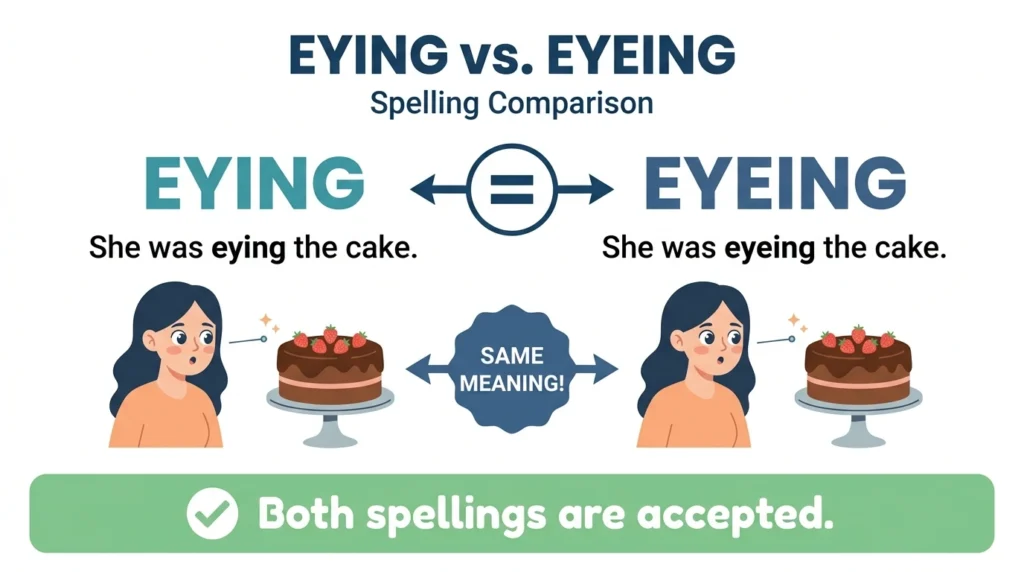
- She was eyeing the last slice of cake.
- She was eying the last slice of cake.
Both sentences mean that she was looking at the cake with interest, possibly because she wanted to eat it.
Why Does the Correct Spelling Matter?
Spelling choices affect how easily readers understand your writing. Even when two spellings are accepted, one may look more familiar to your audience.
Choosing eyeing can help avoid unnecessary confusion because readers can immediately recognize its connection to eye.
This matters in several situations:
- Work emails: A familiar spelling helps your message look polished.
- Academic writing: Consistent spelling supports clear, professional writing.
- Social media: Readers can focus on your message instead of wondering whether a word is misspelled.
- Blog posts: Familiar wording and spelling make articles easier to read.
- Exams and assignments: Following your teacher’s or institution’s preferred spelling conventions can help you avoid needless corrections.
The important point is that eying is not automatically wrong. The choice is about spelling preference and consistency, not a difference in meaning.
The Core Rule: Eying or Eyeing?
The simplest rule is this:
Both eying and eyeing are accepted. Use eyeing as your default spelling for general writing.
The verb eye has an unusual-looking ending because it is also the name of a body part. When adding -ing, writers may keep the final e to make the connection with eye immediately visible, producing eyeing. The alternative spelling eying follows the common spelling pattern in which a final silent e is dropped before -ing.
Neither spelling changes the pronunciation or meaning.
How to Use Eyeing and Eying
Use either form when you mean that someone is looking at something with interest, attention, suspicion, or a particular intention.
Use Eyeing in Everyday Writing
Eyeing is a good default when you want a familiar spelling.
Examples:
- He was eyeing the new car parked outside.
- The cat was eyeing the bird on the fence.
- I noticed her eyeing my dessert.
- The manager was eyeing the sales figures carefully.
- They were eyeing a larger office for the growing team.
Use Eying When It Matches Your Preferred Style
Eying is also an accepted form. You may encounter it in published writing, but some readers may find it less familiar.
Examples:
- The children were eying the presents under the tree.
- He stood near the shop window, eying the expensive watch.
- The team was eying a place in the final.
- She kept eying the clock during the long meeting.
- Investors were eying the company as a possible acquisition target.
These examples use the same meaning as the equivalent sentences with eyeing.
Understand the Meaning of the Verb Eye
The verb eye can describe several kinds of looking. The surrounding words usually reveal the intended meaning.
- Desire: “He was eyeing the chocolate cake.” He wanted it or was considering eating it.
- Interest: “She is eyeing a new position.” She is considering or hoping to obtain it.
- Suspicion: “The guard eyed the stranger.” The guard watched the person carefully.
- Assessment: “The buyer eyed the damaged furniture.” The buyer examined it or judged its condition.
- Competition: “The club is eyeing the championship.” The club hopes to win it.
In each case, eyeing and eying can express the same idea.
Correct Examples of Eyeing and Eying
The following examples show how both spellings work in different contexts.
| Context | Example |
|---|---|
| Everyday conversation | “Why are you eyeing my sandwich?” |
| Text message | “I know you’re eying the new headphones!” |
| Workplace | The director was eyeing a possible expansion into another city. |
| Business email | We are eyeing two locations for the next branch. |
| School | The student was eyeing the clock as the exam continued. |
| Social media | Everyone is eyeing the new phone launch. |
| Shopping | She was eyeing a pair of leather boots. |
| Sports | The team is eyeing a place in the playoffs. |
| Finance | Investors are eyeing opportunities in renewable energy. |
| Travel | We are eyeing a quiet beach destination for our next holiday. |
| Suspicion | The detective was eyeing the unusual package. |
| Family life | The toddler was eyeing the cookies on the counter. |
Both spellings are possible in these sentences. For consistency, this article uses eyeing as its main example.
Incorrect vs. Correct: Common Spelling Mistakes
Because both eying and eyeing are accepted, a sentence containing either spelling is not automatically incorrect. The following table focuses on genuine usage problems and situations in which writers mistake a spelling preference for a grammar rule.
| Incorrect or misleading usage | Correct or clearer usage | Why |
|---|---|---|
| She was eyeing to buy a new car. | She was eyeing a new car. | Eye normally takes the thing being considered as its object. |
| He is eyeing for a promotion. | He is eyeing a promotion. | The verb usually does not need for before its object. |
| They are eying at the house. | They are eyeing the house. | The verb is normally used directly with an object, without at. |
| I was eyeing to the cake. | I was eyeing the cake. | Remove to and use the noun directly as the object. |
| She eyeing the bag. | She is eyeing the bag. | The sentence needs an appropriate auxiliary verb to form the present continuous tense. |
| He was eyeing the door and leave. | He was eyeing the door before leaving. | The original sentence does not connect the actions grammatically. |
| The company is eyeing to expand. | The company is looking to expand. | In this meaning, eyeing normally takes a noun phrase, not a to-infinitive. |
| The team is eyeing for the title. | The team is eyeing the title. | Eyeing takes a direct object here. |
| She was eying at him suspiciously. | She was eyeing him suspiciously. | The preposition at is unnecessary with this use of eye. |
| Eying is always wrong. | Eying is an accepted spelling. | Treating one accepted form as universally incorrect is inaccurate. |
| Eyeing is always the only correct spelling. | Both eyeing and eying are accepted. | The spelling distinction is a matter of accepted variants, not a rule that makes one form universally invalid. |
| He was eyeing the menu to order food. | He was studying the menu before ordering food. | The original is understandable, but studying may describe deliberate reading more naturally. |
Important: The spelling of eying is not the same issue as the grammatical structure of a sentence. A sentence can use an accepted spelling but still contain a grammar or usage error.
Why Do People Confuse Eying and Eyeing?
Several factors explain why writers hesitate between these two forms.
1. The Word Eye Looks Unusual
The noun eye ends in the letter e, but the ending is part of the word’s familiar spelling. When writers add -ing, they may be unsure whether to keep or remove that final letter.
Both eying and eyeing are accepted forms, so the uncertainty is understandable.
2. The Final-E Rule Seems to Give One Answer
A common English spelling rule says that a silent final e is often dropped before a suffix beginning with a vowel, as in make → making and write → writing.
Applying that pattern to eye suggests eying. However, English contains accepted spelling variations and words whose familiar written form is retained in a particular variant. That is why eyeing is also accepted.
Read More: Labelling vs Labeling: Which Spelling Is Correct?
3. Spellcheckers May Prefer One Form
A spellchecker may accept both forms, prefer one, or flag a less familiar variant depending on its dictionary and settings. A spelling suggestion is not always proof that another accepted spelling is wrong.
4. Writers Assume Similar Words Follow Identical Patterns
English spelling rules are useful, but they are not universal. Writers may assume that every verb ending in a silent e must form its -ing version in exactly the same way. In practice, spelling conventions sometimes allow more than one form.
5. Regional and Editorial Preferences Can Differ
A reader, publication, teacher, or style guide may prefer one spelling. That preference does not automatically make the alternative incorrect. The safest approach is to follow the required style consistently.
Common Mistakes Checklist
Use this checklist when editing your writing.
- Assuming eying is a typo: It is an accepted spelling. Check a reliable dictionary before correcting someone else’s writing.
- Assuming eyeing is incorrect because the final e remains: The spelling eyeing is also accepted.
- Switching between both forms without a reason: Choose one form for a document and use it consistently.
- Adding unnecessary prepositions: In ordinary usage, write “eyeing the prize,” not “eyeing at the prize.”
- Using an awkward verb construction: Write “They are eyeing a new location,” not “They are eyeing to get a new location.”
- Confusing spelling with meaning: Both forms mean the same thing. Neither expresses a different kind of looking.
- Trusting automatic corrections without checking: Review the suggested change and confirm that it reflects an actual error rather than a style preference.
Eying vs Eyeing in Real English
Grammatically Correct
Both eying and eyeing are accepted spellings of the verb eye in its -ing form. You can use either in a sentence such as “She was eyeing the new laptop” or “She was eying the new laptop.” Both sentences are grammatically correct and communicate the same meaning. The spelling choice does not change the tense, pronunciation, or grammatical function of the word.
Grammatically Possible but Potentially Unfamiliar
A sentence using eying may look unusual to a reader who is more accustomed to eyeing. That reaction is about familiarity, not grammatical correctness. Similarly, a publication that consistently uses eyeing may edit eying to match its house style. Such an edit can improve consistency without establishing that the original spelling was wrong.
Natural, Everyday English
For general writing, eyeing is a practical default because it visibly preserves the familiar word eye. It works naturally in sentences such as “He was eyeing the cake” and “The company is eyeing a new market.” Eying is also usable, but readers who encounter it less often may pause briefly over its spelling. If clarity and familiarity are your priorities, choose eyeing.
Read More: Instalments vs Installments: Which Spelling Is Correct?
American vs. British English
There is no major American-versus-British spelling distinction that requires you to use eying in one variety and eyeing in the other. Both forms are accepted.
Unlike pairs such as color/colour or organize/organise, this is not a standard case in which one spelling belongs exclusively to American English and another to British English.
For an international audience, eyeing is a sensible default. If a publisher, university, or organization has a style guide, follow its preferred form.
Formal vs. Informal Usage
Both spellings can appear in formal and informal writing. The choice does not make a sentence more or less formal.
- Formal writing: “The organization is eyeing opportunities to expand its services.”
- Informal writing: “Are you eyeing my fries?”
- Business writing: “The company is eyeing a potential acquisition.”
- Academic writing: “The researchers are eyeing additional areas for investigation.” Depending on the intended meaning, considering, examining, or investigating may be more precise.
The important distinction is often the meaning of the verb rather than its spelling. Eyeing can suggest interest, desire, suspicion, or evaluation. If you need to communicate a specific analytical process, a more precise verb may be preferable.
Comparison Table: Eying vs Eyeing
| Feature | Eying | Eyeing |
|---|---|---|
| Accepted spelling | Yes | Yes |
| Meaning | Looking at or considering something | Looking at or considering something |
| Part of speech | Present participle/gerund of eye | Present participle/gerund of eye |
| Pronunciation | Same | Same |
| Meaning difference | None | None |
| American English | Accepted | Accepted |
| British English | Accepted | Accepted |
| General-writing recommendation | Acceptable alternative | Recommended default |
| Example | He was eying the prize. | He was eyeing the prize. |
Memory Trick: Keep the Eye in Eyeing
If you want the easiest way to remember your preferred spelling, think of the noun eye.
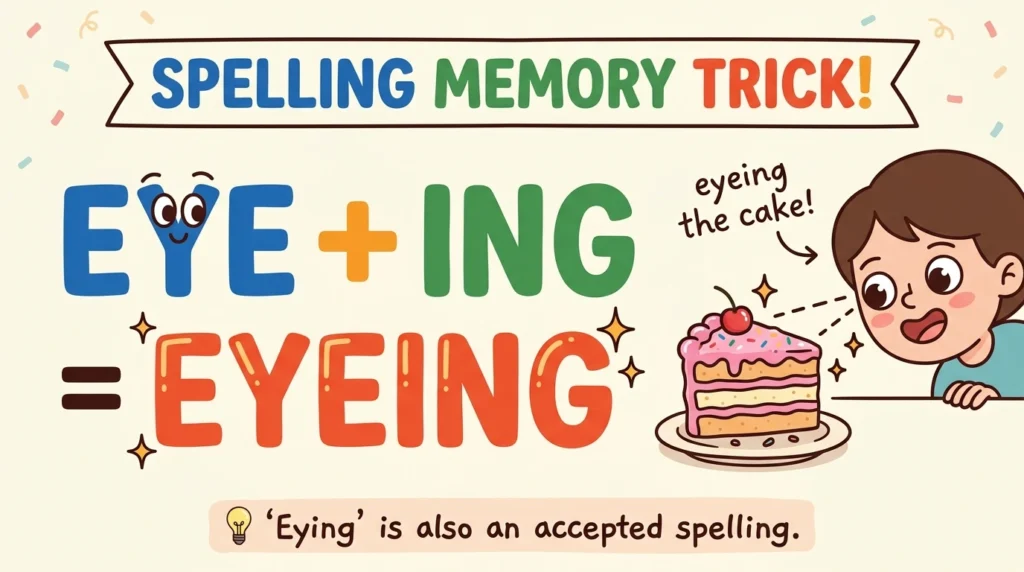
Eye + ing = eyeing.
Picture someone looking at a delicious dessert. The word eyeing keeps the word eye visible, which makes the spelling easier to recognize and remember.
Remember, this is a memory aid for choosing your default spelling, not proof that eying is wrong. Both forms are accepted.
Real-Life Situations: How to Use Eyeing Correctly
In a Job Interview
A candidate might say:
“I have been eyeing opportunities in digital marketing because I enjoy combining creativity with data.”
Here, eyeing means considering or taking an interest in potential opportunities. In a formal interview, “exploring opportunities” might sound more direct, but the original sentence is understandable.
During a Business Meeting
A manager might say:
“We are eyeing two locations for our next branch.”
The sentence means the company is considering those locations. Both eyeing and eying would work.
In a Work Email
“After reviewing the available options, we are eyeing the second supplier because its delivery schedule better suits our needs.”
The verb communicates interest in a possible choice. If the email needs a more formal tone, “considering” may be preferable.
In a Text Message
“Stop eyeing my pizza!”
This informal sentence means the speaker thinks the other person wants the pizza.
In an Exam
If a question asks you to choose between eying and eyeing, remember that both are accepted. If the question is testing a particular textbook’s preferred spelling, follow that textbook’s convention.
Read More: Sneek vs Sneak: Which Spelling Is Correct?
Expert Tips for Choosing the Right Spelling
- Choose one spelling and stay consistent. In an article, report, or book, avoid switching between eying and eyeing without a reason.
- Use eyeing as your default. It is a recognizable spelling for a broad readership.
- Do not automatically correct eying. Check whether it is being used as the verb eye before marking it as an error.
- Check the whole sentence. A sentence can spell eyeing correctly but use the verb awkwardly.
- Choose a more precise verb when needed. Use considering for evaluating an option, watching for observing movement, or examining for inspecting something closely.
- Follow the relevant style guide. A publisher or school may prefer a specific form for consistency.
- Do not confuse accepted spelling with preferred spelling. One form can be the better practical choice without making the other wrong.
FAQ: Eying vs Eyeing
Is eying a real word?
Yes. Eying is an accepted spelling of the -ing form of the verb eye. It means looking at or considering someone or something.
Is eyeing a real word?
Yes. Eyeing is an accepted spelling of the same verb form. It has the same meaning as eying.
Which is correct: eying or eyeing?
Both are correct. For general writing, eyeing is a useful default because it is familiar and keeps the spelling of eye visible.
Does eying mean something different from eyeing?
No. Both forms have the same meaning and grammatical function. Neither spelling indicates a different kind of looking or intention.
Is eyeing preferred in American English?
Eyeing is a familiar choice in American English, but eying is also accepted. Follow the spelling preference of your publication or style guide when one is specified.
Is eying acceptable in British English?
Yes. Eying is an accepted spelling, and eyeing is also used. Neither form is restricted to one major English variety.
Why does eyeing keep the final e?
The spelling eyeing retains the familiar written form of eye. English spelling conventions allow this form alongside eying, which follows the pattern of dropping a final e before adding -ing.
Should I write “eyeing at” or “eyeing”?
In ordinary usage, use eyeing directly with its object: “She was eyeing the painting.” The preposition at is generally unnecessary in this construction.
Can I use eyeing in formal writing?
Yes. Eyeing can appear in formal writing, including business reporting. However, depending on the context, words such as considering, assessing, or examining may express the intended meaning more precisely.
What is the past tense of eye?
The past tense is eyed. For example: “She eyed the painting carefully.” The past participle is also eyed, as in “He had eyed the opportunity for months.”
What is the plural form of eyeing?
Eyeing is a verb form or a gerund, not a countable noun that normally takes a plural ending. You would write “They are eyeing the property,” not “eyeings the property.”
What is the easiest way to remember eyeing?
Remember the pattern eye + ing = eyeing. It helps you choose the familiar spelling. Just remember that eying is also accepted.
Quick Summary
Both eying and eyeing are accepted spellings of the verb eye in its -ing form. They have the same meaning: to look at, watch, or consider someone or something with interest, desire, suspicion, or attention. The difference is spelling, not grammar or pronunciation. For general writing, eyeing is a practical default because readers can easily recognize its connection to eye. However, eying is not automatically incorrect. Use one spelling consistently, follow any relevant style guide, and check the sentence’s grammar separately from its spelling. If you want to remember the familiar form, think eye + ing = eyeing.